
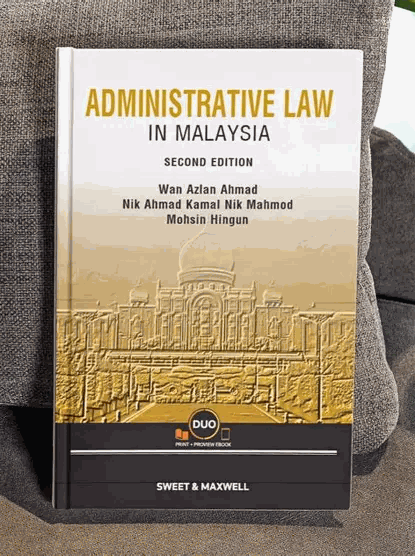
Administrative Law in Malaysia by Wan Azlan Ahmad & Nik Ahmad Kamal Nik Mahmod


Description
Administrative Law
in Malaysia
Wan Azlan Ahmad
LLB (Hons), MSc, CLP
Nik Ahmad Kamal Nik Mahmod
LLB (Hons), LLM, PhD
Book Review of Administrative Law in Malaysia
Review author: marceljude.ai
The book’s central project is to explain how Malaysian administrative law controls public power: it is concerned with legality, abuse of discretion, fair procedure, remedies, and governmental liability. Its own stated aim is to highlight both the principles governing governmental power and the rights members of the public enjoy in dealings with public authorities; the book is organised around judicial review concepts, substantive illegality, procedural illegality, remedies, and governmental tort liability.
Contents map with page numbers
Front matter
Preface — vii
About the Authors — xi
Table of Cases — xix
Table of Statutes — xxxvii
Chapter I: The Province of Administrative Law — pp. 1–26 Nature of administrative law — p. 1 Judicial review — p. 7 Intensity of review — p. 11 Review and appeal — p. 13 Application for judicial review — p. 17 Habeas corpus — p. 17 Grounds of judicial review — p. 17 Administrative law in Malaysia: The future — p. 20
Chapter II: Elements of Judicial Review — pp. 27–52 Generally — p. 27 The foundation of judicial review — p. 27 The question of invalidity — p. 28 Ultra vires decisions: Void and voidable — p. 31 Authorities subject to judicial review — p. 33 Entities enjoying monopoly power — p. 37 Inappropriateness of judicial review — p. 39 Premature decisions — p. 42 Civil servants — p. 43 Domestic tribunals — p. 43 Institutions of higher learning — p. 46 Position of the government in tort — p. 47 Military decisions — p. 47 Judicial review, legality and merit — p. 48 Moulding of relief — p. 51 Application for judicial review: Remedies — p. 52
Chapter III: Jurisdictional Challenge — pp. 53–70 Generally — p. 53 Jurisdictional law — p. 53 The development of English law — p. 54 The law before Anisminic — p. 54 The law adopted in Anisminic — p. 54 Post-Anisminic and before Page v Hull University Visitor — p. 57 The current law: Page v Hull University Visitor — p. 58 The law in Malaysia — p. 59 Findings of facts and evidence — p. 62 Jurisdictional fact doctrine — p. 62 Reaching a conclusion without evidence — p. 63 Irrelevancy — p. 66 Unreasonableness — p. 67 Review of credibility of witnesses — p. 68 Jurisdictional challenge: Intensity of review — p. 69
Chapter IV: Abuse of Discretion — pp. 71–118 Discretionary power generally — p. 71 Purpose — p. 72 Relevancy — p. 75 Unreasonableness — p. 79 Further inquiries — p. 87 Failure to provide reasons — p. 87 Proportionality — p. 88 England — p. 88 Malaysia — p. 90 Fettering of discretion — p. 92 Abdication — p. 95 Decision taken by the wrong authority — p. 96 Delegation — p. 97 Bad faith — p. 101 Unlawful advice and estoppel — p. 101 Authority — p. 102 Evidential requirements — p. 105 Disclosure by applicant — p. 106 Delay — p. 107 Substantive legitimate expectation — p. 109 Category I — p. 110 Category II — p. 110 Category III — p. 111 International treaties and legitimate expectation — p. 116 Discretionary power in the context of national security — p. 118
Chapter V: Procedural Ultra Vires at Common Law — pp. 119–178 Common law duty to act fairly — p. 119 Right to be heard and written law — p. 120 Nullity — p. 122 The necessity for the right to be heard — p. 123 The right to a hearing — p. 126 Duty to act fairly — p. 127 Procedural fairness and legitimate expectation — p. 128 Preliminary hearings — p. 132 Procedural fairness on account of what was done or said in proceedings — p. 133 Fair hearing: Some particular areas — p. 139 Licensing — p. 139 Employment — p. 140 Membership of professional bodies — p. 143 Students — p. 143 Members of public services — p. 147 Components of right to a fair hearing — p. 150 Right to know the charges — p. 151 Open mind — p. 153 Sufficiency of time — p. 153 Access to documentation — p. 153 Right to oral hearing — p. 163 Admissibility of evidence — p. 164 Right to legal representation — p. 164 Cross-examination of witnesses — p. 165 Reasons for decisions — p. 165 Failure to provide reasons and abuse of discretion — p. 167 Duty to make further inquiries — p. 168 Delay and procedural unfairness — p. 168 Nemo judex in re sua — p. 172 Pecuniary interest — p. 172 Strong personal interest — p. 172 Non-pecuniary interest or promotion of cause — p. 173 The test of bias — p. 175
The printed contents for Chapters I to V and their subsections appear in the book’s own contents listing.
Chapter VI: Statutory Procedure — pp. 179–184 Generally — p. 179 Procedural ultra vires — p. 180 Determining parliamentary intention — p. 183 Meaning of consultation — p. 183
Chapter VII: Delegated Legislation — pp. 185–206 Generally — p. 185 Forms of delegated legislation — p. 186 Circulars, brochures and the like — p. 186 Statutory formula authorising delegated legislation — p. 188 Regulate and prohibit — p. 189 Challenging the validity of delegated legislation — p. 190 Judicial review of delegated legislation: Generally — p. 190 Presumptive validity of delegated legislation — p. 191 The general framework of review — p. 191 The enabling Act is unconstitutional — p. 192 The delegated legislation is unconstitutional — p. 192 Delegated legislation is inconsistent with the parent Act — p. 192 The imposition of fiscal obligations — p. 195 Delegated legislation to be used for proper purpose — p. 196 Reasonableness — p. 196 Proportionality — p. 197 Failure to comply with statutory procedures — p. 198 Consultation — p. 200 Certainty of delegated legislation — p. 201 Improper delegation — p. 201 Exclusion of judicial review — p. 201 “As if enacted by Parliament” clause — p. 201 Severance — p. 202 Publication — p. 202 “Published” — p. 203 Retrospective application — p. 204
Chapter VIII: Procedure and Remedies — pp. 207–260 Judicial review applications — p. 207 Decision — p. 207 Procedure — p. 208 Leave — p. 209 Time limit for application — p. 210 Stay of proceedings — p. 211 The availability of alternative procedures — p. 211 The English background — p. 211 The Malaysian position — p. 214 Cross-examination and discovery — p. 218 Non-prerogative remedies — p. 219 Injunctions — p. 219 Locus standi — p. 222 Discretion — p. 223 Declarations — p. 223 Defects justifying grant of declaration — p. 226 Standing to sue: Locus standi — p. 226 The case law — p. 228 Conclusion — p. 233 Order 53: “Adversely affected” person — p. 235 Consequence of the grant of declaration — p. 236 Prerogative remedies — p. 237 Certiorari and prohibition — p. 237 Defects justifying award — p. 240 Certiorari: The availability of alternative remedies — p. 242 Other grounds of refusal — p. 243 Locus standi for certiorari and prohibition — p. 244 Consequence of quashing — p. 245 Mandamus — p. 246 Defects justifying award — p. 246 Grounds of refusal — p. 246 Mandamus: The availability of alternative remedies — p. 247 Locus standi — p. 247 Hearing of application for leave — p. 248 Damages in judicial review proceedings — p. 249 Exclusion of judicial review — p. 250 “Shall be final” clause — p. 251 “No certiorari” clause — p. 251 “Shall not be called in question in any court of law” clause — p. 252 Time stipulations — p. 253 Ouster clauses in “special cases” — p. 253 Preventive detention — p. 254 Immigration — p. 255 Emergency (Public Order and Prevention of Crime) Ordinance 1969 — p. 255 Specific Relief Act 1950, section 44 — p. 256 The making of applications — p. 258 Writ of quo warranto — p. 259 Habeas corpus — p. 259
Chapter IX: Government Proceedings — pp. 261–274 Generally — p. 261 Liability in tort — p. 262 Acts done under prerogative and statutory powers — p. 267 Nature of relief in Government proceedings — p. 268 Anglo-Scottish position — p. 269 Malaysian position — p. 270 Limitation of actions — p. 273
Chapter X: Liability of Public Authorities in Tort and Restitution — pp. 275–330 Liability in tort: Generally — p. 275 Liability for omissions — p. 276 Negligence in implementing statutory duties — p. 276 Economic loss: Defective premises — p. 281 The English experience — p. 282 Other common law jurisdictions — p. 283 Malaysia — p. 284 Steven Phoa at the Federal Court — p. 288 Abdul Hamid Mohamad FCJ — p. 289 Steve Shim CJ (Sabah & Sarawak) — p. 290 Analysis of Federal Court judgment — p. 291 Woolcock Street Investments — p. 294 Workable basis for local law — p. 295 Negligent misstatements — p. 297 Psychiatric illness — p. 298 Exercise of statutory discretion — p. 299 Failure to exercise statutory powers — p. 300 Private law liability in tort of public authorities: Policy considerations — p. 302 JD v East Berkshire Community Health NHS — p. 303 Lord Nicholls — p. 304 Lord Rodger — p. 305 Lord Brown — p. 307 Lord Bingham — p. 307 Nuisance — p. 312 Breach of statutory duty — p. 313 Misfeasance in public office — p. 317 Damages for misfeasance in public office — p. 319 Liability in restitution — p. 326 Mistaken payments — p. 326 Ultra vires demands — p. 328 Index — p. 331
The printed contents for Chapters VI to X, including the remedies, government proceedings, tort, restitution, and index page references, are stated in the later contents listing.
Overall review
This is a serious, doctrinally ambitious book. It is not merely a student guide to administrative law. It is closer to a public-law argument about how courts, legislatures, ministers, departments, tribunals, universities, local authorities, and other public actors should be disciplined by legality. Its strongest quality is that it does not treat Malaysian administrative law as a loose collection of cases. It builds a structure: first, the nature of judicial review; second, the grounds of review; third, procedural fairness; fourth, delegated legislation; fifth, remedies; and finally, public authority liability in tort and restitution.
From a law professor’s perspective, the book’s intellectual centre is the rule-of-law idea that governmental power must be authorised, limited, reviewable, and procedurally fair. Its doctrinal centre is ultra vires, used broadly to capture jurisdictional error, abuse of discretion, procedural unfairness, and invalid exercises of delegated legislative power. The book is especially valuable because it keeps returning to the distinction between legality and merits, but it also recognises that Malaysian courts, especially in industrial and public-law contexts, have sometimes moved close to merits review when justice requires effective relief. The authors’ discussion of judicial review, procedural fairness, Order 53, standing, declarations, injunctions, and governmental liability shows that access to justice is not merely procedural; it is constitutional in character.
Its weakness is also the price of its strength: the book is dense and case-heavy. A beginner may struggle because the authors assume familiarity with English common law, Malaysian constitutional structure, prerogative remedies, statutory interpretation, and tort. But for a serious law student, postgraduate researcher, advocate, judge’s clerk, or public-law scholar, that density is an advantage.
Chapter-by-chapter review
Chapter I — The Province of Administrative Law, pp. 1–26
Chapter I performs the foundational work. It asks why administrative law exists before it asks how administrative law is defined. That is the correct jurisprudential order. Administrative law is presented as the law governing the discharge of public functions, the control of public power, and the protection of individuals against unlawful administration. The chapter’s discussion of the nature of administrative law stresses that public power must not be abused or exceeded and that administrative law is tied closely to constitutional law, especially in a system with a written constitution.
The section on judicial review is one of the chapter’s most important parts. Judicial review is treated as supervisory, not appellate. The court’s task is to police legality, not to make the administrative decision itself. That point matters because it preserves the separation of powers: the executive decides, but the court ensures that the executive decides lawfully. The book also explains intensity of review, showing that courts scrutinise some decisions more closely than others depending on the context. Life, liberty, livelihood, property, and procedural fairness attract stronger judicial attention; national security, emergency powers, and high-policy decisions attract greater deference.
The section on review and appeal is doctrinally essential. The chapter insists that review is not the same as appeal. Appeal may allow reconsideration of the merits, but judicial review normally concerns legality, jurisdiction, fairness, reasonableness, and proper process. This distinction is one of the book’s recurring themes.
The discussion of application for judicial review, habeas corpus, and grounds of judicial review introduces the practical architecture of public-law litigation. The chapter lists the standard grounds: improper purpose, irrelevant considerations, unreasonableness, failure to follow statutory procedure, breach of procedural fairness, jurisdictional error, fettering discretion, unlawful delegation, and no-evidence findings.
The final section, Administrative law in Malaysia: The future, is more reformist. It recognises concerns about standing, public interest litigation, access to justice, and the need for institutional improvements such as stronger complaint mechanisms and better transparency. The chapter’s reform proposals include ideas such as freedom of information, strengthening public complaint systems, strengthening SUHAKAM, an ombudsman, and more robust consultation mechanisms.
Professor’s assessment: Chapter I is an excellent opening because it frames administrative law as the working machinery of constitutionalism. Its central message is that public authorities must justify their power in law. The chapter is strongest when it connects judicial review to rule of law. It is slightly less accessible when it moves quickly between Malaysian, English, Australian, and comparative materials, but that comparative method is also what gives the book scholarly depth.
Chapter II — Elements of Judicial Review, pp. 27–52
Chapter II develops the technical foundations. Its first major claim is that ultra vires is the backbone of judicial review. The book explains ultra vires as acting outside or in excess of power, but it also recognises that modern judicial review is not limited to a narrow idea of jurisdiction. Abuse of power, improper process, illegality, and procedural unfairness can all be understood through the broader ultra vires tradition.
The section on the question of invalidity is important because administrative decisions can be challenged directly or collaterally. The book treats invalidity not as an abstract theoretical matter but as something that affects remedies, defences, and the legal consequences of administrative action.
The discussion of void and voidable decisions is doctrinally sophisticated. The book recognises the tension between legal theory and practical administration: if an unlawful act is void, what happens to actions taken in reliance on it before a court declares invalidity? The authors are alert to the administrative reality that invalidity has consequences beyond the immediate litigants.
The chapter’s treatment of authorities subject to judicial review is one of its most valuable parts. It does not confine judicial review only to traditional government departments. It asks whether the body performs a public function, whether it has statutory underpinning, whether it is woven into governmental control, and whether the matter is public rather than purely private. That allows the book to deal with statutory bodies, monopolistic service providers, domestic tribunals, universities, professional bodies, and government-linked entities.
The sections on entities enjoying monopoly power, domestic tribunals, and institutions of higher learning are especially useful. The authors show that private-law form does not always prevent public-law scrutiny. Where a body controls livelihood, access, professional standing, public services, or statutorily supported functions, judicial review principles may enter.
The sections on inappropriateness of judicial review, premature decisions, civil servants, military decisions, and government in tort show that judicial review has limits. Not every grievance is justiciable. Not every preliminary step is reviewable. Not every public authority action belongs in public law. This restraint is important because without it judicial review could become general judicial management of administration.
The chapter ends by discussing legality and merit, moulding of relief, and remedies. The book recognises Malaysian developments allowing courts to craft effective remedies, especially where ordinary public-law remedies would not do justice. The authors discuss the power of courts to grant relief beyond rigid inherited English forms.
Professor’s assessment: Chapter II is the structural key to the book. It teaches the reader to ask four questions: Who made the decision? What power was exercised? Is the issue public-law in character? What remedy can the court properly grant? It is a strong chapter because it avoids crude categories and focuses on function, power, and legal effect.
Chapter III — Jurisdictional Challenge, pp. 53–70
Chapter III is a historical and doctrinal chapter on jurisdictional error. The chapter begins with the idea that statutory power often depends on the existence of certain conditions. If those conditions do not exist, the authority may lack legal power. That is the essence of jurisdictional challenge. The book explains jurisdictional error as an error that renders a public authority’s decision ultra vires and void.
The English law discussion is built around Anisminic. Before Anisminic, English law distinguished between errors within jurisdiction, errors outside jurisdiction, and errors of law on the face of the record. Anisminic weakened that distinction by treating many errors of law as jurisdictional. The book then moves through post-Anisminic law and Page v Hull University Visitor, showing how English administrative law came to treat error of law as reviewable unless there is some special reason for restraint.
The Malaysian section is crucial. The authors explain that Malaysian law largely follows the view that errors of law can be jurisdictional and therefore reviewable, although areas such as preventive detention and national security may be treated differently because of statutory restrictions and judicial deference.
The chapter then turns from law to facts. The sections on jurisdictional fact, no evidence, irrelevancy, unreasonableness, and credibility of witnesses explain when factual mistakes become legal errors. A court will not normally retry facts, but if a decision is made with no evidence, by ignoring relevant matters, by relying on irrelevant matters, or in a way no reasonable decision-maker could adopt, the error may become reviewable.
The final section on intensity of review is important because jurisdictional review is not uniform. Courts are more willing to intervene where livelihood, liberty, or serious rights are affected. They are less willing where the decision involves specialised judgment, policy, or areas constitutionally assigned to the executive.
Professor’s assessment: Chapter III is demanding but rewarding. Its value lies in showing how the concept of jurisdiction has evolved from a formal boundary into a flexible legality doctrine. For students, this chapter is essential for understanding why Anisminic matters and why the distinction between law, fact, and discretion is often unstable in judicial review.
Chapter IV — Abuse of Discretion, pp. 71–118
Chapter IV is one of the strongest chapters in the book. It begins from the classic public-law proposition that there is no truly unfettered statutory discretion. Discretion means a power to choose, but that choice must be legally disciplined. The chapter explains that even where legislation uses subjective language such as “if the Minister is satisfied” or “if he is of the opinion,” the discretion must still be exercised lawfully.
The section on purpose explains that powers must be used for the purposes for which they were conferred. If an authority uses a statutory power for a collateral, political, punitive, or otherwise alien purpose, the decision is vulnerable.
The section on relevancy develops the companion principle: decision-makers must consider relevant matters and disregard irrelevant ones. This is one of the most common and practical grounds of review because many administrative errors arise not from lack of power but from distorted reasoning.
The section on unreasonableness deals with the Wednesbury tradition. The book explains that unreasonableness is not ordinary disagreement. It is a high threshold: the decision must be so defective that it falls outside the range of lawful administrative judgment. The authors also recognise that Malaysian courts have sometimes treated unreasonableness in a more interventionist way, especially where livelihood and industrial justice are involved.
The sections on further inquiries and failure to provide reasons show the chapter’s practical value. A decision-maker may act unlawfully by failing to inquire into matters that fairness or rationality requires. Likewise, while there may not always be a general duty to give reasons, failure to give reasons can support an inference that the authority had no lawful reason.
The discussion of proportionality is significant because it introduces a more structured test than Wednesbury unreasonableness. Proportionality asks whether the means used are appropriately related to the legitimate aim. The authors discuss both English and Malaysian approaches, showing that proportionality is especially important where constitutional rights or serious interests are involved.
The sections on fettering of discretion, abdication, wrong authority, and delegation are doctrinally clear. A public authority must not treat policy as an iron rule, surrender its discretion to another body, allow the wrong authority to decide, or delegate unlawfully. The book also gives careful attention to bad faith, estoppel, authority, evidential requirements, disclosure, and delay.
The most jurisprudentially important part is substantive legitimate expectation. The book explains the categories of legitimate expectation and the extent to which an authority may be held to a representation, promise, or regular practice. It also considers international treaties and whether they can shape legitimate expectations. The chapter ends with national security, where the authors show that judicial review becomes more deferential and more difficult.
Professor’s assessment: Chapter IV is the book’s best account of substantive illegality. It shows that discretion is not a legal blank cheque. Its strength is its range: purpose, relevancy, reasonableness, proportionality, fettering, delegation, estoppel, delay, legitimate expectation, and national security. Its weakness is that the density of authority may overwhelm students, but doctrinally it is excellent.
Chapter V — Procedural Ultra Vires at Common Law, pp. 119–178
Chapter V is the book’s major chapter on natural justice and procedural fairness. It begins with three questions: whether a public authority owes a hearing duty, when that duty arises, and what the duty requires. The book organises the doctrine around two principles: audi alteram partem, the right to be heard, and nemo judex in re sua, the rule against bias.
The section on right to be heard and written law explains the relationship between common law fairness and statutory procedure. If legislation provides procedure, common law may supplement it unless excluded. If legislation excludes fairness, courts must interpret that exclusion carefully. The Malaysian constitutional dimension is important because fairness may be linked to constitutional protections.
The section on nullity connects procedural unfairness with ultra vires. If a decision is made without procedural fairness where fairness is required, it is not merely unattractive; it is legally defective.
The section on necessity for the right to be heard is one of the chapter’s most persuasive parts. The authors reject the idea that a hearing is unnecessary just because a case appears obvious. Administrative justice requires process because apparently obvious cases may change once the affected person is heard.
The section on duty to act fairly explains why modern law prefers “fairness” to rigid “natural justice” terminology. Fairness is flexible: sometimes it requires a full hearing, sometimes written representations, sometimes disclosure, sometimes reasons, and sometimes very little. The duty changes with context.
The discussion of legitimate expectation shows how procedural rights can arise from promises, representations, regular practices, or prior policies. The subsections on preliminary hearings and procedural fairness arising from what was said or done in proceedings are practically important because unfairness may arise before the final decision.
The chapter’s treatment of particular fields—licensing, employment, professional bodies, students, and public service members—is very useful. It shows that the content of fairness depends on the nature of the interest: livelihood, professional status, academic discipline, public employment, and licensing all call for different procedural standards.
The section on components of a fair hearing is perhaps the most practitioner-friendly part of the book. It covers notice of charges, open-minded decision-making, adequate time, access to documents, oral hearing, evidence, legal representation, cross-examination, reasons, further inquiries, delay, and bias. The bias discussion distinguishes pecuniary interest, strong personal interest, non-pecuniary interest, promotion of a cause, and the test of bias.
Professor’s assessment: Chapter V is indispensable. It moves procedural fairness beyond slogans and gives it operational content. The chapter is at its best when it explains that fairness is not a fixed formula but a calibrated duty. It also makes clear that a hearing is not merely ceremonial; it must be meaningful.
Chapter VI — Statutory Procedure, pp. 179–184
Chapter VI is short but conceptually important. It deals with what happens when a statute prescribes procedure and the authority fails to comply. The key issue is whether non-compliance invalidates the decision. The traditional language is “mandatory” versus “directory” procedure, but the book treats those labels cautiously. The real question is legislative purpose: did Parliament intend non-compliance to invalidate the act?
The section on procedural ultra vires shows that breach of statutory procedure can invalidate a decision where the procedure is important to the statutory scheme. The book’s treatment of cases such as consultation requirements demonstrates that statutory procedure often protects participation, accuracy, accountability, and legitimacy.
The section on determining parliamentary intention is the heart of the chapter. It asks courts to look at the purpose, subject matter, and structure of the statute. Formal classification is not enough.
The section on meaning of consultation is especially useful. Consultation is not a decorative step. It requires a genuine invitation, sufficient information, adequate time, and a receptive mind, even if the decision-maker is not bound to accept the consultee’s view.
Professor’s assessment: Chapter VI is concise, perhaps too concise, but it performs an important bridge function between common law fairness and statutory procedure. It teaches that procedural requirements are not technical ornaments; they are part of the legality of administrative action.
Chapter VII — Delegated Legislation, pp. 185–206
Chapter VII moves from administrative decisions to executive law-making. It begins by recognising delegated legislation as a necessary part of modern government. Parliament cannot legislate every technical detail, respond to every emergency, or manage every administrative scheme directly. But delegated legislation is dangerous if uncontrolled because it transfers legislative power to the executive. The book therefore treats judicial review as one safeguard against unlawful delegated legislation.
The sections on forms of delegated legislation and circulars, brochures and the like are practically important. Regulations, rules, by-laws, circulars, policy documents, and departmental instructions often shape rights and obligations. The book correctly distinguishes between materials that merely communicate information and materials that effectively alter legal rights.
The section on statutory formula authorising delegated legislation considers how enabling Acts confer law-making power. The difference between powers to “regulate” and powers to “prohibit” is important because a delegate cannot exceed the scope of the parent Act.
The heart of the chapter is the challenge to validity. Delegated legislation may be invalid where the enabling Act is unconstitutional, the delegated legislation itself is unconstitutional, the delegated legislation is inconsistent with the parent Act, the delegate imposes fiscal obligations without authority, or the delegated law is made for an improper purpose.
The sections on reasonableness, proportionality, statutory procedure, consultation, certainty, improper delegation, and publication show how administrative-law controls apply to quasi-legislative instruments. Publication and retrospectivity are especially important because people cannot obey secret law, and retrospective rules can unfairly alter legal rights after the fact. The book’s discussion of retrospective delegated legislation stresses the presumption against retrospectivity unless proper authority exists.
Professor’s assessment: Chapter VII is one of the most underrated chapters. Many students focus on judicial review of decisions, but modern administration often governs through rules, circulars, guidelines, and regulations. This chapter shows that delegated legislation is not immune from legality. Its weakness is that it could have said more about parliamentary scrutiny, but its judicial-review analysis is strong.
Chapter VIII — Procedure and Remedies, pp. 207–260
Chapter VIII is the practical core of the book. It explains how judicial review is brought and what remedies are available. The chapter opens by confirming that injunctions, declarations, certiorari, prohibition, mandamus, and monetary compensation may be available in public-law proceedings depending on the rules and circumstances.
The sections on decision, procedure, leave, time limits, and stay of proceedings are essential for litigation. Judicial review is not only about having a good legal point; it also requires proper procedural entry. Leave controls access. Time limits protect administrative certainty. Stay protects applicants from the consequences of challenged decisions pending litigation.
The discussion of alternative procedures and the English and Malaysian positions is very important. The book explores whether public-law complaints must be brought under judicial review or whether ordinary civil actions can also be used in some cases. The authors are concerned with access to justice and the danger that procedural exclusivity can block genuine grievances.
The section on cross-examination and discovery is realistic. Judicial review is usually affidavit-based and not designed for full factual trials, but where essential facts are seriously disputed, cross-examination or discovery may be necessary. The book recognises the tension between speed and fairness.
The chapter then divides remedies into non-prerogative and prerogative remedies. Injunctions and declarations are treated first. The injunction discussion is especially important in government litigation because of statutory limits and older assumptions that injunctions could not be granted against government. The authors discuss the need to distinguish civil proceedings from judicial review and the modern movement toward allowing coercive relief where legally justified.
The declaration discussion is equally important because declarations are often used to state legal rights without coercive enforcement. The chapter’s treatment of standing, including the “adversely affected” person under Order 53, is one of its strongest contributions. Standing is not a mere technicality; it determines whether administrative unlawfulness can be challenged at all.
The prerogative remedies section explains certiorari, prohibition, and mandamus. Certiorari quashes unlawful decisions; prohibition restrains unlawful action; mandamus compels performance of public duty. The chapter explains defects justifying each remedy, alternative remedies, grounds of refusal, locus standi, and consequences of quashing.
The chapter ends with damages, exclusion of judicial review, ouster clauses, preventive detention, immigration, emergency powers, Specific Relief Act section 44, quo warranto, and habeas corpus. This is where the chapter becomes constitutionally sharp. Ouster clauses and preventive detention test whether legality is real or only rhetorical.
Professor’s assessment: Chapter VIII is indispensable for advocates. It is the book’s procedural engine. Its strongest contribution is its insistence that remedies must be effective and that access to justice matters. The chapter is technical, but public law without remedies is only theory.
Chapter IX — Government Proceedings, pp. 261–274
Chapter IX deals with proceedings against government. It explains the Government Proceedings Act framework and the extent to which government liability resembles ordinary civil liability. The chapter’s main concern is that older interpretations had sometimes treated government as enjoying wider immunity than principle required.
The section on liability in tort explains the statutory basis for government liability for wrongful acts, neglect, or default by public officers. It also explains that government liability depends on whether proceedings could have been brought against the officer personally.
The section on acts done under prerogative and statutory powers deals with the residual powers and protections preserved by legislation. This matters because not all government acts are ordinary private-law acts.
The section on nature of relief in Government proceedings is especially significant. The chapter discusses statutory limits on injunction and specific performance, then compares English and Scottish positions before discussing the Malaysian position. The Malaysian discussion highlights the importance of not confusing the government with the Crown in a way that wrongly extends immunity. The book treats Sabil Mulia as important because it supports a more principled approach to injunctive relief against government servants or departments in the proper context.
The final section on limitation of actions addresses statutory protection for public authorities through special limitation rules. This is practically important because public-law and tort claims can fail not on merits but because they are brought too late.
Professor’s assessment: Chapter IX is compact but powerful. It reminds the reader that administrative law is not only about quashing decisions; sometimes the question is whether government can be sued, whether coercive relief is available, and whether statutory limitation rules bar the claim. It is a useful bridge into Chapter X.
Chapter X — Liability of Public Authorities in Tort and Restitution, pp. 275–330
Chapter X is the most private-law chapter, but it belongs in the book because administrative illegality often causes private harm. The chapter begins by recognising that public authority liability in tort was historically narrow, but modern law has expanded in certain areas. The chapter organises the topic under omissions, negligence in statutory duties, economic loss, misstatements, psychiatric illness, statutory discretion, failure to exercise powers, nuisance, breach of statutory duty, misfeasance in public office, and restitution.
The section on liability for omissions explains the general reluctance of tort law to impose duties to act. Public authorities are usually not liable merely because they failed to prevent harm, but liability may arise where they worsen the situation, assume responsibility, or stand in a special relationship to the claimant.
The section on negligence in implementing statutory duties is doctrinally important. Public authorities do not automatically enjoy immunity in negligence. However, the statutory framework matters. Courts consider foreseeability, proximity, fairness, justice, reasonableness, the nature of the statutory duty, operational complexity, and policy implications.
The book’s discussion of economic loss from defective premises is substantial. It reviews English law, other common law jurisdictions, Malaysia, and the Steven Phoa litigation. The authors carefully distinguish between physical damage or personal injury, which is more readily recoverable, and pure economic loss, which raises policy concerns. They argue that the Federal Court in Steven Phoa did not necessarily foreclose all recovery for economic loss from defective premises, and that Malaysian law still had room to develop a more precise test.
The subsection workable basis for local law is especially valuable. The authors suggest that Malaysian law should distinguish between defects that merely reduce value and defects that pose real health or safety risks. That is a sensible compromise: it avoids unlimited public-authority liability while still protecting people where defects create serious danger.
The sections on negligent misstatements, psychiatric illness, exercise of statutory discretion, and failure to exercise statutory powers show how negligence principles are adapted to public decision-making. The policy discussion around JD v East Berkshire demonstrates the book’s awareness that tort liability can affect how public authorities perform sensitive statutory functions.
The sections on nuisance and breach of statutory duty move from negligence to other torts. Breach of statutory duty is especially important because some statutes are intended not only to regulate public administration but also to protect a class of individuals. If the statutory scheme supports a private action, breach may generate liability.
The section on misfeasance in public office is one of the most important parts of the chapter. Misfeasance is not ordinary negligence. It concerns deliberate or reckless misuse of public power. The book’s discussion of damages shows that the tort requires proof of material loss; it is not actionable merely because a public officer behaved badly.
The final section on restitution is an excellent closing move. Administrative law often focuses on invalid decisions, but restitution asks what happens when money has been paid under mistake or under an ultra vires demand. The law of restitution therefore completes the public-law remedial picture.
Professor’s assessment: Chapter X is ambitious and valuable. It shows that public law and tort cannot be entirely separated. When public authorities act unlawfully, people may need damages, restitution, or private-law remedies, not merely declarations. The chapter is particularly strong on defective premises, misfeasance, and restitution. It is, however, an area where later case-law developments would always need to be checked before litigation.
Whole-book evaluation
The book’s main strength is its architecture. It begins with administrative law’s constitutional purpose, moves to judicial review and jurisdiction, then to substantive grounds of invalidity, then procedural fairness, then statutory procedure, delegated legislation, remedies, government proceedings, and tort/restitution. That is the correct intellectual sequence. It teaches students that administrative law is not merely “cases about government”; it is a legal system for controlling power.
The second strength is its Malaysian anchoring. The book draws heavily on English, Australian, Canadian, New Zealand, and Commonwealth authorities, but it repeatedly asks whether those principles fit Malaysian constitutional and statutory conditions. That comparative method is appropriate because Malaysian administrative law developed within the common-law tradition but must remain responsive to the Federal Constitution, local statutes, local courts, and Malaysian institutional realities.
The third strength is the book’s treatment of remedies. Many administrative law texts over-focus on grounds of review and under-focus on what the court can actually do. This book understands that public law becomes real only when remedies are available. Its treatment of declarations, injunctions, certiorari, prohibition, mandamus, habeas corpus, damages, standing, ouster clauses, and government proceedings makes it especially useful to practitioners.
The fourth strength is the book’s commitment to access to justice. The authors are clearly concerned that procedural barriers, restrictive standing, ouster clauses, and rigid remedial categories can prevent genuine complaints of abuse of power from being heard. That concern gives the book a normative spine: public authorities must be able to govern, but citizens must be able to challenge unlawful governance.
The main limitation is density. The book is not light reading. It assumes that readers can follow long chains of authority and doctrinal movement from English law to Malaysian law. It is also sometimes more concerned with what the law ought to become than with a simple statement of what the law is. For advanced readers, that is a virtue; for beginners, it can be difficult.
Another limitation is that some chapters are uneven. Chapter VI is short compared with Chapters IV, V, VIII, and X. Delegated legislation receives a useful but relatively compressed treatment. Government proceedings are also concise. But this unevenness reflects the book’s priorities: judicial review, procedural fairness, remedies, and public authority liability receive the most attention because they are the most contested and practically important areas.
Final verdict
As a law professor, I would describe this book as a serious and valuable Malaysian public-law text. Its best chapters are Chapter IV on abuse of discretion, Chapter V on procedural fairness, Chapter VIII on remedies, and Chapter X on tort and restitution. Chapter I gives the constitutional philosophy; Chapter II gives the judicial-review framework; Chapter III gives the jurisdictional machinery; Chapter VII explains executive law-making; Chapter IX explains how government can be sued.
The book’s central lesson is simple but powerful: public power must have legal authority, must be exercised for lawful purposes, must follow fair procedures, must remain within jurisdiction, and must be answerable through effective remedies. That makes the book not merely a study of administrative law, but a study of constitutional government in action.
- MALAYSIA'S 1ST AI LAWYER - CLICK HERE
- ISMAIL – INTEGRATED SINGAPORE/MALAYSIA AI & LAW (Library)
- OPENING OF SINGAPORE MALAYSIA AI CENTRE AND LAW LIBRARY
- LIFT - LAW INSTRUMENTS FORMS & TEMPLATES
- LAWS OF MALAYSIA FOR SINGAPOREAN DUMMIES
- HANNAH YEOH'S ARTIFICIAL INTELLIGENCE LAW ENCYCLOPEDIA
- LEAD CR - Law Ecosystem Archive Databases on CD-ROM
- BREAKING NEWS FROM MJN
- CLICK HERE CO. PROFILE
- EXCITING NEW SERIES - THE ADVENTURES OF BOBBY TAN -ADVOCATE & SOLICITOR IN THE HIGH COURT OF NORTH BORNEO by marceljude.ai
- MEDICO LEGAL - BY PRISKILA AKWILA & GLORIOUS PETAL SDN BHD - powered by marceljude.ai
- MISCELLANOUS
- ANNOTATED STATUTES OF SABAH - A NEW SERIES
- e-library - marceljude.ai
- DRAFT - DOCUMENT RESEARCH & AUTOMATED FILING TECHNOLOGY
- CLARA – Case Law Analysis & Retrieval AI
- FOR RESEARCH REQUEST CLICK HERE
- CLICK HERE TO ASK ANYTHING
- RAMBO'S LAW - THE LAW OF THE LAW JUNGLE - EXCITING NEW SERIES - CASE ANALYSIS BY JOHN RAMBO @ +60138646786
- PRISKILA AKWILA ADVOCATES - High Court of Sabah & Sarawak @ Kota Kinabalu
- COLA - COMMONWEALTH ONLINE LAWCASES AI -marceljude.ai
- THE LAW LIBRARY THAT COMES TO YOU ANYWHERE AND ANYTIME
- marceljude.ai training academy
