
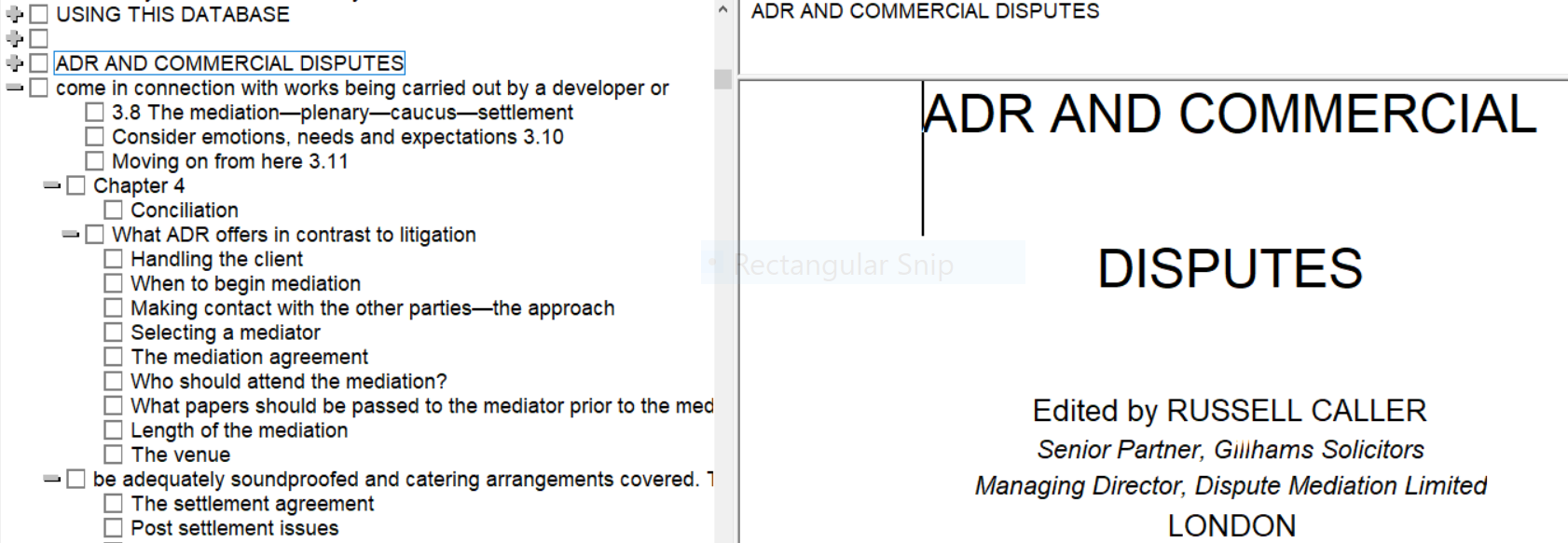
ADR AND COMMERCIAL DISPUTES - with database


Description
ADR and Commercial Disputes — Book Review
Review author: marceljude.ai
I read the book as a specialist, practice-oriented legal text on the use of Alternative Dispute Resolution, especially mediation, across major categories of commercial disputes. The book is edited by Russell Caller and is built around specialist chapters written by practitioners who combine subject-matter expertise with mediation experience. The editor explains that the book is not meant to be read like a novel from cover to cover, but as a practical work that a busy practitioner may “dip into” by dispute category; he also states that each chapter is largely self-contained, which explains some repetition across chapters.
Actual book page numbers and contents
The book’s own contents page organizes chapters primarily by paragraph numbers rather than by page-level subsection locators. I therefore give the actual book page ranges for each chapter and then identify the paragraph-numbered subsections within each chapter.
Front matter:
Foreword — page v Introduction — pages vii–ix Profiles of contributors — pages xi–xv Contents — pages xvii–xx Table of Cases — pages xxi–xxii Table of Statutes — pages xxiii–xxiv Table of Statutory Instruments — pages xxv–xxvi Table of International Treaties and Conventions — page xxvii
Main contents:
Chapter 1, ADR: What is it and what are the pros and cons? — pages 1–11 Subsections: 1.1 Introduction; 1.2 What is ADR?; 1.3 How does it work?; 1.4 The advantages of ADR; 1.5 The disadvantages of ADR; 1.6 Why is ADR seldom used?
Chapter 2, Banking and Finance Disputes — pages 13–35 Subsections: 2.1 Introduction; 2.2 Banks and dispute resolution; 2.3 Types of disputes involving banks and financial institutions; 2.4 Trends; 2.5 What is ADR?; 2.6 Why have banks traditionally favoured litigation over ADR?; 2.7 Advantages of ADR and mediation in banking disputes; 2.8 The court’s powers in relation to ADR; 2.9 ADR clauses; 2.10 The mediation process; 2.11 The right time to mediate; 2.12 Change of attitude by banks and current practice of U.K. clearing banks; 2.13 Banking mediation in action; 2.14 Other methods of resolving banking disputes; 2.15 Case studies. The contents page lists the chapter through 2.14, while the chapter text itself continues with 2.15 case studies.
Chapter 3, Commercial Property Disputes — pages 37–56 Subsections: 3.1 Introduction; 3.2 “Transaction” or “Relationship” dispute; 3.3 The parties and their perceptions; 3.4 History makes us litigious; 3.5 Litigate or mediate?; 3.6 Rules of presentation of the case—impress the client, impress the mediator; 3.7 What went wrong and why?—how did we end up here?; 3.8 The mediation—plenary—caucus—settlement; 3.9 Specific problems—special skills—the benefits of experience; 3.10 Consider emotions, needs and expectations; 3.11 Moving on from here.
Chapter 4, Employment Disputes — pages 57–72 Subsections: 4.1 Introduction to ADR; 4.2 The ADR options; 4.3 What ADR offers in contrast to litigation; 4.4 ADR providers; 4.5 Advantages of mediation over other ADR processes; 4.6 How mediation works; 4.7 Appendix to Chapter 4.
Chapter 5, Franchising Disputes — pages 73–90 Subsections: 5.1 Introduction; 5.2 Effective communication between franchisors and franchisees; 5.3 Types of dispute; 5.4 Role of court; 5.5 Limitations of litigation in franchise cases; 5.6 Arbitration; 5.7 Mediation; 5.8 Choice of mediator; 5.9 Venue of mediation; 5.10 Involvement of professional advisers; 5.11 Staggered mediation; 5.12 Preparation for the mediation; 5.13 Structure of the mediation; 5.14 Settlement agreement; 5.15 Conclusions.
Chapter 6, Insolvency Disputes — pages 91–113 Subsections: 6.1 The statutory framework; 6.2 Types of dispute; 6.3 The role of courts and tribunals; 6.4 The role of ADR generally and advantages of mediation over other forms of ADR; 6.5 The role of straightforward negotiation; 6.6 The role of mediation; 6.7 Conclusion.
Chapter 7, Insurance Related Disputes, including Reinsurance and Professional Indemnity — pages 115–137 Subsections: 7.1 Introduction; 7.2 Mediation of claims; 7.3 Mediation and reinsurance disputes; 7.4 Professional indemnity claims; 7.5 Appendix to Chapter 7.
Chapter 8, IT Disputes — pages 139–164 Subsections: 8.1 Introduction; 8.2 Types of IT dispute; 8.3 Role of courts and tribunals; 8.4 Role of ADR generally—advantages of mediation or other forms of ADR; 8.5 The role of mediation; 8.6 Ten key points to remember.
Chapter 9, Landlord and Tenant Disputes — pages 165–179 Subsections: 9.1 Introduction; 9.2 Types of landlord and tenant disputes amenable to ADR; 9.3 The role of courts and tribunals; 9.4 The role of ADR generally and advantages of mediation over other forms of ADR; 9.5 The role of negotiations; 9.6 The role of mediation.
Chapter 10, Partnership and Professional Practice Disputes — pages 181–211 Subsections: 10.1 Introduction; 10.2 Types of disputes; 10.3 The role of the court and tribunals; 10.4 The role of ADR generally and advantages of mediation over other forms of ADR; 10.5 The role of straightforward negotiations; 10.6 Practical considerations when mediating partnership and professional practice disputes; 10.7 Ten key points to remember.
Chapter 11, Shipping Disputes — pages 213–237 Subsections: 11.1 Types of disputes; 11.2 Resolving shipping disputes in courts and tribunals; 11.3 The role of courts and tribunals; 11.4 The role of ADR generally and advantages of mediation over other forms of ADR; 11.5 The role of mediation; 11.6 Ten key points to remember.
Chapter 12, Probate and Trust Disputes — pages 239–246 Subsections: 12.1 Why mediate?; 12.2 A death in the family; 12.3 Enter the lawyers; 12.4 Litigation commences; 12.5 The mediation process; 12.6 Mediation commences; 12.7 Why a settlement was reached; 12.8 Using mediation and other ADR processes.
Index — begins at page 247.
Overall review of the book
As a law professor, I would describe ADR and Commercial Disputes as a doctrinally practical rather than theoretically abstract book. Its central claim is that commercial litigation should no longer be treated as the ordinary first resort for business conflict. Instead, the book argues that mediation and other forms of ADR should be treated as serious, disciplined, lawyerly tools that can resolve commercial disputes more quickly, more cheaply, more privately, and often more intelligently than trial.
The Foreword frames mediation as one of the major procedural developments in modern English civil justice, especially after the Woolf reforms. The book’s intellectual setting is therefore the transition from adversarial default litigation to active case management, proportionality, settlement culture, and judicial encouragement of ADR. That is the book’s major legal-historical importance: it captures the moment when mediation moved from peripheral respectability into mainstream commercial litigation practice.
The Introduction by Russell Caller gives the book its working philosophy. It rejects the idea that mediation is merely “soft” negotiation or a retreat from legal rights. It presents ADR as a commercially rational method of dispute management. The editor also makes a significant jurisprudential point: he does not accept the view that a mediator need not understand the subject matter. Instead, he argues that subject-matter knowledge increases the chance of resolving a dispute because it improves the mediator’s understanding of the parties’ real problem.
The book is strongest when it connects three things: the legal structure of a dispute, the commercial incentives of the parties, and the practical psychology of settlement. It repeatedly shows that disputes are not only about rights. They are also about cash flow, risk, reputation, time, continuing relationships, insurance cover, market position, family resentment, emotional exhaustion, and the fear of losing control once a case enters the court system.
The book’s limitation is also clear. Because each chapter is written by a different specialist, the book sometimes repeats the same propositions: mediation is confidential, without prejudice, voluntary, flexible, cheaper than litigation, and dependent on decision-makers attending with settlement authority. But this repetition is not entirely a weakness. It shows that across commercial fields, the same procedural architecture recurs, while the reasons for using mediation differ according to the dispute category.
My overall assessment: the book is a valuable practitioner’s manual and a strong teaching text for lawyers learning to think beyond litigation. It is less a work of grand ADR theory than a field guide to mediated settlement in commercial law.
Chapter-by-chapter review Chapter 1 — ADR: What is it and what are the pros and cons? — pages 1–11
This opening chapter is the conceptual gateway to the entire book. It explains that lawyers must understand ADR both transactionally and litigiously: transaction lawyers must know whether to include ADR clauses in contracts, and litigators must know when and how to suggest or respond to ADR.
1.1 Introduction. The introduction insists that ADR literacy is part of competent commercial legal practice. A lawyer who cannot advise on ADR is incomplete as a modern dispute lawyer.
1.2 What is ADR? The chapter adopts a broad definition that includes arbitration, though it acknowledges that many practitioners reserve ADR for non-binding settlement processes such as mediation. The key idea is that ADR is a facilitated settlement process, generally confidential and without prejudice, where the client is not forced into an outcome unless a settlement agreement is reached.
As a law professor, I would stress that this distinction is doctrinally important. Arbitration is adjudicative and binding; mediation is facilitative and consensual. The chapter’s inclusive definition is pragmatic, but analytically it is useful to distinguish “alternative adjudication” from “assisted negotiation.”
1.3 How does it work? The chapter identifies three principal forms: mediation, neutral evaluation, and executive mini-trial. Mediation is the dominant form. The chapter explains the appointment of a mediator, preliminary procedural arrangements, mediation agreements, core bundles, written case statements, attendance by decision-makers, opening statements, caucuses, and settlement agreements. Its treatment of caucus is especially important: the mediator’s private meetings permit candid discussion, testing of positions, and movement beyond public posturing.
1.4 The advantages of ADR. The advantages are not merely cost and speed. The chapter’s richer insight is that mediation creates structured commitment. Decision-makers attend, hear the other side directly, confront litigation risk, and are pushed to focus on settlement in a way ordinary correspondence often cannot achieve. The chapter also emphasizes flexibility: courts generally award legal remedies, whereas mediation can produce apologies, revised business terms, staged payments, future discounts, and commercial solutions unavailable at trial.
1.5 The disadvantages of ADR. The chapter does not romanticize mediation. It recognizes situations where ADR may be inappropriate: urgent injunctions, need for pleadings, disclosure, expert evidence, witness testing, precedent, or a public judgment. It also recognizes the danger of abuse, including parties using ADR to fish for information or pressure weaker parties.
1.6 Why is ADR seldom used? The chapter identifies conservatism, unfamiliarity, inertia, and the perception that ADR is merely settlement negotiation. Its strongest point is that parties often reject mediation early, only to settle later after enormous cost has been incurred.
Review judgment. This is an excellent introductory chapter. Its value lies in its balanced treatment. It does not present mediation as a miracle. Instead, it teaches lawyers to ask the right procedural question: is this dispute better served by adjudication, negotiation, mediation, or some staged combination?
Chapter 2 — Banking and Finance Disputes — pages 13–35
Chapter 2 applies ADR to banking disputes, where the institutional habit has traditionally been litigation. The chapter is especially useful because banking disputes often involve power imbalance, repeat-player institutions, reputational concerns, and enforcement concerns.
2.1 Introduction. The chapter’s purpose is to introduce ADR, especially mediation, in banking disputes. It treats banks and financial institutions collectively because the same dispute-resolution principles apply across lenders, investment institutions, building societies, securities firms, and similar bodies.
2.2 Banks and dispute resolution. Banks are routine users of the court system. The chapter begins from the realistic premise that disputes are inevitable in financial markets because of the volume and complexity of financial transactions.
2.3 Types of disputes involving banks and financial institutions. The chapter identifies loan recovery, enforcement of security, personal guarantees, letters of credit, negligent advice, pension and mortgage mis-selling, interbank disputes, overcharging, and premature calling-in of loans or receiver appointments. This catalogue is important because it shows that banking disputes range from simple debt collection to complex fiduciary, regulatory, and commercial disputes.
2.4 Trends. The chapter notes increased litigation against banks, greater complexity in banking products, and more willingness by customers to sue powerful financial institutions. The doctrinal theme is lender liability and the expansion of duties owed by banks.
2.5 What is ADR? The chapter distinguishes negotiation, mediation, arbitration, ICSID processes, and early neutral evaluation. Its key preference is for mediation because of flexibility and party control.
2.6 Why have banks traditionally favoured litigation over ADR? This is one of the chapter’s most interesting parts. Banks have often preferred litigation because it offers summary judgment, injunctions, public precedent, jurisdictional certainty, enforcement leverage, and a familiar institutional path. The chapter also notes fear of debtor default, abuse of mediation, and the absence of an immediately enforceable court order.
2.7 Advantages of ADR and mediation in banking disputes. The chapter argues that mediation offers flexibility, preserves commercial relationships, allows banks to retain control, saves money, speeds resolution, and protects confidentiality. A professor’s point here: the chapter reframes banking litigation from “we are owed money, so sue” to “what outcome best protects economic value?”
2.8 The court’s powers in relation to ADR. The chapter situates ADR within active case management and judicial encouragement. It discusses how courts can encourage or pressure parties to consider ADR through allocation, stays, and costs consequences.
2.9 ADR clauses. This subsection is particularly practical. ADR clauses put mediation “on the agenda” before conflict hardens. The chapter rightly recognizes that parties are more likely to accept mediation if they have already agreed to it contractually.
2.10 The mediation process. The chapter explains facilitative and evaluative mediation, choosing a mediator, preliminary contact, mediation agreements, opening sessions, caucuses, confidentiality, and settlement documentation.
2.11 The right time to mediate. The timing question is treated carefully. Early mediation saves cost, but premature mediation may fail if the parties lack enough information.
2.12 Change of attitude by banks and current practice. The chapter observes a changing banking culture: more attention to early settlement, panel solicitors trained in ADR, maintaining customer relationships, public image, and case management.
2.13 Banking mediation in action. The chapter discusses institutional mediation mechanisms, including financial regulatory mediation and the City Disputes Panel.
2.14 Other methods of resolving banking disputes. The Banking Ombudsman scheme is discussed as a lower-value, consumer-facing dispute mechanism.
2.15 Case studies. The chapter’s case studies show mediation solving syndicated-loan, Barings-related, infrastructure-finance, insolvency-acquisition, and interest-rate swap disputes. The text notes, for example, that a major British and Commonwealth/Atlantic Computers dispute involving £850 million was mediated in four days, illustrating mediation’s capacity for high-value commercial complexity.
Review judgment. This is one of the strongest chapters because it confronts institutional resistance. Its major contribution is to show that mediation is not merely for small or emotionally charged disputes; it can resolve sophisticated financial disputes where timing, reputation, confidentiality, and commercial creativity matter.
Chapter 3 — Commercial Property Disputes — pages 37–56
Chapter 3 is conceptually elegant because it classifies property disputes as either transaction disputes or relationship disputes.
3.1 Introduction. The chapter begins by stating that property disputes share the ordinary features of commercial conflict: disappointed expectations, loss, and desire for redress. But mediation is attractive because it can end the dispute quickly, preserve business time, and reduce costs.
3.2 “Transaction” or “Relationship” dispute. This is the chapter’s central analytical tool. Transaction disputes arise from failed one-off dealings, such as sale or development agreements. Relationship disputes arise from continuing legal relationships: landlord and tenant, neighbours, shared rights, easements, or multi-occupier arrangements. The distinction matters because relationship disputes require future-facing solutions.
3.3 The parties and their perceptions. The chapter is alert to the mismatch between legal categories and client perceptions. Lawyers may classify a dispute as property, partnership, construction, negligence, or administrative law, but clients often experience it simply as a property conflict.
3.4 History makes us litigious. This subsection explores the territorial and emotional nature of property. The chapter’s insight is that property disputes often become personal because property is tied to business survival, home, identity, control, and status.
3.5 Litigate or mediate? The author illustrates how litigation can entrench positions. The chapter criticizes the “I’ll show him” mentality and argues that mediation is often the more commercially rational option.
3.6 Rules of presentation of the case. This subsection examines advocacy in mediation. The advocate must impress the client, but also avoid poisoning the mediation. Aggressive opening statements may satisfy a client emotionally but damage prospects of settlement.
3.7 What went wrong and why? The chapter stresses diagnosis. A mediator must discover when communication failed, what expectations were mismanaged, and why the parties’ legal positions became hardened.
3.8 The mediation—plenary—caucus—settlement. The case study demonstrates how a commercial property dispute moves from plenary presentation to caucus reality-testing and then toward financial settlement. It is a practical anatomy of mediation.
3.9 Specific problems—special skills—the benefits of experience. The author argues for subject-matter expertise. A mediator familiar with commercial property can test assertions more confidently and understand lease amendments, development expectations, planning constraints, and industry practice.
3.10 Consider emotions, needs and expectations. This subsection is among the book’s most humane. It insists that even commercial property disputes involve emotional reactions: disrespect, exclusion, irritation, and perceived indifference.
3.11 Moving on from here. The final subsection emphasizes future communication, apologies, and structured mechanisms to avoid repeat conflict.
Review judgment. Chapter 3 is a superb example of legally informed mediation analysis. It shows that property law disputes are not merely about land, leases, or covenants; they are about expectation, control, dignity, commercial continuity, and future coexistence.
Chapter 4 — Employment Disputes — pages 57–72
Chapter 4 addresses employment and workplace conflict. It is particularly sensitive to the human cost of litigation.
4.1 Introduction to ADR. Employment tribunals are described as expensive, stressful, unpredictable, time-consuming, and damaging to ongoing relationships. ADR is introduced as a set of processes that can resolve disputes privately, informally, and with outcomes broader than tribunal remedies.
4.2 The ADR options. The chapter compares conciliation, arbitration, and mediation. ACAS conciliation is explained as a familiar statutory mechanism. Arbitration is described as binding and less formal than tribunal litigation, but still adjudicative. Mediation is presented as interest-based, party-controlled, and capable of producing creative remedies.
4.3 What ADR offers in contrast to litigation. ADR offers lower cost, speed, privacy, user-friendliness, informality, and wider remedies. The chapter is especially persuasive on workplace relationships: litigation often destroys the very relationship the parties may need to preserve.
4.4 ADR providers. The chapter identifies mediation providers and notes the importance of trained mediators.
4.5 Advantages of mediation over other ADR processes. The chapter argues that mediation is superior to arbitration and conciliation where the real problem involves relationship, behaviour, communication, dignity, and future working arrangements. Mediation allows apologies, protocols, explanations, and workplace adjustments.
4.6 How mediation works. This is the practical core: handling the client, when to begin mediation, approaching the other party, selecting a mediator, agreeing mediation terms, deciding who attends, preparing papers, venue, fees, settlement agreement, review mechanisms, caucuses, preparation, and suitability.
The chapter’s treatment of suitability is nuanced. It recognizes that mediation may not be right where public vindication, precedent, or a clear ruling on right and wrong is needed. It also recognizes power imbalance and violence concerns; in such cases, shuttle mediation may be appropriate.
4.7 Appendix to Chapter 4. The sample agreement to mediate is useful because it translates theory into a working legal instrument. It covers impartiality, confidentiality, voluntary participation, settlement authority, and the non-advisory role of the mediator.
Review judgment. This chapter is strong because it sees employment disputes as human disputes embedded in legal structures. Its chief lesson is that legal remedies may be too narrow for workplace harm. A tribunal can award compensation; mediation can rebuild working conditions or at least end conflict with dignity.
Chapter 5 — Franchising Disputes — pages 73–90
Chapter 5 is one of the most commercially sophisticated chapters because franchise disputes sit between contract, intellectual property, relational business law, brand control, and inequality of bargaining power.
5.1 Introduction. The chapter uses the “Coco the Clown” example to show that franchising may appear simple to the public but is legally structured through trade names, goodwill, licensing, systems, and control. It focuses on business-format franchising, where the franchisee operates under the franchisor’s trade name and system.
5.2 Effective communication between franchisors and franchisees. The chapter emphasizes continuing cooperation. Franchising is a long-term relationship, and disputes can damage both parties: the franchisee may lose a business; the franchisor may lose brand continuity and market presence.
5.3 Types of dispute. Disputes may involve projections, support, training, advertising, product quality, fees, territory, renewal, system compliance, payment, time commitment, equipment, competing businesses, termination, fixtures, goodwill, transfers, and non-compete covenants.
5.4 Role of court. The court remains important where urgent injunctions, declarations, search orders, freezing orders, or binding determinations are needed. The chapter properly recognizes that litigation is not obsolete.
5.5 Limitations of litigation in franchise cases. Litigation is criticized as blunt because it produces win/lose outcomes and may fail to address the commercial reality: the parties may need restructuring, buy-out, modified territory, or renegotiation.
5.6 Arbitration. Arbitration offers privacy, specialist decision-making, and speed compared to some litigation, but it can still be expensive, formal, and adversarial.
5.7 Mediation. Mediation’s strength is flexibility. It can resolve non-compete disputes, buy-outs, group franchisee disputes, renewal conflicts, and brand issues confidentially.
5.8 Choice of mediator. The chapter argues that the mediator should understand franchising. This reflects the editor’s broader thesis: subject expertise improves the mediator’s ability to test reality and craft solutions.
5.9 Venue of mediation. Neutral venue matters, especially where the franchise relationship involves perceived inequality.
5.10 Involvement of professional advisers. Professional advisers are useful, but equality of arms matters. A lone franchisee should not be overwhelmed by the franchisor’s advisory team.
5.11 Staggered mediation. The chapter allows for staged mediation, especially where buy-out valuation or commercial restructuring requires multiple phases.
5.12 Preparation for the mediation. The parties should clarify issues, prepare documents, summarize positions, attend fully prepared, ensure settlement authority, and understand costs.
5.13 Structure of the mediation. The chapter describes opening joint sessions, private rooms, shuttle discussions, and written settlement.
5.14 Settlement agreement. Franchise settlements may be complex, especially when business sale, goodwill, IP rights, non-competes, or future obligations are involved.
5.15 Conclusions. The conclusion is pragmatic: litigation remains necessary for some urgent or disciplinary matters, but mediation is often better suited to long-term franchise relationships.
Review judgment. Chapter 5 is excellent on the tension between uniform brand control and individual franchisee autonomy. Its central legal insight is that franchise disputes often require solutions courts cannot impose.
Chapter 6 — Insolvency Disputes — pages 91–113
Chapter 6 is doctrinally dense because insolvency mediation depends on statutory powers, officeholder duties, creditor interests, and court or committee sanction.
6.1 The statutory framework. This subsection asks whether officeholders under insolvency legislation have power to mediate or compromise. It examines administrators, administrative receivers, liquidators, provisional liquidators, trustees in bankruptcy, supervisors of voluntary arrangements, and creditors’ committees. The core point is that insolvency officeholders generally have powers to compromise, but those powers may require sanction or must be exercised consistently with fiduciary duties.
6.2 Types of dispute. Officeholders may face landlord disputes, tenant disputes, professional negligence claims, insurance claims, employment issues, product liability, preferences, transactions at undervalue, and claim-priority disputes.
6.3 The role of courts and tribunals. The chapter places insolvency within the court’s scrutiny of officeholder conduct. Courts may examine whether litigation expenditure was prudent, especially where officeholders spend estate funds.
6.4 ADR generally and advantages of mediation. The chapter argues that mediation is attractive because insolvency estates are cost-sensitive. Money spent litigating may reduce returns to creditors. In multi-party or multi-jurisdictional insolvency, mediation may be not merely useful but essential.
6.5 The role of straightforward negotiation. The chapter distinguishes positional bargaining from principled negotiation. It shows how officeholders, though often experienced negotiators, may still benefit from a mediator when positions harden.
6.6 The role of mediation. This practical section covers identifying the “client,” persuading creditors or secured creditors, timing, approaching parties, selecting mediators, mediation agreements, confidentiality, governing law, settlement, stay of proceedings, authority, attendance, documents, venue, cost, settlement drafting, and post-settlement sanction.
6.7 Conclusion. The chapter concludes that insolvency mediation can achieve cost-effective settlement, preserve estate value, respect public interest concerns, and address global insolvency complications. The text specifically notes that mediation may be especially valuable in multi-jurisdictional disputes.
Review judgment. This is one of the most legally rigorous chapters. It reminds us that mediation is not only a soft commercial tool; it must be grounded in authority, fiduciary duty, sanction, and creditor protection.
Chapter 7 — Insurance Related Disputes, Reinsurance and Professional Indemnity — pages 115–137
Chapter 7 is written as a practical guide for insurance-related mediation and is organized around questions a claimant’s lawyer must ask.
7.1 Introduction. The chapter situates insurance and reinsurance in a long commercial tradition and explains that dispute resolution in these markets historically relied on litigation, arbitration, and private negotiation before ADR emerged as a serious alternative.
7.2 Mediation of claims. This section is practical and tactical. It asks whether the client should mediate, what risks mediation creates, what happens if the client resists mediation, when mediation should occur, how to choose a mediator, how to prepare, whether counsel or experts should attend, how to set a bottom line, how the mediation day unfolds, and how settlement is recorded.
Its most useful contribution is its warning about insurer behavior. Insurers may agree to mediate without genuine settlement intention, using mediation to test witnesses, assess credibility, or learn the claimant’s case.
7.3 Mediation and reinsurance disputes. This subsection addresses a crucial doctrinal issue: how settlement of an underlying claim affects reinsurance recovery. The reinsured must consider follow-the-settlements clauses, claims control clauses, and the need to involve reinsurers before settlement.
7.4 Professional indemnity claims. The chapter observes that professional indemnity disputes should be suitable for mediation because professionals often want privacy and early resolution. Yet the chapter notes resistance in parts of the market.
7.5 Appendix to Chapter 7. The sample mediation agreement covers parties, mediator role, confidentiality, settlement, termination, costs, governing law, and mediator liability.
Review judgment. Chapter 7 is valuable because it teaches that mediation strategy changes when insurers or reinsurers fund or control the litigation. The party on the claim form may not be the true economic decision-maker. That is essential for any lawyer mediating insured disputes.
Chapter 8 — IT Disputes — pages 139–164
Chapter 8 is a strong chapter because IT disputes are typically complex, document-heavy, technically difficult, and commercially disruptive.
8.1 Introduction. The chapter opens with public and private sector IT failures, using examples of delayed, over-budget, or failed systems. The point is that IT disputes are widespread and often enormous in scale.
8.2 Types of IT dispute. The chapter identifies recurring causes: poor user involvement, weak management support, unclear requirements, poor planning, unrealistic expectations, insufficient milestones, lack of competent staff, weak project ownership, unclear objectives, and poor implementation. It then breaks these failures into inception/design problems, implementation delay, project management failures, risk planning failures, and supplier-relationship problems.
8.3 Role of courts and tribunals. The Technology and Construction Court is discussed as the natural forum for complex IT disputes, but the chapter stresses the expense and formality of litigation. Arbitration, dispute escalation clauses, expert determination, and court encouragement of ADR are considered.
8.4 Role of ADR generally. The chapter explains adjudicative and consensual methods: expert determination, facilitated negotiation, early neutral evaluation, mini-trial, and mediation. Mediation is preferred for large IT disputes because the parties retain control.
8.5 The role of mediation. This is one of the book’s most detailed mediation-practice sections. It deals with client preparation, timing, approaching the other side, choosing a mediator, co-mediation, mediation agreements, exchange of submissions, document bundles, pre-action document requests, attendees, papers, chronology, venue, cost, settlement agreement, and post-settlement issues.
8.6 Ten key points to remember. The chapter’s ten points emphasize that IT disputes are expensive to litigate, mediation should not be seen as weakness, an IT expert is not always the best mediator, submissions should tell a clear story, clients must understand weaknesses, and settlements should be signed before the mediation ends.
Review judgment. Chapter 8 is outstanding as a mediation manual for complex technical disputes. Its best insight is that the mediator does not need every document; the mediator needs a clear story, the key documents, and authority to move the parties toward settlement.
Chapter 9 — Landlord and Tenant Disputes — pages 165–179
Chapter 9 argues that landlord and tenant disputes are especially suited to ADR, despite the superficial assumption that possession disputes are “all or nothing.”
9.1 Introduction. The chapter opens by rejecting the idea that landlord and tenant disputes are too binary for ADR. Even possession issues may be mediated, and many disputes concern broader lease relationships.
9.2 Types of landlord and tenant disputes amenable to ADR. This is a long and substantive section. It covers breach of covenant by tenant, repair and decoration, user covenants, change of use, restrictions on possession-sharing, breach by landlord, assignments, rent arrears, guarantors, service charges, rent review, renewal under business tenancy legislation, disputed lease rights, end-of-tenancy rights, fixtures, dilapidations, and general landlord-tenant relationships.
The section’s central point is that lease disputes often involve continuing relationships and practical solutions beyond court orders.
9.3 The role of courts and tribunals. The chapter explains the allocation between High Court and county court, the Civil Procedure Rules, stays for ADR, case management, and court encouragement of settlement.
9.4 The role of ADR generally. The chapter compares mediation, arbitration, and early neutral evaluation. Mediation is preferred because it is informal, flexible, speedier, and focused on interests rather than rights.
9.5 The role of negotiations. Negotiation remains important, but mediation is useful where ordinary negotiation fails or where neither party wants to appear weak.
9.6 The role of mediation. This practical section covers handling the client, whether to mediate before or after proceedings, approaching the other side, mediator selection, attendance, documents, length, venue, and settlement agreement. The chapter states that in landlord and tenant disputes the mediator should receive the lease or tenancy agreement, relevant documents, expert reports, and pleadings if proceedings exist.
Review judgment. Chapter 9 is doctrinally and practically strong. It captures the reality that leases are not merely contracts; they are continuing frameworks for property use, economic planning, and mutual dependence.
Chapter 10 — Partnership and Professional Practice Disputes — pages 181–211
Chapter 10 is one of the richest chapters because partnership disputes are commercially serious, legally complex, and emotionally charged.
10.1 Introduction. The chapter explains that partnership and professional practice disputes cover partnerships, companies, limited liability partnerships, and professional businesses. It notes that such disputes are especially destabilizing because the owners are often also the managers and reputation-bearers of the business.
10.2 Types of disputes. The chapter categorizes disputes into retirement, expulsion, fraud, bad faith, misrepresentation, dissolution, winding-up, non-competition covenants, goodwill agreements, lock-ins, and garden leave. This is an excellent taxonomy because it shows how partnership disputes often combine money, control, reputation, and future livelihood.
10.3 The role of court and tribunals. The chapter examines court jurisdiction, arbitration, receivers, dissolution, unfair prejudice, winding up, and professional practice disputes involving corporate or LLP structures.
10.4 ADR generally and advantages of mediation. This is the chapter’s strongest intellectual section. It compares early neutral evaluation, expert determination, executive tribunal, and mediation. It argues that mediation is especially valuable because it addresses cost, speed, complex factual issues, emotion, and confidentiality.
10.5 The role of straightforward negotiations. Negotiation is useful, but it can fail due to pride, revenge, mistrust, poor communication, unrealistic expectations, positional bargaining, and cost burdens.
10.6 Practical considerations when mediating partnership and professional practice disputes. This section covers client handling, timing, approaching parties, mediator choice, mediation agreement, attendance, documents, length, venue, cost, settlement agreement, and post-settlement issues.
10.7 Ten key points to remember. The chapter’s closing points emphasize survival of the business, reputational protection, hidden agendas, emotional release, personal liabilities, taxation issues, and the usefulness of mediation clauses in settlement agreements.
Review judgment. Chapter 10 is excellent. Its most important contribution is to show that partnership litigation can destroy the very asset being fought over. In professional practice disputes, confidentiality and speed are not luxuries; they are central to preserving goodwill.
Chapter 11 — Shipping Disputes — pages 213–237
Chapter 11 is specialized and industry-conscious. It recognizes that shipping has long had its own dispute-resolution culture.
11.1 Types of disputes. The chapter distinguishes “wet” shipping and “dry” shipping. Wet shipping involves marine casualties such as collision, salvage, arrest, and limitation. Dry shipping concerns commercial use of ships, including contracts of carriage, charterparties, bills of lading, cargo claims, and related commercial disputes. The chapter explains that arrest is a means of obtaining jurisdiction and security, and that limitation in shipping means limitation of liability, not limitation periods.
11.2 Resolving shipping disputes in courts and tribunals. The chapter explains that shipping disputes traditionally use the Admiralty Court, Commercial Court, arbitration, salvage arbitration, and specialized industry procedures.
11.3 The role of courts and tribunals. The chapter recognizes that courts and tribunals provide the adjudicative backdrop. For many dry shipping disputes, the threat of open-ended cost and delay encourages settlement; in collision and salvage matters, formal factual investigation may be more necessary before settlement is realistic.
11.4 ADR generally and advantages of mediation. This section treats ADR not as an alternative to negotiation, but as an adjunct to negotiation. Mediation may restart failed negotiations or structure settlement discussions. The chapter also discusses mini-trials, early neutral evaluation, expert determination, adjudication, customized ADR, and med-arb.
11.5 The role of mediation. This practical section addresses whether mediation should occur, timing, client handling, approaching the other side, mediator type, mediation agreement, attendance, papers, length, venue, costs, settlement agreement, and post-settlement issues. The chapter is especially attentive to international enforcement, service clauses, Tomlin Orders, and consent awards.
11.6 Ten key points to remember. The chapter’s closing list is pragmatic: know the law and facts, calculate costs, calculate future costs, value claims and counterclaims, include interest, record previous offers, brief clients thoroughly, ensure full authority to settle, assess offers objectively, mediate in good faith, appear reasonable, and keep calm.
Review judgment. Chapter 11 is strong because it adapts mediation to a field with deeply embedded arbitration and court traditions. Its major lesson is that mediation must respect industry practice rather than pretend every dispute has the same procedural culture.
Chapter 12 — Probate and Trust Disputes — pages 239–246
Chapter 12 is different from the rest of the book. It is built around a case study rather than the more systematic structure used elsewhere.
12.1 Why mediate? The chapter begins by explaining why probate and trust disputes are especially suitable for mediation. Family history, bereavement, emotional grievance, and financial dependence often make litigation both expensive and personally destructive. The chapter emphasizes that the law may not produce a result either party experiences as fair.
12.2 A death in the family. The case study involves a father, two daughters, a second wife, and a will that gives the second wife occupation rights and pension benefits while leaving the residuary estate to the daughters. The second wife believes the will does not make fair provision for her.
12.3 Enter the lawyers. The chapter shows how legal advice transforms family grievance into doctrinal litigation: life interest, right of occupation, reasonable financial provision, estate valuation, and likely court outcomes.
12.4 Litigation commences. The dispute escalates into formal litigation. This subsection contrasts the family’s underlying needs with the legal machinery that begins to take over.
12.5 The mediation process. The chapter explains preparation, case summaries, documents, opening joint session, caucus, confidentiality, mediator shuttling, and interest-based exploration.
12.6 Mediation commences. The daughters refuse to meet the stepmother. The mediator explores what each side actually needs. The daughters need money now and do not want to wait for a life interest to end. The stepmother does not want to remain in the house because it is too large, costly, and emotionally burdened.
12.7 Why a settlement was reached. Settlement becomes possible because the mediator uncovers the parties’ true interests rather than treating the dispute as only a legal contest. The daughters want present value; the stepmother wants security and independence. The legal positions are not identical to the human needs.
12.8 Using mediation and other ADR processes. The chapter closes by generalizing the lesson: probate and trust disputes often need a process that can handle law, emotion, family history, and practical settlement.
Review judgment. Chapter 12 is the emotional climax of the book. It demonstrates the book’s deeper thesis: litigation may determine rights, but mediation can identify needs. In probate and trust disputes, that distinction is fundamental.
Major themes across the book
The first major theme is the movement from rights to interests. The book does not deny legal rights. Instead, it shows that legal rights are only one part of dispute resolution. In many commercial disputes, what the parties really need is liquidity, confidentiality, apology, business continuity, revised terms, future communication, or a dignified exit.
The second theme is the importance of timing. Many chapters ask when to mediate. Early mediation saves costs, but if done too early, parties may lack pleadings, disclosure, expert evidence, or sufficient understanding of risk. The book’s mature answer is not “mediate immediately” but “mediate when the dispute is sufficiently understood and before litigation costs destroy settlement value.”
The third theme is authority to settle. Across banking, insurance, employment, shipping, IT, and partnership disputes, the book repeatedly stresses that mediation fails if the person in the room lacks authority. This is not a technicality. Mediation works by building momentum; lack of authority breaks that momentum.
The fourth theme is confidentiality. This matters differently in each field: banks worry about reputation; insurers worry about precedent and coverage; professional practices worry about goodwill; probate parties worry about family privacy; franchise systems worry about brand integrity; shipping parties may worry about market consequences.
The fifth theme is subject-matter competence. The editor and many chapter authors reject the simplistic claim that any good mediator can mediate anything. The stronger view in the book is that mediation skill is essential, but subject-matter knowledge can make reality-testing sharper and settlement design more credible.
The sixth theme is the limits of mediation. The book repeatedly recognizes situations where litigation, arbitration, injunctions, expert determination, or court orders are necessary. This restraint makes the book more persuasive. It is pro-mediation, not anti-law.
Critical evaluation as a law professor
The book’s greatest strength is its field-specific method. Instead of treating ADR as a single universal technique, it asks what mediation means in banking, property, employment, franchising, insolvency, insurance, IT, landlord and tenant, partnership, shipping, and probate. This is exactly how ADR should be taught to lawyers: not as generic “settlement talk,” but as a legal process shaped by the substantive field.
Its second strength is its procedural realism. The book understands lawyers, clients, insurers, banks, franchise systems, officeholders, and professional partnerships as actors with incentives. It does not pretend that everyone enters mediation in good faith. It recognizes gamesmanship, delay, positional bargaining, information asymmetry, reputational pressure, and emotional resistance.
Its third strength is its practice utility. The book provides mediation agreements, case studies, checklists, and practical guidance on attendance, documents, venue, mediator selection, and settlement drafting. These details matter. Bad mediation preparation can waste the process.
The book’s weakness is that its structure can produce repetition. Many chapters restate the same basic features of mediation. But because the book is designed for practitioners who may read only the chapter relevant to their dispute, repetition is defensible.
A second weakness is that the book is rooted in a specific civil justice moment. A modern reader should supplement it with current procedural rules, current mediation case law, current court guidance, and current sector-specific schemes. That does not reduce its value as a conceptual and practical work; it simply means that its legal propositions should be updated before being used in live advice.
A third limitation is that the book’s enthusiasm for subject-matter expertise in mediators, though persuasive, could be overread. Expertise can help, but it may also tempt a mediator into evaluation too early or undermine perceived neutrality. The best mediator in complex disputes is often one who combines process mastery, legal judgment, commercial intelligence, and enough subject fluency to ask the right questions.
Final verdict
ADR and Commercial Disputes is a highly useful and serious practitioner’s book. It teaches that ADR is not a decorative add-on to litigation but a central part of modern commercial dispute strategy. Its best chapters show that mediation is most powerful where courts can decide liability but cannot design the commercial, relational, emotional, or reputational solution the parties actually need.
As a law professor, I would recommend the book for lawyers, mediators, postgraduate ADR students, commercial litigators, in-house counsel, and anyone studying the practical consequences of the Woolf-era shift toward settlement culture. Its enduring lesson is simple but profound: a good lawyer must know not only how to win a case, but how to resolve a dispute.
- MALAYSIA'S 1ST AI LAWYER - CLICK HERE
- ISMAIL – INTEGRATED SINGAPORE/MALAYSIA AI & LAW (Library)
- OPENING OF SINGAPORE MALAYSIA AI CENTRE AND LAW LIBRARY
- LIFT - LAW INSTRUMENTS FORMS & TEMPLATES
- LAWS OF MALAYSIA FOR SINGAPOREAN DUMMIES
- HANNAH YEOH'S ARTIFICIAL INTELLIGENCE LAW ENCYCLOPEDIA
- LEAD CR - Law Ecosystem Archive Databases on CD-ROM
- BREAKING NEWS FROM MJN
- CLICK HERE CO. PROFILE
- EXCITING NEW SERIES - THE ADVENTURES OF BOBBY TAN -ADVOCATE & SOLICITOR IN THE HIGH COURT OF NORTH BORNEO by marceljude.ai
- MEDICO LEGAL - BY PRISKILA AKWILA & GLORIOUS PETAL SDN BHD - powered by marceljude.ai
- MISCELLANOUS
- ANNOTATED STATUTES OF SABAH - A NEW SERIES
- e-library - marceljude.ai
- DRAFT - DOCUMENT RESEARCH & AUTOMATED FILING TECHNOLOGY
- CLARA – Case Law Analysis & Retrieval AI
- FOR RESEARCH REQUEST CLICK HERE
- CLICK HERE TO ASK ANYTHING
- RAMBO'S LAW - THE LAW OF THE LAW JUNGLE - EXCITING NEW SERIES - CASE ANALYSIS BY JOHN RAMBO @ +60138646786
- PRISKILA AKWILA ADVOCATES - High Court of Sabah & Sarawak @ Kota Kinabalu
- COLA - COMMONWEALTH ONLINE LAWCASES AI -marceljude.ai
- THE LAW LIBRARY THAT COMES TO YOU ANYWHERE AND ANYTIME
- marceljude.ai training academy
