
Affidavit Evidence Dr Andrew Chew Peng Hui - marceljude.ai
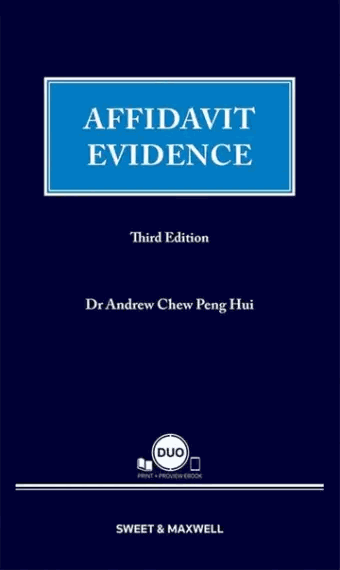


Description
Book Review of Affidavit Evidence
Dr Andrew Chew Peng Hui
LLB (London), LLM (London), PhD (London) of Lincoln's Inn, Barrister-at-law Advocate of the High Court of Sabah & Sarawak
Review by marceljude.ai
I read the book as a specialist procedural-law work on affidavit evidence. It is not merely a handbook of forms. It is a sustained study of how affidavit evidence functions as the written substitute for oral proof in civil, criminal, bankruptcy, judicial review, injunction, enforcement, appeal, and contempt settings. Its central lesson is that affidavit practice is both technical and substantive: a defective jurat, a hearsay paragraph, a badly identified exhibit, or an unsupported assertion can alter the outcome of litigation.
The book’s strongest quality is its insistence that affidavits are not casual statements. They are court evidence. The author repeatedly treats them as legal instruments that must satisfy formal rules, evidentiary principles, professional duties, and the practical demands of litigation strategy. The book’s contents show twelve chapters, appendices, an index, and extensive tables of cases and statutes; the chapter pagination and section headings below use the book’s own page numbers, not any separate document numbering.
Overall Review of the Entire Book
The book is a doctrinal and practice-oriented study of affidavit evidence. Its real contribution is to show that affidavit law sits at the junction of civil procedure, evidence, ethics, and advocacy. The author’s method is case-heavy: rules are not merely stated; they are tested against procedural failures, judicial discretion, waiver, prejudice, delay, hearsay, and the conduct of parties.
From a law professor’s perspective, the book has five major themes.
First, affidavits are evidence, not argument. The book repeatedly warns that affidavits should contain facts that the deponent can prove, not submissions, rhetoric, or counsel’s legal argument placed into the mouth of a witness. This is one of the book’s most pedagogically valuable points because many young practitioners confuse persuasive drafting with admissible evidence.
Second, form matters, but justice may override some technical defects. The book gives close attention to title, commencement, jurat, exhibits, language, filing, service, and defects. Yet it also gives serious treatment to curative provisions, especially where a procedural breach is technical and no substantial injustice has resulted. This makes the book more sophisticated than a mere “rules checklist.”
Third, the deponent is central. The book’s discussion of who should swear or affirm an affidavit, what personal knowledge means, when a lawyer may depose, and how hearsay must be sourced shows that affidavit law is ultimately about responsibility: who is speaking, what do they know, and why should the court believe them?
Fourth, affidavit evidence is procedural power. In summary judgment, judicial review, injunctions, Mareva relief, default judgment, bankruptcy, contempt, appeals, and stays, the affidavit often determines whether a party obtains urgent relief, resists enforcement, or survives procedural dismissal. Chapter Eleven is especially valuable because it applies affidavit doctrine to concrete proceedings.
Fifth, false affidavits are not merely defective; they are ethically and criminally dangerous. The final chapter makes the book’s moral architecture clear. Affidavit evidence depends on honesty. Lawyers, commissioners for oaths, and deponents each carry different responsibilities, and the book treats false affidavits as threats to the administration of justice.
The book is strongest as a litigation manual for Malaysian civil procedure and related proceedings. Its weakness, if one may call it that, is density. It is not a light student text. It is best read with the Rules of the High Court, the Subordinate Courts Rules, the Evidence Act, bankruptcy rules, and reported cases nearby. But for legal practice, that density is the point: the book teaches that affidavit evidence is not simple because litigation itself is not simple.
Contents and Chapter-by-Chapter Review Front Matter
Foreword — vii The foreword frames affidavit evidence as a subject often mistaken for elementary procedure but actually capable of determining whether cases succeed or fail. It positions the book as useful to judges, legal officers, practitioners, academics, and students.
Preface — ix The preface explains the author’s motivation: affidavit evidence is central to litigation because much judicial business is disposed of through affidavits. The author also highlights the tension between strict procedural technicality and the modern tendency to prevent justice from being defeated by mere technical defects.
Acknowledgments — page not clearly shown in the contents extract The acknowledgments situate the book in the author’s professional and personal networks, including assistance from legal practitioners and the publisher.
Table of Cases — xxvii The table of cases is substantial. This signals that the book is not merely rule-based but built through judicial interpretation.
Table of Statutes — lxvii The statutory table confirms the book’s procedural breadth: it ranges across civil procedure, bankruptcy, evidence, court rules, oaths, legal profession rules, and related legislation.
Chapter One — Introduction, p. 1 Nature of an affidavit — p. 1
The opening section asks the basic but legally important question: what is an affidavit? The book treats an affidavit as a sworn or affirmed written statement used as evidence when receivable. The section is important because it distinguishes an affidavit from ordinary written narrative: the oath or affirmation, the authorised officer, the deponent, and the jurat all give it legal character.
Uses of affidavits — p. 3
This section shows the breadth of affidavit practice. Affidavits are used in interlocutory applications, originating summonses, petitions, enforcement, judicial review, habeas corpus, contempt, discovery, taxation, stay applications, and many other procedural contexts. The book’s point is that litigation is often conducted on paper long before, or instead of, full oral trial.
Notice and grounds — p. 7
Here the author discusses the use of affidavits to give notice of objections or to state grounds supporting applications. The section is practically significant because a defective notice or vague grounds can leave the opposing party unprepared or cause the court to reject procedural reliance on the affidavit.
Applications under particular laws — p. 8
This section explains that affidavits are not confined to general civil procedure. Particular statutes and rules may impose their own affidavit requirements. The law professor’s point: always identify the governing procedural regime before drafting.
Clarification and foreign law — p. 9
Affidavits may clarify court proceedings or prove foreign law through expert evidence. This section matters because foreign law is treated as a fact to be proved, and affidavits are a common vehicle for that proof.
Affidavits to stand as pleadings — p. 9
This section examines when affidavit material can function as pleadings, especially where proceedings are converted or where the court orders affidavits to stand in place of formal pleadings. The danger is obvious: an affidavit drafted merely as evidence may suddenly bear the burden of defining issues.
Criminal proceedings — p. 10
The chapter closes by noting that affidavits also have a role in criminal procedure, including bail, habeas corpus, transfer applications, and other specific contexts. The discussion is careful because criminal proof and liberty interests require heightened procedural caution.
Chapter One Review: This chapter succeeds as a conceptual map. It prevents the reader from treating affidavits as routine clerical documents. Its law-professor value lies in showing that affidavit evidence is a general procedural technology: it travels across civil, criminal, insolvency, administrative, and appellate law.
Chapter Two — Preparation of Affidavits, p. 15 Preliminary matters — p. 15
The chapter begins with preparation. The author emphasizes that affidavit drafting starts before writing: counsel must know the governing rule, the relief sought, the evidence required, and the consequences of defect.
Collation of facts, information and documents — p. 17
This section is foundational. It instructs the practitioner to gather facts, information, and documents before drafting. Affidavit preparation is thus an evidence-management task.
Whole picture and evidence to be appreciated — p. 17
The deponent’s evidence must be understood as part of the overall case. A narrow or fragmented affidavit may fail because it does not support the legal burden.
Knowing what is to be proved or verified — p. 18
This is one of the most important practice points in the book. Some affidavits prove facts; others verify procedural requirements. Drafting without knowing which task is required leads to overstatement, omission, or inadmissibility.
Plausible, precise, unequivocal and consistent with other statements — p. 19
Affidavit evidence must not be vague or contradictory. Courts may reject assertions that are implausible, imprecise, inconsistent with documents, or inherently improbable.
Bare statements — p. 20
The author condemns bare assertions. A statement such as “I deny” or “I am prejudiced” has little value unless supported by facts and particulars.
Documentary evidence — p. 21
Documents must be studied and organized before being exhibited. The author treats documents not as decorative attachments but as evidence that must cohere with the affidavit’s factual narrative.
Resisting an application — p. 21
This section shifts from drafting in support to drafting in opposition. A respondent must know whether to answer facts, object to defects, or both.
Replying to an affidavit — p. 21
Failure to rebut material averments may be treated as admission. This is a key adversarial principle: silence in affidavit litigation can be costly.
Stranger to affidavit exchange — p. 24
A person outside the affidavit exchange may not simply enter the evidentiary conversation without procedural basis. The section highlights fairness and orderly litigation.
Opposing an exhibit in a previously filed affidavit — p. 24
The author explains that exhibits from earlier affidavits cannot always be relied upon casually. Their procedural status matters.
Matters in exhibit — p. 25
A party must respond not only to the body of an affidavit but sometimes to matters embedded in exhibits. This is a subtle but important point because exhibits may carry factual allegations.
The deponent or who is to make the affidavit — p. 25
The author asks who should speak. The correct deponent is the person with personal knowledge or proper authority.
Bankrupts — p. 26
Bankruptcy status does not automatically prevent a person from deposing, but it may be material and should be disclosed where relevant.
Counsel — p. 26
Counsel should generally avoid swearing affidavits on disputed facts. The advocate’s role is to argue, not to become the witness, except in proper limited circumstances.
Different deponents for different parts and joint affidavit — p. 29
Where different people know different facts, separate or carefully structured joint affidavits may be needed. The author is attentive to evidentiary precision.
Deponent a party or employed by a party to the cause or matter — p. 32
The affidavit should disclose party status or employment relationship so that the court can evaluate possible interest or bias.
Authority to make affidavits — p. 32
This section analyzes whether the deponent must be authorized to swear the affidavit, especially for companies or representative settings. It is a useful discussion because authority can become both a procedural and evidential issue.
Organising and presentation of exhibits — p. 36
The author stresses sequencing, relevance, authenticity, and usability. Exhibits should help the judge, not bury the judge.
Time for filing and serving affidavits — p. 37
Deadlines are treated as substantive procedural obligations. Late affidavits may be excluded or require leave.
Who to take affidavits — p. 37
This section explains who may administer the oath or affirmation. The authority of the person taking the affidavit is essential to validity.
Order 41 r 8 of the RHC — p. 40
This rule prevents affidavits from being sworn before certain interested solicitors. It protects independence and procedural integrity.
Duties of commissioners for oaths — p. 40
Commissioners must do more than stamp documents. They must ensure proper oath-taking, identity, understanding, and jurat completion.
Duty of advocate preparing affidavit — p. 42
The advocate’s duty is ethical as well as technical. Counsel must avoid drafting false or improper affidavit evidence.
Deponent — p. 44
The deponent must understand and own the evidence. The affidavit is the deponent’s evidence, not counsel’s invention.
Only facts deponent has personal knowledge of — p. 45
This section reinforces the personal knowledge rule. Exceptions exist, especially interlocutory hearsay with sources, but the default is direct knowledge.
Going through with deponent — p. 47
A prudent lawyer should review the affidavit with the deponent. This reduces error and supports the integrity of the oath.
Physical form — p. 47
The book discusses form, paper, format, and presentation. These matters may look mundane but affect filing and admissibility.
Question of consistent terminology — p. 49
Terminology such as supporting affidavit, affidavit in reply, affidavit in opposition, corrective affidavit, and supplementary affidavit should be used consistently to avoid confusion.
Chapter Two Review: This is one of the book’s best chapters for young lawyers. It teaches that affidavit drafting is not “writing down what the client says.” It is disciplined evidentiary architecture: choose the right deponent, identify the burden, organize documents, avoid hearsay, meet deadlines, and preserve professional ethics.
Chapter Three — Affidavits in Judicial Proceedings, p. 51 Formal requirements: Heading and commencement — p. 51
The chapter begins the technical architecture of affidavits. Heading and commencement identify the proceeding, the parties, and the deponent.
Order 41 of the RHC and Order 25 of the SCR — p. 52
The author compares High Court and subordinate court affidavit requirements. The rules regulate how affidavits are structured, sworn, affirmed, filed, and used.
Parts of an affidavit — p. 53
The book identifies the standard parts: heading, introduction, body, jurat, and conclusion. This analytical breakdown is very useful for teaching.
Sample affidavit — p. 54
The sample provides a practical model. It demonstrates how legal form, factual narrative, exhibits, and jurat fit together.
Title of the affidavit — p. 56
The affidavit must be properly entitled in the cause or matter. A bad title may create uncertainty about the proceeding in which the affidavit is used.
Affidavit sworn before writ — p. 57
This section explores whether an affidavit made before formal commencement can be used. The answer depends on purpose, timing, and fairness.
Application for leave to issue and serve notice of writ out of jurisdiction — p. 60
The affidavit must support jurisdictional facts. Service out of jurisdiction is not routine; the court must be satisfied.
Injunction applications — p. 60
Urgency may require affidavits before ordinary procedural steps, but the affidavit must still support the legal requirements for injunctive relief.
Applications in pending causes or matters — p. 61
Where proceedings already exist, titling and procedural connection become more straightforward but must still be accurate.
Originating summonses — p. 64
Affidavits are central in originating summons procedure because many such proceedings are disposed of on affidavit evidence.
Particular law providing for affidavits to be affirmed after filing of cause — p. 64
The author notes that special statutes or rules may allow or require affidavits at particular procedural moments.
Verifying affidavits sworn before bankruptcy petition — p. 65
Bankruptcy has special timing and verification rules. The author treats insolvency procedure as a recurring source of affidavit disputes.
Several matters — p. 67
This section deals with affidavits spanning multiple matters and the need to avoid uncertainty or procedural misfit.
Non-compliance with requirement as to title — p. 68
The author analyzes when bad titling is fatal and when it may be cured.
Introduction or commencement — p. 68
The commencement identifies who the deponent is and how the oath or affirmation is made.
Proper Bahasa Malaysia rendering — p. 69
Language matters because mistranslation of oath language can affect validity.
Affirmation a substitute for oath — p. 70
The law allows affirmation where oath-taking is not appropriate. The book treats oath and affirmation as functionally equivalent when properly made.
First person — p. 70
Affidavits should speak in the first person because they are the deponent’s evidence.
Official name — p. 71
Correct naming avoids uncertainty about identity.
Place of residence — p. 71
Residence assists identification and accountability.
Use of business address — p. 72
A business address may be relevant, but the affidavit should still identify the deponent properly.
Occupation or description — p. 73
Occupation or description helps show identity, capacity, and sometimes authority.
Full age — p. 74
The author discusses whether stating full age is required or prudent.
Chapter Three Review: This chapter is formalistic in the best sense. It shows that form is not empty ritual. The title, commencement, identity of deponent, and language of oath all connect the affidavit to jurisdiction, responsibility, and admissibility. The book also explains that many requirements are mandatory but may sometimes be read with curative rules focused on preventing injustice.
Chapter Four — Contents of Affidavit, p. 75 The body — p. 75
The body is the evidentiary core. The author treats it as the place for admissible facts, not argument.
Relevancy and admissibility — p. 76
This section separates relevance from admissibility. Evidence may be relevant but still excluded by privilege, hearsay rules, or procedural rules.
Relevancy — p. 76
The affidavit must address matters that matter to the application.
Admissibility — p. 77
The author explains that admissibility rules still discipline affidavit evidence.
“Without prejudice” correspondence or negotiations referred to and exhibited in affidavit — p. 77
This is an important section on privilege. A party who refers to settlement communications may risk waiver, but the opposing party must object carefully.
Offensive and defamatory statements — p. 80
Affidavits must not become vehicles for unnecessary scandal or defamation.
Inordinate delay — p. 80
Delay must be explained by evidence, not merely by counsel’s statement from the Bar.
Language of affidavits — p. 87
Language requirements vary by jurisdiction and court context. The author treats language as part of validity, not mere style.
Style — p. 87
Affidavits should be clear, factual, and restrained.
Order 41 r 1(4) of the RHC and Order 25 r 22(4) of the SCR — p. 88
These provisions relate to identification and description of deponents.
First person — p. 88
The first-person style reinforces personal responsibility.
Deponent a party or employed by a party to the cause or matter — p. 89
Disclosure helps the court assess interest and bias.
Paragraphing, dates, sum and numbers — p. 89
The affidavit should be orderly. Dates, sums, and numbers should be clear to avoid ambiguity.
Swearing or affirming — p. 89
The affidavit must properly state whether it is sworn or affirmed.
Affidavit to deal with facts known to deponent only — p. 90
This is the key evidentiary rule. The deponent must testify to personal knowledge unless an exception applies.
From documents seen — p. 93
Personal knowledge may come from records reviewed by the deponent, especially where the deponent is an officer of a company or institution.
Discretionary matters — p. 93
Where the court must exercise discretion, the affidavit must provide factual material for that discretion.
Newspaper reports — p. 94
Newspaper reports are risky because they may be hearsay unless used for a proper limited purpose.
Annexures — p. 96
Annexures may themselves contain hearsay or inadmissible content. Attaching a document does not automatically make it admissible for every purpose.
Putting plaintiff to strict proof — p. 97
A formulaic demand for strict proof is not a substitute for factual rebuttal.
To the best of my knowledge, information and belief — p. 98
The phrase must be used carefully. It does not magically cure lack of personal knowledge.
Unless otherwise stated — p. 98
This formula may help drafting but cannot obscure the basis of knowledge.
Non-compliance — p. 99
Failure to comply with personal knowledge or hearsay rules may lead to rejection or striking out.
Curing affidavit based on hearsay by subsequent affidavit — p. 99
Some defects may be cured by later evidence, but this depends on timing, prejudice, and the applicable rule.
Striking out hearsay matters — p. 99
The court may remove offending hearsay rather than reject the whole affidavit.
Exceptions — p. 100
The chapter recognizes exceptions, particularly in interlocutory proceedings.
Order 41 r 5(2) of the RHC: rationale for allowing hearsay in interlocutory proceedings — p. 100
The rationale is practical: urgent or preliminary applications often cannot wait for full direct proof, but sources and grounds must be disclosed.
First hand and second hand hearsay — p. 101
The book distinguishes degrees of hearsay, affecting weight and admissibility.
Weight and admissibility of hearsay evidence — p. 103
Admissible hearsay may still carry little weight.
Stating sources or grounds — p. 104
This is vital. Information-and-belief evidence must disclose where the information came from and why it is believed.
“Advised and verily believe” — p. 104
The phrase cannot be used as a substitute for evidence. It may show belief but not the factual foundation.
Deposition based on personal knowledge, information and belief — p. 105
A mixed affidavit must separate what the deponent knows from what the deponent believes based on information.
Consequence of non-compliance — p. 107
Non-compliance can lead to rejection, striking out, reduced weight, or procedural consequences.
What are interlocutory proceedings — p. 108
The author explains why the classification matters: hearsay rules are more flexible in interlocutory settings.
Scandalous, irrelevant or otherwise oppressive matters — p. 113
The court can control abusive affidavit material.
Three heads — p. 113
The three heads are scandalous, irrelevant, and oppressive material.
Complete discretion and manner of exercise — p. 114
The court’s discretion is broad but must be exercised judicially.
Scandalous — p. 116
Scandalous content is unnecessary material that attacks character or reputation without proper evidential purpose.
“Without prejudice” correspondence — p. 116
This returns to privilege and the risk of improper deployment of settlement communications.
Irrelevant — p. 121
Irrelevant material wastes court time and may prejudice the other side.
Oppressive — p. 122
Oppressive material burdens or harasses beyond what justice requires.
Who can apply — p. 122
A party affected by improper affidavit material may seek to strike it out.
Chapter Four Review: This is the evidentiary heart of the book. Its most important lesson is that affidavit content must be disciplined by relevance, admissibility, privilege, personal knowledge, and fairness. The author’s treatment of hearsay is especially strong because it balances practical litigation needs with evidentiary reliability.
Chapter Five — The Jurat, p. 123 Meaning of jurat — p. 123
The jurat is the formal certification that the affidavit was sworn or affirmed before an authorized person.
Jurat must be in one of the prescribed forms — p. 123
The book emphasizes prescribed forms because the jurat proves the solemnity and legality of the oath or affirmation.
Absence of jurat — p. 124
An absent jurat is a serious defect because the court cannot see that the affidavit was properly sworn or affirmed.
Completion and signing of jurat by commissioners — p. 125
Commissioners must complete the jurat properly. Their signature is not a mere administrative formality.
Omission from and variation of jurat — p. 127
The author examines when omissions or variations are fatal and when they may be treated as curable defects.
Duties of a commissioner when taking an affidavit — p. 129
The commissioner must verify that the oath or affirmation is properly taken and that special cases, such as illiteracy, are handled correctly.
Endorsement of date and place where affidavit sworn — p. 129
Date and place are important for authenticity, timing, and procedural compliance.
Must be sworn or affirmed and signed by deponent — p. 130
The deponent’s signature and oath or affirmation are essential to evidentiary responsibility.
Particular forms of jurat — p. 131
Different circumstances require different jurat forms.
Joint affidavits — p. 134
Where more than one deponent swears or affirms, the jurat must make clear who did what and when.
Blind or illiterate deponent — p. 135
Special certification is required to show that the affidavit was read or explained and understood.
Proof of literacy — p. 137
If literacy is contested, evidence may be required. The book treats understanding as central to validity.
Rule 40 of the Bankruptcy Rules 1969 — p. 138
Bankruptcy has its own jurat-related rules, and the author compares them with general affidavit practice.
Alteration in jurat: Order 41 r 7 — p. 138
Alterations must be handled carefully to preserve authenticity.
Titling of jurat — p. 139
The jurat’s relationship to the affidavit title can affect formal sufficiency.
Placement of the jurat — p. 140
Placement matters because it connects the oath or affirmation to the content sworn.
Waiver of irregularity in jurat — p. 141
Some jurat defects may be waived if not timely objected to.
Non-compliance — p. 142
The author distinguishes curable non-compliance from defects that undermine validity.
Order 41 r 4 — p. 143
This rule gives the court discretion to allow defective affidavits in appropriate cases.
Chapter Five Review: This chapter teaches why the jurat is not decorative. It is the formal bridge between a written statement and admissible sworn evidence. The strongest part is the treatment of blind and illiterate deponents, where procedural form protects substantive understanding.
Chapter Six — The Exhibits, p. 145 Language of exhibited documents — p. 145
Exhibits must satisfy language requirements, especially where national language and English rules differ.
Exhibition and marking — p. 146
Documents must be properly marked and identified so the court can connect them to the affidavit.
The hearsay rule — p. 147
A document attached as an exhibit may still be hearsay. Exhibit status does not automatically prove truth.
Primary and secondary evidence — p. 147
The author explores the evidentiary difference between originals, copies, and secondary proof.
Privilege rule — p. 150
Privileged documents require special care. Improper exhibition may waive privilege or invite objection.
Method of annexation — p. 150
The physical and procedural attachment of exhibits must be clear.
Effect of annexation — p. 151
Annexation may make the document part of the affidavit, but not necessarily admissible for all purposes.
Documents in a bundle — p. 153
Bundling can be efficient but must not obscure individual relevance or authenticity.
Bulky exhibits — p. 153
Large exhibits require practical management so they do not overwhelm the affidavit.
Photos — p. 154
Photographs must be properly identified and connected to the facts.
Newspapers — p. 154
Newspaper reports often raise hearsay concerns.
Endorsements — p. 155
Endorsements must be proved by proper evidence where their truth is in issue.
Statutory declarations — p. 155
Statutory declarations may be exhibited, but their evidentiary effect must be understood.
Affidavits — p. 155
Affidavits from earlier proceedings may sometimes be exhibited or used through notice, subject to procedural rules.
Opinion and foreign law — p. 156
Opinion evidence and foreign law proof require proper foundation.
Recordings — p. 156
Recordings require identification, authenticity, and sometimes transcription or certification.
Drawings etc. — p. 157
Drawings and diagrams must be connected to a witness who can explain them.
Certificate — p. 157
Certificates may identify exhibits or support evidentiary use.
Filing of exhibits — p. 158
Exhibits must be filed consistently with the affidavit and court requirements.
Marking fees — p. 158
The book includes practical cost-related points.
Right to peruse exhibits — p. 159
Parties must be able to inspect material relied upon.
Custody of exhibits — p. 159
Custody protects integrity and prevents evidentiary dispute.
Chapter Six Review: This chapter is highly practical. Its main lesson is that exhibits are not dumping grounds. They are evidentiary objects that require authentication, relevance, marking, language compliance, and procedural discipline.
Chapter Seven — Affidavits Made Outside the Country, p. 161 Persons able to take affidavits made abroad — p. 161
The chapter explains who may validly take affidavits outside Malaysia.
Rules of the High Court 1980: Order 41 r 12 — p. 161
Order 41 r 12 facilitates recognition of foreign-taken affidavits, especially through seals and signatures.
Diplomatic and Consular Officers (Oaths and Fees) Act 1959 — p. 162
Diplomatic and consular officers may play a role in administering oaths abroad.
Oaths and Affirmations Act 1949 — p. 163
This section places foreign affidavits within the wider law of oath-taking and affirmation.
Proving the seal etc. — p. 164
The validity of a foreign affidavit may depend on proof or recognition of seals and signatures.
Proper language of affidavits and exhibits: Order 92 r 1 — p. 165
Language requirements become difficult when affidavits are made abroad. A deponent and the person taking the affidavit must understand the language used.
Foreigners making affidavits in the national language — p. 167
The book warns that an affidavit in a language not understood by the deponent or oath-taker may be invalid.
Affidavits or exhibits in English — p. 168
The position differs depending on jurisdiction and whether the material is an affidavit or exhibit.
Affidavit and exhibits in languages other than the national language or English — p. 172
Translation and certification become essential.
Principle of translation — p. 173
Translations must be reliable and properly connected to the document translated.
Chapter Seven Review: This chapter is valuable because cross-border litigation often fails at the practical level. The author’s emphasis on language understanding is especially important: a sworn document is meaningless if the deponent or officer does not understand what is being sworn.
Chapter Eight — Filing and Service of Affidavits, p. 175 Endorsement of date of swearing and filing — p. 175
Date endorsement proves timing and procedural compliance.
Different dates of swearing and filing — p. 176
An affidavit may be sworn before filing, but the difference may matter for deadlines and validity.
Use of original un-filed affidavit — p. 177
The book examines when an original unfiled affidavit may be used and when it cannot.
Alterations of affidavits: Order 41 r 7 — p. 178
Alterations must be properly authenticated.
Rejection for filing by registry — p. 179
The registry may reject defective documents, but not every defect should be treated identically.
Use of un-filed copy with leave of court: Order 41 r 10 — p. 179
The court may permit use of an unfiled copy in appropriate circumstances.
Time for filing and service of affidavits — p. 180
Deadlines govern procedural fairness.
Applications under the Bankruptcy Rules 1969 — p. 181
Bankruptcy proceedings have specific timing requirements.
Order 32 r 13 — p. 182
This provision governs affidavits in chambers proceedings.
Time for filing and serving affidavit for use in chambers: the 14 days rule — p. 182
The 14-day rule is a major procedural control against last-minute affidavit abuse.
Purpose of provisions — p. 183
The purpose is orderly litigation and prevention of ambush.
Ambit — p. 184
The author examines the scope of the rule and what proceedings it covers.
Affidavits filed in previous proceedings and further corrective affidavit — p. 185
The chapter considers how earlier affidavits interact with current proceedings.
Order 2 r 1 — p. 185
This section deals with procedural irregularity and curative power.
Reckoning of 14 days — p. 186
The computation of time affects validity.
Computation of time — p. 186
The author deals with how time is calculated.
Waiver — p. 187
Late service or filing objections may be waived.
Retrospectivity — p. 187
The author considers whether timing rules apply to earlier procedural events.
Extension of time — p. 187
Extensions require proper grounds, usually supported by affidavit.
Abridgment of time where inter partes hearing ordered under Order 29 r 1(2A) — p. 188
Urgent injunction practice may compress ordinary timing.
Notification of filing of affidavit in proceedings in chambers — p. 188
Notice ensures fairness to the opposing party.
Affidavits filed or sworn in previous proceedings — p. 189
The author addresses when earlier affidavits may be reused.
Party intending to use an affidavit filed by him in previous proceedings — p. 189
Notice is required where a party wishes to use his own earlier affidavit.
Notice of intention to use affidavit — p. 190
Notice allows the other party to respond.
Annexing an affidavit is not equivalent to calling its deponent as a witness — p. 191
This is an important evidentiary point: documents and witnesses are not the same thing.
Relying on inconsistency in affidavit previously filed — p. 192
A party seeking to rely on inconsistency should usually confront the deponent fairly.
Comments and submissions on contents of previously filed affidavit — p. 193
The court distinguishes evidence from argument about evidence.
Rejection by the court of affidavit filed in previous proceedings in respect of which there is no objection from the other party — p. 193
Even absent objection, the court retains control over admissibility.
14 days rule not applicable to affidavit filed in previous proceedings — p. 194
The author distinguishes current filing deadlines from use of earlier affidavits.
Admissibility issues — p. 194
Earlier affidavits raise hearsay, relevance, and procedural concerns.
Section 33 of the Evidence Act 1950 — p. 196
This section concerns the use of prior testimony or statements under statutory conditions.
Cessation of affidavits or “affidavit ceasefire” — p. 197
The author discusses when affidavit exchanges should stop.
Opposing with an exhibit to an affidavit filed by the applicant — p. 198
A party may rely on the opponent’s exhibits, but must do so procedurally.
Replying by a non-party to affidavit exchange — p. 199
Non-party participation requires care.
Inspection and entitlement to be provided with a copy of affidavit — p. 199
Fairness requires access to material used in court.
Filing, taking and marking fees — p. 200
The chapter includes practical cost mechanics.
Taking fees and marking fees — p. 200
Fees attach to oath-taking and exhibit marking.
Filing fees — p. 201
Court filing may carry prescribed fees.
Stamp duty — p. 201
Stamp requirements may arise.
Cost of drawing filing and service — p. 201
The author considers recoverable costs.
Affidavit of documents — p. 201
Specific cost treatment may apply.
Affidavit of service — p. 201
Proof of service affidavits are treated as routine but important documents.
Other affidavits — p. 202
Other affidavits may attract different cost consequences.
Search or bespeaking an affidavit — p. 202
The book deals with obtaining copies or searches.
Attendance on deponent swearing affidavit — p. 202
Attendance costs may arise.
Chapter Eight Review: This chapter is procedural discipline in action. Its teaching is simple but vital: even a good affidavit can fail if filed late, served wrongly, used without notice, or introduced through the wrong procedural route.
Chapter Nine — Defective Affidavits, p. 203 Rejection by registry — p. 203
The registry may reject affidavits for formal non-compliance.
Rejection by the court suo motu — p. 205
The court can act on its own initiative where defects matter.
Objecting to defective affidavits — p. 206
Parties must object properly and timely.
Consequence of rejection of affidavit — p. 207
Rejection may leave an application unsupported.
Acceptance of affidavit by court at leave stage and in hearing at first instance — p. 208
Acceptance at one stage does not always settle admissibility at later stages.
Defects and irregularities: waiver and estoppel — p. 208
A party may lose the right to complain by conduct.
Inadmissible matters — p. 209
The court may exclude parts rather than the whole affidavit.
Formal defects — p. 210
The author distinguishes form defects from substantive invalidity.
Irregular procedure — p. 213
Procedural misuse may affect whether the affidavit can be relied on.
Defective affidavit not automatically an illegality — p. 214
This is a crucial modern point. Defect does not always mean nullity.
Corrective and supplementary affidavits — p. 214
Later affidavits may correct or supplement earlier material.
Leave necessary — p. 216
Leave may be required before filing further corrective material.
Prescribed time — p. 217
Corrective steps must observe timing rules.
Curative provisions and remedial measures — p. 219
The book analyzes how courts rescue defective affidavits where justice requires.
Order 41 r 4 of the RHC and Order 25 r 25 of the SCR — p. 220
These provisions are central to curing formal defects.
Some general principles and observations — p. 220
Rules are to be obeyed, but curative powers exist.
Discretion — p. 222
Judicial discretion is structured by prejudice, seriousness, and justice.
Irregularity in form — p. 224
Formal irregularities are more readily cured.
Matter of characterisation — p. 225
Whether a defect is formal or substantive is often decisive.
Intitulement — p. 226
Wrong or absent titling may be curable depending on prejudice.
Occupation and address of deponent and description — p. 226
Identity defects may be serious if they cause uncertainty.
Jurat — p. 227
Jurat defects are carefully analyzed because they affect oath validity.
Signing by commissioner for oaths — p. 228
The commissioner’s signature may be essential evidence of proper swearing.
Placement of jurat — p. 228
Misplacement may be formal or serious depending on context.
Personal knowledge requirement — p. 228
A breach of personal knowledge rules may be more than formal.
Certification under r 3 — p. 229
Certification is especially important for blind or illiterate deponents.
Alterations — p. 231
Unauthenticated alterations can undermine reliability.
Absence of title — p. 231
Absence of title may be cured in some cases but remains risky.
Non-compliance with Order 92 r 1 and illegal amendment — p. 231
Language non-compliance may be serious.
Swear or affirm — p. 231
Failure to show swearing or affirmation strikes at validity.
Pertinent considerations — p. 232
The court weighs context, fault, prejudice, and seriousness.
Section 62 of the Interpretation Acts 1948 and 1967 not affecting exercise of discretion — p. 232
The author clarifies the limits of statutory interpretation provisions.
Attitude or fault of applicant — p. 232
Deliberate or careless non-compliance may count against cure.
Prejudice to objecting party — p. 233
Prejudice is central. Curative discretion should not harm fairness.
Mere oversight of party or counsel — p. 234
Oversight may be excused but not automatically.
Importance of requirement and extent of non-compliance or deviation — p. 235
The more important the rule and the greater the deviation, the harder it is to cure.
Omission and imperfect or substantial compliance — p. 237
Substantial compliance may save an affidavit.
More than required by the rules — p. 238
Over-compliance or extra material may create confusion but not necessarily invalidity.
Numerous or litany of defects — p. 238
Multiple defects may show deeper unreliability.
Bankruptcy cases — p. 239
Bankruptcy defects receive special treatment because insolvency consequences are severe.
How to invoke rule — p. 240
A party seeking cure should properly invoke the curative rule.
Burden on person relying on rule — p. 241
The party relying on curative discretion must supply material justifying it.
Adjournment to file corrective affidavit may be better course than reliance on r 4 — p. 241
Sometimes a fresh corrective affidavit is cleaner than arguing cure.
Relation of r 4 to other saving provisions — p. 242
Curative provisions must be read together.
Order 1A and Order 2 r 3 — p. 243
These modern rules shift focus toward justice rather than technicality.
Technical non-compliance with the rules — p. 248
Technical breaches may be forgiven if no injustice results.
Retrospectivity — p. 250
The author examines whether modern curative approaches apply to earlier procedural acts.
Non-compliance with other rules and laws — p. 252
Not every breach is curable under general procedural provisions.
Form and substance dichotomy — p. 253
The form/substance distinction is central but not always easy.
Judicial invocation — p. 253
The court may sometimes invoke curative principles.
Seriousness of the defect and conduct of parties — p. 254
Serious defects and bad conduct weigh against cure.
Element of prejudice and miscarriage of justice — p. 255
The controlling question is whether injustice would occur.
Justice with reference to both parties and their conduct and seriousness of the defects — p. 256
Justice must be bilateral, not only applicant-focused.
Order 92 r 4 and Order 2 r 1(1) — p. 257
The author considers additional saving powers.
Order 92 r 4 — p. 257
This provides inherent or broad procedural power in appropriate cases.
Statement not based on personal knowledge where sources and grounds not disclosed — p. 258
Failure to disclose sources may remain fatal.
Order 2 r 1(1) — p. 258
This provision addresses procedural irregularity.
Mandatory terms of Order 41 r 3 precludes Order 2 r 2(1) — p. 259
Some mandatory defects may not be curable by general provisions.
Failure or non-compliance with the Rules which is so fundamental or serious — p. 259
Fundamental defects cannot be brushed aside.
Modern approach to breach of procedural provisions — p. 260
The chapter closes by emphasizing a modern, justice-focused approach while preserving rule discipline.
Chapter Nine Review: This chapter is the book’s jurisprudential center. It asks when rules are rules, when defects are curable, and when technical justice becomes injustice. The analysis is nuanced: the author neither worships technicality nor abolishes procedural discipline.
Chapter Ten — Assessment of Affidavit Evidence, p. 261 Bare allegations — p. 263
Bare allegations have little evidentiary value. Courts want facts.
Need to rebut averments — p. 265
Unanswered material assertions may be treated as admitted.
Court will not accept uncritically ambiguous vague or improbable affidavit evidence — p. 267
Courts assess plausibility and consistency.
Use of undisputed contemporary documents to decide dispute of facts — p. 269
Documents created at the time may outweigh later affidavit assertions.
Improbable assertions — p. 270
Implausible evidence may be rejected even if formally sworn.
Affidavit based on information and belief — p. 271
Such affidavits require sources and grounds and may carry reduced weight.
Order 14 — p. 271
Summary judgment affidavits require special care because they may dispose of litigation without trial.
Drawing inference of bad motive from affidavit evidence — p. 272
Courts are cautious about inferring motive from paper evidence alone.
Admission in previously filed affidavit — p. 273
Earlier affidavits may contain admissions but fairness may require confronting the deponent.
Affidavit stalemate — p. 275
Where affidavits conflict, the court may need cross-examination or may decide based on documents and probability.
Assessment — p. 276
The court evaluates affidavit evidence for credibility, consistency, and probative force.
Cross-examination on affidavits — p. 277
Cross-examination can test disputed affidavit evidence.
Failure to cross-examine — p. 279
Failure may affect whether a party can later challenge the evidence.
Order 38 r 2(3) — p. 280
This provision governs cross-examination on affidavits in appropriate cases.
Complete discretion — p. 281
The court has discretion whether to order cross-examination.
Cross-examination to resolve conflict of evidence — p. 283
Cross-examination is useful where affidavit conflicts are material and cannot be resolved otherwise.
No cross-examination as to issue in the trial — p. 284
The court may refuse cross-examination if it trespasses into trial issues.
Motive, intention and state of mind — p. 284
These matters are difficult to assess on affidavit and may justify cross-examination.
Academic exercise — p. 285
Cross-examination should not be ordered for abstract or irrelevant reasons.
Relevancy to determination of truth — p. 285
The central question is whether cross-examination will assist truth-finding.
Where the court can decide without cross-examination — p. 287
If documents or undisputed facts suffice, cross-examination may be unnecessary.
Dispute of material facts in affidavits — p. 289
Only material factual disputes justify further evidentiary testing.
Matters extraneous to the issue in the matter or collateral purpose — p. 289
Cross-examination should not be used for collateral attacks.
Where application is an abuse of process — p. 292
The court will refuse abusive requests for cross-examination.
Special circumstances — p. 292
Special contexts may justify or defeat cross-examination.
Automatic exclusion — p. 292
Non-attendance for cross-examination may have evidentiary consequences.
Cross-examination of a person who has not given an affidavit — p. 292
The author examines whether non-deponents can be examined.
When to apply — p. 293
Timing matters; late applications may fail.
Who can and how to apply — p. 295
The proper party must apply through the proper procedure.
The supporting affidavit — p. 298
An application for cross-examination may itself require affidavit support.
Cross-examination in particular proceedings — p. 298
Different proceedings have different tolerances for cross-examination.
Bankruptcy proceedings — p. 299
Bankruptcy cross-examination must respect insolvency procedure.
Habeas corpus applications — p. 299
Liberty proceedings require careful evidentiary handling.
Proceedings for certiorari — p. 300
Judicial review and certiorari may restrict factual contest.
Winding-up proceedings — p. 303
Winding-up petitions often involve affidavit disputes but cross-examination is controlled.
Summary judgment proceedings — p. 304
Cross-examination is limited because summary judgment is meant to be swift.
Privilege against self-incrimination — p. 305
Cross-examination may raise privilege concerns.
Ruling on admissibility of affidavit evidence — p. 307
The court may rule on admissibility before deciding the merits.
Appealability — p. 307
Some evidentiary rulings may be appealable depending on context.
Reopening earlier ruling — p. 308
The court may revisit earlier rulings in limited circumstances.
Further affidavit — p. 310
Further affidavits may be allowed, but the court controls timing and fairness.
Chapter Ten Review: This chapter is about judicial evaluation. It teaches that an affidavit is not believed merely because it is sworn. Courts assess weight, probability, documentary consistency, failure to rebut, and the need for cross-examination. This is excellent litigation theory.
Chapter Eleven — Affidavits in Particular Proceedings, p. 311 Scope — p. 311
The author explains that the chapter is selective, focusing on common proceedings where affidavits are especially important. The key idea is that affidavit content depends on the legal test for the particular application.
Affidavits in bankruptcy proceedings — p. 315
Bankruptcy affidavits are treated with special seriousness because they may lead to drastic consequences.
Formal requirements — p. 316
Bankruptcy rules impose particular formal requirements.
Blind or illiterate deponents — p. 317
Special jurat safeguards apply.
Use of original affidavit — p. 317
The use of original documents may be governed by bankruptcy rules.
Swearing of affidavit — p. 317
Proper swearing is essential.
Who can take affidavits for use in bankruptcy proceedings — p. 318
Authorized oath-takers must be identified under the relevant law.
Proof of seal — p. 318
Seal proof supports authenticity.
Affidavit filed out of time — p. 318
Late filing may require leave.
Formal defect — p. 319
Some bankruptcy affidavit defects may be formal.
Curative provisions — p. 319
The court may cure appropriate defects.
Waiver — p. 320
A debtor may waive some objections.
Application of the Rules of the High Court 1980 — p. 322
The chapter explains when general High Court rules apply to bankruptcy.
Use of affidavits filed in bankruptcy proceedings in other proceedings — p. 323
Bankruptcy affidavits may have evidentiary use beyond bankruptcy.
Applications and service of affidavits in opposition in bankruptcy proceedings — p. 323
Opposition affidavits must comply with bankruptcy procedure.
Ambit of section — p. 323
The author defines the reach of the bankruptcy discussion.
Affidavit to prove service of bankruptcy notice and petition — p. 324
Service proof is central.
Service of bankruptcy notice and creditor’s petition — p. 324
Improper service undermines bankruptcy proceedings.
Defective service of bankruptcy notice — p. 324
Defective service may invalidate later steps.
“Person in their employment” — rule 109 — p. 325
The book examines who may effect service.
Affidavit of service of bankruptcy notice and petition — p. 326
The affidavit must prove service facts precisely.
Affidavit to set aside bankruptcy notice: rule 95 application or rule 18 application — p. 327
Different procedural routes require different affidavit support.
Bankruptcy notice stage — p. 327
At the notice stage, the debtor’s affidavit must raise proper grounds.
Rule 95 affidavit — p. 329
Rule 95 applications require adequate affidavit detail.
Form 7 — p. 329
Form compliance matters.
Sufficient particulars of counterclaim, set-off or cross demand — p. 330
The debtor must give particulars, not vague assertions.
Filing and service of rule 95 affidavit — p. 335
Timing and service are essential.
Creditor’s affidavit to oppose — p. 336
The creditor may answer the debtor’s objections by affidavit.
Rule 18 summons with supporting affidavit — p. 336
A rule 18 application must be supported with proper factual evidence.
Grounds of application must be stated in summons — p. 337
Grounds cannot be hidden only in affidavit material.
Relying on grounds not stated in the summons — p. 338
The court may refuse reliance on unstated grounds.
Petition stage — p. 338
At petition stage, affidavit standards remain rigorous.
Affidavit verifying creditor’s petition — p. 340
Verification is essential to creditor petition validity.
Time to swear or affirm — p. 341
Timing affects validity.
Annexation of the petition to the affidavit — p. 343
The petition must be properly connected to the affidavit.
Service of verifying affidavit — p. 343
The debtor must know the evidentiary basis.
Subsumption — p. 344
The author analyzes when procedural requirements merge or are satisfied by related steps.
Omission to insert name of deponent in jurat — p. 344
This may be a formal defect depending on context.
As a notice required by s 3(2) paragraph (ii) — p. 345
The affidavit may serve statutory notice-related functions.
Verification of debtor’s statement of affairs required by s 16(1) — p. 346
Debtor statements require verification.
Supporting application for extension of time to hear petition — p. 347
Extensions require evidentiary explanation.
Proof of authority of officer or agent to sign or present petition on behalf of corporation — p. 347
Corporate authority must be shown.
Authority under seal — p. 347
Seal-based authority may be required.
Proof of authority under seal — p. 349
The affidavit must prove authority, not assume it.
Ratification — p. 350
Defective authority may sometimes be ratified.
Sub-delegation — p. 351
The authority to act may not automatically permit delegation.
Ex parte applications, interlocutory injunctions and Mareva injunction — p. 352 Ex parte applications — p. 352
Ex parte relief requires strict candour because the other side is absent.
Full and frank disclosure rule — p. 352
The applicant must disclose material facts, including unfavorable ones.
Test of materiality — p. 354
Material facts are those that may affect the court’s decision.
Interlocutory injunctions — p. 355
Affidavits must support the legal test for interim restraint.
Ex parte interlocutory injunction: full and frank disclosure requirement — p. 356
Non-disclosure can discharge the order.
Culpability at ex parte stage has a bearing on exercise of discretion at inter partes stage — p. 357
Bad conduct in obtaining ex parte relief may affect later discretion.
Order 29 — p. 358
Order 29 structures injunction affidavit requirements.
Rule 1(2A)(a): facts giving rise to claim against defendant — p. 358
The affidavit must show the underlying cause of action.
Rule 1(2A)(b): facts giving rise to claim for interlocutory relief — p. 359
The affidavit must justify urgent interim relief.
Urgency and r 1(2A)(c) — p. 359
Urgency must be evidenced, not asserted.
Rule 1(2A)(d): any answer asserted or likely to be asserted by defendant — p. 360
The applicant must fairly anticipate the defendant’s response.
Rule 1(2A)(e): facts known to applicant which might lead the court to deny relief — p. 361
This is a strong form of candour.
Rule 1(2A)(f): disclosure of similar previous ex parte application — p. 361
Repeated applications must be disclosed.
Rule 1(2A)(g): precise relief sought — p. 361
The court must know exactly what order is sought.
Duty to make proper enquiries — p. 362
An applicant cannot hide behind ignorance caused by lack of inquiry.
Without prejudice materials — p. 362
Settlement communications must be handled carefully.
The essentials — p. 362
The affidavit must cover all essential requirements for relief.
Order 32 r 13(2)(a) — p. 363
Timing and service rules interact with injunction applications.
Order 1A and Order 2 r 3 — p. 363
Curative justice-focused provisions may apply.
Mareva injunction — p. 364
The book then moves to freezing orders.
Jurisdiction — p. 364
The court must have jurisdiction to grant Mareva relief.
The essential ingredients — p. 364
The affidavit must establish the required ingredients.
Full and frank disclosure — p. 365
The duty is especially strict for freezing relief.
Interlocutory — p. 365
Mareva relief is interim and protective.
Supporting affidavits for Mareva injunctions: guidelines and essential matters — p. 365
The affidavit must be detailed and carefully structured.
Good arguable case: the cause of action — p. 368
The applicant must show a serious claim.
Defective cause of action — p. 370
A weak or defective claim undermines the injunction.
Assets within the country — p. 371
The affidavit must show assets to be frozen.
Risk of dissipation — p. 373
This is central: the applicant must show risk that assets will be removed or concealed.
Impecuniosity — p. 374
Financial weakness alone may not prove dissipation, but may be relevant.
Character or structure of defendant — p. 377
Corporate structure and conduct may support risk.
Issue of dishonoured cheque by a director — p. 380
Such facts may contribute to inference of risk.
Failure to pay plaintiff’s claim or to indicate intention to meet such claims — p. 380
Non-payment alone is not always enough but may form part of the evidential picture.
Intention to sell — p. 381
Evidence of intended sale may show risk.
Further affidavit in inter partes hearing of injunction applications — p. 381
Further material may be allowed depending on fairness.
Supplementary affidavit to show disclosure of material fact not required by judge — p. 383
Supplementary affidavits may clarify disclosure issues.
Charge actions — p. 384 Statutory particulars — p. 384
Charge actions require specific statutory information.
The originating summons procedure — p. 385
Affidavit evidence supports originating summonses in charge enforcement.
Service of notice of appointment and affidavit — p. 386
Service must be proved.
Where possession claimed — p. 386
Possession claims require additional affidavit particulars.
Adjourned hearing — p. 387
Adjournment procedures may require further notice and proof.
Proof of service of notice of appointment and notice of adjourned hearing — p. 388
Service proof remains central.
Notice of intention to proceed — p. 389
A party must show that procedural steps have been taken.
The statutory particulars — p. 389
The affidavit must contain required particulars.
Objective of Order 83 r 3 — p. 389
The rule ensures the court has full financial and procedural information.
More than one affidavit — p. 390
Required information may be spread across affidavits if properly connected.
Practical tabulation of statutory requirements — p. 391
The author favors practical organization of required facts.
Proof of money due and payable under charge with statutory particulars — p. 392
The amount due must be proved.
Chargee’s burden — p. 392
The chargee bears the evidential burden.
Order 83 r 3 not confined to action for delivery of possession — p. 393
The rule has broader application.
Chargor’s onus — p. 393
The chargor must show cause where resisting.
Order 83 r 3(3)(b) and (c) — p. 395
Specific financial particulars must be addressed.
Omission to state amount of interest in arrears and instalments in arrears at date of affidavit — p. 397
Omissions may be serious.
Power of dispensation — p. 397
The court may dispense with some requirements where justified.
Order 83 r 3(7) — p. 398
This provision supports dispensation.
Abuse of process — p. 398
Charge proceedings may be challenged if abusive.
Clarification after commencement of submissions — p. 399
Late clarification is procedurally sensitive.
Order 1A and Order 2 r 3 — p. 399
Justice-focused provisions may rescue technical non-compliance.
Reciprocal enforcement of judgments — p. 401 Affidavit requirements for application for registration — p. 401
The affidavit must prove the foreign judgment and statutory requirements.
Registration to be set aside and jurisdiction of original court — p. 403
The debtor may challenge registration based on jurisdictional defects.
Affidavit of service of notice of registration — p. 405
Service of registration notice must be proved.
Application to set aside registration — p. 406
The debtor’s affidavit must identify valid grounds.
Affidavit based on belief — p. 407
Belief-based evidence may be permitted but must be properly grounded.
Section 10 application — p. 407
The affidavit must supply detailed judgment and enforcement particulars.
Judicial review — p. 409 Full and frank disclosure — p. 410
Leave applications require candour.
At leave stage merits are not primary concern — p. 410
The court screens arguability rather than deciding the merits fully.
Supporting affidavit — p. 411
The affidavit must support the leave application.
Further affidavit — p. 412
Further affidavits may be controlled by the court.
Grounds of application must be in the statement and not affidavit — p. 414
The statement defines grounds; the affidavit supplies evidence.
Persons exercising discretion — p. 415
The proper decision-maker may need to explain discretionary decisions.
Cross-examination on affidavits — p. 415
Cross-examination is exceptional but possible.
Delay and extension of time to apply — p. 416
Delay must be explained by evidence.
Order 1A and Order 2 r 3 — p. 418
Technical non-compliance may be assessed through justice-focused rules.
Contempt proceedings — p. 419 Contempt by publication — p. 421
Affidavits may prove publication and context.
Procuring false evidence and obtaining evidence to prove a defence — p. 421
The author distinguishes improper evidence procurement from legitimate defence preparation.
Mitigation — p. 422
Affidavit evidence may support mitigation.
Inordinate delay — p. 423
Delay in contempt proceedings must be explained.
Further evidence at inter partes hearing — p. 423
The court controls additional evidence.
Hearsay evidence — p. 423
Hearsay problems remain relevant.
Default judgment — p. 424 On entering judgment in default of appearance — p. 424
Affidavits may support entry or challenge of default judgment.
Jurisdiction — p. 424
Jurisdictional facts must be shown.
Full, frank, candid and honest disclosure in supporting affidavit — p. 425
Even default procedures require candour.
Distinction between regular and irregular judgments — p. 426
The distinction affects the court’s power and discretion to set aside.
Affidavit of merits — p. 427
A defendant seeking to set aside often needs to show a defence on the merits.
Level of merits — p. 434
The affidavit must show more than vague hope.
Annexing a draft defence to affidavit — p. 435
A draft defence may help demonstrate merit.
Delay — p. 437
Delay affects discretionary relief.
Acceptable explanation for delay — p. 438
The explanation must be credible.
Acceptable explanation — p. 439
The book continues analysis of what suffices.
Extension of time — p. 441
Extensions require evidence.
Explanation for allowing default judgment to be entered — p. 442
The applicant must explain how default occurred.
Discretionary power: laches and delay etc. — p. 444
Equitable delay principles influence discretion.
Conflict of affidavit evidence — p. 445
Conflicting affidavits must be assessed carefully.
Order 1A and Order 2 r 3 — p. 446
Modern procedural rules may affect technical objections.
Application for interim payment — p. 447 Availability — p. 447
Interim payment depends on statutory or procedural availability.
Actions for damages — p. 448
Damages claims are a major context.
Other claims — p. 449
Interim payment may extend beyond ordinary damages contexts.
Payment — p. 449
The affidavit must justify payment.
Directions, disclosure and accounting for and contribution to interim payment etc. — p. 450
The court may impose management directions.
Application by summons and supporting affidavit — p. 451
The application must be properly supported.
Burden of proof — p. 451
The applicant bears the evidential burden.
Leave to defend in summary judgment application — p. 452
Interim payment may interact with summary judgment.
Supporting affidavit — p. 453
The affidavit must address the required legal test.
The discretion and the quantum of award — p. 461
The court decides whether and how much to order.
Striking out for want of prosecution — p. 462 The principles — p. 462
Delay and prejudice govern the application.
Professional persons — p. 464
Claims against professionals may raise special prejudice issues.
The affidavits — p. 465
Affidavit evidence must prove delay, explanation, and prejudice.
The delay — p. 466
The length and nature of delay matter.
Explanation for delay — p. 466
The plaintiff must explain delay.
Evidence of prejudice — p. 467
The defendant must show actual prejudice where required.
As regards matters of proof — p. 467
Loss of evidence or witnesses is relevant.
Financial prejudice — p. 467
Financial prejudice may support striking out.
Applications in or in connection with appeals — p. 468 Stay of execution — p. 469
A stay pending appeal is discretionary and requires evidence.
Affidavits must condescend upon particulars — p. 472
The supporting affidavit must state facts, not slogans such as “special circumstances.”
Instances of special circumstances — p. 473
The book gives examples of when stay may be justified.
Money judgment — p. 475
Money judgments are harder to stay unless repayment risk or other special circumstances exist.
Destruction of subject matter of appeal — p. 476
Stay may be justified where enforcement would destroy the appeal’s subject matter.
Stay in criminal appeals — p. 477
Criminal stay rules differ and may involve liberty or sentence concerns.
Leave to appeal to Court of Appeal and Federal Court — p. 478
Leave applications require affidavit support addressing the legal threshold.
At hearing — p. 482
The court considers affidavit evidence at the hearing stage.
On appeal to High Court or judge in chambers — p. 484
Different appellate routes have different affidavit requirements.
Criminal appeals and revision: use of affidavit — p. 489
Affidavits may support limited criminal appellate or revision matters.
Affidavit in support for extension of time to appeal — p. 490
Delay must be explained with particularity.
Civil appeals to the Court of Appeal — p. 490
Civil appeal procedure uses affidavits in applications and fresh evidence contexts.
The supporting affidavit — p. 494
The supporting affidavit must address the appellate test, not merely repeat dissatisfaction with the judgment.
Chapter Eleven Review: This is the longest and most practice-heavy chapter. It shows the book’s real value: every proceeding has its own affidavit logic. Bankruptcy requires precision and service proof; injunctions require candour and urgency; Mareva relief requires risk evidence; judicial review requires properly separated grounds and facts; default judgment requires merits and explanation; appeals require particularized special circumstances. This chapter transforms affidavit law from general principle into litigation craft.
Chapter Twelve — Making False Affidavits, p. 503 Lawyers — p. 503
The chapter begins with lawyers because lawyers draft and manage affidavits. The book’s view is that lawyers must not become instruments of false evidence.
Duty of counsel — p. 503
Counsel may not be required to verify every client statement independently, but counsel must not knowingly or recklessly include false statements.
Fabrication of false evidence — p. 506
Fabrication crosses from poor practice into serious misconduct and possible criminality.
Contempt of court for allowing a deponent to put in false affidavit — p. 506
Knowingly allowing false affidavit evidence may amount to contempt.
Rules of ethics — p. 508
Professional conduct rules require honesty toward the court.
Proof of falsity: joining common purpose to pervert course of public justice — p. 509
The author examines proof problems and the need to connect participants to a common unlawful purpose.
Commissioners for oaths — p. 515
Commissioners have duties in taking affidavits. Their role is not mechanical; they help protect the authenticity of sworn evidence.
Deponents — p. 515
The deponent is personally responsible for the affidavit’s truth.
Oaths and affirmations legislation — p. 516
The book analyzes statutory consequences of false sworn evidence.
Gravamen of s 191 — p. 521
The core wrong is knowingly making false evidence.
Mens rea — p. 521
Mental state matters: the deponent must know, believe, or not believe the statement in the relevant legal sense.
Giving or fabricating false evidence: ss 191, 193 and 199 of the Penal Code — p. 521
The Penal Code provisions criminalize false evidence and false declarations in specified contexts.
False evidence in annexures to affidavit — p. 525
Falsehood may appear not only in the body but also in annexed material.
False evidence in statutory declarations not annexed to affidavit — p. 526
The chapter closes by distinguishing statutory declarations outside affidavit annexure contexts.
Chapter Twelve Review: This is a powerful ending. After hundreds of pages on form, content, filing, service, defects, and proceedings, the author returns to first principles: affidavit evidence depends on truth. The chapter rightly places ethical responsibility on lawyers, procedural responsibility on commissioners, and evidentiary responsibility on deponents. It is a fitting conclusion because it shows that affidavit law is not just technical law; it is law about the integrity of justice.
Appendices
Appendix 1: Titling of affidavit — p. 529 A practical form aid on correct affidavit titling.
Appendix 2: Joint affidavit of deponents who affirm at the same or different times — p. 530 A practical template for multi-deponent affidavits.
Appendix 3: Joint affidavit where deponents sworn in different languages and at different times — p. 532 A useful model for complex oath and language situations.
Appendix 4: Formal notice of intention to use affidavit — p. 534 A procedural form for using previously filed affidavits.
Appendix 5: Supporting affidavit — p. 536 A model supporting affidavit.
Index — p. 541 The index supports quick practical research across topics such as hearsay, jurat, exhibits, bankruptcy, cross-examination, defective affidavits, and appeals.
Final Evaluation
As a law professor, I would describe Affidavit Evidence as a serious litigation text. Its subject may look narrow, but the book proves that affidavit law is a full procedural discipline. It teaches the reader how written evidence is created, challenged, cured, weighed, and ethically controlled.
The best readers for the book are litigation lawyers, pupil advocates, judicial officers, and advanced law students studying civil procedure or evidence. Its greatest classroom value is that it reveals how procedural rules operate in real litigation: not as abstract commands, but as tools that can decide rights, remedies, enforcement, liberty, property, insolvency, and appeals.
The book’s best chapters are Chapter Four on contents, Chapter Nine on defective affidavits, Chapter Ten on assessment of affidavit evidence, and Chapter Eleven on particular proceedings. Together, they show the complete life cycle of affidavit evidence: drafting, filing, challenge, cure, evaluation, and deployment in specific applications.
The final lesson is this: an affidavit is not just paper. It is sworn legal evidence. A competent lawyer must know how to draft it, test it, object to it, cure it, and, above all, ensure that it remains truthful.
- MALAYSIA'S 1ST AI LAWYER - CLICK HERE
- ISMAIL – INTEGRATED SINGAPORE/MALAYSIA AI & LAW (Library)
- OPENING OF SINGAPORE MALAYSIA AI CENTRE AND LAW LIBRARY
- LIFT - LAW INSTRUMENTS FORMS & TEMPLATES
- LAWS OF MALAYSIA FOR SINGAPOREAN DUMMIES
- HANNAH YEOH'S ARTIFICIAL INTELLIGENCE LAW ENCYCLOPEDIA
- LEAD CR - Law Ecosystem Archive Databases on CD-ROM
- BREAKING NEWS FROM MJN
- CLICK HERE CO. PROFILE
- EXCITING NEW SERIES - THE ADVENTURES OF BOBBY TAN -ADVOCATE & SOLICITOR IN THE HIGH COURT OF NORTH BORNEO by marceljude.ai
- MEDICO LEGAL - BY PRISKILA AKWILA & GLORIOUS PETAL SDN BHD - powered by marceljude.ai
- MISCELLANOUS
- ANNOTATED STATUTES OF SABAH - A NEW SERIES
- e-library - marceljude.ai
- DRAFT - DOCUMENT RESEARCH & AUTOMATED FILING TECHNOLOGY
- CLARA – Case Law Analysis & Retrieval AI
- FOR RESEARCH REQUEST CLICK HERE
- CLICK HERE TO ASK ANYTHING
- RAMBO'S LAW - THE LAW OF THE LAW JUNGLE - EXCITING NEW SERIES - CASE ANALYSIS BY JOHN RAMBO @ +60138646786
- PRISKILA AKWILA ADVOCATES - High Court of Sabah & Sarawak @ Kota Kinabalu
- COLA - COMMONWEALTH ONLINE LAWCASES AI -marceljude.ai
- THE LAW LIBRARY THAT COMES TO YOU ANYWHERE AND ANYTIME
- marceljude.ai training academy
