
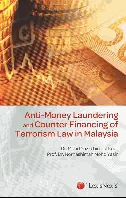
00`Anti-Money Laundering and Counter Financing of Terrorism Law in Malaysia


Description
Anti-Money Laundering and Counter Financing of Terrorism Law in Malaysia
Review by marceljude.ai
This book by Prof. Dr. Norhashimah Mohd Yasin and Dr. Mohd Yazid Zul Kepli is best read as more than a legal textbook. It is a doctrinal guide, a compliance manual, and a policy map of Malaysia’s AML/CFT regime at the same time. The authors say it is meant for readers who want a deeper understanding of AML/CFT law in Malaysia, especially students, investigators, compliance officers, financial institutions, lawyers, accountants, and other reporting institutions. That purpose shapes the entire book: it is written to explain how the system works in practice, not just in theory.
The structure is clear and purposeful. The book is organized into seven chapters, moving from foundations, to offences, to legal framework, compliance duties, investigations, court orders, and finally terrorism financing. It ends with a large appendix section that includes FATF-compliance tables, comparison charts on freezing/seizure/forfeiture, FAQs, risk-based approach guidance, customer due diligence material, the schedules to AMLA, and sanctions material. That layout tells you a lot about the book’s ambition: it wants to be a working reference, not just an academic commentary.
Overall judgment
The book’s biggest strength is that it turns a complex body of law into a connected system. Instead of treating anti-money laundering as one statute, it shows AML/CFT as an ecosystem: international standards, Malaysian institutions, reporting duties, investigative powers, asset-freezing tools, and terrorism-financing controls all interact. The authors are especially strong when they explain the institutional architecture of AML/CFT in Malaysia and when they connect statutory language to real enforcement problems.
Its main limitation is that it is deeply tied to the regulatory and risk picture reflected in the book’s edition, especially its reliance on the 2015 Mutual Evaluation Report and then-current sectoral guidance. That does not reduce its value as a legal review, but it means readers should treat it as a snapshot of a particular stage in Malaysia’s AML/CFT development rather than as a substitute for current legal updates.
Chapter-by-chapter analysis Chapter 1: Introduction
The opening chapter does three important things well. First, it establishes the scale of the problem globally and in Malaysia. Second, it defines money laundering through Malaysian law and international instruments. Third, it locates Malaysia inside a wider international AML/CFT framework that includes the UN, FATF, Egmont Group, APG, Basel Committee, IMF, OECD, OFAC, and Wolfsberg. It also explains the Malaysian framework around Bank Negara Malaysia, the Financial Intelligence Unit, and the National Coordination Committee.
Analytically, this is a strong foundation chapter because it avoids a common mistake: treating AML law as only criminal law. The authors show that AML/CFT is also about supervision, information flows, inter-agency coordination, and international legitimacy. In other words, the chapter frames AML/CFT as a governance system. That is one of the book’s smartest moves.
Chapter 2: Understanding Money Laundering
This is where the book becomes especially practical. The authors explain the offence of money laundering, then walk through the classic three-stage model of placement, layering, and integration, before grounding the theory in sectoral examples. They also identify Malaysia’s higher-risk sectors, especially banking, money services businesses, and casinos, and use suspicious transaction data to show where the system is most exposed.
This chapter’s real strength is that it bridges abstract legal definitions and actual laundering behavior. It is not satisfied with saying what money laundering is; it asks how it is done. That is exactly the right question for a book that aims to help investigators and compliance professionals. It also makes the reader see why AML/CFT law focuses so much on reporting institutions and transaction monitoring.
Chapter 3: The Legal Framework
Chapter 3 is the book’s doctrinal spine. It explains the role of AMLA as the central statute, notes the breadth of predicate offences, describes the court structure, and situates AMLA alongside earlier laws and the Mutual Assistance in Criminal Matters Act 2002 (MACMA). It also discusses professional actors, reporting duties affecting lawyers and accountants, and the extra-territorial or cross-border dimensions of enforcement.
This chapter matters because it shows that AMLA is not a stand-alone instrument. It sits inside a dense legal web involving criminal procedure, professional regulation, mutual legal assistance, and comparative influence from other jurisdictions. The authors are especially effective here in showing how Malaysian AML/CFT law borrows from international standards while adapting them to local institutions.
The only weakness is density. This chapter is case-heavy and legislation-heavy, so it can feel technical. But that density is also why it is useful.
Chapter 4: Reporting Institutions & Obligations
If Chapter 3 is the doctrinal spine, Chapter 4 is the operational heart of the book. It covers record keeping, cash threshold reports, suspicious transaction reports, customer due diligence, retention of records, false-name accounts, compliance programmes, software, and the overriding of secrecy obligations. It also explains how the standard of banking care has moved from passive caution to active customer inquiry and due diligence.
This chapter captures one of the book’s clearest themes: AML/CFT succeeds or fails at the level of gatekeepers. Banks, insurers, money service businesses, DNFBPs, and other reporting institutions are presented as the first real line of defence. The authors do not romanticize compliance. They show it as a legal obligation backed by penalties, internal controls, audits, training, and management accountability.
Critically, the chapter also tracks the shift from secrecy to disclosure. That tension between confidentiality and reporting is one of the most important legal tensions in financial crime law, and the authors handle it well.
Chapter 5: Investigations
This chapter maps the investigative powers under AMLA: the role of different enforcement agencies, powers of search, seizure, examination, arrest, information demands, and the offence of tipping-off. It shows how AMLA gives investigators broad tools, including powers to question persons, compel production, and deal directly with financial institutions.
The analytical value of this chapter lies in how it reveals the coercive logic of AMLA. The law is not merely prohibitory; it is investigative and preventive. The chapter also highlights the tension between enforcement efficiency and procedural fairness, particularly where compulsory statements, secrecy overrides, and anti-tipping-off rules are involved. For lawyers and rights-minded readers, this chapter is where the deeper constitutional questions begin to emerge.
Chapter 6: Types of Orders
This is probably the most important chapter in the whole book. It deals with freezing, seizure, forfeiture, pecuniary orders, third-party rights, judicial review, and immunity. The authors make clear that Part VI of AMLA creates a standardized enforcement architecture across agencies. At the same time, they openly warn that these powers can be devastating if used carelessly: freezing can destroy businesses, and the regime can seem to reverse the normal presumption of innocence.
That candor is one of the book’s best features. The authors are not just describing powers; they are evaluating them. They understand why the law needs rapid asset-control mechanisms, but they also stress the danger of injustice, especially where property is restrained before trial or where remedies are weak. This gives the chapter real intellectual weight.
From a review standpoint, Chapter 6 is where the book becomes genuinely critical rather than merely descriptive. It raises the central question of AML/CFT law: how far should the state be allowed to go, and at what cost to due process and property rights?
Chapter 7: Terrorism Financing (TF)
The final chapter widens the frame from money laundering to terrorism financing. It discusses definition, causes of terrorism, cost structures, sources of financing, the Malaysian threat picture, the 2015 evaluation findings, specialized security units, and the relevant legislative framework including the Penal Code, AMLA, SOSMA, POTA, and POCA. It also covers specified entities, sanctions, and implementation measures.
This chapter is valuable because it refuses to collapse terrorism financing into ordinary money laundering. The book shows that TF has a different logic: the funds may be legal or illegal, the amounts may be small, and the financial trail may stay outside formal channels. That distinction is crucial and often misunderstood.
The chapter is also broader than pure black-letter law. By discussing radicalisation, grievances, and the social causes of terrorism, the authors add explanatory context. Some readers may find that shift from statute to causation slightly wide-ranging, but I think it strengthens the chapter. It reminds the reader that legal tools are only one part of a much bigger security problem.
What the appendices add
The appendices significantly increase the book’s practical value. They include compliance tables on FATF recommendations, a comparison of freezing/seizure/forfeiture, FAQ-style guidance, risk-based approach Q&A, CDD material on high-risk countries, the first and second schedules to AMLA, and extensive sanctions materials dealing with terrorism, proliferation, WMD, and country-related restrictions.
That means the book functions partly as a desk manual. For practitioners, these appendices are not extras; they are part of the book’s utility.
Final verdict
This is a serious, useful, and well-structured legal work. Its strongest achievement is that it connects law, policy, institutions, and compliance practice into one readable framework. Its best chapters are Chapter 4 and Chapter 6, because those chapters show the everyday machinery and the coercive force of AML/CFT law. Its most conceptually important chapter is Chapter 7, because it makes clear that terrorism financing is related to money laundering but not reducible to it.
As a review, my conclusion is this: the book succeeds as both an academic reference and a practitioner’s guide, especially for anyone trying to understand how Malaysia’s AML/CFT regime actually operates on the ground. Its only major limitation is that parts of its risk picture and legal context are time-bound, but as a structured analysis of the Malaysian AML/CFT system, it remains highly valuable.
 A Critical Doctrinal Review of Anti-Money Laundering and Counter Financing of Terrorism Law in Malaysia A Critical Doctrinal Review of Anti-Money Laundering and Counter Financing of Terrorism Law in Malaysia By marceljude.ai Introduction The book Anti-Money Laundering and Counter Financing of Terrorism Law in Malaysia by Prof. Dr. Norhashimah Mohd Yasin and Dr. Mohd Yazid Zul Kepli represents a comprehensive attempt to systematize Malaysia’s AML/CFT regime. Rather than functioning as a purely descriptive legal text, the work operates simultaneously as a doctrinal analysis, a compliance manual, and an institutional study of financial crime governance. This review advances the thesis that the book’s primary contribution lies in its integration of legal doctrine with enforcement practice, although its dependence on time-specific regulatory contexts slightly limits its long-term analytical reach. Structural Logic of the Book The book is organized into seven chapters progressing from conceptual foundations to enforcement mechanisms and terrorism financing. This structure is not accidental—it mirrors the lifecycle of AML/CFT enforcement: Conceptual understanding Criminal conduct Legal framework Preventive compliance Investigation Asset control Terrorism financing This progression reflects a systems-based understanding of AML/CFT law rather than a fragmented statutory reading. Chapter-by-Chapter Critical Analysis Chapter 1: Introduction – AML/CFT as a Governance System The opening chapter successfully situates Malaysia within a global AML/CFT ecosystem involving institutions such as FATF and the Egmont Group. It emphasizes that AML/CFT is not merely criminal law but a multi-layered governance structure involving regulation, intelligence, and international coordination. This is analytically important because it reframes AML/CFT from: “law against crime” → to → “law as risk management infrastructure” That shift underpins the entire book. Chapter 2: Understanding Money Laundering – From Theory to Practice This chapter bridges theory and operational reality. The classical stages—placement, layering, integration—are explained alongside sector-specific risks such as banking and casinos. What makes this chapter strong is its empirical orientation: It links legal definitions to actual laundering behavior It uses risk-sector analysis to show vulnerability patterns The implication is clear: AML law cannot function without understanding how crime moves through financial systems. Chapter 3: Legal Framework – The Architecture of AMLA Here, the authors map the Anti-Money Laundering Act (AMLA) within a broader legal ecosystem, including mutual legal assistance and professional obligations. The key insight is that AMLA is: Not isolated But interdependent with multiple legal regimes This chapter reveals AML law as a networked legal structure, not a single statute. However, its density may challenge non-specialist readers. Chapter 4: Reporting Institutions – The Gatekeeper Theory This is one of the most important chapters. It details obligations such as: Suspicious transaction reporting Customer due diligence Record-keeping Compliance systems The chapter demonstrates a central truth of AML/CFT law: Enforcement begins not with police, but with financial gatekeepers. The shift from banking secrecy to mandatory disclosure is particularly significant. It reflects a transformation in financial law—from privacy protection to surveillance-oriented compliance. Chapter 5: Investigation – Expansion of State Power This chapter outlines investigative powers under AMLA, including: Search and seizure Compulsory disclosure Anti–tipping-off rules The deeper issue here is constitutional: AML investigations rely heavily on coercive powers that blur traditional procedural safeguards. The authors implicitly raise an important question: How far can investigative efficiency justify intrusion into individual rights? Chapter 6: Types of Orders – The Core of AML Enforcement This is the most analytically significant chapter. It deals with: Freezing Seizure Forfeiture Pecuniary penalties The discussion of non-conviction based forfeiture is especially critical. The law allows property to be forfeited even without a criminal conviction, which creates serious tension with traditional legal principles. For example, the book highlights judicial concern that forfeiture is a “serious matter” requiring clear evidential basis . This chapter exposes the central paradox of AML law: It is designed to fight crime efficiently, but in doing so, it risks undermining due process and property rights. This is where the book moves from descriptive to normatively critical. Chapter 7: Terrorism Financing – A Distinct Legal Problem The final chapter expands the analysis beyond money laundering. It correctly distinguishes terrorism financing as: Not always dependent on illegal funds Often involving small, hard-to-trace transactions The inclusion of broader causes of terrorism (radicalisation, grievances) is notable. It shifts the discussion from law to security studies, showing that AML/CFT law alone cannot solve terrorism. Thematic Strengths of the Book 1. Integration of Law and Practice The book does not isolate statutes—it connects: Legal rules Enforcement agencies Compliance systems 2. Institutional Clarity It clearly maps the roles of: Bank Negara Malaysia Financial Intelligence Unit Enforcement bodies 3. Honest Treatment of Controversies Especially in Chapter 6, the authors acknowledge: Risk of injustice Power imbalance Due process concerns Limitations 1. Time-Specific Regulatory Context The analysis relies partly on earlier evaluation frameworks, meaning: Some risk assessments may be outdated 2. Density in Legal Sections Certain chapters (especially Chapter 3) may be: Too technical for beginners Final Evaluation This book succeeds in transforming AML/CFT law from a set of statutes into a coherent legal system. Its greatest contribution is conceptual: It shows AML/CFT as a balance between security and rights It reveals how modern financial law operates through prevention, surveillance, and asset control Final Verdict: A rigorous and highly useful work that bridges theory, law, and enforcement—essential for understanding how AML/CFT actually functions in Malaysia. |
- MALAYSIA'S 1ST AI LAWYER - CLICK HERE
- ISMAIL – INTEGRATED SINGAPORE/MALAYSIA AI & LAW (Library)
- OPENING OF SINGAPORE MALAYSIA AI CENTRE AND LAW LIBRARY
- LIFT - LAW INSTRUMENTS FORMS & TEMPLATES
- LAWS OF MALAYSIA FOR SINGAPOREAN DUMMIES
- HANNAH YEOH'S ARTIFICIAL INTELLIGENCE LAW ENCYCLOPEDIA
- LEAD CR - Law Ecosystem Archive Databases on CD-ROM
- BREAKING NEWS FROM MJN
- CLICK HERE CO. PROFILE
- EXCITING NEW SERIES - THE ADVENTURES OF BOBBY TAN -ADVOCATE & SOLICITOR IN THE HIGH COURT OF NORTH BORNEO by marceljude.ai
- MEDICO LEGAL - BY PRISKILA AKWILA & GLORIOUS PETAL SDN BHD - powered by marceljude.ai
- MISCELLANOUS
- ANNOTATED STATUTES OF SABAH - A NEW SERIES
- e-library - marceljude.ai
- DRAFT - DOCUMENT RESEARCH & AUTOMATED FILING TECHNOLOGY
- CLARA – Case Law Analysis & Retrieval AI
- FOR RESEARCH REQUEST CLICK HERE
- CLICK HERE TO ASK ANYTHING
- RAMBO'S LAW - THE LAW OF THE LAW JUNGLE - EXCITING NEW SERIES - CASE ANALYSIS BY JOHN RAMBO @ +60138646786
- PRISKILA AKWILA ADVOCATES - High Court of Sabah & Sarawak @ Kota Kinabalu
- COLA - COMMONWEALTH ONLINE LAWCASES AI -marceljude.ai
- THE LAW LIBRARY THAT COMES TO YOU ANYWHERE AND ANYTIME
- marceljude.ai training academy
