
Anti-Money Laundering and Counter Financing of Terrorism Law in Malaysia by Norhashimah Mohd Yasin and Mohd Yazid Zul Kepli,
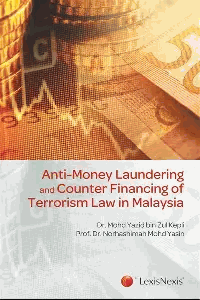


Description
Review of Anti-Money Laundering and Counter Financing of Terrorism Law in Malaysia Review by MarcelJude.AI
This book, by Norhashimah Mohd Yasin and Mohd Yazid Zul Kepli, is built as a seven-chapter legal guide that moves from foundations, to offence analysis, to legal framework, to reporting obligations, to investigations, to asset-control orders, and finally to terrorism financing, with substantial appendices at the end. The preface makes the authors’ purpose plain: this is meant to be an essential guide for readers who want a deeper understanding of AML/CFT law in Malaysia. On its own terms, it succeeds very well. It is not a decorative book. It is a serious practitioner’s book: dense, statutory, careful, and overtly designed for lawyers, reporting institutions, investigators, compliance personnel, and advanced students.
What gives the work its real force is its architecture. It does not treat money laundering as a single criminal offence and then tack on procedure. Instead, it presents a full regime: why laundering exists, how it operates, what the offence is, what institutions must report, how authorities investigate, how property is frozen and forfeited, and how terrorism financing enlarges the entire field. That design makes the book more than a commentary on one statute. It becomes a map of an enforcement ecosystem. Its prose can be compact and sometimes overfull, but its structural intelligence is unmistakable.
Chapter 1 — Introduction
Chapter 1 is expansive and deliberate. It begins from the blunt proposition that many serious crimes are committed for money and then defines money laundering as the concealment or transformation of unlawful proceeds so their source is obscured. From there, it widens quickly into history, definition, international instruments, international organisations, and finally the Malaysian framework, including the role of Bank Negara Malaysia and the National Coordination Committee. That is a very effective opening choice. The chapter is not merely introductory in the casual sense. It builds jurisdictional consciousness. It tells the reader, at once, that this field is economic, criminal, institutional, and international.
The chapter’s strongest feature is breadth with direction. The historical movement from early concealment practices to modern AML/CFT institutions, then to bodies like FATF, Egmont, APG, BCBS, IMF, OFAC, and Wolfsberg, prevents the Malaysian regime from appearing isolated or improvised. The reader sees Malaysia placed within a larger compliance civilization. The later sections on the domestic regime sharpen that impression by showing how Bank Negara Malaysia receives and analyses STRs and CTRs, disseminates intelligence, and coordinates with a multi-agency national structure through the NCC. This is excellent framing. It teaches the reader that AML/CFT is not just law on the books; it is organised state capacity.
As criticism, Chapter 1 is more panoramic than analytical. Institutions are introduced with real utility, but often as components in a system rather than as subjects of sustained critique. Yet that limitation is also part of its design. This chapter is trying to orient, not exhaust. As an opening chapter, it does exactly what it should: it gives the reader the vocabulary, the global frame, and the Malaysian administrative map before the hard doctrinal work begins.
Chapter 2 — Understanding Money Laundering
Chapter 2 is where the book becomes properly legal and practical at the same time. It opens with the offence of money laundering under section 4, emphasizing both the widened statutory scope and the seriousness of liability. The treatment is good because the authors do not reduce the offence to a slogan. They unpack the acts captured, the inference of knowledge or suspicion from objective circumstances, the fact that proceeds need not be traced to one specific unlawful activity, and the striking proposition that conviction can stand even without conviction for the predicate serious offence. That is exact, important law, and the chapter handles it with clarity.
The case-law discussion adds real value. By bringing in cases such as Public Prosecutor v Yap Kok Meng, Public Prosecutor v Saimin & Ors, and Aisyah bt Mohd Rose & Anor v Public Prosecutor, the authors show that money-laundering prosecution is not only about statutory breadth; it is also about charge precision, evidential sufficiency, and procedural validity. That is one of the chapter’s best features. It grounds the offence in courtroom discipline rather than abstract illegality. The chapter understands that broad statutes still live or die through drafting, proof, and procedure.
The most memorable part of the chapter, though, is the treatment of placement, layering, and integration. Here the book becomes pedagogically strong. It explains “black money,” why it cannot safely enter the legitimate financial system in raw form, and how laundering unfolds in stages. The explanation is concrete enough to be usable without becoming sensational. This is where the book best bridges doctrine and method. A reader new to AML law can see why reporting institutions matter so much at the placement stage, and a reader already familiar with the subject can appreciate how the authors tie criminal process to compliance risk.
The chapter closes strongly by turning to Malaysia itself. It identifies high-risk crime areas and high-risk sectors, especially banking, money services business, and casinos, and it notes the importance of suspicious transaction reporting patterns in those sectors. This is a smart move because it prevents the three-stage laundering model from floating free of local enforcement reality. The chapter’s core achievement is that it teaches money laundering as both a legal offence and an economic process. That dual perspective makes it one of the book’s best chapters.
Chapter 3 — The Legal Framework
Chapter 3 widens the field again, but this time with more doctrinal pressure. It begins with the court structure and the place of money-laundering cases within the Malaysian judicial hierarchy, moving from the Sessions Court up through the High Court, Court of Appeal, and Federal Court. That material is not decorative. It quietly answers a practical question every serious legal book must answer: where does this law actually live when it is litigated? The discussion of professionals, especially accountants and lawyers, also matters because AML/CFT obligations are partly enforced through professional gatekeepers, disciplinary structures, and privilege tensions.
The chapter’s real center, however, is its treatment of AMLA as a retrospective, extra-territorial, and comprehensive statute. The discussion of retrospectivity is careful and constitutional; the discussion of extra-territoriality is even more important, because the authors explain that without legislation and treaties such reach would remain only a legal fiction. This is where MACMA enters decisively. The book shows that AMLA’s reach outside Malaysia becomes meaningful only because mutual assistance law exists to enforce orders, obtain evidence, trace persons, restrain property, execute searches, and move requests through the Attorney General. That is very strong analysis because it treats mutual assistance not as an annex, but as the mechanism that turns theory into enforcement.
The chapter is also practically useful because it catalogues the guideline structures issued by Bank Negara Malaysia, Labuan Financial Services Authority, and the Securities Commission. That gives the chapter a dual identity: partly constitutional and statutory, partly compliance-operational. In a weaker book, that could feel scattered. Here it mostly works because the field itself is scattered across statutes, regulators, courts, and cross-border instruments. Chapter 3 does not have the elegance of Chapter 2, but it has something equally valuable: system realism.
Chapter 4 — Reporting Institutions & Obligations
Chapter 4 is among the strongest chapters in the book. Its opening move is excellent: reporting institutions are described as the gatekeepers of the legitimate economy and the first line of defence, especially at the placement stage. This is not rhetorical padding. It tells the reader why reporting duties exist at all. The chapter then lays out the six basic preventive measures: risk assessment, customer due diligence, suspicious transaction reporting, cash threshold reporting, record maintenance and retention, and compliance programmes. That is the right analytical sequence. It shows that AML/CFT prevention is not one duty but a layered control framework.
The chapter’s best quality is that it treats compliance as structure rather than paperwork. Record keeping, reporting, due diligence, retention, false-name prohibitions, and compliance programmes are all presented as interlocking duties, backed by penalties and supervisory powers. The chapter also has practical intelligence. Its discussion of software—especially the distinction between inference-based and scenario-based tools, and the problem of false positives—shows that the authors understand AML/CFT compliance as a live operational problem, not merely a statutory recital. That makes the book more credible. It knows the reporting regime has technological, human, and institutional dimensions.
Just as important, Chapter 4 confronts the tension between reporting and secrecy. It explains that AMLA overrides other secrecy obligations for Part IV purposes and protects those who report in good faith from civil, criminal, and disciplinary exposure. Then it widens the analysis by noting the controversy this creates, especially for bankers, accountants, and lawyers, and by comparing the Malaysian position with Canadian and Hong Kong approaches. This is one of the chapter’s most mature features. The authors do not pretend the override is benign. They recognise that AML/CFT law often advances by cutting through older professional secrecy norms. That recognition gives the chapter real intellectual weight.
If the chapter has a weakness, it is density. It is so full of duties, penalties, sections, and institutional consequences that it sometimes reads like compressed compliance training. But for the intended audience, that is scarcely a flaw. This is a chapter to work from, not merely admire. As a treatment of reporting institutions and obligations, it is authoritative and highly useful.
Chapter 5 — Investigations
Chapter 5 is the book at its most operational. It begins with the multi-agency design of AMLA enforcement, noting the role of the FIED/FIU and the participation of agencies such as the Royal Malaysia Police, the Malaysian Anti-Corruption Commission, and Bank Negara Malaysia, along with specialized AMLA units and the central prosecutorial role of the Attorney General’s Chambers. That foundation matters because the rest of the chapter would otherwise look like a list of dispersed powers. Instead, it reads as a coordinated machinery of investigation.
The chapter then moves through the powers of investigating officers with impressive completeness: appointment, entry, search, seizure, examination of persons, personal search, obstruction, tipping-off, translation requirements, delivery of property or information, detention and release, admissible statements, arrest, investigation of financial institutions, and Public Prosecutor information-gathering powers. The presentation is particularly strong because it reveals sequencing. These are not random authorities. They are stages in a coercive evidentiary pipeline. The investigating power to act without a search warrant, and the connected offences for obstruction or tipping-off, show how seriously the statute treats the risks of delay, concealment, and interference.
This is one of the most practically valuable chapters in the book because it gives the reader a feel for how AMLA investigations actually bite. It also preserves enough procedural texture—same-gender personal search, magistrate authorisation beyond a time threshold, prosecutorial control—to prevent the chapter from becoming a simple celebration of power. Still, the dominant impression is unmistakable: AMLA investigations are broad, forceful, and deliberately engineered to overcome the evidentiary opacity of laundering and terrorism-financing cases. That exact impression is what the chapter needs to convey, and it does so very well.
Chapter 6 — Types of Orders
Chapter 6 is the book’s most consequential chapter. It covers the entire asset-control regime under Part VI: freezing, revocation, seizure of movable and immovable property, seizure of business, prohibited dealing, forfeiture upon prosecution, forfeiture without prosecution, validity of freeze and seizure, vesting, pecuniary orders, release, bona fide third parties, disposition, absconders, death, service, judicial review, and immunity. This is the chapter where AML/CFT law shows its real teeth. The book is entirely right to devote major space to it.
What makes this chapter outstanding is its candor. The authors plainly warn that these powers can be devastating: freezing or seizing a business on suspicion can destroy reputation and even cause collapse before a case is resolved. They go so far as to observe that the regime can appear to reverse the ordinary presumption and function like “guilty until proven innocent.” That is the book’s bravest analytical moment. It acknowledges the coercive intensity of modern proceeds-of-crime law instead of disguising it under procedural formalities. At the same time, the authors explain why such powers exist: without pre-conviction control, evidence can be tampered with, property can be moved, and recovery can become meaningless. This balance between warning and justification is very impressive.
The chapter is also the most willing to criticize the law internally. The discussion of pecuniary orders points to shortcomings, including the absence of a specified time period in the AMLA context. The discussion of bona fide third parties is even sharper: the burden on third parties is described as heavy, and the authors suggest the requirement should be reviewed so legitimate claims are not unfairly prejudiced. That is not timid commentary. It is serious legal evaluation from within the statutory framework.
For that reason, Chapter 6 is the intellectual center of the book. It is where black-letter law, policy design, constitutional instinct, fairness concerns, and enforcement necessity all collide. It is also where the authors are most visibly doing more than summarising the statute: they are judging it. The result is the strongest chapter in the entire work.
Chapter 7 — Terrorism Financing (TF)
Chapter 7 is the broadest and most ambitious chapter. Its structure is visibly different from the earlier chapters. It moves from introduction and definition to the causes and cost of terrorism, the types and sources of financing, mutual evaluation findings, specialized units, domestic legal frameworks, international legal frameworks, interpretation, specified entities, implementation measures, and techniques for combating terrorism financing. That breadth is intentional. The chapter wants to show that terrorism financing is not just an annex to money laundering law; it is a related but distinct field with its own security logic.
The chapter’s strongest material is the legal analysis. It explains the role of the Penal Code terrorism provisions, the interpretive provisions in Part VIA of AMLA, the declaration of specified entities under section 66B, and the implementation of United Nations Security Council measures under section 66C. The specified-entity discussion is especially strong because it shows how designation triggers powerful prohibitions on providing property, dealing with assets, facilitating transactions, and making services available. The implementation section is equally effective because it ties domestic freezing and control measures to international security obligations while preserving narrow access for basic or extraordinary expenses. That is exact, disciplined legal writing.
The chapter’s weakness is also its ambition. By including causes, costs, financing sources, and broader terrorism discussion alongside the black-letter law, it becomes less tightly controlled than Chapters 4 through 6. At moments it feels closer to a compact course on terrorism financing than a pure legal chapter. But that is not really a failure. It reflects the authors’ judgment that terrorism financing cannot be understood purely as an accounting problem. It must be understood as part of a wider security and international-law matrix. For many readers, that widened lens will be a major strength.
Final verdict
This is a very strong book. It knows its audience, it knows its field, and it knows that AML/CFT law is not one topic but a linked regime of offence, reporting, supervision, investigation, property control, and security law. The preface promises a serious guide to deeper understanding of AML/CFT law in Malaysia, and the chapter structure fulfills that promise with unusual discipline. The appendices on FATF compliance, freezing/seizure/forfeiture comparison, FAQs, risk-based approach, customer due diligence, schedules, sanctions, glossary, and index further push the book beyond commentary into working reference territory.
Its greatest virtues are precision, structure, and practical seriousness. Its chief limitations are stylistic: some chapters are dense, some institutional material is more catalogued than interpreted, and the terrorism-financing chapter is broader and looser than the core AML chapters. But those are modest criticisms against a book that is consistently useful, legally exact, and often impressively candid about the power and risks of the AML/CFT regime. For professionals, it is highly valuable. For students, it is demanding but rewarding. For the subject itself, it is a substantial and credible contribution.
MarcelJude.AI
- MALAYSIA'S 1ST AI LAWYER - CLICK HERE
- ISMAIL – INTEGRATED SINGAPORE/MALAYSIA AI & LAW (Library)
- OPENING OF SINGAPORE MALAYSIA AI CENTRE AND LAW LIBRARY
- LIFT - LAW INSTRUMENTS FORMS & TEMPLATES
- LAWS OF MALAYSIA FOR SINGAPOREAN DUMMIES
- HANNAH YEOH'S ARTIFICIAL INTELLIGENCE LAW ENCYCLOPEDIA
- LEAD CR - Law Ecosystem Archive Databases on CD-ROM
- BREAKING NEWS FROM MJN
- CLICK HERE CO. PROFILE
- EXCITING NEW SERIES - THE ADVENTURES OF BOBBY TAN -ADVOCATE & SOLICITOR IN THE HIGH COURT OF NORTH BORNEO by marceljude.ai
- MEDICO LEGAL - BY PRISKILA AKWILA & GLORIOUS PETAL SDN BHD - powered by marceljude.ai
- MISCELLANOUS
- ANNOTATED STATUTES OF SABAH - A NEW SERIES
- e-library - marceljude.ai
- DRAFT - DOCUMENT RESEARCH & AUTOMATED FILING TECHNOLOGY
- CLARA – Case Law Analysis & Retrieval AI
- FOR RESEARCH REQUEST CLICK HERE
- CLICK HERE TO ASK ANYTHING
- RAMBO'S LAW - THE LAW OF THE LAW JUNGLE - EXCITING NEW SERIES - CASE ANALYSIS BY JOHN RAMBO @ +60138646786
- PRISKILA AKWILA ADVOCATES - High Court of Sabah & Sarawak @ Kota Kinabalu
- COLA - COMMONWEALTH ONLINE LAWCASES AI -marceljude.ai
- THE LAW LIBRARY THAT COMES TO YOU ANYWHERE AND ANYTIME
- marceljude.ai training academy
