
Bank Security Documents by J R Lingard - reivew by marceljude.ai


Description
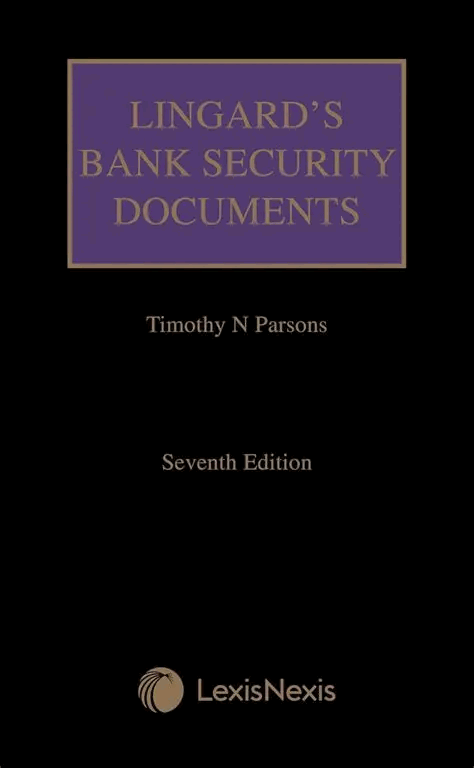
Bank Security Documents
J R Lingard, LLB (London) Solicitor of the Supreme Court Partner in Messrs Norton Rose
Bank Security Documents — extensive chapter-by-chapter book review
Review by marceljude.ai Perspective: law professor
I read the book as a legal-practice text, not as a purely theoretical treatise. Its controlling idea is that bank security is not made safe by elegant drafting alone. The book’s central lesson is that enforceable security depends on the entire chain: corporate authority, commercial benefit, registration, priority, insolvency vulnerability, documentary technique, enforcement discipline, and practical realism. The author states that the work is meant not merely to help bankers and advisers draft security documents, but to identify problem areas and suggest solutions; he also emphasises valid creation of security and practical enforcement as core concerns.
Contents with printed page numbers
Preliminary matter: Preface to the third edition, p. v; Preface to the first edition, p. vii; Table of statutes, p. xv; Table of cases, p. xxi.
Part I — The Creation of Security, p. 1. Chapter 1, “Preliminary steps,” p. 3: Constructive notice, p. 3; The latest available accounts, p. 8; A search at the Companies Registry, p. 9; The memorandum and articles of association, p. 9; The deeds of any properties charged, p. 11; Prior charges, p. 12; Insurance, p. 12. Chapter 2, “Minutes,” p. 14: Royal British Bank v Turquand, p. 15; Statutory protection, p. 16; Specimen minutes, p. 21. Chapter 3, “Registration and other formalities,” p. 29: The Companies Act 1985, p. 31; The Companies Act 1989, Part IV, p. 42; Law of Property (Miscellaneous Provisions) Act 1989, p. 50; Other formalities in taking security, p. 54. Chapter 4, “Commercial benefit: guarantees and third-party charges,” p. 56: Transactions at an undervalue, p. 62. Chapter 5, “Facility letters,” p. 65: Security, p. 66; The facility letter: specimen, p. 67; Financial covenants: specimen, p. 75. Chapter 6, “Inherent defects,” p. 79: Insolvency Act 1986, s. 245, p. 79; Voidable preference, p. 84; Voidable preference of connected persons, p. 89; Extortionate credit transactions, p. 90; Transactions prejudicing creditors, p. 91; Misfeasance, p. 93; Wrongful trading, p. 97; Fraudulent trading, p. 99; Retention of title, p. 100; Financial assistance for the acquisition of shares, p. 105; Loans to directors, p. 108; Individuals, p. 108; Administrators and administrative receivers, p. 109; General, p. 115.
Part II — The Debenture, p. 117. Chapter 7, “The covenant to pay,” p. 119: On demand, p. 121; The covenant, p. 123; The default clause, p. 124; Events of default, p. 125; Interest, p. 130; Default interest, p. 131. Chapter 8, “Fixed charges,” p. 135: Syndicates, p. 136; Land and fixtures, p. 136; Other fixed charges, p. 138; Priorities, p. 139; Set-off, p. 145; Fixed charge over book debts, p. 149. Chapter 9, “Floating charges,” p. 155: The nature of a floating charge, p. 155; Prohibitions against subsequent charges, p. 159; Crystallisation, p. 161; Automatic crystallisation, p. 164; Preferential creditors, p. 166; PAYE and VAT, p. 169. Chapter 10, “Covenants and miscellaneous clauses,” p. 173: Covenants, p. 173; Further assurances, p. 176; Power of attorney, p. 178; Exclusion of the power of leasing, p. 179; Miscellaneous clauses, p. 179. Chapter 11, “Enforcement,” p. 182: Demands, p. 183; Appointment of joint administrative receivers: specimen, p. 187; Receivers, p. 188; Powers of receivers, p. 196; Duties of a receiver, p. 201; Powers and duties of the bank, p. 202. Chapter 12, “The composite guarantee and debenture and syndication clauses,” p. 208: Syndicates, p. 209; Syndication clauses, p. 210.
Part III — Guarantees and Other Security Documents, p. 219. Chapter 13, “Guarantees and third-party charges,” p. 221: Legal presumptions concerning guarantees and indemnities, p. 226; Rights of a guarantor, p. 242; Joint and several guarantees, p. 245; Notice of determination, p. 246; Modern trends, p. 248; Standard guarantee clauses, p. 249; Comfort letters, p. 254; Performance bonds, p. 255. Chapter 14, “Land,” p. 258: Equitable charges, p. 259; Legal mortgages, p. 260; Leases, p. 261; Agricultural land, p. 262; Houses, p. 262; Standard clauses, p. 265; Proposed reforms, p. 268. Chapter 15, “Shares,” p. 269: Disadvantages of an equitable charge, p. 270; Disadvantages of a legal charge, p. 271; Listed securities, p. 274; Private companies, p. 276; Subsidiaries, p. 276; Standard clauses, p. 279. Chapter 16, “Life policies and contracts,” p. 281: Life policies, p. 281; Contracts, p. 287. Chapter 17, “Goods,” p. 294: The Factors Act 1889, p. 295; Types of security available, p. 296; Registration and the Bills of Sale Acts, p. 298; Pledge, p. 301; The key to the store, p. 303; Storage charges, p. 304; The weakness of a pledge, p. 305; The powers of a pledgee, p. 305; Documents of title, p. 306; Trust receipts, p. 310; Letters of hypothecation, p. 311; Stock purchase schemes, p. 312. Chapter 18, “Money,” p. 314: “Back to back” deposits, p. 314; Contingent liabilities, p. 317; Set-off against assignees, p. 322; Charges over deposits, p. 323; The Charge Card case, p. 324; Combination of accounts, p. 327; Pledge, p. 329. Chapter 19, “Miscellaneous,” is printed in the contents as p. 322, but that entry is internally inconsistent because Chapter 18 continues to p. 329 and Part IV begins at p. 343; the sequence strongly suggests p. 332. Its subsections are Agreement for postponement of debt, printed p. 322, likely p. 332; Priority agreements, p. 337; Ships and aircraft, p. 341; Trusts, p. 342; Sub-mortgages, p. 342; Films, p. 342.
Part IV — Specimen Security Documents, p. 343: Document 1, Debenture, p. 345; Document 2, Composite debenture, p. 363; Document 3, Guarantee individual, p. 386; Document 4, Guarantee company, p. 393; Document 5, Legal charge of freeholds and/or leaseholds, p. 402; Document 6, Charge over shares, p. 415; Document 7, Letter of pledge, p. 423; Document 8, Trust receipt, p. 428; Document 9, Letter of hypothecation and lien, p. 431; Document 10, Priorities deed, p. 438. Appendix, “Banking practice after the Insolvency Act 1986,” p. 447. Index, p. 455.
Overall review of the entire book
This is a practitioner’s book with a jurist’s anxiety. Its style is not decorative; it is defensive, transactional, and insolvency-conscious. The book asks a lawyerly question on nearly every page: will the security still work when the borrower is insolvent, the liquidator is hostile, the registry particulars are wrong, the directors acted under pressure, the debtor’s assets have moved, and the receiver must sell quickly?
As a law professor, I would describe the work as a bridge between banking practice and equity. It does not treat security documents as neutral forms. It treats them as legal instruments living inside company law, property law, insolvency law, priority rules, agency doctrine, suretyship, constructive notice, commercial benefit, and enforcement ethics. That is the book’s intellectual strength. It sees bank security not as “paper,” but as an ecosystem.
Its most important contribution is the insistence that a bank’s position is vulnerable long before default. The bank may lose priority because it failed to inspect accounts, failed to understand earlier charges, failed to register correctly, failed to give notice, relied too casually on printed forms, assumed directors had authority, or accepted a guarantee that lacked commercial benefit. The work is especially valuable because it resists the lazy assumption that security is simply a matter of taking “a debenture.” A debenture may be powerful, but only if validly created, properly registered, properly structured, and intelligently enforced.
The book’s limitation is also its character: it is deeply tied to the statutory and case-law environment it analyses. It is therefore best read as a doctrinal and historical-practical study of bank security technique rather than as a current black-letter statement for modern transactions. Its method, however, remains instructive: identify the asset; identify the debtor’s capacity and authority; identify priority risks; register where required; draft for insolvency; and enforce with professional discipline.
Chapter 1 — Preliminary steps, pp. 3–13
Subsections and pages: Constructive notice, p. 3; The latest available accounts, p. 8; A search at the Companies Registry, p. 9; The memorandum and articles of association, p. 9; The deeds of any properties charged, p. 11; Prior charges, p. 12; Insurance, p. 12.
Chapter 1 performs the most basic but often most neglected function in secured lending: it tells the lawyer and banker to look before drafting. The opening premise is that even carefully drafted security documents are ineffective unless validly created and registered. The chapter therefore frames preliminary investigation as both commercial prudence and legal necessity.
The subsection on constructive notice is the chapter’s doctrinal core. It examines the degree to which third parties dealing with a company are deemed to know public constitutional or registered information. The author’s treatment is nuanced: older law imposed constructive notice of the memorandum and articles, but statutory reform limited that doctrine. Yet the author does not let bankers become complacent. Actual knowledge, suspicious circumstances, and matters appearing from accounts or registry searches may still put a bank on inquiry. The practical lesson is that statutory protection is not a licence to ignore warning signs.
The subsection on latest available accounts is commercially sophisticated. Accounts are not merely financial statements; they are evidence of ownership, group structure, existing charges, inter-company debts, retention of title risks, foreign assets, and the availability of fixed-charge assets. The author’s strongest insight is that security should follow the asset reality, not the borrower’s general description of its business. If valuable plant, receivables, intellectual property, licences, or shares exist, the bank should consider whether they can be specifically charged.
The Companies Registry search section is a caution against relying blindly on registry information. The register may be incomplete, delayed, or historically cluttered by unsatisfied charges. The bank must read it, but also understand its limits. The memorandum and articles discussion complements this by focusing on corporate power, directors’ authority, borrowing limits, quorum, and conflicts of interest. The chapter’s repeated message is that a bank must know whether the company can properly do what the security assumes it can do.
The sections on deeds, prior charges, and insurance move from corporate authority to asset protection. Deeds identify title and competing interests. Prior charges affect both priority and default risk. Insurance preserves the value of the collateral. The chapter is therefore a checklist, but not a mechanical one: each item is tied to a failure mode that can destroy security at insolvency or enforcement.
Chapter 2 — Minutes, pp. 14–28
Subsections and pages: Royal British Bank v Turquand, p. 15; Statutory protection, p. 16; Specimen minutes, p. 21.
Chapter 2 explains why corporate minutes are not clerical decoration. They are evidence that the security was authorised by the company’s board or shareholders. The author criticises the practice of simply relying on the indoor management rule and statutory protections, because in difficult cases no board meeting may have been properly held at all. Certified minutes can estop a company from denying that a meeting took place, though the author remains cautious about whether such estoppel necessarily binds a liquidator.
The treatment of Royal British Bank v Turquand is central. The rule protects third parties dealing with a company in good faith from internal irregularities, but it does not protect a party that has notice of the defect or is put on inquiry. The author’s deeper point is institutional: a large bank may possess relevant knowledge in different departments. The lending officer may not know what the relationship manager knows; the law may nevertheless treat the bank as fixed with knowledge. That is a serious compliance lesson.
The statutory protection subsection examines the Law of Property Act and Companies Act provisions that protect purchasers, mortgagees, and persons dealing with companies in good faith. The author gives those provisions weight but refuses to overstate them. They do not cure every absence of board authority; they do not neutralise bad faith; and they do not eliminate the need for careful procedure.
The specimen minutes subsection is especially practical. It shows how minutes should record the facility, the proposed security, directors’ interests, shareholder authority where necessary, commercial benefit, and filing obligations. The author’s drafting philosophy is preventive litigation: minutes should answer the questions a liquidator will later ask.
Chapter 3 — Registration and other formalities, pp. 29–55
Subsections and pages: The Companies Act 1985, p. 31; The Companies Act 1989, Part IV, p. 42; Law of Property (Miscellaneous Provisions) Act 1989, p. 50; Other formalities in taking security, p. 54.
Chapter 3 is one of the book’s most important chapters. It treats registration not as an administrative afterthought but as a condition of effectiveness against liquidators, administrators, creditors, and purchasers. Security created by companies generally must be registered, with notable exceptions such as charges over shares, pledges of goods or negotiable instruments, and charges over life policies. Failure to register within the statutory period renders the security vulnerable or void in the relevant insolvency or priority contest.
The Companies Act 1985 subsection analyses registrable charges, timing, prescribed particulars, certificates, and the effect of late or defective registration. The discussion of the 21-day registration period is particularly valuable because it links formality to priority. The author’s point is that a bank cannot treat the charge date casually; the date of creation, delivery, and registration may determine whether the security survives.
The Companies Act 1989, Part IV subsection is analytical and critical. It explains proposed reforms to registration, including the weakening of conclusive certificates and the possibility of later challenges based on defective particulars. The author plainly regards the loss of conclusiveness as dangerous because it shifts risk back onto those preparing the particulars. That concern is doctrinally important: certainty in security registration is a market good, not merely a lender’s convenience.
The Law of Property (Miscellaneous Provisions) Act 1989 subsection explains how formalities for deeds and contracts affecting land alter security practice. The author emphasises that equitable charges over land can no longer safely rest on informal deposits of deeds; writing and signature requirements matter. The chapter then closes with other formalities, including land registration, notice to debtors for choses in action, notice to prior chargees, and delivery of registration evidence. The chapter’s theme is perfection: security must be made good not only between borrower and bank, but against the world.
Chapter 4 — Commercial benefit: guarantees and third-party charges, pp. 56–64
Subsections and pages: Transactions at an undervalue, p. 62.
Chapter 4 is one of the book’s most conceptually rich chapters. It addresses a problem that remains central to secured lending: when a company guarantees another’s debt or charges its assets for another’s liabilities, what benefit does it receive? The author recommends that board minutes state why the directors consider the guarantee or third-party charge to be in the company’s interests. That recommendation is not merely evidential; it reflects the fiduciary principle that directors must act for the company whose assets are being put at risk.
The chapter distinguishes between corporate capacity, directors’ authority, and commercial benefit. A company may have power to give guarantees, but if that power is merely ancillary, directors must exercise it for the company’s commercial benefit. The author’s treatment of Rolled Steel and related cases is used to show that a bank may be affected if it knows, actually or constructively, that directors are misusing corporate powers.
The subsection on transactions at an undervalue adds insolvency bite. A guarantee or third-party security may be attacked if the company receives no real consideration or significantly less than the value of what it gives. The author recognises that intra-group support often has commercial value, but he is careful: when the group is near collapse, benefit to one company cannot simply be assumed from benefit to the group. This chapter should be required reading in any course on corporate groups and lender liability.
Chapter 5 — Facility letters, pp. 65–78
Subsections and pages: Security, p. 66; The facility letter: specimen, p. 67; Financial covenants: specimen, p. 75.
Chapter 5 explains the relationship between the facility letter and the security document. The author warns against duplicating covenants and default provisions in both. Covenants designed to protect security belong in the security documents; financial covenants are often better placed in the facility letter. Breach of financial covenants gives the bank leverage before insolvency makes recovery doubtful.
The Security subsection is direct: the best security for a company borrower is often a full debenture containing fixed and floating charges over all assets, because it gives control over the business as a going concern. But the author does not romanticise the debenture. Fixed charges should be taken over as many specific assets as possible, while floating charges remain necessary to capture the circulating remainder and to support receivership powers.
The specimen facility letter is not reviewed here as a form to be copied blindly; rather, it illustrates the legal architecture of lending: definitions, drawdown, interest periods, repayment, default interest, security conditions, information undertakings, events of default, and conditions precedent. It shows that the facility letter is the economic constitution of the lending relationship.
The financial covenants subsection is one of the book’s most commercially useful moments. The author treats financial ratios as an early-warning system. A law professor would say this chapter reveals the contractual governance function of bank lending: the lender does not merely wait for default; it monitors deterioration through covenants.
Chapter 6 — Inherent defects, pp. 79–116
Subsections and pages: Insolvency Act 1986, s. 245, p. 79; Voidable preference, p. 84; Voidable preference of connected persons, p. 89; Extortionate credit transactions, p. 90; Transactions prejudicing creditors, p. 91; Misfeasance, p. 93; Wrongful trading, p. 97; Fraudulent trading, p. 99; Retention of title, p. 100; Financial assistance for the acquisition of shares, p. 105; Loans to directors, p. 108; Individuals, p. 108; Administrators and administrative receivers, p. 109; General, p. 115.
Chapter 6 is the book’s insolvency-risk chapter. Its thesis is sobering: even perfectly drafted and registered security may fail because the law invalidates or subordinates certain transactions. The opening states that some defects are inherent: the law itself declares certain security void or unlawful despite careful drafting and formal creation.
The Insolvency Act 1986, s. 245 subsection focuses on floating charges created shortly before insolvency. The key concern is whether the company was unable to pay its debts and whether the charge secures old money rather than new value. The author’s analysis shows why last-minute floating charges are especially vulnerable.
The voidable preference sections examine whether security or payment improved a creditor’s or guarantor’s position shortly before insolvency. The author is particularly alert to director guarantees: where directors have personally guaranteed bank debt, a later charge granted by the company may prefer the guarantors by reducing their exposure. The connected-person rules heighten this risk.
The sections on extortionate credit, transactions prejudicing creditors, misfeasance, wrongful trading, and fraudulent trading broaden the chapter from security validity to conduct. Banks, directors, and receivers are all situated within an insolvency morality: not every hard bargain is unlawful, but transactions that prejudice creditors, misuse powers, or continue hopeless trading may attract serious consequences.
The retention of title discussion is essential for inventory lending. Goods shown as assets in accounts may not belong beneficially to the borrower. A bank relying on stock as floating-charge collateral may find that suppliers retain title. The chapter’s analysis of financial assistance for share acquisitions further demonstrates the book’s strength: it links bank security to company-capital doctrine and statutory prohibitions.
The sections on administrators and administrative receivers are critical to the book’s practical orientation. They explain why enforcement strategy depends on who controls the insolvency process. The closing “General” section reads as a warning to banks: protect assets physically, obtain advice on foreign assets, and do not enforce defective security recklessly.
Chapter 7 — The covenant to pay, pp. 119–134
Subsections and pages: On demand, p. 121; The covenant, p. 123; The default clause, p. 124; Events of default, p. 125; Interest, p. 130; Default interest, p. 131.
Chapter 7 opens Part II by analysing the debtor’s promise to pay. The author recommends that security documents contain an express covenant to pay, even in non-recourse or third-party contexts, with liability limited where necessary. The covenant is not decorative; it supplies the personal obligation around which security enforcement is organised.
The On demand subsection is practical and subtle. “On demand” affects limitation periods, default timing, enforcement rights, and service practice. The author insists that demand should be made carefully, during banking hours, and with attention to the debtor’s ability to pay. A bad demand may compromise enforcement.
The covenant and default clause subsections distinguish the obligation to pay from the events that accelerate or permit enforcement. The book’s drafting theory is that default clauses must be broad enough to protect the bank but precise enough to withstand scrutiny.
The events of default subsection captures the normal commercial dangers: non-payment, insolvency, breach of covenant, misleading information, execution, distress, loss of assets, and changes in control. The treatment of interest and default interest reflects a legal balancing act. The bank may price default risk, but default interest must remain within proper commercial bounds and avoid being characterised as penal, unconscionable, or a clog on redemption.
Chapter 8 — Fixed charges, pp. 135–154
Subsections and pages: Syndicates, p. 136; Land and fixtures, p. 136; Other fixed charges, p. 138; Priorities, p. 139; Set-off, p. 145; Fixed charge over book debts, p. 149.
Chapter 8 is a cornerstone chapter. It begins from the premise that a debenture should contain fixed charges over as many assets as possible. The reason is priority: fixed-charge assets generally stand outside the floating-charge pool and are less exposed to preferential creditors. But the author is alert to the doctrinal limit: a purported fixed charge over all assets of a trading company is likely to be treated as floating if the company remains free to deal with the assets.
The Syndicates subsection considers how fixed security works when multiple banks lend together. The author is concerned with ensuring that all syndicate members obtain real security, not merely contractual expectations.
The Land and fixtures subsection explores what a legal charge over land captures. The law of fixtures becomes commercially important because machinery and equipment may either pass with land security or remain separate assets. The chapter’s treatment of heavy machinery, plant, computers, office equipment, and licences shows the author’s preference for asset-specific drafting.
The Other fixed charges subsection recommends fixed charges over uncalled capital, goodwill, intellectual property, shares, bonds, and securities. Intellectual property is treated as a going-concern asset, not merely a legal abstraction. The author also argues that accounts should be reviewed to identify further assets capable of fixed charge treatment.
The Priorities and Set-off subsections address how fixed charges interact with later interests, notice, legal and equitable set-off, insolvency set-off, and the rights of debtors. The fixed charge over book debts subsection is the chapter’s most contested area. The author recognises the attraction of such charges but also their vulnerability, especially where the company can collect and use the debts. The discussion anticipates later modern controversies about whether control over proceeds is necessary for a fixed charge.
Chapter 9 — Floating charges, pp. 155–172
Subsections and pages: The nature of a floating charge, p. 155; Prohibitions against subsequent charges, p. 159; Crystallisation, p. 161; Automatic crystallisation, p. 164; Preferential creditors, p. 166; PAYE and VAT, p. 169.
Chapter 9 gives the floating charge its due: it is weaker than a fixed charge, but indispensable. The author explains that floating charges should be drafted widely, yet they do not attach in the same proprietary way as fixed charges until crystallisation. The chapter quotes the classic idea of the floating charge as ambulatory, hovering over changing assets until an event causes it to fasten.
The subsection on the nature of a floating charge is doctrinally excellent. It explains why a floating charge permits business continuity: the borrower may deal with circulating assets until crystallisation. That commercial flexibility is precisely why the charge is vulnerable to later fixed charges, liens, execution, distress, and statutory preferential claims.
The prohibitions against subsequent charges subsection examines negative pledge clauses. Such clauses may work against parties with notice, but they do not automatically bind the commercial world. The bank must understand the difference between a covenant against the borrower and a proprietary priority rule against third parties.
The crystallisation and automatic crystallisation subsections analyse when the floating charge becomes fixed. The author is cautiously supportive of drafting mechanisms but recognises that courts may resist devices that prejudice preferential creditors or operate without sufficient notice.
The preferential creditors and PAYE/VAT subsections expose the floating charge’s economic weakness. Preferential claims can consume assets the bank thought it controlled. As a teaching chapter, Chapter 9 is excellent because it shows that floating charges are both commercially powerful and structurally vulnerable.
Chapter 10 — Covenants and miscellaneous clauses, pp. 173–181
Subsections and pages: Covenants, p. 173; Further assurances, p. 176; Power of attorney, p. 178; Exclusion of the power of leasing, p. 179; Miscellaneous clauses, p. 179.
Chapter 10 is a drafting-discipline chapter. The author’s first rule is restraint: security covenants should protect the security; wider business covenants belong in the loan agreement or facility letter. This is a sophisticated point. Overloaded security documents may be ignored in practice, while realistic covenants are more likely to be observed.
The Covenants subsection covers business conduct, regulatory compliance, repairs, insurance, rent and taxes, subsidiaries, debts, property covenants, deposit of title documents, and optional covenants. The author repeatedly warns against covenants that look good but are commercially unrealistic.
The Further assurances subsection is crucial for after-acquired property and imperfect equitable security. A covenant requiring the company to execute later legal charges can convert or supplement the bank’s position when needed. The author recommends reviewing security before enforcement and calling for supplemental charges where advantageous.
The Power of attorney subsection explains why the bank needs authority to perfect title or vest assets in a purchaser when the company refuses to cooperate. The power must be irrevocable and carefully drafted.
The Exclusion of the power of leasing subsection is a property-law warning: a mortgagor’s power to grant leases can destroy security value. The Miscellaneous clauses subsection addresses continuing security, merger, currency, notices, deeds, and other protective provisions. The continuing security clause is particularly important because accounts may fluctuate into credit without the bank intending to discharge security.
Chapter 11 — Enforcement, pp. 182–207
Subsections and pages: Demands, p. 183; Appointment of joint administrative receivers: specimen, p. 187; Receivers, p. 188; Powers of receivers, p. 196; Duties of a receiver, p. 201; Powers and duties of the bank, p. 202.
Chapter 11 is the book’s practical climax. Security is only as good as its enforcement. The author begins with the remedies conferred by security documents: sale, appointment of a receiver, possession, and foreclosure. Yet he emphasises that banks usually rely on sale and receivership rather than foreclosure.
The Demands subsection is important because enforcement often begins with a demand, and a defective demand may create avoidable litigation. The chapter advises care in the amount demanded, timing, service, and notice.
The appointment of joint administrative receivers subsection gives a specimen form, but the deeper legal point is that appointment must be accepted, valid, and within the powers conferred. Receivers should examine the security, appointment, assets, and powers before acting.
The Receivers and Powers of receivers subsections distinguish the receiver’s agency status from his practical loyalty to the debenture-holder’s realisation. The receiver needs wide powers: to take possession, sell, carry on business, compromise claims, borrow, employ staff, deal with contracts, and preserve value.
The Duties of a receiver and Powers and duties of the bank subsections are the chapter’s jurisprudential centre. The bank may enforce in its own interest, but must take reasonable care to obtain a proper price. The mortgagee is not a trustee of the power of sale for the mortgagor, yet must act in good faith and take reasonable care to achieve true market value at the chosen time of sale.
The duties extend beyond the borrower. A mortgagee’s and receiver’s realisation duties may affect guarantors; both bank and receiver can be liable for breach, though the bank is not usually liable for the receiver unless it interferes. The author’s advice to rely on competent professional agents is not merely practical; it is a legal risk-control strategy.
Chapter 12 — The composite guarantee and debenture and syndication clauses, pp. 208–218
Subsections and pages: Syndicates, p. 209; Syndication clauses, p. 210.
Chapter 12 addresses group and syndicated lending. The composite guarantee and debenture is described as the most comprehensive English-law security document: each company cross-guarantees the others and charges its assets. This is powerful, but it raises issues of validity, commercial benefit, double proof, release of subsidiaries, supplemental security, and foreign-law limits.
The chapter’s treatment of group companies is commercially realistic. Groups dispose of subsidiaries, acquire new ones, and reorganise. A composite debenture must therefore allow releases and supplemental accessions. The author also cautions that cross guarantees usually have commercial benefit within a viable group, but not where a company is insolvent with no realistic prospect of recovery.
The Syndicates subsection examines how security should be structured for multiple banks. If the agent is not a trustee, charges may need to be created in favour of each bank. Syndicated set-off is difficult: a bank with a credit balance may set off, but equity may require sharing with the syndicate.
The Syndication clauses subsection is one of the strongest practical portions of the book. It recommends majority-bank control, borrower dealings through the agent before default, syndicate meetings after default, information-sharing clauses, severability, and careful limitation of the agent’s fiduciary exposure. The author is especially attentive to conflicts of interest where the lead bank has other relationships with the borrower.
Chapter 13 — Guarantees and third-party charges, pp. 221–257
Subsections and pages: Legal presumptions concerning guarantees and indemnities, p. 226; Rights of a guarantor, p. 242; Joint and several guarantees, p. 245; Notice of determination, p. 246; Modern trends, p. 248; Standard guarantee clauses, p. 249; Comfort letters, p. 254; Performance bonds, p. 255.
Chapter 13 is a full suretyship chapter. It begins with the warning that guarantees and indemnities are difficult because much of the law favours sureties. The bank must draft around presumptions that may discharge or reduce guarantor liability. The index confirms the range: continuing security, covenant to pay, indulgence, release of principal debtor or security, misrepresentation, undue influence, set-off, notice, and standard clauses.
The subsection on legal presumptions explains why guarantees must be drafted with precision. Variation of the principal contract, release of the principal debtor, release of co-sureties, time given without reservation, misrepresentation, and failure to preserve security may all affect the surety. The author’s theme is that a bank guarantee is not safe because it is long; it is safe only if it deals with the right legal presumptions.
The rights of a guarantor subsection covers indemnity from the principal debtor, subrogation, contribution, and the effect of payment. This is essential because a guarantor is not merely a passive payer; equity gives him rights once he pays.
The joint and several guarantees and notice of determination sections address drafting traps. Where multiple guarantors sign, alterations or limitations can affect all. Continuing guarantees must handle termination carefully so that future liabilities and existing obligations are distinguished.
The modern trends subsection recognises courts’ greater willingness to scrutinise bank dealings, especially where individuals, spouses, or vulnerable parties are involved. The standard clauses portion responds by drafting waivers, continuing-security language, set-off, lien, currency, notices, and powers.
The comfort letters subsection is important because it distinguishes moral assurance from legal obligation. The performance bonds section draws a sharp line between true guarantees and bank instruments payable on demand. The author stresses that unconditional bank bonds are treated like autonomous payment undertakings; fraud is the narrow exception.
Chapter 14 — Land, pp. 258–268
Subsections and pages: Equitable charges, p. 259; Legal mortgages, p. 260; Leases, p. 261; Agricultural land, p. 262; Houses, p. 262; Standard clauses, p. 265; Proposed reforms, p. 268.
Chapter 14 begins with a strong anti-formalistic point: printed forms obscure that land differs dramatically in character. A town-centre development, factory, farm, house, leasehold shop, and building site all raise different security concerns.
The Equitable charges subsection explains why equitable security over land is weaker after statutory formality reforms. A bank relying on informal title-deed deposits is exposed. The Legal mortgages subsection therefore presents the full legal charge, properly executed and registered, as the strongest form of land security.
The Leases subsection is practically important because leasehold value depends on covenants, forfeiture risk, consent requirements, arrears, and restrictions on assignment or underletting. The Agricultural land and Houses subsections recognise special statutory and social contexts. Residential security raises possession and occupier-rights issues; agricultural land raises tenancy and statutory protection concerns.
The Standard clauses subsection covers covenants, insurance, rent, repairs, enforcement powers, leasing powers, power of attorney, notice, and currency clauses. The author places special weight on excluding or controlling the mortgagor’s leasing powers because a lease can materially reduce market value.
The Valuations discussion is one of the chapter’s most useful practical contributions. Valuers must receive not only the property description but also title problems. A factory in a depressed area or a specialised property may be far harder to value than a house or farm. The chapter closes with proposed reforms, noting the movement toward formal land mortgages governed by statute.
Chapter 15 — Shares, pp. 269–280
Subsections and pages: Disadvantages of an equitable charge, p. 270; Disadvantages of a legal charge, p. 271; Listed securities, p. 274; Private companies, p. 276; Subsidiaries, p. 276; Standard clauses, p. 279.
Chapter 15 explains that share security is conceptually slippery. Banks may speak of a “pledge” over shares, but shares are choses in action, and certificate deposit normally creates an equitable charge rather than a true pledge.
The disadvantages of an equitable charge are serious: the bank may not receive notices of rights issues, bonus issues, takeover offers, or other corporate events; priority may be vulnerable; and blank transfers create practical and fiduciary risks. The disadvantages of a legal charge are different: registration in the bank’s nominee may give control but may also create commercial, regulatory, or group-accounting consequences.
The listed securities subsection addresses marketability and transfer mechanics. The private companies subsection focuses on pre-emption rights, board discretion over transfers, restrictions in articles, and the difficulty of realising shares in a closely held company. The subsidiaries subsection is especially interesting because voting control over shares can create subsidiary-status consequences; the bank must avoid accidentally becoming treated as controlling the company.
The standard clauses section recommends a broad charge over shares and accretions, covenants to deposit certificates and transfers, restrictions on dealing, voting-right provisions, dividend provisions, further assurance, power of attorney, sale powers, and continuing-security clauses. The closing caution is that English-form charges are appropriate for shares in English companies; overseas shares need local-law treatment.
Chapter 16 — Life policies and contracts, pp. 281–293
Subsections and pages: Life policies, p. 281; Contracts, p. 287.
Chapter 16 divides choses in action into two valuable categories: life policies and contractual rights. The Life policies subsection explains that a life policy is a thing in action, but possession of the policy document functions somewhat like title deeds. Failure to produce the policy puts the bank on inquiry. Notice to the assurance company is essential to protect priority.
The chapter’s priority analysis is careful. Equitable interests in life policies are governed by notice principles, but a bank with actual or constructive notice of a prior charge cannot improve its position merely by racing to give notice first. The author recommends legal charges where possible and compliance with the Policies of Assurance Act requirements.
The Contracts subsection turns to assignments of contractual rights. It considers legal and equitable assignments, notice to the other contracting party, restrictions on assignment, and the dangers of trying to charge contracts that are personal, non-assignable, or dependent on ongoing performance. A bank may need the right to appoint a receiver who can perform or manage contractual obligations, not merely collect money.
The chapter’s academic value lies in showing that security over choses in action is not simply “take an assignment.” Priority, notice, performance obligations, set-off, anti-assignment clauses, and insolvency restrictions must all be considered.
Chapter 17 — Goods, pp. 294–313
Subsections and pages: The Factors Act 1889, p. 295; Types of security available, p. 296; Registration and the Bills of Sale Acts, p. 298; Pledge, p. 301; The key to the store, p. 303; Storage charges, p. 304; The weakness of a pledge, p. 305; The powers of a pledgee, p. 305; Documents of title, p. 306; Trust receipts, p. 310; Letters of hypothecation, p. 311; Stock purchase schemes, p. 312.
Chapter 17 is a commercial-law chapter about possession, fraud, and title. Goods are difficult collateral because they move, perish, fluctuate in value, attract storage costs, may be subject to retention of title, and may be transferred by mercantile agents or through documents of title.
The Factors Act 1889 subsection explains how a bank’s security can be defeated by statutory rules protecting good-faith dealings with mercantile agents and buyers. The types of security subsection distinguishes legal interest, equitable charges, pledges, and letters of hypothecation.
The registration and Bills of Sale Acts subsection is crucial for personal property security. The author distinguishes company charges from individual bills of sale rules and warns that the form of the document cannot hide its substance.
The Pledge subsection is practical: possession or control is the essence of a pledge. The discussions of the key to the store, storage charges, weakness of a pledge, and powers of a pledgee show how fragile possessory security can be where the bank lacks real control or must rely on warehouses, carriers, or borrower cooperation.
The documents of title and trust receipts subsections are among the most technically valuable. A bank may release documents to the borrower for a limited purpose without losing juridical possession if the trust-receipt structure is properly maintained.
The letters of hypothecation subsection distinguishes hypothecation from pledge: the bank has neither property nor possession, so the security is inferior and vulnerable to bona fide purchasers. The stock purchase schemes subsection is sceptical, warning that off-balance-sheet structures may provide less real security than they appear to provide.
Chapter 18 — Money, pp. 314–331
Subsections and pages: “Back to back” deposits, p. 314; Contingent liabilities, p. 317; Set-off against assignees, p. 322; Charges over deposits, p. 323; The Charge Card case, p. 324; Combination of accounts, p. 327; Pledge, p. 329.
Chapter 18 is deceptively complex. Money seems ideal collateral, but the chapter shows that deposits are debts owed by the bank, not bags of cash owned by the customer. That distinction creates issues of charge, assignment, set-off, insolvency, and negotiability.
The back-to-back deposits subsection considers a common banking arrangement: a deposit supports a loan, sometimes in another currency. The author examines whether the bank can set off the deposit against the liability, including foreign-currency complications and the need to establish a sufficiently close connection between the transactions.
The contingent liabilities subsection is especially important for bank guarantees and counter-indemnities. If the bank’s liability is contingent, can it set off against a deposit? The author reviews conflicting authority and treats insolvency set-off as both powerful and uncertain.
The set-off against assignees and charges over deposits subsections examine whether a customer can assign or charge the deposit to another creditor and what the bank can do to protect itself. The author prefers carefully structured equitable charges and express set-off rights where necessary.
The Charge Card case subsection is the doctrinal centre. It discusses whether a bank can take a charge over a debt it itself owes to the customer. The author’s practical conclusion is that documentation should establish set-off wherever possible and not rely solely on uncertain charge analysis.
The combination of accounts subsection explains the banker’s right to combine accounts and its limits, especially where loan and current accounts are kept separate. The pledge subsection closes by discussing negotiable instruments: only negotiable securities can be pledged, and negotiability depends on English law or established market custom.
Chapter 19 — Miscellaneous, printed p. 322, likely p. 332–342
Subsections and pages: Agreement for postponement of debt, printed p. 322, likely p. 332; Priority agreements, p. 337; Ships and aircraft, p. 341; Trusts, p. 342; Sub-mortgages, p. 342; Films, p. 342.
Chapter 19 gathers important residual topics that do not fit neatly elsewhere. The agreement for postponement of debt subsection addresses inter-company loans. English law ordinarily ranks group debts equally with trade and bank debt, but banks often insist that parent-company or affiliate debt be subordinated. The author discusses whether such subordination works by trust, contract, or postponement mechanism, and whether it risks being characterised as a registrable charge.
The priority agreements subsection is highly practical. Secured creditors may agree among themselves to alter priority. The author recommends recording priority arrangements clearly and endorsing memoranda on security documents. He also warns that mixed fixed and floating priority structures can create serious problems because preferential creditors rank ahead of floating charges. The chapter’s message is that priority must be engineered consciously; it should not be left to accident.
The ships and aircraft subsection is deliberately brief and cautious. The author treats them as specialist subjects requiring expert advice because the assets move across jurisdictions and may be subject to maritime liens, international registration, and foreign enforcement risks.
The trusts subsection addresses security over beneficial interests. The bank is no better than the chargor against trustees unless notice is given and the trust terms permit effective enforcement.
The sub-mortgages subsection notes that a sub-mortgage depends on the head mortgage. If the head mortgage is defective or the secured debt disappears, the sub-mortgage may fall with it.
The films subsection treats film finance as specialised, involving worldwide rights, contracts, and intellectual property across jurisdictions. The author’s brief treatment is wise: some assets require specialist legal infrastructure, not generic security forms.
Part IV — Specimen security documents, pp. 343–446
Part IV is not merely an appendix of forms; it is the drafting laboratory for the whole book. The documents include a debenture, composite debenture, individual guarantee, company guarantee, legal charge, share charge, letter of pledge, trust receipt, letter of hypothecation and lien, and priorities deed.
As teaching material, the specimen documents are valuable because they show how the doctrinal problems in Parts I–III translate into clauses: charging provisions, covenants, power of attorney, continuing security, set-off, currency, notices, receivership powers, guarantees, and priority mechanics. The reader sees how a security document must anticipate insolvency, enforcement, priority disputes, and asset-specific defects.
As a law professor, I would caution students not to treat the forms as timeless templates. Their value lies in the reasoning behind them. The true lesson of Part IV is not “copy these clauses”; it is “understand why each clause exists, what risk it answers, and what statutory or equitable rule it is trying to manage.”
Appendix — Banking practice after the Insolvency Act 1986, p. 447
The Appendix reinforces the book’s insolvency theme. It explains why banks care so much about the ability to appoint an administrative receiver and why floating charges over substantially the whole of a company’s assets matter. A floating charge over only part of the assets may be overridden by administration, while administrative receivership gives the bank greater control over timing and realisation.
The Appendix is valuable because it connects technical security drafting to insolvency strategy. It shows that the legal form of the security determines who controls the distressed company, when assets can be sold, whether prior rights can be challenged, and how much value will be preserved.
Final evaluation
This is an excellent specialist banking-law work because it never separates doctrine from practice. It teaches that secured lending is a sequence of legal judgments: investigate the borrower, confirm corporate authority, identify commercial benefit, register correctly, obtain priority, draft for specific assets, protect against insolvency clawback, and enforce with care.
The best chapters are Chapters 3, 6, 8, 11, 12, 13, and 18. Chapter 3 is the formal heart of security validity. Chapter 6 is the insolvency heart. Chapter 8 is the proprietary heart. Chapter 11 is the enforcement heart. Chapter 12 is the group-finance heart. Chapter 13 is the suretyship heart. Chapter 18 is the conceptual heart for money and set-off.
The book’s deepest insight is that bank security is never merely bilateral. A bank may think it is contracting only with the borrower, but in reality it is contracting in the shadow of liquidators, administrators, guarantors, preferential creditors, purchasers, assignees, landlords, suppliers, debtors, trustees, registries, and courts of equity.
Its most important warning is this: a security document that looks strong at signing may be weak at enforcement. The legal professor’s verdict is therefore favourable. The book is rigorous, practical, sometimes severe, and consistently alert to the ways in which security fails. It is a strong work not because it flatters bankers, but because it teaches them fear: fear of defective authority, bad minutes, unregistered charges, false priorities, weak floating charges, careless enforcement, and insolvency law. That fear is the beginning of competent secured lending.
- MALAYSIA'S 1ST AI LAWYER - CLICK HERE
- ISMAIL – INTEGRATED SINGAPORE/MALAYSIA AI & LAW (Library)
- OPENING OF SINGAPORE MALAYSIA AI CENTRE AND LAW LIBRARY
- LIFT - LAW INSTRUMENTS FORMS & TEMPLATES
- LAWS OF MALAYSIA FOR SINGAPOREAN DUMMIES
- HANNAH YEOH'S ARTIFICIAL INTELLIGENCE LAW ENCYCLOPEDIA
- LEAD CR - Law Ecosystem Archive Databases on CD-ROM
- BREAKING NEWS FROM MJN
- CLICK HERE CO. PROFILE
- EXCITING NEW SERIES - THE ADVENTURES OF BOBBY TAN -ADVOCATE & SOLICITOR IN THE HIGH COURT OF NORTH BORNEO by marceljude.ai
- MEDICO LEGAL - BY PRISKILA AKWILA & GLORIOUS PETAL SDN BHD - powered by marceljude.ai
- MISCELLANOUS
- ANNOTATED STATUTES OF SABAH - A NEW SERIES
- e-library - marceljude.ai
- DRAFT - DOCUMENT RESEARCH & AUTOMATED FILING TECHNOLOGY
- CLARA – Case Law Analysis & Retrieval AI
- FOR RESEARCH REQUEST CLICK HERE
- CLICK HERE TO ASK ANYTHING
- RAMBO'S LAW - THE LAW OF THE LAW JUNGLE - EXCITING NEW SERIES - CASE ANALYSIS BY JOHN RAMBO @ +60138646786
- PRISKILA AKWILA ADVOCATES - High Court of Sabah & Sarawak @ Kota Kinabalu
- COLA - COMMONWEALTH ONLINE LAWCASES AI -marceljude.ai
- THE LAW LIBRARY THAT COMES TO YOU ANYWHERE AND ANYTIME
- marceljude.ai training academy
