
Civil Law Act 1956 Text Book
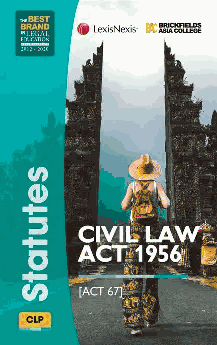


Description
Civil Law Act 1956
review by marceljude.ai
This work is best understood as an annotated statute rather than a conventional narrative law book. The Act itself is the spine; the real intellectual weight comes from the “Notes on Cases”, which turn each provision into a running record of how Malaysian courts have received, limited, resisted, or localized English common-law ideas. The structure is also revealing: the book is arranged in eight Parts, supported by a large table of cases, and its densest treatment falls on the provisions dealing with common-law reception, assignments, fatal accidents, contribution, interest, contributory negligence, frustrated contracts, infants, defective title, and personal-injury damages.
My overall judgment is that this is a serious practitioner’s book, not a classroom primer. Its biggest strength is that it teaches doctrine through judicial application. Its main weakness is that it sometimes reads more like a case repository than a fully synthesized commentary. But that is also why it is valuable: it lets doctrine emerge from repeated courtroom use instead of hiding it behind neat summaries. It is strongest when it shows Malaysian law thinking through English authority rather than merely repeating it.
What the book is really doing
At its core, the book keeps returning to one master question: when does Malaysian civil law adopt English common law, and when does local statute, local circumstance, equity, land law, Muslim law, or native custom push back? That single tension gives the book coherence.
A second unifying theme is remedy design. The text is not satisfied with abstract rights. It is repeatedly concerned with contribution, damages, interest, assignment, proof, apportionment, survivorship of actions, and procedural access to relief.
A third theme is judicial localization. The most interesting passages are the ones showing that English authority may be persuasive, but never mechanically controlling once local statutory architecture or local conditions intervene.
Part-by-part, chapter-by-chapter review Part I — Preliminary
1. Short title A bare opening on the surface, but the accompanying note gives it real interpretive value. The chapter frames the Act not as a mere label, but as legislation with consolidating and amending force. That matters because it tells the reader the statute is not passive housekeeping; it actively reorganizes the field.
2. Interpretation This is a small chapter with large consequences. Definitions like “Court,” “executor,” and “written law” look routine, but the notes show that these terms drive later questions about jurisdiction, estates, and whether imported common law must yield to local legislation. It is a good example of the book’s method: even the definitional clauses are treated as litigation tools.
Part II — General
3. Application of U.K. common law, rules of equity and certain statutes This is the center of gravity of the entire book. It is not just one chapter; it is practically a legal system map. The notes beneath it spill into civil procedure, precedent, Mareva injunctions, locus standi, contempt, contracts, defamation, easements, evidence, family law, probate, hire-purchase, sovereign immunity, personal law, equitable licence, sale and purchase of land, tenancy, tort, trusts, patents, limitation, false imprisonment, and even semantics. Why it matters: this chapter explains the logic of reception. English common law and equity enter only subject to local written law and local circumstances; equity prevails over common law in conflict; and Malaysian courts are shown repeatedly refusing blind imitation. My review: this is the book’s most ambitious and most rewarding chapter. It is also its most sprawling. At times it feels overloaded, but that overload is revealing: the editors are showing that section 3 is the switchboard through which much of Malaysian private law has historically been routed.
4. Administration of insolvent estates, and winding up of companies This is the book’s most technical commercial-law chapter, and one of its best. Much of its force lies in the treatment of legal assignment versus equitable assignment: what makes an assignment absolute, why notice matters, what rights an assignee gets, when an assignor must be joined, and how chose-in-action security interacts with winding-up principles. My review: this chapter is excellent for practitioners. It is less elegant as literature, but doctrinally it is sharp and painstaking. It rewards close reading because it turns abstract assignment law into a practical checklist.
5. Application of English law in commercial matters This chapter is section 3’s commercial twin. It walks through agency, companies, hire-purchase, marine insurance, partnership, sale of goods, interest, damages, contempt, breach of promise, patent, costs, and bills of lading. My review: useful and important, but less intellectually dramatic than chapter 3. It reads more like a targeted extension than a self-contained doctrinal monument. Still, it shows how mercantile law became a principal site for selective English influence.
6. Immovable property This chapter is crucial because it explains a major limit: English law is not wholesale imported into Malaysian land tenure and conveyancing. Yet equity remains relevant in personam. The notes carefully separate imported equitable ideas from impermissible importation of English land law as such. My review: concise, high-impact, and conceptually clean. It is one of the book’s most important corrective chapters because it prevents the reader from overreading common-law reception.
Part III — Fatal Accidents and Survival of Causes of Action
7. Compensation to the family of a person for loss occasioned by death This is the biggest and most practically important chapter in the book. It expands from the statutory cause of action into a full negligence-and-damages manual: duty, breach, occupiers’ liability, professional negligence, remoteness, Re Polemis, The Wagon Mound, res ipsa loquitur, vicarious liability, apportionment, proof of dependency, funeral expenses, bereavement damages, living expenses deductions, multiplier analysis, limitation, procedure, and appellate restraint. My review: outstanding as a research chapter. It is the kind of chapter that can guide both argument and judgment-writing. Its weakness is density; its strength is that it earns that density.
8. Effect of death on certain causes of action This chapter is shorter but highly disciplined. It deals with survivorship, limits on recoverable heads of damages, pain and suffering, funeral expenses, and claims that survive for the estate. My review: a tight companion to chapter 7. Where chapter 7 is expansive and litigational, chapter 8 is narrowing and housekeeping in the best sense. It prevents overclaiming.
Part IV — Tortfeasors and Award of Interest
9. Repealed A non-chapter, but its inclusion still matters structurally. The book is transparent about legislative absence.
10. Proceedings against, and contribution between, joint and several tortfeasors This chapter is brief and functional. It deals with multiple tortfeasors, non-bar of subsequent actions, aggregate limits on recovery, and contribution between wrongdoers. My review: short, but solid. It does not aspire to grandeur; it gives the reader the architecture needed for multi-defendant tort litigation.
11. Power of Courts to award interest on debts and damages One of the strongest remedy chapters. It takes what could have been a narrow statutory discretion and turns it into a robust discussion of judicial power, contractual interest, commercial claims, damages timing, and doctrinal limits such as the bar on interest upon interest. My review: highly valuable. This chapter shows the book at its best when a procedural or remedial provision is allowed to blossom through case law.
Part V — Contributory Negligence and Common Employment
12. Apportionment of liability in case of contributory negligence A classic apportionment chapter. Its central moral idea is that plaintiff fault reduces recovery rather than defeats it, and that the court’s task is to find what is “just and equitable.” My review: not as vast as chapter 7, but it pairs very well with it. This chapter turns blame into arithmetic without losing sight of fairness.
13. Saving for Merchant Shipping Ordinance 1952 This is a carve-out chapter. It exists to stop overgeneralization. My review: tiny, but necessary. It reminds the reader that even broad liability rules often coexist with domain-specific regimes.
14. Common employment Short, direct, and normatively forceful. The employer cannot evade liability merely because the negligent employee and the injured employee worked in common employment. My review: legislatively simple, conceptually strong. A good example of reform through abolition of an old defense.
Part VI — Frustrated Contracts
15. Adjustment of rights and liabilities of parties to frustrated contracts This chapter has real elegance. It deals with sums paid, sums payable, expenses, valuable benefits conferred before discharge, and restitutionary adjustment when performance becomes impossible or otherwise frustrated. My review: one of the cleanest chapters in the Act. The notes are shorter than in the tort chapters, but the underlying statutory design is crisp and modern in feel.
16. Provisions as to application of section 15 This chapter performs the exclusion and boundary work for frustration. It limits where the restitutionary machinery applies. My review: technical, but indispensable. It keeps the frustration regime from being overextended.
Part VIA — Apportionment
16A. Interpretation A definitional gateway for rents, annuities, dividends, and similar recurring income items. My review: functional rather than exciting.
16B. Rents, etc., to accrue from day to day A simple but commercially useful rule of temporal accrual. My review: small provision, practical effect.
16C. Apportioned part payable when next entire portion due This chapter gives the accrual rule its payment mechanism. My review: procedural glue.
16D. Remedies for recovering apportioned parts Completes the apportionment package by giving enforceability. My review: necessary closing mechanism.
16E. Exclusion of policies of assurance A targeted limit. My review: a narrow but careful qualification.
16F. Exclusion by express stipulation Shows statutory rules can still yield to clearly expressed agreement. My review: a neat nod to party autonomy.
16G. Validation of past apportionments A saving and validation clause. My review: not analytically rich, but important for stability.
Part VII — Disposal and Devolution of Property
17. General restrictions on accumulation of income This chapter restricts excessive accumulation of income in settlements and dispositions. My review: old-school private law, but still conceptually important because it reflects distrust of indefinite control from the dead hand.
18. Qualification of restrictions on accumulation A moderation clause. My review: brief and subordinate to chapter 17, but logically necessary.
19. Restriction on accumulation for the purchase of land A further focused restriction. My review: narrow, specialized, coherent.
20. Validation of appointments where objects are excluded or take illusory shares A corrective provision dealing with defective appointments. My review: one of those terse property chapters whose value lies in preventing technical collapse.
21. Executor deemed to be trustee for person entitled to residue on intestacy A bridge between estate administration and trust obligation. My review: short, elegant, and conceptually satisfying.
22. Charges on property of deceased to be paid primarily out of property charged A rule of primary burden. My review: modest but clear; it does quiet but important prioritization work.
23. Moneys payable under policy of assurance not to form part of estate of insured This is one of the standout chapters in Part VII. It creates a trust structure for policies expressed for spouse or children and protects the proceeds from estate debts, while preserving creditor relief where fraud is proved. My review: practically significant, doctrinally neat, and one of the most useful succession-related provisions in the book.
24. Bona vacantia A fascinating chapter on ownerless intestate personal estate passing into the public fund, subject to possible equitable or moral claim. My review: brief, but memorable. It is one of the few chapters whose legal function is also philosophically interesting.
25. Saving This is a very important limiting clause. The Act does not displace disposal according to Muslim law and, in Sabah and Sarawak, native law and custom. My review: this is one of the book’s most important reminders that civil-law administration in Malaysia is plural, not unitary.
Part VIII — Miscellaneous
26. Agreement by way of gaming or wagering to be null and void A compact moral-policy chapter. It voids gaming and wagering agreements, blocks recovery actions, yet preserves lawful sporting prize structures. My review: direct and effective. It shows statute doing blunt normative work.
27. Infants This is a short statutory clause with surprisingly rich notes. It expands into guardianship, custody, welfare of the child, parental claims, religion, and custom. My review: another example of the book’s method. The statute is brief; the real law lives in the cases.
28. No person chargeable with rent bona fide paid to holder under defective title This chapter is unusually mixed. One side protects bona fide payors of rent or profits; another allows relief for improvements made under a mistaken belief of title; another imposes double-rent consequences on tenants holding over. My review: one of the most eclectic chapters in the book. It combines equity, restitution, property, and landlord-tenant penalty in a way that feels patchwork, but also very alive.
28A. Damages in respect of personal injury This is the other great damages chapter, beside chapter 7. It excludes insurance, pension, and statutory benefit payments from the assessment exercise; bars damages for loss of expectation of life; structures pain and suffering analysis; and tightly regulates future-earnings assessment. My review: extremely important, heavily litigable, and one of the book’s strongest practical chapters. If chapter 7 is the death-damages engine, chapter 28A is the personal-injury engine.
29. Repeal Administrative close. My review: formal ending, but a proper one.
Final assessment
This book succeeds because it knows what it is. It is not trying to be a lyrical theory book. It is trying to be a working map of Malaysian civil law through statute plus case digestion, and on that standard it performs very well.
Its best chapters are 3, 4, 7, 11, 12, 15, 23, 27, 28, and 28A. Those are the chapters where the book becomes more than annotation and starts to feel like an actual jurisprudential archive.
Its central lesson is simple: Malaysian civil law, at least in this text, is presented as a field built through selective reception, statutory priority, equitable adjustment, and local qualification. That is the book’s deepest contribution, and it is why the work still reads as more than just a reference aid.
by marceljude.ai
 marceljude.ai @ +60128285778 |
- MALAYSIA'S 1ST AI LAWYER - CLICK HERE
- ISMAIL – INTEGRATED SINGAPORE/MALAYSIA AI & LAW (Library)
- OPENING OF SINGAPORE MALAYSIA AI CENTRE AND LAW LIBRARY
- LIFT - LAW INSTRUMENTS FORMS & TEMPLATES
- LAWS OF MALAYSIA FOR SINGAPOREAN DUMMIES
- HANNAH YEOH'S ARTIFICIAL INTELLIGENCE LAW ENCYCLOPEDIA
- LEAD CR - Law Ecosystem Archive Databases on CD-ROM
- BREAKING NEWS FROM MJN
- CLICK HERE CO. PROFILE
- EXCITING NEW SERIES - THE ADVENTURES OF BOBBY TAN -ADVOCATE & SOLICITOR IN THE HIGH COURT OF NORTH BORNEO by marceljude.ai
- MEDICO LEGAL - BY PRISKILA AKWILA & GLORIOUS PETAL SDN BHD - powered by marceljude.ai
- MISCELLANOUS
- ANNOTATED STATUTES OF SABAH - A NEW SERIES
- e-library - marceljude.ai
- DRAFT - DOCUMENT RESEARCH & AUTOMATED FILING TECHNOLOGY
- CLARA – Case Law Analysis & Retrieval AI
- FOR RESEARCH REQUEST CLICK HERE
- CLICK HERE TO ASK ANYTHING
- RAMBO'S LAW - THE LAW OF THE LAW JUNGLE - EXCITING NEW SERIES - CASE ANALYSIS BY JOHN RAMBO @ +60138646786
- PRISKILA AKWILA ADVOCATES - High Court of Sabah & Sarawak @ Kota Kinabalu
- COLA - COMMONWEALTH ONLINE LAWCASES AI -marceljude.ai
- THE LAW LIBRARY THAT COMES TO YOU ANYWHERE AND ANYTIME
- marceljude.ai training academy
