
The Company Constitution Chen Thim Wai & Chen Siew Thong - marceljude.ai 067
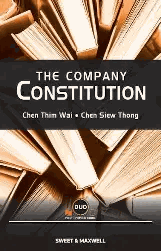


Description
Book Review
Author of review: marceljude.ai
I have read the book.
The book is a focused and technically serious study of the Malaysian company constitution under the Companies Act 2016. Its central concern is the legal and practical shift from the older Memorandum and Articles of Association system, especially the familiar Table A regulations, to the newer framework in which internal governance rules are embedded within the Act itself as mandatory provisions, presumptive provisions, and optional provisions. The authors’ main achievement is to show that the Companies Act 2016 did not merely rename the constitutional documents of companies; it changed the architecture of private-company governance.
The book is particularly valuable because it treats the company constitution not as a decorative filing document, but as a living instrument of corporate governance. It asks what rules govern directors, shareholders, meetings, resolutions, share transfers, class rights, dividends, notices, and alterations of constitutional rights. It is written for legal practitioners, company secretaries, directors, shareholders, accountants, academics, and students who need to understand how the new statutory framework affects both existing private companies and newly incorporated private companies.
List of Contents
The book’s contents may be understood as follows:
Preface The authors explain the legislative shift from the Companies Act 1965 to the Companies Act 2016. They identify the disappearance of Table A as a major practical problem and introduce the concept of “Replaceable Rules” to describe provisions that may be altered, modified, excluded, or adopted through a company constitution.
About the Authors The authors’ professional legal background is given, showing that the book is written from a practitioner-scholar perspective.
Table of Cases The book relies heavily on Malaysian, English, Singaporean, Australian, New Zealand, and Commonwealth company-law authorities.
Table of Statutes The book draws extensively from the Companies Act 1965, the Companies Act 2016, and comparative statutes from Australia, New Zealand, and the United Kingdom.
Chapter 1: The Constitution Under the Companies Act 2016 This chapter introduces the new statutory framework, the old Table A system, the transition of existing companies’ Memorandum and Articles into the modern constitution, the role of objects clauses, constructive notice, alteration of the constitution, and the emergence of Replaceable Rules.
Chapter 2: The Constitution and Existing Private Companies This chapter examines how existing private companies are affected by the Companies Act 2016, especially where they previously relied on Table A. It discusses corporate organs, division of powers, meetings, resolutions, written resolutions, AGMs, and major departures from Table A.
Chapter 3: Alteration of the Constitution This chapter gives a doctrinal analysis of alteration of the company constitution, especially the legal test that alterations must be made bona fide for the benefit of the company as a whole. It studies the leading cases and the tension between majority power and minority protection.
Chapter 4: The Constitution and New Private Companies This chapter considers whether new private companies should have a constitution even though the Act permits some companies to operate without one. It discusses tailored provisions such as restriction of share transfers, casting votes, AGMs, different classes of shares, and types of resolutions.
Chapter 5: Replaceable Rules This chapter is the book’s technical core. It identifies Replaceable Rules under the Companies Act 2016, distinguishes presumptive provisions from optional provisions, and explains how companies may use or modify them.
Appendices to Chapter 5 The appendices collect presumptive and optional provisions in a more accessible form.
Chapter 6: Table A Regulations and the Replaceable Rules This chapter compares the old Table A regulations with the new statutory provisions and Replaceable Rules. It explains what has been retained, what has changed, and what has become mandatory.
Index The index allows the reader to locate topics, cases, statutory provisions, and legal concepts.
Overall Thesis of the Book
The book’s central thesis is that the Companies Act 2016 modernises Malaysian company law but creates a practical gap: the older Table A regulations were gathered in one convenient place, while the newer internal governance rules are scattered throughout the Act. This makes it difficult for companies, lawyers, directors, shareholders, and company secretaries to identify which rules are mandatory, which rules apply by default, and which rules require express adoption in the constitution.
The authors respond to that problem by classifying the relevant statutory provisions into what they call Replaceable Rules. They further divide these into two categories.
First, there are presumptive provisions. These apply automatically unless the company constitution provides otherwise. In practical terms, these are default rules. A company that does nothing will be governed by them.
Second, there are optional provisions. These do not operate automatically. They apply only if the constitution expressly adopts them.
This distinction is one of the book’s most important contributions. It gives structure to an Act that, in the authors’ view, modernises company law but does not always make the internal governance rules easy to find.
Chapter 1 Review: The Constitution Under the Companies Act 2016
Chapter 1 performs the essential groundwork. It introduces the Companies Act 2016 as a major reform of Malaysian company law and explains that the Act replaced the older Companies Act 1965 framework. The authors are especially concerned with the fate of Table A, the old model articles that many companies had relied on for decades.
The chapter explains that under the older regime, companies had a Memorandum of Association and Articles of Association. The Memorandum usually dealt with the company’s objects and powers, while the Articles governed internal management. The Articles regulated matters such as shareholder rights, voting, share transfers, directors’ powers, meetings, dividends, and notices.
The key legal point is that the Articles were not merely administrative rules. They operated as a statutory contract between the company and its members and among the members in their capacity as members. That idea is foundational to company law because it means that constitutional rules are legally binding without every shareholder having to sign a fresh contract whenever shares are transferred.
The chapter then explains the transition under the Companies Act 2016. Existing companies’ Memorandum and Articles are treated as their constitution, but only to the extent that they do not contradict the new Act. This is a major practical issue. A company may think its old Articles still govern everything, but if a provision is inconsistent with a mandatory rule in the new Act, that provision will be ineffective.
The authors also explain the change in corporate capacity. Under older company law, the objects clause could restrict what the company was legally capable of doing. The book explains that the Companies Act 2016 gives companies broad capacity, but existing objects clauses may still matter if retained in the constitution. This is important for lawyers reviewing old company documents because an apparently obsolete objects clause may still restrict a company unless properly removed or revised.
Another important part of the chapter is its discussion of constructive notice. Under older law, because constitutional documents were publicly filed, outsiders dealing with a company could be deemed to know their contents. The Companies Act 2016 changes that position by abolishing constructive notice, except in relation to certain charge documents. This is a significant modernisation because it protects commercial convenience and reduces the burden on outsiders.
The chapter also introduces alteration of the constitution. A company may alter its constitution by special resolution, but that power is not unlimited. The authors preview the principle that alteration must comply with the Act and must satisfy equitable limits developed by case law.
From a law-professor perspective, Chapter 1 is strong because it combines statutory explanation, historical transition, and doctrinal analysis. It does not treat the Companies Act 2016 as a mere update. Instead, it shows that the Act changes the legal architecture of company governance. The chapter’s most valuable contribution is its identification of the hidden difficulty created by the Act: the governance rules have not disappeared, but they are no longer conveniently located in one model document.
The weakness of the chapter is that it is dense. A beginner may struggle with the movement between statutory provisions, Table A, objects clauses, constructive notice, and Replaceable Rules. But that density is also part of the book’s purpose. It is not a casual introduction. It is a technical guide to a technical problem.
Chapter 2 Review: The Constitution and Existing Private Companies
Chapter 2 is concerned with existing private companies, meaning companies that were incorporated under the older regime and whose Memorandum and Articles continue as their constitution. The chapter asks a practical question: what happens to private companies that previously relied on Table A after the Companies Act 2016 changes the governance framework?
The authors begin by explaining that a company acts through organs. The two principal organs are the board of directors and the members in general meeting. This is basic company-law doctrine, but the chapter uses it to frame a larger question: who has power to make which decisions?
The book then compares the older Table A structure with the Companies Act 2016. Under Table A, the board of directors generally managed the company’s business. Shareholders had residual powers, but the board was the primary organ of management. Under the Companies Act 2016, the same broad idea remains, but it is expressed more directly through statutory provisions giving the board authority to manage the company’s business and affairs, subject to the Act and the constitution.
A major strength of Chapter 2 is its discussion of resolutions. The authors explain ordinary resolutions and special resolutions, and they examine the introduction of the written resolution procedure for private companies. This is one of the most important practical reforms in the Act. A private company can pass resolutions without a physical meeting, provided the statutory requirements are met.
The chapter rightly treats written resolutions as both convenient and risky. They reduce cost and speed up decision-making. But they may also weaken minority shareholder participation. In a physical meeting, minority shareholders can ask questions, challenge assumptions, and attempt to persuade others. A written resolution may bypass that deliberative setting. The authors therefore identify a real corporate-governance tension: efficiency versus accountability.
The chapter’s discussion of annual general meetings is especially important. Under the Companies Act 2016, public companies must hold AGMs, but private companies are not generally required to do so unless their constitution requires it. Existing private companies that adopted Table A-style provisions may still have an AGM requirement in their constitution. If they want to remove it, they must do so properly.
This part of the chapter is valuable because it does not assume that removing AGMs is always good. The authors recognise that AGMs can serve as an accountability mechanism. They give shareholders a structured opportunity to receive information, ask questions, and vote on matters such as directors and accounts. For small private companies where all shareholders are directors, an AGM may be unnecessary. But for private companies with minority shareholders who are not involved in management, removing the AGM may prejudice legitimate expectations.
Chapter 2 also identifies significant departures from Table A. These include changes relating to shares, meetings, directors, dividends, and notices. For example, the Act changes the treatment of share certificates, proxy rights, dividends, and electronic communication. The chapter is therefore both doctrinal and practical.
As a law professor, I would describe Chapter 2 as one of the book’s most useful chapters for practitioners. It explains why existing companies cannot simply assume that their old constitutions are still fully reliable. The chapter encourages a constitutional audit: companies should examine their old Articles, identify provisions inconsistent with the Companies Act 2016, and decide whether to retain, modify, or replace them.
Its main limitation is that the analysis is heavily statutory. The reader must already be comfortable with company-law language. However, the legal importance of the chapter is clear: existing private companies face a transitional risk, and Chapter 2 provides a structured way to understand that risk.
Chapter 3 Review: Alteration of the Constitution
Chapter 3 is the most doctrinally sophisticated chapter in the book. It examines the legal principles governing alteration of a company constitution.
The chapter begins by explaining the nature of the constitution as a statutory contract. This matters because ordinary contract doctrines do not apply in a simple way. A constitution is not merely a bargain between two parties. It is a statutory instrument that binds the company and its members over time, including future members. Because membership changes, and because company law expects corporate arrangements to endure, the law permits alteration of the constitution by special resolution.
But the power of alteration is dangerous. A majority may alter the constitution in a way that harms minority shareholders. The central legal question is therefore: how does the law allow flexibility while preventing abuse?
The answer is the famous principle from Allen v Gold Reefs: an alteration must be made bona fide for the benefit of the company as a whole. The chapter explains this test in detail. It examines what “bona fide” means, what “benefit” means, and what “company as a whole” means.
The authors rightly show that the phrase “company as a whole” is difficult. Sometimes it means the company as a separate commercial entity. At other times, especially where shareholder rights inter se are concerned, it may mean the shareholders as a general body. This distinction is crucial. If the alteration concerns the company’s ability to recover debts or manage its affairs, the focus may be on the company as an entity. If the alteration concerns relative shareholder rights, the court may examine whether the alteration unfairly discriminates between majority and minority shareholders.
The chapter discusses the tension between majority power and shareholder property rights. A shareholder generally has the right to vote in their own interest. Unlike directors, shareholders do not ordinarily owe fiduciary duties when voting. Yet when voting to alter the constitution, majority shareholders cannot simply use their voting power oppressively. The law therefore walks a delicate line: it respects shareholder voting freedom but restricts abusive constitutional alterations.
The chapter’s treatment of the subjective and objective approaches is another strength. Courts generally defer to shareholders’ judgment about what benefits the company. But that deference is not absolute. If no reasonable person could regard the alteration as beneficial, or if the alteration is oppressive, unjust, or outside the scope of the power, the court may intervene.
The chapter also explains other limits on alteration. A constitution may itself prohibit certain alterations. A member cannot be forced to take additional shares or increased liability without consent. An alteration cannot override statutory rights, such as the right to seek winding up where the Act grants that right.
The chapter then discusses court-ordered alteration. This is a newer statutory possibility. A director or member may apply to court if it is not practicable to alter the constitution through ordinary procedures. The authors treat this cautiously, noting that it should not be used simply because a proposed amendment failed to obtain enough votes. The issue is impracticability of procedure, not dissatisfaction with the result.
From a law-professor perspective, Chapter 3 is the intellectual centre of the book. It shows that company constitutions are not merely administrative documents. They are instruments through which private power is organised, contested, and reviewed. The chapter is especially strong because it connects statutory law with equitable principles and comparative case law.
Its weakness is that it may be challenging for non-lawyers. The case law is dense and conceptually demanding. But for legal education, this chapter is excellent. It would be suitable for advanced company-law students because it illustrates how statutory power, majority rule, minority protection, and judicial review interact.
Chapter 4 Review: The Constitution and New Private Companies
Chapter 4 turns from existing companies to new private companies. The Companies Act 2016 allows most companies to operate with or without a constitution. At first glance, that seems to simplify incorporation. But the authors argue that a private company will often still need a constitution.
The chapter’s argument is practical and persuasive. A company without a constitution must rely on the Act. But the Act is lengthy, scattered, and not tailored to the needs of a particular company. A constitution gathers the relevant internal governance rules into one document. It gives directors, shareholders, officers, lenders, and outsiders a clearer statement of how the company is governed.
The authors explain several reasons for having a constitution. First, it can replace or modify unsuitable default rules. Second, it can supplement the Act where the Act is silent. Third, it can provide certainty. Fourth, it can prevent automatic reliance on statutory rules that the company may not want. Fifth, it can include objects clauses where a company is formed for a specific commercial purpose, such as a joint venture.
The chapter then identifies tailored provisions that private companies should consider.
The most important is restriction on transfer of shares. A private company must restrict the transfer of its shares. The authors argue that a company without a constitution may struggle to satisfy this requirement adequately, especially where fully paid shares are concerned. This is one of the strongest practical points in the book. It shows that although the Act says a company may not need a constitution, private companies may in practice require one to meet statutory expectations and avoid governance uncertainty.
The chapter also discusses a chairperson’s casting vote. Under older Table A rules, the chairperson could have a casting vote in the event of equality. Under the Companies Act 2016, this is not automatically provided for general meetings. If a company wants that mechanism, it should include it in the constitution.
The authors also discuss AGMs for private companies. Although the Act does not generally require private companies to hold AGMs, a company may choose to include an AGM requirement in its constitution. This may be useful where shareholders are not all directors or where minority shareholders want an annual accountability forum.
Different classes of shares are another important topic. A private company may want ordinary shares, preference shares, non-voting shares, or other classes with different rights. The constitution should clearly state these rights, including voting, dividend, capital repayment, and priority rights. This is crucial because unclear class rights often generate litigation.
The chapter also explains that companies can specify whether certain matters require ordinary or special resolutions. This gives shareholders a way to raise the approval threshold for sensitive decisions. For example, a constitution may require a special resolution for matters that would otherwise require only an ordinary resolution.
The specimen constitution included in the chapter is practical but should be treated carefully. The authors themselves present it as illustrative, not as universal advice. That is important because company constitutions should be tailored. A family company, a joint venture company, a professional services company, and a passive investment company may all need different governance rules.
The discussion of share transfer restrictions is particularly useful. The authors distinguish between a refusal-to-register clause and a pre-emption clause. A refusal-to-register clause gives directors power to decline registration of a transfer in specified circumstances. A pre-emption clause requires a selling shareholder to offer shares first to existing shareholders before selling to outsiders. The chapter correctly warns that pre-emption clauses must be drafted with precision because courts usually construe restrictions on share transfer strictly.
As a law professor, I consider Chapter 4 one of the book’s most commercially useful chapters. It translates statutory reform into drafting advice. It also exposes a tension in the Companies Act 2016: the Act offers constitution-free incorporation, but private company governance often still requires a constitution.
The chapter’s limitation is that it could have gone further in distinguishing different types of private companies. A one-member company, a two-founder start-up, a family company, and a venture-backed company have different constitutional needs. The book recognises that size matters, but a deeper typology would have made the drafting discussion even stronger.
Chapter 5 Review: Replaceable Rules
Chapter 5 is the technical core of the book. It explains the nature, categories, and practical use of Replaceable Rules.
The authors adopt the term “Replaceable Rules” from Australian company law. They use it to describe provisions in the Companies Act 2016 that may be replaced, modified, or adopted through the constitution. This terminology is extremely helpful because the Malaysian Act itself does not conveniently gather all such provisions in one place.
The chapter distinguishes two major types of Replaceable Rules.
The first type is presumptive provisions. These apply by default unless the constitution provides otherwise. They are similar in spirit to default rules. For example, where a provision says “unless otherwise provided in the constitution” or “subject to the constitution,” the company may modify the rule by constitutional drafting. If it does not, the statutory rule applies.
The second type is optional provisions. These apply only if expressly adopted. They are not default rules. A company that wants them must put them into its constitution.
This distinction is crucial. A company may accidentally be governed by a presumptive provision because it failed to exclude it. Conversely, a company may fail to obtain the benefit of an optional provision because it failed to adopt it. Chapter 5 therefore teaches that silence can have different legal consequences depending on the type of statutory provision involved.
The chapter then identifies the phrases used in the Act. These include phrases such as “unless otherwise provided in the constitution,” “subject to the constitution,” “subject to the conditions or limitations in the constitution,” “unless expressly prohibited in the constitution,” and other variations. For optional provisions, the chapter identifies phrases such as “authorised by the constitution,” “under the constitution,” and “in accordance with the constitution.”
The chapter’s most valuable feature is its attempt to collect and classify these provisions. The Companies Act 2016 scattered the rules throughout the Act. The authors’ classification makes the Act more usable. This is a genuine scholarly-practical contribution.
The discussion also explains how companies should use Replaceable Rules. The authors argue that companies and advisers should review each rule and decide whether it is appropriate. For example, a private company may want to alter board powers, specify special-resolution requirements, create rules for director vacation of office, or include pre-emption rights for issued shares. The constitution is therefore not merely a compliance document. It is a planning document.
The chapter also gives an important warning: modifying Replaceable Rules is not unlimited. A company cannot use its constitution to contradict mandatory provisions of the Act. Nor can it create rules that are inconsistent with statutory rights, duties, or creditor-protection mechanisms.
From a law-professor perspective, Chapter 5 is the book’s most original contribution. It fills a legislative usability gap. Where the Act leaves users to search through hundreds of provisions, the authors create a conceptual map.
The limitation is that the chapter can feel like a statutory catalogue. It is less narrative than Chapters 1 to 4. But that catalogue-like quality is also the point. The chapter is designed to be used. It is a working tool for lawyers, secretaries, and corporate advisers.
Chapter 6 Review: Table A Regulations and the Replaceable Rules
Chapter 6 compares the old Table A regulations with the new Companies Act 2016 framework. It is the book’s transition chapter. If Chapter 5 identifies the Replaceable Rules, Chapter 6 asks how they relate to the familiar old Table A rules.
The chapter begins by explaining that Table A operated as a convenient single set of default articles under the older Act. In contrast, the new Replaceable Rules are embedded in the statute. This means that users must now move between the company constitution and the Act itself.
The authors also discuss drafting style. Table A was drafted in an older, more compact, and often archaic style. The Companies Act 2016 uses a more modern drafting style, often breaking ideas into numbered provisions and subsections. The authors illustrate this by comparing the old rule on calls on shares with the newer statutory provisions. This is a useful exercise because it shows that the change is not merely linguistic. Some parts of the old rule may now be mandatory, while other parts may be replaceable.
The bulk of Chapter 6 maps the 113 Table A regulations against the Companies Act 2016. This is highly practical. The chapter identifies where an old regulation has a similar statutory equivalent, where the new Act differs, where a rule is now mandatory, where it is replaceable, and where there is no equivalent provision.
The chapter highlights many important changes. For example, some provisions relating to share issue, share capital, transfer of shares, meetings, proxies, directors, dividends, notices, and winding up are no longer governed in the same way. Certain Table A provisions may be ineffective if inconsistent with the Act. Other provisions may still be useful and may be retained or adapted in a constitution.
The chapter is especially important for existing private companies. A company that adopted Table A cannot safely assume that all its old provisions remain effective. Some may contradict the Companies Act 2016. Others may be outdated because of changes such as the abolition of par value. Others may need to be replaced because the Act now handles the subject differently.
The authors ultimately suggest that existing private companies may be better served by revoking outdated constitutional documents and adopting a new constitution designed for the Companies Act 2016 framework. That is a sensible recommendation. Piecemeal amendment may leave hidden inconsistencies. A new constitution can be clearer, shorter, and better adapted to the modern Act.
As a law professor, I consider Chapter 6 a valuable bridge between old and new company law. It is not merely descriptive. It teaches legal method: one must compare old constitutional language against the new statute, identify inconsistencies, and distinguish mandatory rules from replaceable ones.
The chapter’s limitation is that it is necessarily technical and sometimes repetitive. But for practitioners, that technical detail is precisely what makes the chapter useful.
Whole-Book Review
The book is a serious and practical contribution to Malaysian company law. Its subject may appear narrow, but the issue is fundamental. The company constitution determines how corporate power is allocated, how shareholders participate, how directors act, how shares are transferred, how meetings are conducted, and how disputes may arise or be prevented.
The book’s greatest strength is that it recognises the Companies Act 2016 as a structural reform. Many legal updates are explained as lists of new sections. This book goes further. It asks how the new Act changes the everyday governance of private companies. It shows that the disappearance of Table A has consequences. The rules have not vanished; they have been relocated, reclassified, and sometimes transformed.
The book is especially strong in four respects.
First, it explains the transition from Memorandum and Articles to the modern constitution. This is essential for existing companies.
Second, it identifies the practical importance of Replaceable Rules. This is the book’s most distinctive contribution.
Third, it gives serious attention to private companies. Many company-law texts focus heavily on public companies and listed-company governance. This book recognises that private companies form the overwhelming majority of companies and that their governance problems are different.
Fourth, it combines doctrine and practice. The authors do not merely describe statutory provisions. They discuss cases, legal principles, drafting consequences, and practical risks.
The book’s treatment of minority shareholders is also significant. The authors repeatedly show that efficiency reforms, such as written resolutions and the removal of mandatory AGMs for private companies, may weaken accountability if used carelessly. This is a mature point. Modern company law often seeks speed, reduced cost, and ease of doing business. But private company law must also protect shareholders who are not involved in management.
The chapter on alteration of the constitution is doctrinally rich. It reminds readers that majority rule is not the same as unlimited power. A company constitution may be altered, but alteration remains subject to statutory limits, equitable principles, and judicial supervision.
The book’s practical drafting advice is also valuable. Its discussion of share-transfer restrictions, pre-emption rights, casting votes, AGMs, class rights, and special-resolution thresholds shows that a constitution should be designed, not copied blindly.
The book does have limitations. It is not an easy introductory text. A reader without prior exposure to company law may find the discussion dense. The authors assume familiarity with statutory interpretation, corporate organs, shareholder rights, directors’ duties, and case-law reasoning. This is not a major flaw, but it affects the audience. The book is best suited for lawyers, company secretaries, advanced students, directors, and advisers rather than complete beginners.
The book could also have developed more policy analysis. It explains the practical effect of the Companies Act 2016 very well, but it could have gone further in evaluating whether the legislative design itself is optimal. For example, the absence of a statutory table of Replaceable Rules is criticised, but the broader question of legislative accessibility could have received deeper theoretical treatment.
Another limitation is that the book could provide more differentiated constitutional models for different kinds of private companies. A small owner-managed company, a family company, a joint venture company, and a company with passive minority investors have different governance needs. The book recognises this, but a fuller typology would make its drafting guidance even more powerful.
Despite these limitations, the book succeeds in its main purpose. It fills a practical gap created by the Companies Act 2016. It gives readers a way to identify, understand, and use the constitutional rules that now govern Malaysian companies.
Law-Professor Evaluation
From an academic perspective, the book deserves praise for treating corporate constitutional law as a central field rather than a procedural afterthought. The constitution is not merely a document lodged with the Registrar. It is the legal machinery through which corporate power is structured.
The authors’ most persuasive insight is that modernisation can create uncertainty when old default documents are abolished but new default rules are scattered. The Companies Act 2016 may simplify some aspects of incorporation, but it complicates the task of identifying internal governance rules. The book responds to that complication with classification, explanation, and comparison.
The book is also jurisprudentially interesting because it shows how company law combines public statute and private ordering. A company constitution is private in the sense that shareholders may tailor many rules. But it is public in the sense that it operates within a statutory framework and cannot contradict mandatory law. The book repeatedly returns to that balance.
For students, the book teaches three major lessons.
First, always distinguish mandatory rules from default rules.
Second, never assume that old constitutional language remains effective after statutory reform.
Third, understand that corporate governance is not only about listed-company codes. It also concerns private companies, share transfers, meetings, resolutions, directors’ powers, and minority protections.
For practitioners, the book teaches a direct practical lesson: every existing private company should review its constitution, and every new private company should seriously consider adopting a carefully drafted constitution rather than relying blindly on the Act.
For lawmakers, the book implies a legislative lesson: accessibility matters. If internal governance rules are scattered across a long statute, companies may incur higher advisory costs and face avoidable uncertainty. A statutory table of Replaceable Rules would improve clarity.
Final Assessment
This is a careful, technical, and practically important company-law book. Its main contribution is to explain how the Companies Act 2016 reshapes the company constitution and replaces the older Table A model with a more dispersed system of statutory governance rules. The authors’ classification of Replaceable Rules into presumptive and optional provisions is especially useful.
The book is strongest when it links legal doctrine to practical consequences. Its analysis of existing private companies, written resolutions, AGMs, alteration of constitutions, share-transfer restrictions, and Table A comparisons makes it a valuable guide for anyone dealing with Malaysian private-company governance.
As a law professor, I would describe the book as a practitioner-scholar’s guide to the constitutional life of the Malaysian company. It is not light reading, but it is legally serious. Its value lies in showing that after statutory reform, the constitution remains central. Indeed, because the Act allows more flexibility and scatters governance rules across statutory provisions, the constitution may be more important than ever.
 marceljude.ai @ +60128285778 |
- MALAYSIA'S 1ST AI LAWYER - CLICK HERE
- ISMAIL – INTEGRATED SINGAPORE/MALAYSIA AI & LAW (Library)
- OPENING OF SINGAPORE MALAYSIA AI CENTRE AND LAW LIBRARY
- LIFT - LAW INSTRUMENTS FORMS & TEMPLATES
- LAWS OF MALAYSIA FOR SINGAPOREAN DUMMIES
- HANNAH YEOH'S ARTIFICIAL INTELLIGENCE LAW ENCYCLOPEDIA
- LEAD CR - Law Ecosystem Archive Databases on CD-ROM
- BREAKING NEWS FROM MJN
- CLICK HERE CO. PROFILE
- EXCITING NEW SERIES - THE ADVENTURES OF BOBBY TAN -ADVOCATE & SOLICITOR IN THE HIGH COURT OF NORTH BORNEO by marceljude.ai
- MEDICO LEGAL - BY PRISKILA AKWILA & GLORIOUS PETAL SDN BHD - powered by marceljude.ai
- MISCELLANOUS
- ANNOTATED STATUTES OF SABAH - A NEW SERIES
- e-library - marceljude.ai
- DRAFT - DOCUMENT RESEARCH & AUTOMATED FILING TECHNOLOGY
- CLARA – Case Law Analysis & Retrieval AI
- FOR RESEARCH REQUEST CLICK HERE
- CLICK HERE TO ASK ANYTHING
- RAMBO'S LAW - THE LAW OF THE LAW JUNGLE - EXCITING NEW SERIES - CASE ANALYSIS BY JOHN RAMBO @ +60138646786
- PRISKILA AKWILA ADVOCATES - High Court of Sabah & Sarawak @ Kota Kinabalu
- COLA - COMMONWEALTH ONLINE LAWCASES AI -marceljude.ai
- THE LAW LIBRARY THAT COMES TO YOU ANYWHERE AND ANYTIME
- marceljude.ai training academy
