
DAVID BEAN ON INJUNCTIONS
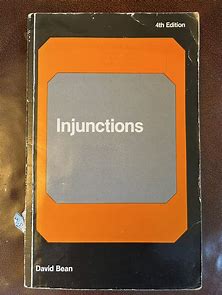


Description
review by marceljude.ai
David Bean’s Injunctions. the book is built as a piece of legal method rather than just a collection of rules. The book itself presents itself as a concise, practical guide with a strong emphasis on procedure, while still rooting that procedure in principle; it is very much a working lawyer’s book, but one with clear judicial intelligence behind it.
What strikes one immediately is that this is not a book about injunctions in the loose, popular sense of “court order telling someone to stop.” It is a book about injunctions as a highly disciplined equitable remedy. Bean’s central message, running from the opening pages through the specialist chapters, is that injunction law is powerful precisely because it is controlled. It is discretionary, coercive, fact-sensitive, and often urgent; because breach may lead to contempt, every part of the law insists on clarity, fairness and procedural seriousness. That concern with precision is one of the master ideas of the text. It appears in the opening definition of injunctions, in the discussion of mandatory orders, in the treatment of anti-social behaviour orders, and again in the contempt chapter. The book repeatedly insists that an order backed by the threat of imprisonment must be practicable, intelligible and exact.
The architecture of the book The structure is deliberate. Part A deals with jurisdiction and principles. Part B turns to practice and procedure. Part C isolates matrimonial and domestic proceedings, where injunction law takes on a special protective function. Part D provides precedents, showing that for Bean, injunction law is never complete unless one can draft the relevant application or order properly. The appendices then anchor the whole thing in rules, practice directions and court guides. So the book moves from concept, to criteria, to process, to specialist context, to drafting. That is exactly how a good practitioner or judge has to think.
Chapter 1: Introduction This chapter lays the foundations. Bean begins with definition, but he does more than define. He classifies injunctions into mandatory and prohibitory, and also into perpetual and interim. That opening classification matters because the rest of the book depends on it. A prohibitory injunction stops conduct; a mandatory injunction compels positive action. A perpetual injunction is final relief after the merits are decided; an interim injunction is provisional relief given before final trial. Those distinctions are not merely descriptive. They determine the level of judicial caution, the evidence required, and the procedural path that follows.
Bean then introduces the idea of quia timet relief, which is one of the most important equitable ideas in the whole field. The law does not wait helplessly for damage to happen. In the right case, the court may intervene because a claimant reasonably fears that a legal wrong is about to occur. This signals early that injunction law is preventive, not merely compensatory. It exists because damages sometimes come too late.
The chapter’s next major point is that an injunction is backed by contempt, so it must be clear. This is not decoration. It is constitutional in importance. A vague damages award may be inconvenient; a vague injunction is dangerous. If liberty can be lost for breach, the defendant must know what he is forbidden or required to do. That single insight gives coherence to much of the whole book.
Bean also insists that an injunction is a remedy, not a cause of action. This is classic equitable orthodoxy. A claimant cannot ask the court for an injunction in the abstract. There must be some substantive legal right or recognisable legal claim behind it. The injunction rides on the back of that right. This is crucial because it prevents the remedy from becoming free-floating judicial power. Equity assists rights; it does not invent them at whim.
The discussion of the phrase “just and convenient” is one of the intellectually important parts of the chapter. Bean recognises that the statutory words are broad, but he is careful to show that they are not a licence for ad hoc moralism. Judges do not grant injunctions because they dislike what the defendant is doing. The jurisdiction is wide, but disciplined by doctrine, precedent and self-restraint. In lecturer’s terms, this is the chapter where Bean protects injunctions from degenerating into palm-tree justice.
The chapter also surveys judges, courts, parties and the scope of the remedy. This is where the book shows its practical orientation. Bean explains who can grant what, including the limits on masters and district judges, and the special treatment of freezing and search orders. He also discusses injunctions against named persons, unknown persons, and in rare cases orders with wider effect. Finally, he gives a panoramic catalogue of the settings in which injunctions may operate: land, nuisance, employment, intellectual property, commerce, fiduciary obligations, publications, domestic matters, discrimination, public law and litigation itself. This survey is not filler. It teaches the reader that injunction law is not a narrow subject; it is a remedial technique that cuts across almost all private and public law.
My assessment of Chapter 1 is that it is an excellent gateway chapter. It does not drown the reader in theory, but it quietly frames the subject in the right way: injunctions are exceptional in force, ordinary in legal availability, and always dependent on disciplined reasoning.
Chapter 2: Criteria — Permanent Injunctions This chapter asks the classic question: when, after trial, should a court grant final injunctive relief rather than leave the claimant to damages? Bean’s answer is rooted in equity’s discretionary nature.
He starts with the proposition that an injunction is not a remedy of right in the same way damages often are. Even when a legal wrong has been shown, the court may refuse an injunction. That is the mark of equity. But Bean is careful not to reduce discretion to unpredictability. The chapter identifies recurring controlling factors: adequacy of damages, claimant conduct, delay, acquiescence, laches, triviality, enforceability and the public interest.
The section on adequacy of damages is central. Bean explores the classic principle that injunctions are generally inappropriate if money can adequately compensate the claimant. But he does not present this crudely. He shows that adequacy depends on context. Property rights, continuing nuisance, interference with unique rights, and cases where loss is hard to quantify often make damages inadequate. By contrast, where the injury is small, measurable and compensable, damages in lieu may be more just. This is where the chapter engages with the famous line of authorities associated with awards of damages instead of injunctions. In doctrinal terms, this is where Bean teaches the student to distinguish between right vindication and loss compensation.
The treatment of the claimant’s conduct is also very equitable. “Clean hands” appears here not as a slogan but as a limit on conscience-based relief. Bean shows that fraud, bad faith, sharp practice or inequitable behaviour may disentitle a claimant. But again, he is not simplistic. The misconduct must matter in relation to the relief sought. That is a subtle and correct point.
The sections on acquiescence and laches are among the stronger doctrinal parts of the chapter. Bean carefully distinguishes them. Acquiescence concerns standing by while another acts in a way that affects one’s rights, such that it would become unconscionable later to object. Laches is more about delay after the infringement has occurred, where the delay and its consequences make relief unjust. This distinction matters because lawyers often blur the two. Bean does not. He uses equity’s old language, but he applies it in a crisp, modern way.
The chapter then turns to mandatory and quia timet injunctions at trial. Here Bean becomes more exacting. Mandatory injunctions are treated as more drastic because they do not merely hold a defendant back; they make him do something. Bean draws out the classic judicial reluctance: these orders are harder to supervise, harder to formulate precisely, and more likely to become oppressive. In quia timet mandatory cases, he stresses the need for a very strong probability of serious future damage, inadequacy of damages, and careful attention to precision. This is a major strength of the chapter. It helps the reader see that not all injunctions are alike even at final stage. The law calibrates intensity.
My view is that Chapter 2 is the chapter that best captures injunctions as equity rather than mere procedure. It teaches the reader how discretion is structured, how damages and injunctions compete, and why some forms of final relief are granted much more cautiously than others.
Chapter 3: Criteria — Interim Injunctions If Chapter 2 is the chapter of equitable principle, Chapter 3 is the beating heart of modern injunction law. Interim injunctions dominate practice because most disputes never reach a full trial after interim relief is sought. Bean makes that point explicitly: the interim stage is often practically decisive. That is why the standards governing it matter so much.
The chapter opens by explaining that an interim hearing is not a trial. There is usually no full disclosure, no cross-examination, and no final resolution of disputed facts. Yet the court may still issue an order with enormous real-world consequences. This tension defines the whole chapter. The court must act under uncertainty without allowing uncertainty to become injustice.
Bean then explains the undertaking in damages, which is one of the structural pillars of interim relief. The claimant who secures an interim injunction but ultimately loses must compensate the defendant for the loss caused by the restraint. Bean treats this not as a technical afterthought but as the moral and procedural price of interim relief. It reflects the provisional nature of the order. It also explains why the claimant’s means matter and why courts sometimes require fortification or security. This section is especially valuable because students often focus only on the defendant’s restraint and forget the counterbalancing protection offered by the undertaking.
The centrepiece is, of course, American Cyanamid. Bean explains the familiar sequence: serious question to be tried, adequacy of damages, balance of convenience, preservation of the status quo. But he does not stop at the formula. He shows its limits and its later refinements. In particular, he notes the later judicial willingness to take into account the apparent strength or weakness of the parties’ cases in suitable circumstances, especially where the court can form a reasonably clear view without conducting a mini-trial. That is important because a mechanical reading of American Cyanamid can become unreal. Bean’s handling of this is good precisely because it is practical. He teaches that principles guide; they do not blind.
The section on the balance of convenience is strong because Bean recognises that the phrase is slightly misleading. The court is really balancing risks of injustice. Whichever way it decides, someone may suffer irremediable harm. The job is to choose the course with the lower risk of doing serious wrong. This is a more accurate and mature way to understand interim discretion.
The chapter also deals with special cases: trade disputes, public authority cases, references to European courts, and cases where the interim decision will effectively decide the whole action. That last category is especially important. Where granting or refusing interim relief will end the matter in practice, the court has to be even more careful, because it is coming close to final judgment without a trial. Bean is very good on this point.
His discussion of without notice injunctions is among the clearest in the book. He emphasises that they are exceptional because they displace the basic rule of hearing the other side. The case for secrecy or urgency must be genuine. The mere fact that the balance of advantage favours the claimant is not enough. This is a powerful lesson in procedural justice: urgency does not abolish fairness; it temporarily compresses it.
The final section on mandatory interim injunctions is also excellent. Bean shows the traditional rule that courts are more reluctant to grant mandatory than prohibitory relief at the interim stage. But he also explains the more modern approach associated with reasoning about which course carries the lower risk of injustice. That gives the chapter sophistication: it neither parrots old caution nor pretends that all injunctions are governed by the same threshold.
In my judgment, Chapter 3 is the most important chapter in the whole book. If one understands this chapter properly, one understands why injunction practice is both powerful and perilous.
Chapter 4: Special Cases in the Law of Injunctions This chapter is where Bean proves that injunction law cannot be learned in the abstract. The remedy changes shape depending on the field of law in which it is sought.
He begins with contracts of employment, where the law is torn between enforcing bargains and refusing indirect specific performance of personal service contracts. Bean explains restraint of trade, garden leave, confidentiality, breaches of confidence and the limits on injunctions against dismissal. This section is especially useful because employment injunctions often look simple but actually involve several tensions at once: freedom to work, contractual bargain, confidentiality, mutual trust and confidence, and the practical impossibility of supervising personal relationships. Bean handles these well.
He then turns to restraint of publication, which is one of the most difficult and politically charged fields. Here Bean examines defamation, breach of confidence, prior restraint, children’s anonymity, contempt of court, election statements, and especially the impact of the Human Rights Act and Convention rights. This is a sophisticated area because it requires balancing expression, privacy, confidentiality, public interest and the administration of justice. Bean’s treatment shows that injunction law here is not merely about property or contract; it becomes constitutional. He uses the law of restraint of publication to show how equitable relief has to coexist with freedom of expression, and how statutes like section 12 of the Human Rights Act raise the threshold for prior restraint.
The public law section is equally significant. Bean explains when injunctions may be used to restrain crime, when only the Attorney General or public authorities may sue, the role of section 222 local authority powers, judicial review, injunctions against the Crown, and the special position created by European law. This part shows the reader that injunctions are not just tools of private dispute. They are also part of the architecture of constitutional control. That is especially clear in the discussion of interim restraints against government action and the old bar on injunctions against the Crown, together with its qualifications.
The sections on foreign defendants and anti-suit injunctions are also important. Bean explains the need for jurisdictional restraint and comity. English courts may restrain foreign proceedings in some cases, but they do not do so lightly. This gives the chapter an international dimension and highlights that injunction law can project power beyond domestic litigation.
The closing sections on discrimination, financial services, state immunity, harassment, ASBIs and ASBOs show Bean at his most practical. He shows how statute-specific injunction regimes operate and how the ordinary equitable principles have to be adapted. His constant insistence on precision reaches a climax here. Anti-social behaviour orders, whether civil or criminal in setting, must identify prohibited conduct with exactness. Generic prohibitions are dangerous. That concern is not just technical drafting. It is a rule-of-law requirement.
This chapter is outstanding because it prevents the reader from thinking there is one universal injunction formula. Instead, it shows that injunction law is a family of related remedial techniques, each shaped by the substantive field in which it appears.
Chapter 5: Interim Applications Chapter 5 moves decisively from doctrine to craft. If Chapter 3 tells you when interim relief may be granted, Chapter 5 tells you how to seek it properly.
Bean begins with jurisdiction and forum selection. He explains the choice between Chancery, Queen’s Bench and county court, and he makes clear that the choice is not cosmetic. It depends on subject matter, urgency, judicial allocation and the nature of the relief sought. Some remedies, especially freezing and search orders, raise special forum issues. The practical effect is to teach the lawyer that the first mistake in injunction practice may be bringing the right application in the wrong court.
The sections on without notice applications are especially strong. Bean explains the procedural framework for exceptional urgency, secrecy, informal notice, out-of-hours applications and even telephone applications. This is not glamorous law, but it is the kind of material that decides whether an injunction is lawfully granted or later set aside. Bean’s insistence on procedural honesty is sharp: if the case does not truly justify without notice relief, then pursuing it that way is a serious mistake.
The discussion of the duty to the court in without notice hearings is one of the most important parts of the book as a matter of professional ethics. Full and frank disclosure is not just good manners. It is an obligation. The applicant must place before the court all material matters, including those adverse to the application. That is because the absent respondent has no voice. Bean is very good at showing how this duty structures the whole hearing and why sloppiness in drafting, evidence or explanation can later destroy the order.
He then covers the actual documents: claim form, evidence, draft order, and notice of application. This part reveals how much injunction practice depends on drafting. Bean explains what evidence should contain, the difference between witness statements and affidavits in particular contexts, and the importance of the draft order’s precision. This fits perfectly with the wider theme of the book: if an injunction is to be obeyed and enforced, it must be drafted with rigor.
The chapter’s treatment of on notice applications is equally practical. Bean walks through service, bundles, listing, the differences between Queen’s Bench and Chancery practice, orders for early trial, and what happens when factual conflict makes interim determination difficult. His discussion of “standing over to trial” is particularly useful because it reveals how costs strategy and procedural manoeuvre operate in real injunction litigation.
The section on costs is another strength. Bean knows that in interlocutory litigation costs orders can shape settlement just as much as the substantive ruling. He explains costs in any event, costs in the case, reserved costs and no order as to costs with admirable clarity.
He also covers summary judgment, default judgment, striking out, and discontinuance in injunction claims. This is exactly the sort of material many academic accounts neglect, yet it matters greatly in practice.
My assessment is that Chapter 5 is one of the best chapters in the book because it shows injunction law as lived litigation. It teaches procedure not as bureaucracy, but as the discipline that makes urgent coercive relief legitimate.
Chapter 6: Other Proceedings This chapter is about the life of the injunction after the interim hearing. In many books this material would feel like leftovers. Bean turns it into a coherent continuation.
He begins with trial and judgment, noting that if the claimant succeeds, the court may grant a permanent injunction, accept an undertaking in lieu, or grant a declaration. This is important because it shows that success at trial does not mechanically produce one form of relief. The court still has remedial choices.
The discussion of undertakings in lieu is especially practical. Bean warns that if the claimant accepts an undertaking instead of an injunction, the wording must truly protect him. An undertaking may be easier to secure, but it is not magical; if loosely framed, it may fail to cover the conduct feared. Again, drafting and precision return as central themes.
The section on declarations is brief but important. A declaration may resolve the legal position without the coercive force of an injunction. This shows Bean’s remedial sophistication. Not every victory requires a threat of contempt.
The treatment of inquiries as to damages on the cross-undertaking is one of the most valuable parts of the chapter. Bean explains that when an interim injunction proves unjustified, the defendant may recover for loss caused by it. He frames the assessment broadly on contract-like principles of causation and remoteness. This is doctrinally important because it shows that interim injunctions are not cost-free experiments. They are balanced by a real compensatory mechanism.
The chapter also discusses suspension of injunctions, discharge, release from undertakings, Part 36 payments, appeals, and injunctions pending appeal. These sections show how flexible injunction practice can be after the main decision. Relief can be delayed, stayed, continued or modified depending on fairness and practicality. Bean’s treatment of suspension is especially good because it reveals the tension between vindicating rights and avoiding immediate oppression or waste.
Overall, Chapter 6 gives the subject its temporal depth. It reminds the reader that an injunction is not a single dramatic moment but part of an ongoing procedural and remedial sequence.
Chapter 7: Freezing Injunctions This chapter deals with one of the most formidable remedies in civil procedure. Bean himself clearly recognises its exceptional status. The freezing injunction is designed to prevent defendants from rendering judgment worthless by dissipating assets before enforcement. It is, in effect, a protective restraint on property in aid of justice.
Bean begins with the historical point that traditionally one could not restrain a debtor merely from dealing with his property. The Mareva development changed that. This is a major moment in legal history because it shows equity adapting to commercial fraud, mobility of assets and international litigation. Bean presents freezing injunctions as a judicial innovation that became central to modern practice, but one that courts later learned to handle more cautiously. The preface itself highlights the move from initial enthusiasm to stricter control.
The chapter then explains the jurisdiction, procedure, and what the claimant must show. The core requirements are a good arguable monetary claim and a real risk of dissipation or concealment of assets. This is critical: the order is not granted merely because the claimant fears non-payment. There must be evidence of risk to enforcement. That keeps the remedy tied to necessity rather than leverage.
Bean’s coverage of ancillary remedies is particularly strong. Freezing orders are rarely self-contained. They are often paired with disclosure orders, sometimes cross-examination, and occasionally receivership. This makes the chapter more than an account of one form of order; it becomes a study in remedial ecosystem.
The discussion of third parties, especially banks, is also essential. A freezing injunction often works only because third parties respect and implement it. But Bean shows that this generates distinct issues of protection, liability and fairness. It is not enough to command the defendant; the law must structure how others respond. That is why the chapter is as much about procedure and third-party consequences as about substantive entitlement.
Then come variation and discharge, competing creditors, ne exeat regno, worldwide freezing orders, and aid of foreign claims. These sections show the extraordinary reach of modern freezing practice. Yet Bean does not romanticise it. He keeps stressing disclosure duties, careful drafting, proportionality and judicial caution. That caution is the chapter’s hidden theme. The freezing injunction is powerful precisely because the law keeps reminding itself how dangerous it would be if used casually.
The final section on restraint orders links civil freezing ideas to criminal and proceeds-of-crime contexts. This broadens the chapter’s relevance and shows how asset preservation techniques travel across legal domains.
This is one of the strongest specialist chapters in the book. It is doctrinally rich, commercially important and practically detailed.
Chapter 8: Search Orders Chapter 8 deals with the other “nuclear weapon” of injunction law: the search order. Bean groups together search orders, interim preservation of property, and delivery up of goods, all of which are effectively mandatory in character.
The search order exists because giving notice may defeat justice. If a defendant is likely to destroy evidence or hide infringing goods, ordinary notice may be self-defeating. Bean explains the history of the order and its statutory basis with clarity. This is one of the great examples of modern equity responding to practical reality, particularly in intellectual property and piracy cases.
But Bean is also very alert to the order’s intrusiveness. A search order is not simply a procedural device. It permits entry onto premises and preservation or removal of material. That means it comes close, in practical effect, to civil search and seizure. Because of that, the chapter necessarily treats safeguards as central. This is exactly right. The more powerful the remedy, the heavier the insistence on judicial control, exact procedure and responsible execution.
The sections on interim preservation of property and delivery up of goods are useful because they stop the reader from treating every urgent evidential order as an Anton Piller order. Bean differentiates them. Some cases call for preservation without search. Some call for delivery up. The legal basis, level of intrusion, and proper forum may differ.
This chapter is narrower than Chapters 3 or 7, but it is very effective. It teaches that civil justice sometimes needs drastic protective powers, yet those powers remain anchored in procedural discipline and proportionality.
Chapter 9: Contempt of Court No book on injunctions would be complete without contempt, because contempt is what gives injunctions their teeth. Bean opens this chapter by making exactly that point: without sanctions an injunction would be a paper tiger. This is not rhetoric. It is the enforcement logic of the whole subject.
The chapter proceeds through jurisdiction, notice of the injunction, notice of the application to commit, hearing procedure, parallel civil and criminal proceedings, penalty, defects, applications by parties in contempt, declarations of non-breach, and appeals. Structurally, it is an anatomy of enforcement.
Bean’s treatment of notice is especially important. Because contempt may lead to imprisonment or sequestration, procedural fairness is indispensable. The defendant must know the injunction, know the penal consequences, and know the case against him. This ties back beautifully to Chapter 1’s insistence on clarity. A badly drafted order is not merely inconvenient; it can undermine lawful enforcement.
He also notes that contempt may arise even where the defendant acted on legal advice that his conduct was lawful. That is a hard but important point. Court orders are to be obeyed until discharged. One does not privately decide that they are wrong and act accordingly. At the same time, Bean allows room for proportionality: trivial or technical breaches may not justify the full machinery of committal.
Another strength is the treatment of non-parties and of contempt’s relationship with the rule of law. Injunctions may affect not only litigants but also third parties who knowingly assist breach. This makes contempt doctrine broader than a simple sanction against one defendant. It becomes part of the court’s institutional authority.
This chapter is very strong because Bean understands contempt not as an embarrassing punitive appendix, but as the indispensable enforcement dimension of equitable relief.
Chapter 10: Matrimonial Injunctions and Similar Orders This is the family-law chapter, and it has a distinct feel from the rest of the book. That is appropriate. In domestic proceedings the injunction is not usually aimed at protecting commerce, property or information. It is more often aimed at safety, occupation, child welfare and immediate human protection. The chapter reflects that shift in legal atmosphere.
Bean begins with jurisdiction under the Family Law Act 1996, explaining that non-molestation and occupation orders are available across High Court, county court and magistrates’ court, and may be sought in free-standing applications as well as in other family proceedings. That is doctrinally important because it shows that family injunctions are not merely incidental remedies hanging off divorce or custody litigation. They may be independent protective orders.
The discussion of non-molestation orders centres on who may apply and what “associated persons” means. Bean’s treatment is appropriately purposive. Family protection statutes are not to be read crabbedly where that would deny protection in cases that fit the mischief of the Act. This is a good example of how statutory injunction regimes require context-sensitive interpretation.
The section on occupation orders is particularly strong. Bean explains that the 1996 Act introduced a new code regulating occupation of the family home and matrimonial home rights. He carefully walks through the different categories of applicant: spouses with existing rights, former spouses, cohabitants, former cohabitants, and cases where neither party is otherwise entitled. He also explains the range of possible orders: regulating occupation, excluding a respondent, permitting entry, and making declarations as to rights. The balancing criteria, especially the “balance of harm” style reasoning, are central here. This is not just land law in domestic clothing; it is a protective jurisdiction shaped by safety, need, resources and the welfare of children.
The chapter then moves to powers of arrest and enforcement, which is where family injunctions reveal their coercive seriousness. The possibility of arrest, committal and related procedures makes precision and procedural fairness even more vital. Bean also discusses the Protection from Harassment Act 1997 in the domestic context, showing how family and general harassment regimes overlap but are not identical.
The part on injunctions concerning children includes prohibited steps orders, wardship-type protection, anonymity and medical treatment questions. This section demonstrates that injunction law in family practice can become intensely protective and welfare-oriented, yet still remains subject to legal form and jurisdictional limits.
The chapter concludes with property preservation and human rights. That last part matters. Family injunctions engage liberty, privacy, fair hearing rights and sometimes criminal-standard protections when breach is punished by committal. Bean’s treatment of human rights in this chapter shows real sensitivity to the procedural stakes.
I would say this chapter is extremely valuable because it stops injunction law from being reduced to commercial urgency. It shows the remedy in its most human and protective form.
Part D: Precedents Some readers skip precedents. That would be a mistake here. This part reveals Bean’s overall philosophy. He does not believe that understanding injunctions is complete until one can translate doctrine into documents.
The precedents include forms for an injunction before issue of claim, an order for injunction, an order containing an undertaking instead, an adjournment order, and an order treating the application as the trial. There are also forms for freezing injunctions, search orders, restraint orders, county court applications, continuation applications, witness statements, anti-harassment injunctions, non-molestation orders, occupation orders, undertakings and committal notices.
Bean expressly notes that prohibitory clauses have infinite variety and that there is no set universal wording. That is a very important drafting lesson. Good injunction law is not copy-and-paste law. The drafter must be precise enough to be enforceable and broad enough to close obvious loopholes. This part of the book therefore performs an educational function beyond precedent supply: it teaches legal drafting as applied equity.
The Appendices The appendices are not mere back matter. They complete the book’s practical purpose.
The inclusion of extracts from CPR Part 25 and PD25 shows that interim injunctions must be read against their procedural framework. The Chancery Guide and Queen’s Bench Guide extracts show how practice differs by forum and why institutional setting matters. The appendix on anti-social behaviour provisions and the Urgent Court Business Scheme underline the reality that injunctions are often sought in situations where delay is itself the problem.
This reinforces a major truth about the book: Bean is not writing a purely conceptual monograph. He is writing a usable manual that still respects legal principle.
The book’s deepest themes If I were teaching this book to law students or pupil barristers, I would say its deepest themes are these.
First, injunction law is structured discretion. The remedy is discretionary, but not arbitrary. Everywhere Bean shows the same pattern: discretion is bounded by principle, precedent, fairness and remedial logic.
Second, procedure is substance in injunction law. In many fields procedure is the road to the outcome. Here procedure often is the outcome. Notice, disclosure, drafting, return dates, undertakings, and forum selection may determine the real justice of the case.
Third, clarity is a constitutional value. Bean returns again and again to precision because injunctions are backed by contempt. In this field, language is not stylistic polish; it is part of legality itself.
Fourth, the remedy changes with context. The injunction in commercial fraud, the injunction in privacy, the injunction in neighbourhood nuisance, and the injunction in domestic violence are all recognisably the same remedy, but they are governed by different pressures and balances.
Fifth, equity is preventive. Damages repair after the event. Injunctions often exist because the law cannot afford to wait.
Strengths of the book Its greatest strength is its combination of judicial realism and practical clarity. It is not over-theorised, but it is never crude. Bean knows exactly which principles matter and which procedural details actually decide cases.
Another major strength is the treatment of interim relief. Many lawyers know the slogans of American Cyanamid; fewer understand how the doctrine works in special cases, in without notice hearings, or where interim relief is practically final. Bean does.
A third strength is the book’s insistence on precision and enforceability. That gives the whole work intellectual coherence.
A fourth strength is its handling of specialised injunctions without losing sight of general principle. The specialist chapters do not feel detached from the opening chapters; they feel like applications of them.
Limits of the book Its very strength is also a limit. Because the book is consciously practical and procedure-heavy, a reader looking for deep philosophical treatment of equity, rights theory, or comparative remedial law will not find that here in abundance. Bean is much more interested in what the court will do tomorrow morning than in abstract jurisprudence.
Also, because it is designed for England and Wales and for practical use, it sometimes assumes a reader who already has some familiarity with civil procedure and the structure of courts. That is not a flaw, but it does mean the book rewards readers who can place the remedy within wider civil litigation.
Overall judgment This is an excellent legal text. It succeeds because it understands what injunctions really are: not merely dramatic court orders, but one of the law’s most exacting remedial instruments. It teaches the reader that the power to restrain or compel conduct before final judgment, or on pain of contempt, can only be justified by tight control of jurisdiction, evidence, drafting and fairness. That insight runs from Chapter 1 to the precedents.
If I were to sum the book up like a law lecturer, I would put it this way:
Bean’s Injunctions is a book about disciplined coercion. It explains how the law gives courts the power to stop harm before it happens, preserve the usefulness of trials, protect homes and children, freeze assets, preserve evidence, and restrain abuse of rights or process — but only on terms that respect procedural fairness, clarity and proportionality. It is at its best when showing that the more powerful the order, the more exacting the law becomes.
That is why the book remains so effective as a teaching text and as a practitioner’s guide. It never forgets that an injunction can protect justice, but can also distort it if carelessly granted.
- MALAYSIA'S 1ST AI LAWYER - CLICK HERE
- ISMAIL – INTEGRATED SINGAPORE/MALAYSIA AI & LAW (Library)
- OPENING OF SINGAPORE MALAYSIA AI CENTRE AND LAW LIBRARY
- LIFT - LAW INSTRUMENTS FORMS & TEMPLATES
- LAWS OF MALAYSIA FOR SINGAPOREAN DUMMIES
- HANNAH YEOH'S ARTIFICIAL INTELLIGENCE LAW ENCYCLOPEDIA
- LEAD CR - Law Ecosystem Archive Databases on CD-ROM
- BREAKING NEWS FROM MJN
- CLICK HERE CO. PROFILE
- EXCITING NEW SERIES - THE ADVENTURES OF BOBBY TAN -ADVOCATE & SOLICITOR IN THE HIGH COURT OF NORTH BORNEO by marceljude.ai
- MEDICO LEGAL - BY PRISKILA AKWILA & GLORIOUS PETAL SDN BHD - powered by marceljude.ai
- MISCELLANOUS
- ANNOTATED STATUTES OF SABAH - A NEW SERIES
- e-library - marceljude.ai
- DRAFT - DOCUMENT RESEARCH & AUTOMATED FILING TECHNOLOGY
- CLARA – Case Law Analysis & Retrieval AI
- FOR RESEARCH REQUEST CLICK HERE
- CLICK HERE TO ASK ANYTHING
- RAMBO'S LAW - THE LAW OF THE LAW JUNGLE - EXCITING NEW SERIES - CASE ANALYSIS BY JOHN RAMBO @ +60138646786
- PRISKILA AKWILA ADVOCATES - High Court of Sabah & Sarawak @ Kota Kinabalu
- COLA - COMMONWEALTH ONLINE LAWCASES AI -marceljude.ai
- THE LAW LIBRARY THAT COMES TO YOU ANYWHERE AND ANYTIME
- marceljude.ai training academy
