
A Deeper Dive into Conflicts Issues in Family and Succession Law
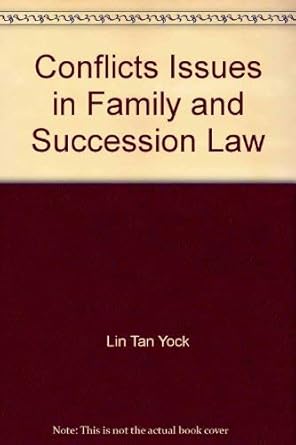


Description
by marceljude.ai
Chapter One: Conflict of Laws Techniques 1. What are conflicts issues?
This opening section teaches the reader not to say lazily that a case has “a foreign element” and stop there. Tan’s first move is to separate the three points of entry of conflicts law: jurisdiction, choice of law, and recognition/enforcement. He then shows how foreign elements may intrude through nationality, place of transaction, location of land, or the existence of a foreign judgment. The point is methodological discipline: the court must decide not merely that something foreign is present, but what legal significance that foreignness has.
2. Need of methodology
This section asks why instinct is not enough. Tan insists that a court needs a structured method because the same facts can be classified very differently in different systems. His example of a Pakistani marriage payment that looks contractual in Singapore or Malaysia but matrimonial in Pakistan shows the core danger: unless a method tells the court how to define the issue, the court may simply choose the answer it already prefers. The section is therefore about avoiding disguised arbitrariness.
3. Categories of methodology
Here Tan surveys the great explanatory models of private international law. He moves through international-jurisdiction reasoning, the old distinction between real and personal laws, Savigny’s “natural seat” theory, and more modern interest-analysis approaches. His tone is learned but skeptical. Savigny is admired for elegance, yet criticized for assuming a harmony of legal concepts that real systems do not possess; interest analysis is noticed, but Tan thinks it can dissolve into endless ad hoc balancing. He then comes back to a practical, judicial method: define the level of inquiry, classify the cause, identify the connecting factors, see where they point, and only then confront renvoi. That is the chapter’s working algorithm.
4. Proof of foreign law
This subsection is more practical than philosophical. Foreign law does not enter the forum as something automatically known; it must ordinarily be proved. Tan notes that absence of proof can sink a claim, as in cases where a foreign marriage contract or foreign personal law could not be adequately established. He also notes the familiar presumption that, if not proved otherwise, foreign law may be treated as the same as the lex fori. What matters here is that Tan is teaching the litigation reality of conflicts law: doctrine is worthless if the foreign system cannot be satisfactorily placed before the court.
5. Classification
This is one of the intellectually hardest sections in the book. Tan begins with the traditional answer that classification is for the lex fori, but he does not stop there. He distinguishes levels of classification and shows that the forum’s claim is strongest at the level of the cause of action, because the court cannot escape circularity unless it first uses its own law to identify the issue. Yet he also argues that at the level of delimiting the extent of an already chosen law, the lex causae may have a stronger claim. His discussion of cases like Ogden v Ogden and Leroux v Brown shows how classification can distort outcomes when the forum insists on its own categories too rigidly. Tan’s deeper point is that classification is not a label; it is often the disguised engine of the result.
6. Renvoi
Tan treats renvoi as a methodological problem, not a metaphysical curiosity. When a conflicts rule points to foreign law, does it point to the foreign system’s internal rules only, or to its entire law, including its own conflicts rules? He explains remission, transmission, partial renvoi, total renvoi, and the contexts where renvoi is most likely to matter: succession, wills, marriage, legitimation, and systems that divide between domicil, nationality, or personal law. He is not doctrinaire. Renvoi is useful where it helps the forum decide as the foreign court itself would decide, especially with land or status, but it is not something to universalize mechanically.
What Chapter One really does: it trains the reader to think like a conflicts lawyer before any family or succession topic is reached.
Chapter Two: Interpersonal Conflicts 1. Introduction
Tan opens by insisting that people within the same territorial state may still be governed by different private laws. That is the foundational fact of interpersonal conflict. He contrasts England, which largely suppresses the doctrine, with Singapore and Malaysia, where pluralism has had to be managed rather than denied. The section frames the whole chapter as a study of legal pluralism inside one polity.
2. Common law conflicts rules
This section traces the old reception story. English judge-made conflicts rules came into the Straits Settlements through the Charters of Justice, and those rules became the starting point for local adjudication. But Tan shows that once those rules entered a plural society, they could not remain purely English in spirit. They had to be adapted.
3. Importance of personal law
Here the book explains why personal law matters so much in this field. Marriage, divorce, legitimacy, succession, and religious identity are areas where communities historically insisted on their own normative order. Tan notes that certain old local enactments had recognized Chinese personal law irrespective of domicil, showing that personal law was not merely theoretical but institutionally embedded.
4. Interpersonal conflicts
This is the chapter’s conceptual core. Tan recounts the device by which local courts, especially under Sir Peter Maxwell, adapted ordinary conflicts techniques to plural communities by fictionally treating members of local religious communities as if they possessed a kind of foreign domicil. That was ingenious, but also unstable. Tan’s larger conclusion is that interpersonal conflicts can sometimes be handled by analogy to international conflict rules, but not always. When the clash is wholly internal, pure private international law may be the wrong tool, and legislation becomes necessary.
5. English statutory conflicts rules
Tan’s point here is mainly negative. English statutory conflicts rules mattered comparatively little because most conflicts law remained judge-made, and many English statutes were not apt for local conditions. This section is important because it clears away the illusion that local law can simply be reconstructed from English statutory imports.
6. Local legislation
At this stage Tan turns to the real sources of modern interpersonal-conflict rules in Singapore and Malaysia: local statutes on marriage, divorce, maintenance, Muslim law administration, foreign judgments, and related matters. This section marks the transition from judge-made adaptation to legislative settlement. It is the chapter’s hinge between history and modern doctrine.
7. The Women’s Charter’s solutions to interpersonal conflicts
This is one of the most important sections in the whole book. Tan explains that the Women’s Charter was designed to make a decisive statement: for non-Muslims, nearly all personal laws were to be displaced by a common statutory regime. Muslim law alone was substantially preserved. Intermarriage under the Charter was made monogamous, though the drafting initially failed fully to suppress all the old complications and needed later repair. Tan’s tone here is that of a lawyer reading a reform statute sympathetically but critically: the ambition is great, but the execution not perfect.
8. Relief of polygamous marriages
This section is about the movement from non-recognition to controlled intervention. Earlier law could refuse direct relief to parties in polygamous marriages; local statutes and practice gradually shifted toward allowing maintenance and other remedies, especially for wives. Tan shows that this was not merely benevolence but a juridical necessity once existing polygamous marriages were allowed to continue and in some cases deemed registered. He is especially attentive to maintenance as the wedge by which the forum began to intervene more realistically.
9. Interpersonal conflicts in Malaysia
The Malaysian part of the story resembles Singapore’s in some respects but remains more structurally plural. Tan shows that the treatment of non-Muslim marriage, Muslim family law, and personal-law jurisdictions remained more differentiated. This section is less about one clean solution than about a managed coexistence of regimes.
10. The administration of Muslim law in Singapore
Here Tan studies preserved Muslim jurisdiction inside a wider civil system. The section is about institutions, not only doctrine: Kathi or Syariah jurisdiction, overlap with civil courts, maintenance, and the limits of Muslim-law administration. The theme is controlled autonomy rather than complete separatism.
11. The administration of Muslim law in Malaysia
This section is more intricate because of state legislation and the deeper constitutional place of Syariah institutions. Tan notes that jurisdiction commonly depends on all parties being Muslim, which immediately creates difficulty in mixed marriages and in disputes involving a kitabiah. He also highlights concurrent or competing jurisdiction with the High Court. This is a highly regional, highly practical section.
What Chapter Two really does: it shows that conflicts law is not only about borders between countries, but also about plural normative communities inside one state.
Chapter Three: Domicil and Residence 1. Domicil
Tan begins by cleaning up the concept. Domicil is not a mere fact; it is the legal consequence of a state of facts. He distinguishes domicil imposed by law from domicil freely chosen, and he explains why law must assign a domicil where effective choice is impossible. This section also makes clear that domicil is the book’s master concept, but not an uncriticized one.
2. Domicil of choice
This section examines the classic two elements: residence and intention. Tan’s treatment is careful. He knows that intention is often ambiguous and that courts infer it from conduct, not merely declarations. He also explores difficult edge cases involving minors, intended new domicils, and abandonment. The reader learns that domicil of choice is a deeply inferential judgment, not a checklist.
3. Domicil of origin
Here Tan explains both the ordinary rule and the peculiarly English tenacity of the domicil of origin. It is assigned at birth, usually through the father for a legitimate child and the mother for an illegitimate child. More strikingly, English law treats it as never truly destroyed, only held in abeyance while a domicil of choice lasts. Tan notices how artificial that is, even while explaining why English law found the revival rule attractive.
4. Domicil of dependency
This section deals chiefly with children. Their domicil follows that of the relevant parent or adoptive parent, and the old label “quasi-domicil” surfaces. Tan is especially interested in the awkwardness of the doctrine: a child may in reality live one kind of life while law attributes to him another legal home. He also discusses whether abandonment of a dependency domicil should be easier to prove than abandonment of a domicil of origin.
5. Residence
Tan ends the chapter by separating residence from domicil. Residence can be habitual, ordinary, casual, constructive, illegal, matrimonial, or temporary; it is more factual and more context-sensitive. This is a crucial bridge to the modern law, because many later statutes and jurisdictions prefer residence to domicil precisely because it is less metaphysical and less tenacious.
What Chapter Three really does: it explains why domicil has been indispensable in private international law, and why modern law keeps looking for ways to escape its artificialities.
Chapter Four: Engagement Contracts and Marriage 1. Contracts to marry or engagement contracts
Tan starts at the contractual edge of marriage. He treats engagement not as pure sentiment but as a legal relationship capable of raising questions of service out, proper law, remedy, and public policy. This opening is deliberate: it reminds the reader that the law of marriage begins before status fully crystallizes.
2. Marriage
This subsection broadens the frame from contract to institution. The point is that marriage cannot be analysed only as an agreement; it is also a status with public consequences. That duality prepares the reader for the formal/essential validity distinction.
3. Classification in marriage formation
Tan shows that many marriage cases are really classification cases. Is a defect one of form, essence, capacity, consent, prohibited degree, parental approval, or the nature of the union itself? His use of cases like Ogden and the discussion of monogamous versus potentially polygamous unions shows how classification quietly determines which law gets to govern.
4. Choice of law – formal validity
Here the familiar rule of the lex loci celebrationis is examined. Tan treats it as strong, but not simplistic. Formal validity includes ceremony, registration, proxy, and evidentiary presumptions. This subsection is about the mechanics of solemnization and why the place of celebration usually has the best claim to govern them.
5. Choice of law – essential validity
This is the great doctrinal centre of the chapter. Tan explains why essential validity is tied to marriage as status, not just act, and why the lex domicilii has long been thought most apt. He canvasses competing views, including the lex loci celebrationis, but his own sympathy lies with domiciliary control, especially through the dual-domicil theory. At the same time, he allows a narrow public-policy escape from foreign incapacities that are penal, discriminatory, or fundamentally alien to the forum.
6. Problems of application in Singapore
This section localizes the doctrine. Tan studies how common-law rules interact with the Women’s Charter and with local attempts to curb or regulate polygamy. He is especially attentive to cases where statutory purpose seems broader than statutory draftsmanship.
7. Problems of application in Malaysia
The Malaysian section works similarly, but under the more plural framework of Act 164 and the exclusion of Muslims from its scope. Tan is very much alert here to the different institutional background within which the same common-law concepts operate.
8. Contracting a polygamous marriage
This is one of the most difficult sections in the book. Tan asks how the law determines whether a union is potentially polygamous, how capacity is tested, what happens to later marriages, how the first wife’s position matters, and how Muslim polygamy fits into the conflicts analysis. He is particularly strong on the two-stage question: first ascertain the nature and incidents of the union; then ask how the forum classifies that union.
9. Conversion of marriage
This closing section studies legal transformation: how a marriage changes category through registration, statutory intervention, religious change, or conversion from a polygamous to a monogamous regime. Tan is interested here in legal character, not just initial formation.
What Chapter Four really does: it teaches that marriage cases are rarely “just about validity”; they are about how the law classifies the type of union before it decides whether that union counts.
Chapter Five: Marriage Incidents and Orders 1. Introduction
Tan opens by separating the consequences of marriage into personal, proprietary, contractual, and remedial spheres. He also distinguishes consequences affecting only spouses from those affecting third parties. This prevents the entire chapter from collapsing into one blurry category called “effects of marriage.”
2. Personality rights
This subsection concerns the personal rights and disabilities arising between spouses. Tan includes matters such as capacity, household management, the wife’s separate legal position, the use of name, and tort immunity, while also discussing when personal laws matter and when public policy overrides them. The section’s real importance is conceptual: it marks out a sphere of purely personal incidents distinct from property.
3. Marital property
Now Tan turns to true proprietary consequences of marriage. He treats classification, community of property, death-related community, mobility, and the relevance of the lex situs. His constant warning is that not every dispute touching spousal property is itself a question of marital property relations.
4. Marital property agreement
This section deals with settlements and agreements as contracts. Tan discusses proper law, construction, third-party effects, and public policy. The larger lesson is that family law does not displace ordinary private-law reasoning; it modifies it.
5. Immutability
Here the book faces the old question whether the matrimonial property regime is fixed at marriage or may change with later movement. Tan treats the issue as one of mobility, predictability, and fairness. This is a classic conflicts problem hidden inside what might look like a domestic family-law issue.
6. Maintenance orders
This is one of the chapter’s largest and most practical sections. Tan covers wife’s maintenance, children’s maintenance, illegitimate children, orders made in guardianship or divorce contexts, jurisdiction, applicable law, foreign enforcement, finality, natural justice, and public policy. He leans toward the lex fori for the power to order maintenance, especially where policy and protection are strong, while treating foreign maintenance orders as in personam judgments subject to recognition rules and serious obstacles such as finality.
7. Restitution of conjugal rights
Tan treats this as a historically important but increasingly strained remedy. The section seems designed less to celebrate the remedy than to show how jurisdiction and recognition problems arise even in remedies that modern instincts distrust.
8. Protection orders in Singapore
This short section is forum-protective in character. Tan’s interest is in the jurisdiction and operation of these orders as local protective devices within the larger matrimonial framework.
9. Affiliation orders
Here the focus shifts to the putative father, jurisdiction, enforcement, and public policy. Tan treats affiliation not sentimentally but structurally: it is about responsibility for the child and the forum’s willingness to impose it.
10. Declaratory relief
The chapter ends with declaratory jurisdiction. This is a fitting close because declaratory relief is often the cleanest way for a court to settle questions of status and incident without immediately moving into coercive orders. Tan uses it as another example of how remedies and status interact in conflicts law.
What Chapter Five really does: it shows that once marriage is validly created, the next question is not one question but many—personal rights, property, agreements, maintenance, paternity, and status declarations all follow different logics.
Chapter Six: Divorce, Nullity and Separation Decrees 1. Introduction
This opening sets up the chapter as one about matrimonial decrees rather than marriage formation. The shift is from creating status to dissolving, denying, or suspending it.
2. Divorce jurisdiction
Tan examines the grounds on which a court may entertain divorce proceedings and the historical role of domicil. This section shows how the old dominance of domicil is gradually pressured by broader jurisdictional ideas.
3. Nullity jurisdiction
Nullity is not simply divorce by another name. Tan treats void and voidable marriages, respondent residence, common residence, and the peculiar strain of fitting nullity into older jurisdictional categories. That distinction is one of his recurrent strengths.
4. Service of petition
This section is procedural but indispensable. Tan deals with service, appearance, stay, and restraint of foreign proceedings. He understands that procedural defects can determine whether a decree is worth anything later in recognition.
5. Separation
Judicial separation is treated as a distinct remedy affecting personal rights rather than fully dissolving status. Tan uses it to illustrate how partial matrimonial remedies create their own recognition questions.
6. Jurisdiction in Singapore
This section localizes the divorce and separation rules under the Women’s Charter and their relation to ancillary relief. Tan is interested not just in the grounds of jurisdiction but also in what those grounds authorize the court to do once jurisdiction exists.
7. Jurisdiction in Malaysia
The Malaysian equivalent is shaped by Act 164 and by the exclusion of Muslims from its field. Tan pays special attention to the interaction between civil and religious jurisdiction.
8. Presumption of death and dissolution
This is one of the chapter’s most subtle sections. Tan asks whether a declaration of death is status or merely relief, and what recognition should mean when the declaration affects the validity of later remarriage. He is dissatisfied with overly procedural answers because they leave remarriage precarious.
9. Divorce recognition
This is the heart of the chapter. Tan argues that recognition is not merely the mirror image of jurisdiction. Reciprocity matters, but so do fairness to the parties, finality, and the reduction of limping marriages. This subsection is where the human stakes of conflicts law become especially visible.
10. Nullity recognition
Tan shows that nullity recognition historically lagged behind divorce recognition and suffered from doctrinal uncertainty until statutory reform. He also notes the use of ideas like “closest and most significant connection,” which he seems to treat as both useful and somewhat puzzling in the nullity context.
11. Recognition of judicial separation
This section emphasizes protection. Tan approves the logic that a spouse who has already secured judicial separation should not have to re-prove cruelty or desertion merely because she has crossed a border, provided natural justice and public policy are respected.
12. Effect of recognition
Recognition changes status, but it also radiates outward into rights and disabilities. Tan therefore treats this section as more than declaratory. Recognition may affect maintenance, remarriage, and the legal position of third parties.
13. Recognition in Singapore and Malaysia
Here Tan maps how the general principles are received under local law. The section is especially useful because it prevents the reader from assuming that English recognition doctrine operates untouched in the local setting.
14. Extra-judicial divorce and nullity
This subsection is vital in plural systems. Tan considers divorces and nullities pronounced outside ordinary judicial form, especially where religion or custom plays the determining role. The issue is not only whether such acts are valid where made, but how far a common-law court should receive them.
15. Breach of natural justice
Tan treats natural justice as the principal safeguard against over-liberal recognition. Notice, opportunity to be heard, and fairness of process are the minimum conditions for a foreign decree to travel respectably. This section is doctrinal ballast.
16. Public policy
Public policy is the final shield, but Tan uses it cautiously. He thinks it should be invoked sparingly, yet he accepts its necessity where foreign decrees trench offensively on the forum’s interests in finality, marriage registration, or basic fairness.
17. Incidents of divorce
This section studies the consequences that survive or follow the dissolution itself, including maintenance and related ancillary matters. Tan’s larger point is that foreign divorce does not automatically answer every post-divorce question.
18. Effect of divorce or nullity on capacity to marry
This is one of the chapter’s most intricate sections because it raises the “incidental question.” Does the forum first apply its recognition rules to the prior divorce and then a capacity rule to the later marriage, or is the whole question really one of capacity? Tan shows how the problem of space and time—where and when to test freedom to remarry—makes this deceptively difficult.
What Chapter Six really does: it teaches that status decrees are only useful if they can move across borders without multiplying injustice.
Chapter Seven: Children 1. Legitimacy
Tan begins with legitimacy as status. He examines applicable law, the role of valid marriage, statutory legitimacy, and the tension between forum concepts of lawful wedlock and foreign personal-law conceptions. The discussion of Muslim paternity rules shows how unstable the supposedly simple word “legitimacy” becomes in plural systems.
2. Legitimation by subsequent marriage
This section explains the old civilian fiction that later marriage retrospectively regularizes the child’s status. Tan surveys competing choice-of-law possibilities and notes the old English reluctance before statutory reform. He also considers renvoi and public policy here, which shows how conflicts doctrine infiltrates status transformation.
3. Legitimation by recognition
Tan next studies systems where a father’s recognition can legitimate the child. He shows that English law historically refused this for its own domiciliaries but might recognize it for foreign domiciliaries. At the same time, he criticizes the double-hurdle approach that required both birth-time and recognition-time domiciliary laws to concur, finding it conceptually weak.
4. Legitimation by adoption
This is a bridge section. It marks the transition from one status-conferring mechanism to another and alerts the reader that adoption will raise its own, more complex conflicts problems.
5. Adoption
Tan’s treatment of adoption is extremely rich. He defines adoption as the destruction of the natural legal bond and the creation of a new artificial parent-child relation. He then asks the hard conflicts question: whose law governs that status—the child’s, the adopter’s, or both? Singapore and Malaysia, he says, are relatively liberal in creating the status but much more guarded in recognizing foreign or extra-judicial adoptions, especially for succession consequences. This is one of the strongest sections in the chapter.
6. Capacity of child
This section is conceptually elegant. Tan separates status from capacity and argues that even if infancy is determined by the lex domicilii, particular incapacities may be ignored by the forum where the forum’s protective interests are stronger. He gives examples involving contracts, religion, education, and property. The section is really about the forum’s protective conscience.
7. Guardianship, custody and wardship
Now the chapter moves from status to protection. Tan treats these as overlapping but distinct modes of legal control and care. Welfare becomes central, but not at the expense of analytical structure.
8. Jurisdiction to appoint guardians
This section isolates the guardian-appointment power as a separate jurisdictional question. Tan’s insistence on such separation is important because it stops all child issues being conflated.
9. Jurisdiction to award custody
Custody has its own jurisdictional basis, commonly linked to residence, presence, or the child’s immediate welfare. Tan treats it as more practical and more mobile than older status categories.
10. Jurisdiction of wardship
Wardship, in Tan’s account, is the court’s highest protective jurisdiction over the child and sometimes over the child’s property. This section shows how conflicts law can become intensely supervisory.
11. Jurisdiction in Singapore
The Singapore section localizes the general doctrines under the relevant statutes and practice. Tan is attentive to the interface between imported common-law reasoning and local legislation.
12. Jurisdiction in Malaysia
In Malaysia, questions of child jurisdiction must also be read against plural family-law institutions. Tan’s value here lies in his sensitivity to that institutional background.
13. Grounds of guardianship, custody and wardship jurisdiction
This section is more detailed and likely the practical heart of the later chapter. The index shows Tan treating nationality, ordinary residence, property, unlawful removal, religion, and welfare as distinct grounds or factors. That means the section is not just about forum power; it is about why a particular forum claims it.
14. Choice of law?
The question mark in the title is telling. Tan seems to regard child-protection cases as areas where the lex fori often has a morally stronger claim than in ordinary status cases, even though personal law and religion may still matter. This subsection is about the pressure the welfare principle places on orthodox choice-of-law theory.
15. Foreign custody orders
Tan closes with recognition. Foreign custody orders matter, but they cannot be treated exactly like property judgments because the child’s welfare remains alive. The material near the end of the chapter shows Tan also engaging return-and-abduction style reasoning, with exceptions rooted in settlement, consent, grave risk, maturity, and fundamental rights.
What Chapter Seven really does: it shows that the law of children is where status doctrine and protective jurisdiction collide most dramatically.
Chapter Eight: Succession 1. Introduction
Tan opens by confronting the problem of defining succession itself. In Roman-style universal succession, heir and deceased are conceptually continuous; in English law, the executor or administrator is interposed, so official succession precedes beneficial succession. This distinction is crucial because the whole chapter depends on it.
2. Movables distinguished from immovables
This section is about classification with real bite. Tan stresses that domestic doctrines like equitable conversion do not automatically decide the conflicts classification of property as movable or immovable. The movable/immovable divide controls the applicable law and often the entire outcome.
3. Jurisdiction generally
Here Tan addresses the forum’s authority over estates, assets, administration suits, and related proceedings. The index shows a wide treatment of in personam and in rem reasoning, service out, Singapore and Malaysian grounds, and submission. This is the procedural skeleton of the chapter.
4. Choice of law generally
This subsection sets out the great scission: lex situs for immovables, domiciliary law for movables, plus the relevance of personal laws, Muslim law, public policy, and the possibility of renvoi. Tan treats scission as established, though often awkward, and contrasts it with universal systems that prefer one unitary law.
5. Official succession or administration
This is one of the chapter’s master sections. Tan distinguishes the representative phase—realizing assets, paying debts, obtaining probate or letters—from the later question of who is beneficially entitled. He resists sloppy use of “administration” because it can obscure this analytical difference.
6. Estate duty
The book then turns to fiscal questions. Though technically separate from beneficial devolution, estate duty forces the court to classify assets and identify situs with precision. Tan includes it because tax reveals how succession doctrine meets state revenue law.
7. Effect of foreign grant
This section asks what a foreign probate or grant actually accomplishes outside the place that issued it. Tan treats recognition cautiously because local administration theory and local control over assets remain strong.
8. Jurisdiction in beneficial succession
Now Tan shifts from representative authority to beneficial entitlement. This section is about the court’s jurisdiction to decide who takes, in what shares, and under what title.
9. Intestate succession to immovables
This section is firmly governed by the lex situs. Burdens on land, the course of succession, and local incidents of title are determined by the place where the land lies. Tan treats this as one of the clearest and most entrenched rules in the subject.
10. Intestate succession to movables
By contrast, Tan presents the classic rule that movables on intestacy devolve by the deceased’s last domicil. He also notes statutory embodiment of this principle locally. This is one of the most orthodox sections in the chapter.
11. Testamentary succession to immovables
For land, essential validity, trusts, charitable limits, revocation issues, and other incidents are governed by the lex situs. Tan’s examples show how forcefully the situs can override domiciliary expectations.
12. Testamentary succession to movables
This section turns back to the domiciliary law. Capacity, construction, change of domicil, revocation, and the proper law of the will all matter here. Tan is especially strong in showing that a will is not one issue but a cluster of issues.
13. Powers of appointment
Tan devotes a full section to powers of appointment, which shows the sophistication of the book. He distinguishes movables and immovables, capacity to exercise the power, essential validity, form, construction, revocation, and donor-imposed formalities.
14. Effect of foreign judgment
This section asks when a foreign succession judgment truly binds. Tan shows that recognition depends not only on jurisdictional competence but also on whether the foreign court really decided the issue now said to be closed. A judgment on marriage validity is not automatically a judgment on succession rights.
15. Doctrine of election
This is one of the chapter’s most technical and most rewarding sections. Tan explains that election arises where a will purports to dispose of property belonging to another who also takes benefits under the will. He then explores the difficult question whether election is a matter of construction or essential validity, and whether it depends on the lex ultimi domicilii or is displaced by lex situs concerns, especially with land. The section is a fine example of Tan at his most exacting.
16. Maintenance out of estate
Here Tan treats family-provision style claims. He tends to see these as part of beneficial succession, not mere administration debt, which usually means the governing law is the deceased’s last domicil. That is a subtle but important classification choice.
17. Compromise and renunciation
This section deals with settling claims, disclaiming benefits, and renouncing succession rights. Tan includes it because real estates are often distributed not by pure adjudication alone but by negotiated rearrangement or refusal to take.
18. Joint wills
The final section shows how succession crosses into contract, mutual intention, and testamentary restraint. It is a fitting end because it leaves the reader with a topic that is never purely succession and never purely contract.
What Chapter Eight really does: it proves that succession is the grand synthesis of the whole book—classification, jurisdiction, domicil, situs, personal law, renvoi, recognition, and equitable doctrine all converge here.
Final judgment on this second layer
When you read the book at subsection level, a clearer pattern emerges. Tan is not just giving rules chapter by chapter. He is doing three things at once. He is teaching method, especially classification and connecting factors; he is mapping how that method changes when one moves from marriage formation to incidents, decrees, children, and death; and he is insisting that Singapore and Malaysia cannot be understood by borrowing English doctrine without adjustment. The preface states that ambition openly, and the detailed structure of the chapters carries it through.
At this deeper level, the book looks even stronger than at first glance. Chapter One gives the conceptual tools. Chapter Two supplies the specifically local difficulty of plural personal laws. Chapters Three to Seven show how those tools work in status and family relations. Chapter Eight then gathers everything into succession, where the classificatory choices become brutally outcome-determinative. That architecture is very deliberate and very intelligent.
The deepest scholarly virtue of the work is this: Tan never lets a family-law problem remain merely a family-law problem. He keeps asking the higher-order question—what kind of legal question is this, and why should that classification govern the choice of law or recognition rule? That is exactly the habit of mind a serious law lecturer would want a student to acquire.
- MALAYSIA'S 1ST AI LAWYER - CLICK HERE
- ISMAIL – INTEGRATED SINGAPORE/MALAYSIA AI & LAW (Library)
- OPENING OF SINGAPORE MALAYSIA AI CENTRE AND LAW LIBRARY
- LIFT - LAW INSTRUMENTS FORMS & TEMPLATES
- LAWS OF MALAYSIA FOR SINGAPOREAN DUMMIES
- HANNAH YEOH'S ARTIFICIAL INTELLIGENCE LAW ENCYCLOPEDIA
- LEAD CR - Law Ecosystem Archive Databases on CD-ROM
- BREAKING NEWS FROM MJN
- CLICK HERE CO. PROFILE
- EXCITING NEW SERIES - THE ADVENTURES OF BOBBY TAN -ADVOCATE & SOLICITOR IN THE HIGH COURT OF NORTH BORNEO by marceljude.ai
- MEDICO LEGAL - BY PRISKILA AKWILA & GLORIOUS PETAL SDN BHD - powered by marceljude.ai
- MISCELLANOUS
- ANNOTATED STATUTES OF SABAH - A NEW SERIES
- e-library - marceljude.ai
- DRAFT - DOCUMENT RESEARCH & AUTOMATED FILING TECHNOLOGY
- CLARA – Case Law Analysis & Retrieval AI
- FOR RESEARCH REQUEST CLICK HERE
- CLICK HERE TO ASK ANYTHING
- RAMBO'S LAW - THE LAW OF THE LAW JUNGLE - EXCITING NEW SERIES - CASE ANALYSIS BY JOHN RAMBO @ +60138646786
- PRISKILA AKWILA ADVOCATES - High Court of Sabah & Sarawak @ Kota Kinabalu
- COLA - COMMONWEALTH ONLINE LAWCASES AI -marceljude.ai
- THE LAW LIBRARY THAT COMES TO YOU ANYWHERE AND ANYTIME
- marceljude.ai training academy
