
ENVIROMENTAL QUALITY ACT 1974 (WITH AMENDMENTS) -marceljude.ai
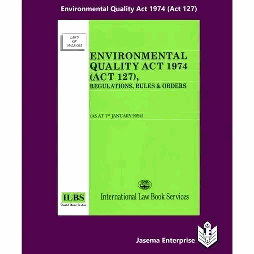
Book Review of Environmental Quality Act 1974 (Act 127) - ANNOTATED STATUTES MALAYSIA
Author of Review: marceljude.ai
I read the book text before me and reviewed the principal Act section by section. Because this is legislation rather than an ordinary narrative book, I treat each Part as a “chapter,” and each statutory section as a review unit. . I also checked the Environmental Quality (Amendment) Act 2024, Act A1712, because the book’s printed statutory text must now be read with that later amendment. The Department of Environment lists Act A1712 as the 2024 amendment to the Environmental Quality Act, and Act A1712 states that it is an Act to amend the Environmental Quality Act 1974; a Malaysian legal update records that it came into operation on 7 July 2024 by Gazette Notification P.U.(B) 243/2024. There is a further sub section dealing with amendments at the end of this article.
List of Contents
The book’s main statutory structure is:
Introduction — pages 1–4.
Part I: Preliminary — sections 1–2, pages 5–12.
Part II: Administration — sections 3–9, pages 13–20.
Part III: Licences — sections 10–17, pages 20–30 . Part IV: Prohibition and Control of Pollution — sections 18–34A, pages 31–69.
Part IVA: Control of Scheduled Wastes — section 34B, pages 69–70.
Part V: Appeal and Appeal Board — sections 35–36, pages 71–74.
Part VA: Payment of Cess and Environmental Fund — sections 36A–36E, pages 74–77.
Part VI: Miscellaneous — sections 37–51, pages 77–103.
List of Amendments — pages 103–104.
Appendix of subsidiary legislation — begins at page 104 and includes licensing, prescribed premises, clean air, compounding, raw natural rubber, sewage and industrial effluents, motor gasoline, motor vehicle noise, EIA prescribed activities, scheduled wastes, delegation, refrigerant, halon, motorcycle emissions, dioxin and furan, prescribed conveyance, and petrol/diesel property instruments.
Overall Review of the Entire Book
As a legal text, the book is best read as a structured statutory commentary on Malaysia’s central environmental pollution-control statute. Its core value lies in showing that the Environmental Quality Act 1974 is not merely a criminal statute. It is an administrative-law framework, a licensing statute, a pollution-control statute, an enforcement statute, and a remedial statute. Its genius is institutional: it builds the Director General of Environmental Quality into the centre of Malaysian environmental regulation, then surrounds that office with licensing, monitoring, investigation, enforcement, appeal, fund-raising, and delegated rule-making powers.
The book’s introduction correctly frames the Act as a decisive move away from scattered resource-management laws toward a dedicated environmental protection regime. The long title of the Act is broad: prevention, abatement, control of pollution, and enhancement of the environment. That breadth matters because it allows the Act to regulate not only visible pollution, but also risks, emissions, discharges, deposits, scheduled wastes, monitoring duties, environmental audits, EIA obligations, and the institutional machinery needed to enforce them.
From a law professor’s perspective, the book’s strongest quality is that it does not treat environmental law as isolated from general law. It repeatedly connects the Act with administrative discretion, statutory interpretation, criminal liability, evidence, common law nuisance, negligence, strict liability, public nuisance, locus standi, judicial review, and regulatory offences. That is exactly how environmental law operates in practice: pollution cases rarely stay inside one statute.
The main weakness of the Act, as revealed by the book, is its historically control-oriented model. The Act allows the Minister to prescribe “acceptable conditions,” and liability often turns on whether those conditions are exceeded. That model is administratively workable, but it can under-protect the environment where “acceptable” standards later prove ecologically unsafe. The book itself notes this criticism in its discussion of pollution control and acknowledges the continued relevance of common law remedies such as nuisance, negligence, and the rule in Rylands v Fletcher.
The 2024 Amendment Act makes the statute much sharper in penalty terms. Act A1712 mainly strengthens fines, creates or inserts penalty provisions, substitutes open-burning provisions, deletes section 29AA, adds a general definition of open burning, and expands compounding and regulation-making machinery. This is not a cosmetic amendment. It changes the enforcement culture of the Act by making non-compliance more expensive and, in several places, more punitive.
Chapter Review: Introduction, pages 1–4
The introduction is historical and conceptual. It explains that before the Act, Malaysian environmental protection was fragmented among laws dealing with land conservation, wildlife, fisheries, mining, forests, and waters. The Act is presented as the statute that gives Malaysia an integrated environmental-control framework. The introduction’s major legal theme is that the Act is divided into administrative institutions, licensing, pollution-control offences, scheduled waste, appeals, environmental funds, and miscellaneous enforcement powers.
The introduction’s most important jurisprudential point is that the Act is largely licensing and control based. Pollution is not always treated as absolutely forbidden. Rather, the Act often permits emissions, discharges, or deposits within acceptable limits or under licence. That makes the Act practical for industry, but it also means regulatory standards must be scientifically current and strictly enforced.
The introduction also rightly highlights later insertions such as open-burning control, environmental audit, EIA, scheduled-waste controls, cess, and the Environmental Fund. These additions show an Act that began as a general pollution-control statute but evolved into a more complex environmental governance code.
Chapter Review: Part I — Preliminary, sections 1–2, pages 5–12
Section 1 — Short title, application and commencement, page 5
Section 1 gives the Act its formal identity: Environmental Quality Act 1974. It applies to the whole of Malaysia, and commencement is by ministerial notification. The legal effect is foundational. It confirms that this is a national environmental statute, but also allows staged commencement across provisions or areas.
2024 amendment: No direct amendment to section 1 by Act A1712.
Section 2 — Interpretation, pages 6–12
Section 2 is one of the most important sections in the Act because environmental liability depends heavily on definitions. “Environment,” “pollution,” “waste,” “pollutants,” “environmentally hazardous substances,” “scheduled wastes,” “premises,” “owner,” “occupier,” “vehicle,” “ship,” “Malaysian waters,” “control equipment,” “monitoring programme,” and “environmental audit” all shape the reach of the Act.
As a law professor, I would stress that section 2 is not a mere glossary. It is a jurisdictional engine. If something falls within “waste,” “pollutant,” “scheduled waste,” or “environmentally hazardous substance,” the Act’s licensing and enforcement machinery may become available. The definitions of “owner” and “occupier” are especially important because environmental offences often attach to control, possession, or operational responsibility rather than personal physical wrongdoing.
2024 amendment: Yes. Act A1712 amends section 2 by inserting a definition of “open burning” after the definition of “oil.” The inserted definition states that open burning means fire, combustion, or smouldering in the open air not directed through a chimney or stack. This is significant because open burning becomes a general statutory term rather than only a concept located inside section 29A.
Chapter Review: Part II — Administration, sections 3–9, pages 13–20
Part II is the administrative constitution of the Act. It establishes the Director General and the Environmental Quality Council. The Act’s enforcement strength depends on this Part because environmental law cannot work without a specialised administrative authority.
Section 3 — Director General and other officers, pages 13–14
Section 3 creates the office of the Director General of Environmental Quality and lists extensive functions: administering the Act, coordinating waste-discharge control, recommending policy, licensing dangerous emissions and discharges, conducting investigations, promoting research, developing criteria, recommending standards, publishing reports, specifying sampling methods, investigating complaints, educating the public, administering the Fund, and maintaining liaison with State Authorities and other countries.
This is the Act’s administrative centre of gravity. The Director General is regulator, investigator, standard-setter, licensing authority, researcher, public educator, and enforcement coordinator. The breadth is powerful but demands accountability because wide discretion can become arbitrary if not bounded by legal principle.
2024 amendment: Yes. Act A1712 amends section 3(1) by adding paragraph (p), giving the Director General power “to determine uniforms for officers appointed under subsection (2).” This is operational, but symbolically it strengthens enforcement identity and official authority.
Section 4 — Establishment of the Environmental Quality Council, pages 15–16
Section 4 creates the Environmental Quality Council. Its role is advisory, not executive. Its membership includes government representatives, industry representatives, academic members, and environmental-interest representation. The Council’s structure shows the Act’s attempt to balance technical, governmental, commercial, and public-interest perspectives.
2024 amendment: No direct amendment to section 4 by Act A1712.
Section 5 — Duration of office and eligibility for reappointment, page 17
Section 5 provides appointed Council members with terms not exceeding three years and eligibility for reappointment. This creates continuity without making membership permanent.
2024 amendment: No direct amendment to section 5 by Act A1712.
Section 6 — Disqualification, resignation and vacation from office, pages 17–18
Section 6 protects institutional integrity. It disqualifies persons of unsound mind, persons convicted of offences involving fraud, dishonesty or moral turpitude, and bankrupts or persons who have arranged with creditors. It also sets out vacancy events such as death, resignation, absence from meetings, or later disqualification.
2024 amendment: No direct amendment to section 6 by Act A1712.
Section 7 — Calling of meetings, quorum, voting, procedure and minutes, pages 18–19
Section 7 ensures the Council actually functions. It requires meetings every four months, sets quorum, gives the chair a casting vote, allows the Council to regulate its own procedure, and requires minutes to be submitted to the Minister.
2024 amendment: No direct amendment to section 7 by Act A1712.
Section 8 — Presiding officer at meetings, page 19
Section 8 deals with chairing meetings. The Chairman presides, and if absent, members elect one of themselves to preside. No business may be transacted until that is done.
2024 amendment: No direct amendment to section 8 by Act A1712.
Section 9 — Remuneration, page 20
Section 9 allows appointed members to be paid attendance sums determined by the Minister. This is administrative but important because statutory councils need workable attendance incentives.
2024 amendment: No direct amendment to section 9 by Act A1712.
Chapter Review: Part III — Licences, sections 10–17, pages 20–30
Part III is the practical regulatory heart of the Act. The Act does not rely only on punishment after pollution occurs. It uses licences to regulate before, during, and after environmentally sensitive activities. The book’s introduction to licensing notes that the Director General is the licensing authority and that licences are required for prescribed premises, atmosphere pollution, noise, soil pollution, inland waters, oil in Malaysian waters, and wastes in Malaysian waters.
Section 10 — Licensing authority, page 20
Section 10 states that the Director General is the licensing authority. This gives one office central responsibility and avoids fragmented licensing.
2024 amendment: No direct amendment to section 10 by Act A1712.
Section 11 — Licences, pages 21–24
Section 11 governs applications, renewals, transfers, information duties, conditional and unconditional grants, variation of conditions, and refusal where premises use would breach planning or land-use law. Subsection (4) is especially important because it requires the Director General, before varying or adding conditions, to consider practicability, economic life of equipment, pollution reduction, compliance cost, and the nature and size of the trade or industry.
Legally, section 11 balances environmental control with administrative fairness. It prevents licensing power from being purely arbitrary by requiring relevant factors to be considered.
2024 amendment: No direct amendment to section 11 by Act A1712.
Section 12 — Power to attach conditions to licences, pages 24–26
Section 12 allows licence conditions requiring repair, alteration, replacement, control equipment, monitoring programmes, and deadlines. It also protects appellants by delaying the force of certain conditions until the appeal period expires or the appeal confirms the decision.
This section is crucial because licence conditions are how broad policy becomes operational compliance.
2024 amendment: No direct amendment to section 12 by Act A1712.
Section 13 — Duration and renewal of licences, pages 26–27
Section 13 sets licence duration, renewal timing, late fees, expiry fees, and postal application rules. It makes environmental licensing time-bound rather than indefinite.
2024 amendment: No direct amendment to section 13 by Act A1712.
Section 14 — Transfer of licences, page 28
Section 14 allows transfer where the licence holder ceases to be occupier of the premises. This is important because environmental obligations must follow operational control.
2024 amendment: No direct amendment to section 14 by Act A1712.
Section 15 — Register of licences, page 28
Section 15 requires prescribed registers of licences. A register supports transparency, administration, and proof.
2024 amendment: No direct amendment to section 15 by Act A1712.
Section 16 — Licensee to comply with licence, pages 28–29
Section 16 is the compliance anchor of Part III. A licence is not merely permission; it is permission burdened by enforceable terms and conditions. The printed book states the duty to comply and provides a penalty for breach.
2024 amendment: Yes. Act A1712 substitutes section 16(2). The amended penalty is a fine of not less than RM25,000 and not more than RM250,000, or imprisonment for up to five years, or both, plus a continuing fine of RM1,000 per day after notice. This is a major strengthening from the older penalty model.
Section 17 — Licence fees, pages 29–30
Section 17 allows fees to be prescribed by class of premises, location, quantity of waste, type of pollutant, and existing pollution level. It also allows recovery where inspection shows higher or different pollution than declared.
This section is economically sophisticated. It links regulatory cost to pollution burden and discourages under-declaration.
2024 amendment: No direct amendment to section 17 by Act A1712.
Chapter Review: Part IV — Prohibition and Control of Pollution, sections 18–34A, pages 31–69
Part IV is the largest and most doctrinally important Part. It controls prescribed premises, construction or alteration of premises, acceptable conditions, air, noise, soil, inland waters, oil, Malaysian waters, open burning, product controls, control equipment, environmental audits, exemptions, and EIA. This is where environmental law moves from administration into direct regulation.
Section 18 — Prescribed premises to be licensed, pages 31–34
Section 18 allows the Minister, after consultation with the Council, to prescribe premises requiring a licence. It also covers prescribed conveyances for movement, transfer, placement, or deposit of wastes. Transitional protection is given to persons who apply within prescribed periods.
2024 amendment: Yes. Act A1712 substitutes section 18(3). Contravention of section 18(1) or 18(1A) now attracts a fine of RM25,000 to RM250,000, imprisonment up to five years, or both, plus RM1,000 per day for continuing offence after notice.
Section 19 — Prohibition against causing vehicle, ship or premises to become prescribed conveyance or prescribed premises, pages 34–35
Section 19 prevents parties from creating regulated environmental risk by works, construction, or alteration without prior written permission. It captures both conversion of existing premises and construction of new premises designed for regulated use.
2024 amendment: Yes. Act A1712 renumbers the existing section as subsection (1) and inserts subsection (2), creating an express offence and penalty: fine of RM25,000 to RM250,000, imprisonment up to five years, or both, plus RM1,000 per day for continuing offence after notice.
Section 20 — Requirement and approval of plans, pages 36–37
Section 20 requires applications for work, building, erection, or alteration to include plans, specifications, layout, trade details, waste descriptions, and other information. The Director General may grant approval subject to conditions and may require control equipment or monitoring programmes.
This section links environmental law with planning law. Environmentally sensitive premises should not be built first and regulated later; the plan must be examined before the activity is allowed.
2024 amendment: No direct amendment to section 20 by Act A1712.
Section 21 — Power to specify conditions of emission, discharge, etc., pages 37–39
Section 21 allows the Minister, after consultation with the Council, to specify acceptable conditions for emissions, discharges, deposits, and noise, and to set aside prohibited or restricted areas. The book notes the importance of subsidiary legislation for acceptable conditions, including clean air, sewage and industrial effluents, noise, diesel engines, and petrol engines.
2024 amendment: No direct amendment to section 21 by Act A1712.
Section 22 — Restrictions on pollution of the atmosphere, pages 39–43
Section 22 prohibits unlicensed atmospheric emissions or discharges in contravention of acceptable conditions. Subsection (2) deems several acts to be atmospheric emission, including placing matter where it may be released, offensive odours, burning trade wastes, and using fuel-burning equipment without required control devices.
2024 amendment: Yes. Act A1712 substitutes section 22(3). Contravention now attracts a fine of RM10,000 to RM1,000,000, imprisonment up to five years, or both, plus a further daily fine up to RM1,000 after notice.
Section 23 — Restrictions on noise pollution, pages 43–44
Section 23 prohibits unlicensed noise beyond acceptable conditions. It treats noise as an environmental pollutant, not merely a private annoyance.
2024 amendment: Yes. Act A1712 substitutes section 23(2). The new penalty is a fine of RM10,000 to RM250,000, imprisonment up to five years, or both, plus a continuing daily fine up to RM1,000 after notice.
Section 24 — Restrictions on pollution of the soil, pages 44–46
Section 24 prohibits unlicensed soil or land-surface pollution contrary to acceptable conditions. It deems soil pollution to include placing matter where it may reach soil and using land for waste, sludge, refuse, or disposal in ways offensive to humans, harmful to groundwater, or detrimental to beneficial soil use.
2024 amendment: Yes. Act A1712 substitutes section 24(3). The amended penalty is a fine of RM50,000 to RM500,000, imprisonment up to five years, or both, plus a continuing daily fine up to RM1,000 after notice.
Section 25 — Restrictions on pollution of inland waters, pages 46–50
Section 25 prohibits unlicensed emission, discharge, or deposit of environmentally hazardous substances, pollutants, or wastes into inland waters contrary to acceptable conditions. Subsection (2) is broad: it captures direct placement, indirect placement where waste may fall, drain, evaporate, wash, blow, or percolate into waters, and thermal alteration beyond prescribed limits. The book’s notes connect this section with both statutory prosecutions and common law water-pollution claims.
2024 amendment: Yes. Act A1712 substitutes section 25(3). The new penalty is imprisonment up to five years and a fine of RM50,000 to RM10,000,000.
Section 26 — Deleted, page 50
Section 26 is deleted. Historically it related to oil discharge into the sea, but the current scheme is handled elsewhere, especially section 27.
2024 amendment: No new amendment to section 26 by Act A1712.
Section 27 — Prohibition of discharge of oil into Malaysian waters, pages 50–51
Section 27 prohibits unlicensed discharge or spillage of oil or a mixture containing oil into Malaysian waters contrary to acceptable conditions.
2024 amendment: Yes. Act A1712 substitutes section 27(2). The new penalty is a fine of RM100,000 to RM10,000,000, imprisonment up to five years, or both.
Section 28 — Special defences, pages 51–52
Section 28 provides defences to section 27 charges, including discharge or spillage for vessel safety, saving human life, vessel damage with reasonable steps taken, leakage not due to lack of care with reasonable steps taken, or refinery effluent where reasonable steps were taken and alternative disposal was not reasonably practicable.
This section is important because marine pollution law must accommodate emergencies, navigation, and human safety.
2024 amendment: No direct amendment to section 28 by Act A1712.
Section 29 — Prohibition of discharge of wastes into Malaysian waters, pages 52–53
Section 29 prohibits unlicensed discharge of environmentally hazardous substances, pollutants, or wastes into Malaysian waters contrary to acceptable conditions.
2024 amendment: Yes. Act A1712 substitutes section 29(2). The new penalty is a fine of RM50,000 to RM10,000,000, imprisonment up to five years, or both.
Section 29A — Prohibition on open burning, pages 53–54
In the book, section 29A prohibits allowing or causing open burning on any premises, defines open burning, and imposes a penalty. Its policy objective is clear: open burning is treated as a public environmental harm because of its air-quality consequences.
2024 amendment: Yes. Act A1712 substitutes section 29A completely. The new section prohibits a person from committing, allowing, instructing, or causing open burning on any premises. It also moves the exemption mechanism into section 29A itself, allows the Minister to declare certain fires not to be open burning if conditions are followed, allows prohibition orders where air quality is unhealthy and burning would be hazardous, allows the Director General to remove such orders, and imposes a penalty of RM25,000 to RM1,000,000, imprisonment up to five years, or both, plus a continuing fine up to RM5,000 per day after notice.
Section 29AA — Exclusion from “open burning,” pages 54–55
In the book, section 29AA allows the Minister to exclude specified fires, combustion, or smouldering from the definition of open burning under conditions. It also allows restrictions during unhealthy air-quality conditions.
2024 amendment: Yes. Act A1712 deletes section 29AA. Its function is effectively absorbed into the substituted section 29A.
Section 29B — Owner or occupier liable for open burning, page 55
Section 29B creates a deeming rule: where open burning occurs on premises, the owner or occupier with control is deemed to have contravened section 29A(1) unless the contrary is proved. This is a strong responsibility provision because open burning often occurs on land where proving the actual burner may be difficult.
2024 amendment: No direct amendment to section 29B by Act A1712.
Section 29C — Defence, pages 55–56
Section 29C gives defences for prosecutions under section 29A or 29B. The person, owner, or occupier may prove that burning occurred outside control or without knowledge, connivance, or consent, or that reasonable precautions or due diligence were exercised.
2024 amendment: No direct amendment to section 29C by Act A1712.
Section 30 — Power to prohibit use of any material or equipment, pages 56–57
Section 30 allows the Minister, after consultation with the Council, to prohibit use of materials, equipment, or industrial plant by order. This is preventive regulation: it allows dangerous processes or equipment to be stopped before pollution occurs.
2024 amendment: No direct amendment to section 30 by Act A1712.
Section 30A — Power to control use of substance and product and to state environmental labelling, pages 57–58
Section 30A allows the Minister to prescribe environmentally hazardous substances requiring reduction, recycling, recovery, or regulation, and to prescribe products for sale that must contain recycled substances and carry environmental declarations. It also allows rules on environmental labelling.
2024 amendment: Yes. Act A1712 substitutes section 30A(3). Failure or refusal to comply with an order under section 30A(1) now attracts a fine of RM25,000 to RM250,000, imprisonment up to five years, or both.
Section 30B — Deposit and rebate schemes, page 58
Section 30B allows guidelines and procedures for deposit and rebate schemes for environmentally unfriendly products or products causing adverse environmental constraint. It anticipates circular-economy regulation by encouraging return, recycling, and environmentally sound disposal.
2024 amendment: No direct amendment to section 30B by Act A1712.
Section 31 — Power to require owner or occupier to install, operate, repair, etc., pages 58–60
Section 31 is one of the Act’s most practical enforcement tools. It allows the Director General to require owners or occupiers of vehicles, ships, premises, or aircraft to install or operate control equipment, repair equipment, increase chimney height, measure and report pollutants, conduct risk studies, run monitoring programmes, or adopt mitigation measures. It also allows directions on timing and manner of emissions or processes.
2024 amendment: Yes. Act A1712 substitutes section 31(3). Contravention of a notice under subsection (1) or (2) now carries a fine of RM50,000 to RM1,000,000, imprisonment up to five years, or both, plus a continuing daily fine up to RM1,000.
Section 31A — Prohibition order, etc., pages 60–61
Section 31A empowers prohibition orders where circumstances justify preventing continued operation of industrial plant or processes releasing environmentally hazardous substances, pollutants, or wastes. It also allows ministerial direction where environment, public health, or safety is under serious threat.
2024 amendment: Yes. Act A1712 substitutes section 31A(3). Contravention of a prohibition order or ministerial order now carries imprisonment up to five years and a fine of RM50,000 to RM1,000,000.
Section 32 — Owner or occupier to maintain and operate equipment, pages 61–62
Section 32 requires owners or occupiers to maintain equipment and control equipment in good condition and operate it properly and efficiently. This is a continuing operational duty, not just an installation duty.
2024 amendment: Yes. Act A1712 renumbers the existing provision as subsection (1) and inserts subsection (2), creating an express offence and penalty: fine of RM5,000 to RM100,000, imprisonment up to five years, or both, plus a continuing daily fine up to RM1,000 after notice.
Section 33 — Power to prohibit or control licensed persons from discharging wastes in certain circumstances, pages 62–63
Section 33 addresses cumulative pollution. Even if several licensees individually comply with their licences, their aggregate discharges may worsen environmental conditions. The Director General may require each licensee to abate emissions, discharges, or deposits.
This is legally sophisticated because environmental harm is often cumulative, not individual.
2024 amendment: Yes. Act A1712 substitutes section 33(2). Contravention now carries a fine of RM50,000 to RM1,000,000, imprisonment up to five years, or both, plus a continuing daily fine up to RM1,000.
Section 33A — Environmental audit, page 63
Section 33A allows the Director General to require owners or occupiers of vehicles, ships, or premises to carry out environmental audits and submit reports. It also requires appointment of registered qualified personnel.
This section is governance-based. It pushes compliance from mere reaction to systematic evaluation of environmental risk.
2024 amendment: No direct amendment to section 33A by Act A1712.
Section 34 — Exemptions, page 64
Section 34 allows exemptions for investigation or research relevant to pollution problems. The book’s commentary correctly notes that discretionary power remains subject to administrative-law control: legality, relevance, reasonableness, proper purpose, and procedural safeguards.
2024 amendment: No direct amendment to section 34 by Act A1712.
Section 34A — Report on impact on environment resulting from prescribed activities, pages 64–69
Section 34A is the EIA provision. It requires persons intending to carry out prescribed activities to submit an environmental impact assessment report before approval is granted. The report must assess likely environmental impact and proposed measures to prevent, reduce, or control adverse effects. The Director General may approve, approve with conditions, reject with reasons, require more than one report, and require proof of compliance during implementation. The book connects this section with cases on locus standi, public participation, prescribed activities, and the role of approving authorities.
2024 amendment: Yes. Act A1712 substitutes section 34A(8). Contravention now carries imprisonment up to five years and a fine of RM100,000 to RM1,000,000.
Chapter Review: Part IVA — Control of Scheduled Wastes, section 34B, pages 69–70
Part IVA is short but extremely important. Scheduled wastes are hazardous wastes, and the book notes that this Part was introduced in connection with transboundary movement and the Basel Convention framework.
Section 34B — Prohibition against placing, deposit, etc. of scheduled wastes, pages 69–70
Section 34B prohibits placing, depositing, or disposing scheduled wastes except at prescribed premises; receiving or sending scheduled wastes in or out of Malaysia; and transit of scheduled wastes without prior written approval of the Director General. It also treats falsified, fraudulent, or materially non-conforming approval documents as an offence.
This section is one of the Act’s most internationally important provisions because hazardous waste easily crosses borders and can create long-term ecological and public-health harms.
2024 amendment: Yes. Act A1712 substitutes section 34B(4). Contravention now carries imprisonment up to five years and a fine of RM100,000 to RM10,000,000.
Chapter Review: Part V — Appeal and Appeal Board, sections 35–36, pages 71–74
Part V is the due-process chapter. Environmental regulators need strong powers, but regulated persons need appeal rights. The Act therefore creates an Appeal Board structure.
Section 35 — Appeal, pages 71–72
Section 35 allows an aggrieved person to appeal against refusal of a licence or transfer, licence conditions, revocation, suspension or variation, amounts payable under section 47, decisions under section 34A, and decisions under section 48A. This is important because administrative environmental decisions can affect property, business, development, and liberty.
2024 amendment: No direct amendment to section 35 by Act A1712.
Section 36 — Appeal Board, pages 72–74
Section 36 creates the Appeal Board, provides for chairman and deputy chairman, appointment qualifications, panel members, revocation of appointments, conflict disclosure, decision-making, costs, procedure, records, and remuneration. The Board is a specialised appellate body designed to bring legal structure into environmental administrative disputes.
2024 amendment: No direct amendment to section 36 by Act A1712.
Chapter Review: Part VA — Payment of Cess and Environmental Fund, sections 36A–36E, pages 74–77
Part VA introduces environmental finance. It recognises that regulation requires money: research, cleanup, mitigation, emergency response, and conservation cannot depend only on ordinary budgets.
Section 36A — Research cess, pages 74–75
Section 36A allows the Minister, after consultation with the Minister of Finance and the Council, to impose, vary, or cancel a cess on waste generated for pollution research. It can provide different rates and exemptions.
2024 amendment: No direct amendment to section 36A by Act A1712.
Section 36B — Establishment of Environmental Fund, page 75
Section 36B establishes the Environmental Fund as a Trust Account within the Federal Consolidated Fund. It consists of government money, donations, cess money, and contributions under section 36D.
2024 amendment: No direct amendment to section 36B by Act A1712.
Section 36C — Environmental Fund Committee, page 76
Section 36C establishes the Environmental Fund Committee, chaired by the Director General, with senior environmental officers and public officers. It controls the Fund and regulates its own proceedings.
2024 amendment: No direct amendment to section 36C by Act A1712.
Section 36D — Contribution into the Fund, pages 76–77
Section 36D allows the Minister, after consultation with the Council, to require contributions from persons engaged in oil exploration, extraction, refining, production, bulk movement, distribution or storage; environmentally hazardous substances; or bulk movement/storage of waste.
2024 amendment: No direct amendment to section 36D by Act A1712.
Section 36E — Application of the Fund, page 77
Section 36E applies the Fund to research, waste recovery, pollution removal or mitigation, preventing or combating oil spills and hazardous-substance or waste discharges, and encouraging conservation measures.
2024 amendment: No direct amendment to section 36E by Act A1712.
Chapter Review: Part VI — Miscellaneous, sections 37–51, pages 77–103
Part VI is called “Miscellaneous,” but that label understates its importance. It contains information-gathering powers, search and seizure powers, evidence rules, penalties, corporate liability, prosecution consent, compounding, jurisdiction, forfeiture, compensation, cost recovery, vehicle detention, delegation, secrecy, and regulation-making power. In practice, this is the enforcement architecture of the Act.
Section 37 — Owner or occupier to furnish information, pages 77–79
Section 37 allows the Director General to require information about ownership, raw materials, environmentally hazardous substances, processes, equipment, discharges, and environmental risk. False or misleading information is an offence.
2024 amendment: Yes. Act A1712 substitutes section 37(2). The penalty for failing to answer, failing to furnish information, or giving materially false or misleading information is now a fine of RM5,000 to RM50,000, imprisonment up to two years, or both.
Section 38 — Power to stop, board, search, etc., pages 79–81
Section 38 allows warrantless stopping, boarding, searching, entry, inspection, examination, seizure, detention, copying, extraction, and sampling where the Director General or authorised officer believes an offence has been committed and investigation requires action. It covers vehicles, ships, aircraft, premises, equipment, computers, records, scheduled wastes, environmentally hazardous substances, and samples.
2024 amendment: No direct amendment to section 38 by Act A1712.
Section 38A — Power to examine person acquainted with case, pages 81–82
Section 38A allows oral examination of persons acquainted with facts and circumstances. Statements must be reduced into writing where possible. Persons must answer but may refuse self-incriminating questions. This section is investigative but includes a basic protection against compelled self-incrimination.
2024 amendment: No direct amendment to section 38A by Act A1712.
Section 39 — Service of notices, pages 82–83
Section 39 provides methods of service: personal delivery, delivery to adult family member or servant, leaving at usual or last known abode or business, registered post, description-based service on owners or occupiers, and affixing to premises.
2024 amendment: No direct amendment to section 39 by Act A1712.
Section 40 — Evidence, pages 83–85
Section 40 contains evidentiary presumptions. Documents prepared or served under the Act are presumed correct until contrary proof. Registers of licences are prima facie proof. Certificates may establish occupier status and licensing status.
This is highly practical because environmental prosecutions often depend on documentary proof.
2024 amendment: No direct amendment to section 40 by Act A1712.
Section 41 — Penalty for offences not otherwise provided for, pages 85–86
Section 41 is the residual penalty section. It catches omissions, neglect, acts contrary to the Act or regulations, and breaches of licence conditions where no specific penalty is provided.
2024 amendment: Yes. Act A1712 amends section 41 by replacing the old fine wording with a fine of RM5,000 to RM250,000. The imprisonment element from the existing section remains part of the residual penalty framework unless separately amended in the current consolidated text.
Section 42 — Attempts and abetments, pages 86–87
Section 42 punishes attempts and abetments with the punishment provided for the substantive offence. This prevents offenders from escaping liability merely because the environmental offence was not completed.
2024 amendment: No direct amendment to section 42 by Act A1712.
Section 43 — Offences by bodies of persons and by servants and agents, pages 87–88
Section 43 is a corporate and vicarious liability provision. Directors, chief executive officers, managers, partners, and similar officers may be deemed guilty unless they prove lack of consent or connivance and due diligence. Principals may also be liable for acts of clerks, servants, or agents committed in the course of employment.
This is essential in environmental law because pollution is often organisational, not merely personal.
2024 amendment: No direct amendment to section 43 by Act A1712.
Section 44 — Prosecution, page 88
Section 44 requires written consent of the Public Prosecutor before prosecution. This centralises prosecutorial control and prevents uncontrolled private prosecution under the Act.
2024 amendment: No direct amendment to section 44 by Act A1712.
Section 45 — Compounding of offences, pages 88–90
Section 45 allows specified authorities to compound prescribed compoundable offences by accepting money from persons reasonably suspected of committing offences. Compounding is an administrative alternative to prosecution.
2024 amendment: Yes. Act A1712 substitutes section 45(1). The amended provision allows the Director General, Deputy Director General, public officer, Government Department, local authority, or corporation delegated by the Director General, with written consent of the Public Prosecutor, to compound prescribed offences for a sum not exceeding 50% of the maximum fine that would apply on conviction.
Section 46 — Sessions Court and Magistrate jurisdiction, page 90
Section 46 gives specified courts jurisdiction to try offences and award full punishment. This prevents jurisdictional limits from weakening enforcement.
2024 amendment: No direct amendment to section 46 by Act A1712.
Section 46A — Power to seize vehicle or ship, pages 90–91
Section 46A allows seizure of vehicles or ships used in transportation or disposal of waste in contravention of the Act or regulations. Release may occur on bond or adequate security.
2024 amendment: No direct amendment to section 46A by Act A1712.
Section 46B — Power of forfeiture and disposal, page 91
Section 46B allows forfeiture and disposal where the court is satisfied that a seized vehicle or ship was used in the commission of an offence.
2024 amendment: No direct amendment to section 46B by Act A1712.
Section 46C — Seizure and forfeiture of vehicle or ship, pages 91–92
Section 46C provides the procedure where seizure occurs and no prosecution is brought within one month. It allows claims by owners and referral to a Sessions Court Judge. It balances enforcement with property rights.
2024 amendment: No direct amendment to section 46C by Act A1712.
Section 46D — No costs or damages unless seizure made without reasonable cause, pages 92–93
Section 46D protects enforcement officers and the government from costs or damages claims arising from seizure unless the seizure lacked reasonable cause.
2024 amendment: No direct amendment to section 46D by Act A1712.
Section 46E — Compensation for loss or damage to property, page 93
Section 46E allows the court, after conviction, to order compensation or costs where another person suffered property loss or damage because of the offence. This section is remedial, not merely punitive.
2024 amendment: No direct amendment to section 46E by Act A1712.
Section 47 — Power of recovery of costs and expenses, pages 94–95
Section 47 allows the Director General to take action to remove, disperse, destroy, or mitigate pollution and recover costs from the responsible person. It also creates evidentiary assistance through certificates and imposes liability rules for oil, mixture containing oil, and waste discharges from ships, apparatus, or land.
This is the Act’s “polluter pays” mechanism.
2024 amendment: No direct amendment to section 47 by Act A1712.
Section 48 — Power to detain and sell vehicle or ship, pages 95–96
Section 48 allows detention of vehicles or ships where the Director General has reason to believe oil, mixture containing oil, or scheduled waste discharge came from them. Detention can continue until security is provided. Sale may be ordered if costs cannot be paid.
2024 amendment: Yes. Act A1712 substitutes section 48(2). Moving a detained vehicle or ship before release now attracts a fine of RM50,000 to RM250,000, imprisonment up to five years, or both.
Section 48A — Power to test and prohibit use of vehicle, pages 96–98
Section 48A allows inspection, testing, detention, and prohibition of vehicles that contravene or are likely to contravene the Act or regulations. It contains notice requirements and provides for removal of prohibition when the vehicle is fit for use.
2024 amendment: Yes. Act A1712 amends section 48A(8) by replacing the old fine wording with a fine of RM5,000 to RM50,000. The existing imprisonment up to one year or both remains in the structure of the section.
Section 48B — Assistance, pages 98–99
Section 48B allows the Director General or authorised person to require assistance from any person in the event of pollution or imminent threat of pollution. This is an emergency-response power.
2024 amendment: No direct amendment to section 48B by Act A1712.
Section 49 — Delegation, pages 99–100
Section 49 allows the Director General to delegate powers, duties, and functions relating to licensing, investigation, and enforcement to public officers, Government Departments, local authorities, or committees. Delegation may be revoked or varied, and the Director General remains responsible for protecting the environment and administering the Act.
2024 amendment: No direct amendment to section 49 by Act A1712.
Section 50 — Secrecy, pages 100–101
Section 50 protects confidential information about manufacturing processes or trade secrets obtained in administering the Act, unless disclosure is for the Act, criminal proceedings, or with consent. This balances environmental regulation with commercial confidentiality.
2024 amendment: No direct amendment to section 50 by Act A1712.
Section 51 — Regulations, pages 101–103
Section 51 is the statute’s rule-making power. It allows the Minister, after consultation with the Council, to make regulations on fees, environmental standards, poisonous or noxious matters, discharges and emissions, ambient air and water standards, equipment, warnings, open burning, waste-disposal sites, noise, aquatic activity, oil-spill reporting, environmental audit, hazardous substances, environmental risk, and competency of persons operating control equipment. The book’s note on consultation emphasises genuine communication and consideration, not empty formality.
2024 amendment: Yes. Act A1712 amends section 51 by adding paragraph (y), allowing regulations prescribing offences that may be compounded. It also substitutes subsection (3), allowing regulations to prescribe offences and penalties up to RM100,000 or imprisonment up to five years or both, plus continuing offence sums up to RM1,000 per day.
2024 Amendment Note for Sections Not Printed in the Book’s Main Act Text
Act A1712 also amends section 34AA and section 48AD. These sections are not reviewed above as printed sections of the book’s main Act text, but they exist in the later current statutory framework. Act A1712 amends section 34AA(3) to impose imprisonment up to five years and a fine of RM100,000 to RM1,000,000 for contravention of a prohibition order or stop work order. It also amends section 48AD to impose a fine of RM5,000 to RM100,000, imprisonment up to five years, or both.
Review of the Appendix, beginning page 104
The Appendix is not decorative. It is where the Act becomes technically enforceable. The principal Act gives the legal architecture, but the subsidiary legislation gives the operational detail: licence forms, prescribed premises, clean-air limits, compounding procedure, raw natural rubber effluent rules, sewage and industrial effluent standards, lead in gasoline, motor vehicle noise, EIA prescribed activities, scheduled waste facilities, marine pollution delegation, CFC controls, engine emissions, refrigerant and halon management, open-burning compounding, motorcycle emissions, dioxin and furan, prescribed conveyance for scheduled wastes, scheduled waste regulations, and petrol/diesel properties.
As a law professor, I would say the Appendix proves a key point about environmental law: the statute is only half the law. Environmental regulation depends on technical instruments that define thresholds, processes, forms, schedules, sampling methods, categories, and compliance mechanisms. Without regulations and orders, sections like 21, 25, 30, 34A, 45, and 51 would be too general to operate effectively.
Final Evaluation
This book is an effective statutory commentary because it presents the Environmental Quality Act 1974 as a living regulatory framework rather than a simple list of offences. Its strongest chapters are Part III on licensing, Part IV on pollution control, section 34A on EIA, Part IVA on scheduled wastes, and Part VI on enforcement. Its most important conceptual lesson is that environmental law depends on a combination of administrative discretion, scientific standards, criminal enforcement, civil remedies, and procedural safeguards.
The 2024 amendments make the Act more forceful. The most important changes are the insertion of a general “open burning” definition, the strengthening of the Director General’s administrative powers, the new or increased penalties across licensing, pollution, open burning, scheduled waste, information, compounding, vehicle detention, and regulation-making provisions, and the deletion of section 29AA because its subject matter is now reorganised through the substituted section 29A.
My final academic judgment is that the Act is a strong but regulator-dependent statute. It gives Malaysia a serious framework for pollution control, but its effectiveness depends on updated standards, transparent enforcement, scientifically credible monitoring, meaningful EIA review, responsible use of discretion, and willingness to prosecute major offenders. Act A1712 improves deterrence, but deterrence alone is not environmental protection. The deeper challenge remains implementation: the law must be enforced before ecological damage becomes irreversible.


- MALAYSIA'S 1ST AI LAWYER - CLICK HERE
- ISMAIL – INTEGRATED SINGAPORE/MALAYSIA AI & LAW (Library)
- OPENING OF SINGAPORE MALAYSIA AI CENTRE AND LAW LIBRARY
- LIFT - LAW INSTRUMENTS FORMS & TEMPLATES
- LAWS OF MALAYSIA FOR SINGAPOREAN DUMMIES
- HANNAH YEOH'S ARTIFICIAL INTELLIGENCE LAW ENCYCLOPEDIA
- LEAD CR - Law Ecosystem Archive Databases on CD-ROM
- BREAKING NEWS FROM MJN
- CLICK HERE CO. PROFILE
- EXCITING NEW SERIES - THE ADVENTURES OF BOBBY TAN -ADVOCATE & SOLICITOR IN THE HIGH COURT OF NORTH BORNEO by marceljude.ai
- MEDICO LEGAL - BY PRISKILA AKWILA & GLORIOUS PETAL SDN BHD - powered by marceljude.ai
- MISCELLANOUS
- ANNOTATED STATUTES OF SABAH - A NEW SERIES
- e-library - marceljude.ai
- DRAFT - DOCUMENT RESEARCH & AUTOMATED FILING TECHNOLOGY
- CLARA – Case Law Analysis & Retrieval AI
- FOR RESEARCH REQUEST CLICK HERE
- CLICK HERE TO ASK ANYTHING
- RAMBO'S LAW - THE LAW OF THE LAW JUNGLE - EXCITING NEW SERIES - CASE ANALYSIS BY JOHN RAMBO @ +60138646786
- PRISKILA AKWILA ADVOCATES - High Court of Sabah & Sarawak @ Kota Kinabalu
- COLA - COMMONWEALTH ONLINE LAWCASES AI -marceljude.ai
- THE LAW LIBRARY THAT COMES TO YOU ANYWHERE AND ANYTIME
- marceljude.ai training academy
