
Federal Constitution A Commentary Srimurugan Alagan - review by mareljude.ai


Description
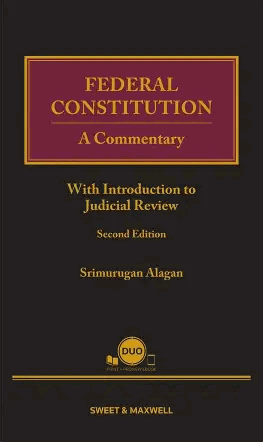
Federal Constitution
A Commentary Srimurugan Alagan
LLB, LLM (London), CLP Advocate & Solicitor High Court (Malaya)
Federal Constitution: A Commentary — Book Review
Review by marceljude.ai
Opening assessment
This is not a narrative book with ordinary literary chapters. It is an article-by-article legal commentary on the Malaysian Federal Constitution. The proper way to review it is therefore to treat each constitutional Part, each internal constitutional chapter, the Schedules, and the Appendix as the book’s “chapters.” The book’s own purpose is to give readers a “composite point of reference” on the provisions of the Constitution, with special attention to cases, fundamental liberties, pre-independence laws, and controversial judicial decisions.
The book’s central achievement is that it makes the Constitution feel like a working legal instrument rather than a ceremonial document. It repeatedly shows that constitutional law affects criminal law, family law, land law, elections, public service, religious questions, parliamentary procedure, state powers, judicial power, and even the ethics of judges. Its weakness, for a total beginner, is that it is still a lawyer’s book: it assumes patience with cases, statutes, constitutional articles, and institutional vocabulary. But as a reference work, it is strong, disciplined, and practical.
Before the chapter review, I will explain a few terms that matter for readers who know nothing about Malaysian constitutional and Islamic-law vocabulary.
Yang di-Pertuan Agong means the federal King, the Supreme Head of the Federation. Malaysia is a constitutional monarchy, so the King is an important constitutional office-holder, but the book repeatedly shows that many royal functions are exercised according to constitutional rules and advice.
Ruler means a hereditary monarch of one of the Malay States. The book distinguishes Rulers from Yang di-Pertua Negeri, who are Governors of States that do not have hereditary Rulers.
Islam in the Constitution is treated as the religion of the Federation, but the commentary also stresses the importance of Article 3(4), which prevents that clause from overriding the rest of the Constitution. In plain language: the book does not present Article 3 as wiping out constitutional supremacy or the civil court system.
Syariah or Islamic law refers to Islamic-law matters assigned mainly to State legislative power, especially in relation to persons professing Islam. The book discusses this mainly through Articles 3, 11, 74, and 121(1A). The important beginner’s point is this: Syariah courts are not simply “religious versions” of all courts. Their jurisdiction depends on constitutional and statutory limits.
Merdeka Day means independence day. Malaysia Day refers to the formation of Malaysia involving Sabah and Sarawak, and formerly Singapore. These terms matter because citizenship, territory, existing laws, and Sabah/Sarawak safeguards are often tied to those constitutional moments.
List of contents reviewed
The book contains preliminary material: Foreword, Preface, Acknowledgement, About the Author, Table of Cases, and Table of Statutes.
The main constitutional commentary is organised as follows:
Part I: The States, Religion and Law of the Federation — Articles 1 to 4.
Part II: Fundamental Liberties — Articles 5 to 13.
Part III: Citizenship — Articles 14 to 31, divided into acquisition of citizenship, termination of citizenship, and supplemental provisions.
Part IV: The Federation — Articles 32 to 69, divided into the Supreme Head, the Conference of Rulers, the Executive, the Federal Legislature, Legislative Procedure, and the Federation’s capacity in property, contracts and suits.
Part V: The States — Articles 70 to 72.
Part VI: Relations Between the Federation and the States — Articles 73 to 95E, covering legislative powers, executive powers, financial burdens, land, national development, surveys and inspection, local government, and special application to Sabah and Sarawak.
Part VII: Financial Provisions — Articles 96 to 112E.
Part VIII: Elections — Articles 113 to 120.
Part IX: The Judiciary — Articles 121 to 131A.
Part X: Public Services — Articles 132 to 148.
Part XI: Special Powers Against Subversion, Organized Violence, Acts and Crimes Prejudicial to the Public, and Emergency Powers — Articles 149 to 151.
Part XII: General and Miscellaneous — Articles 152 to 160B.
Part XIIA: Additional Protections for Sabah and Sarawak — Articles 161 to 161H.
Part XIII: Temporary and Transitional Provisions — Articles 162 to 180.
Part XIV: Saving for Rulers’ Sovereignty — Article 181.
Part XV: Proceedings against the Yang di-Pertuan Agong and the Rulers — Articles 182 and 183.
The Schedules reviewed are the First to Thirteenth Schedules, including oaths, citizenship rules, election of the King, the Conference of Rulers, legislative lists, revenue grants, interpretive provisions, and constituency delimitation.
The closing research materials are the List of Amendments, List of Articles Amended, Appendix, Judges’ Code of Ethics, and Index.
Preliminary material: Foreword, Preface, Acknowledgement, About the Author
The Foreword frames the Constitution as supreme law, not merely political symbolism. It contrasts Malaysia’s Westminster influence with the crucial Malaysian difference: Parliament is not supreme in the British sense; the Constitution is. That is the book’s intellectual foundation. A beginner should understand this first. In Malaysia, Parliament can make laws, but it receives that lawmaking power from the Constitution. If a law conflicts with the Constitution, constitutional law supplies the test for invalidity.
The Preface explains why the author’s approach is practical rather than abstract. His background in criminal law and civil practice leads him to present constitutional law as a daily litigation tool, not just a subject for academics. That is why the commentary is heavy with cases. The book is not trying to be a political manifesto. It is trying to show how courts have handled constitutional provisions in real disputes.
As a law professor, I would describe the preliminary material as unusually important. It tells the reader how to use the book: not as a textbook of political theory, but as a constitutional map for litigation, legal education, and public-law argument. Its strongest promise is that it will connect constitutional provisions to decided cases. Its limitation is that readers who want historical storytelling or philosophical debate may need a separate constitutional history text beside it.
Part I: The States, Religion and Law of the Federation
Part I is the foundation chapter. It answers three basic questions: What is Malaysia? What is the constitutional position of religion? What is the supreme law?
Article 1 is treated not merely as a naming clause, but as a historical clause. The commentary discusses the formation of Malaysia, including Sabah and Sarawak, the Malaysia Agreement, and the special safeguards that became part of the constitutional structure. This is one of the book’s stronger sections because it prevents the reader from thinking of federalism as a dry technical matter. Territory is political memory. Sabah and Sarawak are not treated as ordinary administrative units; their entry into Malaysia carries constitutional consequences.
Article 2, on the admission of new territories, is short but constitutionally significant. It shows that the Federation is capable of legal enlargement, but only through constitutional machinery. The review point here is that the book properly treats even brief provisions as part of a larger federal design.
Article 3, on Islam as the religion of the Federation, is one of the most delicate parts of the Constitution. The book’s treatment is helpful because it separates several ideas that beginners often mix up. First, Islam has a special constitutional position. Second, other religions may be practised in peace and harmony. Third, Article 3 does not by itself destroy constitutional supremacy. Fourth, Islamic-law administration is largely connected to State power and the position of Rulers as heads of Islam in their States. For readers new to Islamic terms, this means the book is not saying “religion replaces the Constitution.” It is saying the Constitution itself gives Islam a recognised position while still structuring legal authority.
Article 4, on constitutional supremacy, is the legal engine of the whole book. The commentary explains that laws inconsistent with the Constitution may be void. It also discusses how constitutional challenges are brought, when leave of the Federal Court is needed, the presumption that legislation is constitutional, severability, and the basic structure doctrine. This is where the author’s law-professor value is most visible: he does not merely say “the Constitution is supreme”; he explains the litigation consequences of supremacy.
The chapter’s strength is its combination of history, religion, and legal hierarchy. Its weakness for beginners is density: the reader is quickly introduced to the Reid Commission, Malaysia Agreement, Sabah/Sarawak safeguards, Islam, constitutional supremacy, and judicial review. That is a lot. Still, the chapter succeeds because these issues truly belong together. A constitution is not just a list of rights; it is the legal birth certificate of the state.
Part II: Fundamental Liberties
Part II is the rights chapter and probably the most attractive part for students, activists, and litigators. The Foreword itself notes that lawyers often focus on this chapter because it is the covenant between the State and the people. The commentary treats these rights as enforceable legal standards, not just moral ideals.
Article 5, liberty of the person, receives deep treatment. The book discusses life, personal liberty, arrest, detention, habeas corpus, the right to be informed of the reason for arrest, the right to legal counsel, and production before a magistrate. For a beginner, habeas corpus means a court procedure by which a detained person can challenge unlawful detention. The commentary’s important contribution is that it does not reduce liberty to physical freedom only. It draws on case law to show how courts have debated whether “life” includes broader ideas such as livelihood, fair procedure, and dignity.
Article 6 prohibits slavery and forced labour. The chapter explains that this right applies beyond citizens and links the provision to human trafficking and forced labour concerns. The review point is that the book treats even brief rights provisions seriously. It does not assume that old constitutional language is obsolete.
Article 7 concerns retrospective criminal laws and repeated trials. In plain language, the State should not punish a person for something that was not a crime when it was done, and a person should not generally be tried again for the same offence after proper acquittal or conviction. The commentary is technically careful here, especially in distinguishing true double jeopardy from retrials after a conviction or acquittal has been quashed.
Article 8, equality, is one of the most important rights provisions. The book explains equality before the law, equal protection of the law, prohibited discrimination, reasonable classification, proportionality, and permitted constitutional preferences. This chapter is especially useful because equality is not treated as a slogan. The author shows that courts ask structured questions: Is there classification? Is it reasonable? Is it connected to a legitimate purpose? Does the Constitution expressly permit the preference?
Article 9 deals with banishment and freedom of movement. The commentary explains that citizens cannot be banished from the Federation and that citizens have movement rights, subject to constitutionally permitted restrictions. Sabah and Sarawak receive special attention because movement into those States may be regulated in ways not applicable to movement within Peninsular Malaysia. This is a practical point many beginners miss.
Article 10 covers freedom of speech, assembly, and association. The book is strong here because it explains both the rights and the restrictions. It discusses public order, morality, parliamentary privilege, contempt of court, defamation, publication controls, sedition law, association restrictions, and peaceful assembly rules. The legal lesson is that Malaysian free speech is constitutionally protected but not absolute. The author’s review of cases makes clear that the real argument often lies in whether restrictions are constitutionally valid.
Article 11, freedom of religion, is essential for readers unfamiliar with Islamic terms. The book explains the right to profess, practise, and propagate religion, while also discussing the constitutional permission to restrict propagation of other religions to Muslims. Propagation here means spreading or communicating religious belief. The commentary also explains that religious freedom is subject to public order, public health, and morality. The book is careful, but the area is difficult because conversion, apostasy, child religion, identity documents, and Syariah jurisdiction are legally sensitive.
Article 12 deals with education. The book explains non-discrimination in education, religious instruction, and the role of parents or guardians in deciding a minor child’s religion. This is a useful bridge between religious freedom and family law. For a beginner, the key point is that education rights in this chapter are not simply about schools; they are also about equality, religion, and parental authority.
Article 13 protects property. The commentary explains deprivation of property, compulsory acquisition, adequate compensation, land acquisition, goodwill, contractual rights, and aboriginal peoples’ land rights. This chapter is particularly strong because property rights can otherwise seem less emotionally urgent than speech or liberty. The book shows that constitutional property protection affects landowners, indigenous communities, businesses, and public development.
Overall, Part II is the book at its best. It is case-rich, argumentative, and practically useful. The limitation is that beginners may need a separate glossary of Latin phrases and procedural terms. But the chapter’s value is high because it teaches that fundamental liberties are not self-executing magic words; they become real through interpretation, procedure, and litigation.
Part III: Citizenship
Part III is technical but important. Citizenship determines who belongs legally to the nation, who enjoys citizen-only rights, who may vote, and who may be protected from banishment. The book organises this Part into three constitutional chapters: acquisition, termination, and supplemental provisions.
Chapter 1: Acquisition of Citizenship
This chapter explains citizenship by operation of law, registration, naturalisation, and incorporation of territory. In beginner language, operation of law means citizenship arises automatically if constitutional conditions are satisfied. Registration means a person applies and is entered as a citizen under constitutional rules. Naturalisation means a non-citizen becomes a citizen after satisfying legal requirements, often involving residence and language.
The commentary is valuable because citizenship law is often emotionally charged but legally exacting. The book examines children, wives of citizens, persons born before independence, persons connected to Sabah and Sarawak on Malaysia Day, and persons under special registration powers. It also discusses cases involving illegitimate children, adopted children, and birth outside Malaysia. The chapter makes clear that small words like “parent,” “father,” “mother,” “born,” and “citizen” can decide a person’s legal identity.
Chapter 2: Termination of Citizenship
This chapter discusses renunciation and deprivation of citizenship. Renunciation means a citizen voluntarily gives up citizenship. Deprivation means the government removes citizenship under constitutional grounds. The book treats deprivation as serious because citizenship is not a mere administrative benefit. It is a legal bond between person and State.
The chapter explains dual citizenship, foreign citizenship, disloyalty, fraud, residence outside Malaysia, and deprivation of children where a parent loses citizenship. Its best feature is procedural detail: the commentary explains notice, inquiry, committees, representation, and the need to follow constitutional safeguards. This matters because citizenship deprivation can be devastating if handled casually.
Chapter 3: Supplemental
The supplemental chapter covers certificates, Commonwealth citizenship, repealed Singapore-related provisions, and the Second Schedule. Its importance is practical. Lawyers need certificates, forms, ministerial powers, and procedural rules. The book correctly treats these “supplemental” matters as legally significant rather than clerical.
Part III’s strength is precision. Its weakness is unavoidable complexity. Citizenship law is not easily simplified. Still, the author makes the reader understand that citizenship is constitutional status, not just paperwork.
Part IV: The Federation
Part IV is the institutional heart of the Constitution. It explains the King, the Conference of Rulers, the Executive, Parliament, legislative procedure, and the Federation’s legal capacity.
Chapter 1: The Supreme Head
This chapter explains the Yang di-Pertuan Agong and his Consort, the Deputy Supreme Head, royal disabilities, civil list, public seal, and oath of office. The book’s explanation of Malaysia’s elected monarchy is useful. For a beginner, the key idea is that the King is selected from among the Rulers and holds office according to constitutional rules.
The commentary shows that monarchy in Malaysia is not merely ceremonial, but neither is it absolute. The King’s office is embedded in written constitutional limits. That is the central legal insight of the chapter.
Chapter 2: The Conference of Rulers
The Conference of Rulers is a distinctive Malaysian institution. It includes the Rulers and has functions concerning the election of the King, certain appointments, Islamic matters, and consent to amendments of protected constitutional provisions. The book explains that “consultation” and “consent” are not the same. This distinction is legally important. Consultation may require asking for views; consent requires approval.
This chapter is one of the book’s constitutional-structure strengths because it shows how Malaysia’s monarchy, federalism, Islam, and amendment rules are connected.
Chapter 3: The Executive
This chapter covers executive authority, the King acting on advice, the armed forces, pardons, Cabinet, Deputy Ministers, Parliamentary Secretaries, and Political Secretaries. The plain-English point is that executive power formally vests in the King, but in ordinary constitutional operation it is exercised through advice, Cabinet responsibility, and ministerial government.
The pardon power is especially interesting. The book explains it as a constitutional mercy power, not an ordinary appeal. Its review of cases helps readers see why courts often treat pardon decisions differently from ordinary legal disputes.
Chapter 4: Federal Legislature
This chapter explains Parliament: the Senate, House of Representatives, qualifications, disqualifications, resignation, vacancies, summoning, dissolution, Speakers, oaths, parliamentary procedure, privileges, remuneration, and clerks. The chapter is dense but highly useful.
The most important concept is parliamentary privilege. This means certain protections given to parliamentary proceedings so that Parliament can function independently. But the book also shows that privilege sits within the Constitution, not above it. The discussion of disqualification is also practically important because it affects who may sit in Parliament.
Chapter 5: Legislative Procedure
This chapter explains how legislation is made: introduction of Bills, money Bills, amendments involving taxation or expenditure, and assent. For a beginner, a Bill is a proposed law. It becomes law only after going through the constitutional process.
The book’s value here is procedural discipline. Constitutional litigation often turns on whether the correct procedure was followed. The author shows that lawmaking is not just political will; it is a legally structured process.
Chapter 6: Capacity as Respects Property, Contracts and Suits
Article 69 deals with the Federation’s capacity to hold property, contract, and sue or be sued. This is short but important. It means government is not just a political idea; it is also a legal person for certain purposes. The commentary helps connect constitutional law with ordinary civil litigation.
Part IV’s strength is institutional clarity. It shows how monarchy, Cabinet government, Parliament, and legal personality fit together. Its limitation is that it may overwhelm non-lawyers because many offices appear quickly, but its structure is sound.
Part V: The States
Part V is short but constitutionally important. It covers precedence of Rulers and Governors, federal guarantee of State Constitutions, and privileges of State Legislative Assemblies.
Article 70 deals with precedence. That sounds ceremonial, but in constitutional monarchies ceremonial order often reflects legal hierarchy and institutional recognition.
Article 71 is more substantial. It guarantees the right of State Rulers to succeed and exercise constitutional rights according to State Constitutions. It also allows federal intervention if constitutional provisions are habitually disregarded. The book treats this as a federal guarantee mechanism.
Article 72 gives State Legislative Assemblies privileges comparable to parliamentary privileges. The review point is that State legislatures are constitutionally protected institutions, not mere local councils. They have their own proceedings and immunities.
Part V’s strength is that it makes readers take State constitutional law seriously. Its weakness is brevity. The subject could support a longer comparative discussion of State Constitutions, but the book’s article-by-article format keeps it concise.
Part VI: Relations Between the Federation and the States
Part VI is the federalism chapter. It explains how power is divided between federal and State governments.
Chapter 1: Distribution of Legislative Powers
This chapter is one of the most important in the book. It covers the extent of federal and State laws, subject-matter lists, inconsistency between federal and State law, Parliament’s power to legislate for States in certain cases, residual powers, rivers, and concurrent powers.
For beginners, legislative power means power to make law. The Constitution divides topics into lists. Some topics belong to Parliament, some to the States, and some to both. The Ninth Schedule is central here.
This chapter is also where Islamic law becomes constitutionally practical. Islamic-law matters are largely located within State legislative competence, subject to constitutional limits. That means Syariah law is not treated as a free-floating national legal system; it exists within a federal distribution of powers.
Chapter 2: Distribution of Executive Power
This chapter explains that executive authority follows legislative authority unless the Constitution says otherwise. In plain language, the government that has power to make laws on a subject often has power to administer that subject. The chapter also covers State obligations toward the Federation.
Chapter 3: Distribution of Financial Burdens
This chapter concerns who pays for matters on the Concurrent List. It is short but important because federalism is not real unless money responsibilities are also allocated.
Chapter 4: Land
The land chapter is rich. It covers federal acquisition of land, land reserved for federal purposes, land values, Malay reservations, customary land in Negeri Sembilan and Malacca, Malay holdings in Terengganu, and the National Land Council.
For beginners, Malay reservation land refers to land reserved under special legal rules for Malays. Customary land means land rights recognised through local custom, not merely ordinary registered title. The book’s treatment of land is strong because land is where federalism, ethnicity, custom, development, and property rights meet.
Chapter 5: National Development
Article 92 permits national development planning in certain circumstances. The commentary presents development as constitutionally structured, not simply administrative policy.
Chapter 6: Federal Surveys, Advice to States and Inspection of State Activities
This chapter deals with data, surveys, statistics, federal advice, and inspection. It reminds readers that federalism requires information. The federal government cannot coordinate national policy without facts, records, and inspection powers.
Chapter 7: National Council for Local Government
This chapter explains the constitutional position of local government coordination. Local government is often treated as mundane, but it affects roads, markets, planning, sanitation, and everyday life. The book rightly includes it in the constitutional federalism discussion.
Chapter 8: Application to Sabah and Sarawak
This is one of the most constitutionally sensitive chapters. It explains modifications for Sabah and Sarawak, exclusions from certain federal powers, and safeguards concerning land, local government, and development. The review point is that the book treats Sabah and Sarawak as constitutionally distinctive. This is essential to understanding Malaysia.
Part VI’s strength is doctrinal architecture. It teaches readers that federalism is not just “central versus local.” It is a carefully divided scheme of lawmaking, administration, finance, land, development, and special regional safeguards.
Part VII: Financial Provisions
Part VII is the financial constitution. It is less glamorous than rights, but no Constitution can function without rules on taxation, spending, auditing, borrowing, and grants.
Chapter 1: General
Article 96 states the principle that taxation must be authorised by law. This is a rule-of-law principle: the State cannot simply take money because it wants to.
The Consolidated Fund provisions explain where public money goes. Supply Bills and annual financial statements explain how public spending is authorised. The Contingencies Fund deals with urgent or unforeseen spending. Withdrawals from funds are constitutionally controlled.
The Auditor General provisions are especially important. The book explains appointment, duties, powers, and reports. A beginner should understand the Auditor General as a constitutional accountability officer: the office checks public accounts and reports on government financial administration.
The National Finance Council, grants to States, assignment of taxes and fees, borrowing restrictions, and State establishment restrictions show that money is a federalism issue. The Federation and States are financially connected.
Chapter 2: Sabah and Sarawak
The Sabah and Sarawak financial provisions deal with State audits, borrowing powers, special grants, and revenue assignments. This chapter matters because Sabah and Sarawak’s constitutional position is not only cultural or political; it is also fiscal. Money is part of the bargain of federation.
Part VII’s strength is that it gives legal shape to public finance. Its limitation is that readers without public-finance background may find it dry. But constitutionally, it is indispensable.
Part VIII: Elections
Part VIII explains the constitutional machinery of democracy. The commentary begins from the premise that elections are central to democratic legitimacy.
Article 113 covers conduct of elections and delimitation of constituencies. Delimitation means drawing electoral boundaries. This is crucial because boundaries can affect political representation.
Article 114 covers the Election Commission. The commentary discusses appointment, status, and removal. The Election Commission is central because it is supposed to administer elections fairly.
Article 115 concerns assistance to the Election Commission. Articles 116 and 117 concern federal and State constituencies. Article 118 explains election petitions, meaning legal challenges to election results. Article 119 explains qualifications of electors. Article 120 deals with direct elections to the Senate, although the practical constitutional history of that provision is limited.
Part VIII’s strength is that it does not treat elections as mere political events. It treats them as constitutional processes capable of legal challenge. Its weakness is that election law is a large field, and the article-by-article format cannot replace a specialised election-law treatise. Still, the chapter gives readers a strong constitutional base.
Part IX: The Judiciary
Part IX is one of the book’s most powerful sections. It concerns judicial power, court structure, appointment of judges, judicial independence, contempt, and Federal Court jurisdiction.
Article 121 is the central provision. The book discusses the High Courts, Court of Appeal, Federal Court, judicial power, the historical deletion of the words “judicial power,” and the continuing debate over judicial independence. It also discusses Article 121(1A), which concerns the relationship between civil courts and Syariah courts.
For a beginner, this is the key: civil courts are the ordinary constitutional courts. Syariah courts are Islamic-law courts with jurisdiction defined by the Constitution and statutes, mainly over persons professing Islam and matters assigned to them. Article 121(1A) does not mean every issue involving Islam automatically leaves the civil courts. The book’s discussion of Indira Gandhi and related cases is important because it explains limits, jurisdiction, and the continuing role of constitutional review.
Articles 122 to 122AB explain the Federal Court, Court of Appeal, High Courts, and Judicial Commissioners. A Judicial Commissioner is a judicial officer appointed to perform High Court judicial functions, subject to constitutional rules.
Article 122B on appointment of judges is a major constitutional provision. The commentary discusses appointment by the King acting on the Prime Minister’s advice after required consultation. It also discusses the Judicial Appointments Commission and criticises the limits of its constitutional role. This is one of the book’s more evaluative sections.
Article 123 concerns qualifications of judges. The book discusses whether non-practising lawyers and academics should be eligible for appointment. The author is willing to critique judicial reasoning and suggest reform. That makes this chapter more than a digest.
Article 124 explains the judicial oath. Article 125 concerns tenure, remuneration, removal, suspension, and tribunals. This is vital for judicial independence. The book explains that judges must not be removable simply because the government dislikes their decisions.
Article 126 covers contempt of court. For beginners, contempt is conduct that interferes with justice or undermines the authority of the court. The book explains civil contempt, criminal contempt, scandalising the court, contempt in the face of the court, and the need for procedural fairness.
Article 127 restricts parliamentary discussion of judicial conduct. Article 128 explains Federal Court jurisdiction, including exclusive jurisdiction over certain constitutional validity questions. Article 130 gives advisory jurisdiction. Repealed provisions are also noted.
Part IX’s strength is depth. The book treats judicial independence as structural, procedural, ethical, and institutional. Its limitation is that the discussion may be difficult for non-lawyers because it involves jurisdiction, court hierarchy, and judicial-review doctrine. But as a constitutional-law chapter, it is excellent.
Part X: Public Services
Part X deals with civil servants, service commissions, disciplinary protection, armed forces, police, education service, and the Attorney General.
Article 132 defines public services. The commentary explains that public employment is not ordinary private employment. Public officers hold a constitutional status, and their appointment, discipline, and removal are governed by constitutional and statutory rules.
Article 135 is especially important. It protects public officers from dismissal or reduction in rank except by proper authority and with a reasonable opportunity to be heard, subject to exceptions. The book discusses procedural fairness, natural justice, oral hearings, written representations, defective charges, and disciplinary proceedings. For beginners, natural justice means basic fairness in decision-making, especially the right to be heard and the rule against bias.
Articles 137 to 141A explain service bodies such as the Armed Forces Council, Judicial and Legal Service Commission, Public Services Commission, Police Force Commission, and Education Service Commission. The book explains their constitutional roles rather than treating them as bureaucratic details.
Article 145, on the Attorney General, is one of the most important discussions in this Part. The Attorney General is both legal adviser to the government and Public Prosecutor. The book notes the dual role and the wide prosecutorial powers. This is a major constitutional tension: the same office advises government and controls prosecutions.
Part X’s strength is practical value. Public-service litigation is common, and the commentary gives lawyers a clear route through disciplinary and constitutional issues. Its limitation is that the material is procedural and may feel technical to general readers. But the chapter shows that rule of law depends not only on courts and Parliament, but also on disciplined, lawful public administration.
Part XI: Special Powers and Emergency Powers
Part XI deals with some of the most serious powers in the Constitution: subversion, public order, preventive detention, and emergency.
Article 149 allows Parliament to pass laws against subversion, organised violence, and acts prejudicial to public order, even if those laws are inconsistent with certain fundamental liberties. This is a constitutional safety-valve provision, but also a rights-risk provision. The book explains that the Constitution itself permits exceptional laws in exceptional situations.
Article 150 concerns emergency proclamations. The commentary discusses the role of the King acting under constitutional advice, emergency ordinances, and non-justiciability issues. For beginners, emergency powers allow the legal system to respond to grave threats, but they can also concentrate power.
Article 151 concerns restrictions on preventive detention. Preventive detention means detention not as punishment after ordinary criminal conviction, but to prevent alleged threats. The book explains the detainee’s rights to grounds, representation, and advisory-board review, while also explaining exceptions where disclosure may be limited.
Part XI’s strength is its seriousness. The author does not romanticise emergency power. He treats it as constitutionally authorised but dangerous. This chapter is essential because every constitutional system must answer the hard question: what happens when the State claims security is at risk?
Part XII: General and Miscellaneous
Part XII contains provisions that may look miscellaneous but are actually central to national identity and constitutional change.
Article 152 declares the national language. The book explains Malay as the national language while noting constitutional protection for learning and using other languages. It also discusses language in courts and legislatures.
Article 153 concerns reservation of quotas in services, permits, scholarships, and similar matters for Malays and natives of Sabah and Sarawak. For beginners, the important point is that this is a constitutional preference provision. It must be read together with equality under Article 8. The book treats Article 153 as legally protected and difficult to amend because of the role of the Conference of Rulers.
Article 154 concerns the federal capital. Articles 155 to 158 cover reciprocity, rates, delegation of State functions, and repealed Brunei arrangements.
Article 159 is a major provision on constitutional amendment. The commentary explains different amendment routes: simple majority for some matters, two-thirds majority for most constitutional amendments, consent of the Conference of Rulers for protected matters, and consent of Sabah and Sarawak for certain safeguards. This chapter is crucial because it shows that constitutional change is possible, but not always easy.
Article 160 defines constitutional terms. This is vital. Words like “law,” “citizen,” “Ruler,” “Malay,” “public authority,” and “federal law” can decide cases. Article 160A concerns reprints of the Constitution, and Article 160B concerns authoritative text.
Part XII’s strength is that it explains identity provisions without separating them from legal method. Language, quotas, amendment rules, and definitions are all treated as law. Its limitation is that some politically sensitive topics could benefit from more social context, but the author’s legal focus is consistent with the book’s purpose.
Part XIIA: Additional Protections for Sabah and Sarawak
Part XIIA is one of the most important chapters for understanding Malaysia as a federation rather than a unitary state.
Article 161 concerns use of English and native languages in Sabah and Sarawak. Article 161A concerns the special position of natives of Sabah and Sarawak. Article 161B restricts extension of rights to practise before courts in Sabah and Sarawak to non-residents. Articles 161C, 161D, 161F, 161G, and 161H are repealed, but their presence in the structure reminds readers of the constitutional history involving Borneo States and Singapore. Article 161E protects the constitutional position of Sabah and Sarawak by requiring special consent for certain amendments.
The chapter’s key concept is safeguard. Sabah and Sarawak joined the Federation with constitutional protections. The book’s treatment is valuable because it brings those safeguards into the same doctrinal field as judicial power, citizenship, language, religion, finance, and land.
Part XIIA’s strength is constitutional sensitivity. It does not flatten Sabah and Sarawak into ordinary administrative regions. It treats their protections as part of the constitutional bargain.
Part XIII: Temporary and Transitional Provisions
Part XIII explains how the legal system moved from the old order into the constitutional order.
Article 162 deals with existing laws. This is very important. When a new constitutional order begins, not every old law disappears immediately. Existing laws continue, but may need modification to fit the Constitution. The book discusses how courts handle old laws that conflict with constitutional rights.
Other provisions concern temporary emergency regulations, old legislative functions, succession to property, rights and liabilities, international agreements made before independence, old citizenship arrangements, constituencies, existing courts, appeals, appointments, transfer of officers, oaths, remuneration, joint services, and pensions.
This chapter is technical but intellectually important. Constitutions do not begin in a vacuum. They inherit statutes, courts, officers, debts, rights, and disputes. Part XIII explains legal continuity.
Its strength is historical legality. Its weakness is that many provisions are spent or repealed, so beginners may underestimate the chapter. But as a law professor, I would insist students read it because transitional law explains how a Constitution becomes operational.
Part XIV: Saving for Rulers’ Sovereignty
Part XIV focuses on Article 181. It preserves the sovereignty, prerogatives, powers, and jurisdiction of Rulers, subject to the Constitution.
The commentary is important because it explains that royal sovereignty is not outside constitutional law. It is saved by constitutional law and limited by constitutional law. The book also discusses immunity and changes to the position of Rulers in litigation.
For a beginner, the key point is this: the Rulers have a special constitutional position, but the Constitution itself defines how that position operates. This chapter connects monarchy, federalism, immunity, and judicial accountability.
Part XIV is short but conceptually weighty. Its strength is that it avoids treating royal power as either purely symbolic or unlimited. It places royal authority inside the constitutional structure.
Part XV: Proceedings against the Yang di-Pertuan Agong and the Rulers
Part XV covers the Special Court and the requirement that actions against the King or a Ruler require the Attorney General’s personal consent.
Article 182 establishes the Special Court. This court has jurisdiction over proceedings involving the Yang di-Pertuan Agong and the Rulers in specified circumstances. The commentary explains jurisdiction, procedure, finality, and the court’s special constitutional nature.
Article 183 requires the Attorney General’s personal consent before actions are instituted. This is a major gatekeeping rule. The book explains it through cases and constitutional language.
Part XV’s strength is clarity on a rare but important subject. Most readers will never encounter Special Court litigation, but its existence is constitutionally significant. It shows how the Constitution balances royal status with legal accountability.
Schedules: Review of each Schedule as a constitutional chapter
The Schedules are not decorative appendices. They are operative constitutional material.
The First Schedule contains the oath for applicants for registration or naturalisation. Its importance is symbolic and legal: citizenship is tied to allegiance.
The Second Schedule deals with citizenship by operation of law for persons born before and after Malaysia Day, plus supplemental citizenship provisions. This is one of the most practically important Schedules because citizenship disputes often depend on detailed rules found here.
The Third Schedule governs election of the Yang di-Pertuan Agong and Deputy Yang di-Pertuan Agong. It explains the mechanics behind Malaysia’s elected monarchy.
The Fourth Schedule contains the oaths of office for the King and Deputy King. Oaths matter because constitutional office is not merely status; it is duty.
The Fifth Schedule concerns the Conference of Rulers. It supports the institutional machinery discussed in Article 38.
The Sixth Schedule contains forms of oaths and affirmations. These appear throughout constitutional office-holding and public service.
The Seventh Schedule concerns election of Senators. It supports the structure of the Senate in Part IV.
The Eighth Schedule contains provisions to be inserted into State Constitutions. This is extremely important for federalism. It ensures minimum constitutional standards across States.
The Ninth Schedule contains the legislative lists. This is one of the most important Schedules in the entire Constitution. It divides lawmaking topics between the Federation, the States, and concurrent authority. Many disputes about Islamic law, land, local government, criminal law, education, and finance trace back to this Schedule.
The Tenth Schedule concerns grants and revenue assigned to States. It supports the financial federalism discussed in Part VII.
The Eleventh Schedule applies interpretive provisions from earlier interpretation law. This matters because constitutional meaning often depends on interpretive rules.
The Twelfth Schedule is repealed. Its inclusion still shows constitutional history.
The Thirteenth Schedule concerns delimitation of constituencies. It is central to elections because drawing boundaries affects representation.
As a group, the Schedules are one of the book’s strengths. A weaker commentary might ignore them or treat them as back matter. This book places them within the constitutional system.
List of Amendments and List of Articles Amended
These lists are research tools. Their value is practical. They allow lawyers, students, and judges to trace constitutional change. In constitutional law, history matters because the wording of an Article may have changed, and the meaning of a case may depend on which version of the Constitution applied.
The review point is simple: these lists make the book more usable. They are not argumentative, but they are important for legal accuracy.
Appendix: Judges’ Code of Ethics 2009
The Appendix contains the Judges’ Code of Ethics. It should be read like a final chapter on judicial responsibility. The main body of the book explains judicial power and independence; the Appendix explains judicial conduct.
Part I of the Code: Preliminary
This part states the application and definitions. It makes clear that the Code governs judges during service and includes Judicial Commissioners. This matters because judicial ethics must apply to the whole superior-court judicial role, not merely permanent judges.
Part II of the Code: Duty to comply
This part states that judges must comply with the Code and that breach may lead to disciplinary proceedings. The legal importance is that ethics are not presented as optional politeness. They are connected to discipline.
Part III of the Code: Code of conduct
This is the heart of the Appendix. It covers independence, integrity, avoiding impropriety, fairness, efficiency, conflicts of interest, extra-judicial activities, asset declaration, and disconnection from former legal practice.
For beginners, impropriety means improper conduct. Appearance of impropriety means conduct that may look improper to a reasonable observer, even if actual corruption is not proved. This matters because public confidence in judges depends not only on actual fairness, but also on visible fairness.
The provisions on avoiding close associations with lawyers, avoiding political activity, not commenting on pending cases, and declaring assets are especially important. The Code recognises that judges do not merely decide cases; they embody public trust.
Part IV of the Code: Procedure on breach
This part explains complaints, the Chief Justice’s role, disciplinary procedure, and representation. It connects ethics with process. A judge accused of breach is not simply condemned by rumour; there is a procedure.
Part V of the Code: Sanctions
This part deals with sanctions. Its importance lies in proportionality. Not every breach necessarily requires removal from office, but misconduct must have consequences.
Part VI of the Code: Miscellaneous
This part covers service of notices, signatures, correspondence, and revocation. These details may look minor, but procedural clarity matters in disciplinary systems.
The Appendix is well chosen. It closes the book by reminding readers that constitutional justice depends not only on elegant Articles but also on the personal discipline of judges. Judicial independence without judicial ethics would be dangerous; judicial ethics without judicial independence would be weak. The Appendix belongs exactly where it is.
Overall book review
This is a strong constitutional commentary. Its main virtue is that it is both doctrinal and practical. It takes the Constitution Article by Article, explains the legal meaning of each provision, and connects that meaning to Malaysian and comparative case law. The book is particularly strong on fundamental liberties, constitutional supremacy, judicial power, public service discipline, federal-state relations, Sabah and Sarawak safeguards, and the Attorney General’s constitutional role.
Its second major strength is that it treats the Constitution as a living litigation document. It does not merely paraphrase Articles. It asks how courts have used them, where courts may have gone wrong, and what arguments might remain open. That makes the book useful to advocates and judges, not just students.
Its third strength is its institutional range. Many constitutional books overemphasise rights and underemphasise finance, public services, elections, State powers, Schedules, and transitional provisions. This book gives those less glamorous areas real attention. That is good constitutional scholarship.
Its fourth strength is its treatment of Malaysia’s distinctiveness. The book recognises Westminster influence, Indian constitutional comparison, Commonwealth materials, monarchy, Islam, Sabah and Sarawak, State powers, and constitutional supremacy. It does not pretend Malaysia is simply Britain, India, or Singapore. It uses comparison, but the Malaysian Constitution remains the centre.
The main limitation is accessibility. For a person who knows nothing about constitutional law, the book is demanding. It uses case names, Article numbers, procedural concepts, and institutional terms. It explains many of them, but not always at beginner pace. A novice reader may need to read slowly with the constitutional text beside them.
A second limitation is that the article-by-article structure can make large themes harder to see. For example, equality, Islam, Syariah jurisdiction, child conversion, and education appear in several places. The reader must connect them across Articles 3, 8, 11, 12, 74, 121, 152, 153, 160, and 161A. The book provides the material, but the reader must build the thematic map.
A third limitation is that the book is primarily legal-doctrinal. It does not attempt a full political science, sociology, or history of Malaysian constitutionalism. That is not a flaw in purpose, but it is a limit in scope.
As a law professor, my final judgment is that this is a serious, useful, case-driven constitutional commentary. It is best used by students, practitioners, judges, researchers, and advanced readers who want to understand how the Malaysian Federal Constitution operates in court and government. For beginners, it is not light reading, but it rewards careful reading. Its greatest lesson is that the Constitution is not one subject. It is the legal structure beneath citizenship, liberty, religion, monarchy, Parliament, courts, elections, public finance, land, public service, emergency power, and federalism
 marceljude.ai @ + 60128285778 |
- MALAYSIA'S 1ST AI LAWYER - CLICK HERE
- ISMAIL – INTEGRATED SINGAPORE/MALAYSIA AI & LAW (Library)
- OPENING OF SINGAPORE MALAYSIA AI CENTRE AND LAW LIBRARY
- LIFT - LAW INSTRUMENTS FORMS & TEMPLATES
- LAWS OF MALAYSIA FOR SINGAPOREAN DUMMIES
- HANNAH YEOH'S ARTIFICIAL INTELLIGENCE LAW ENCYCLOPEDIA
- LEAD CR - Law Ecosystem Archive Databases on CD-ROM
- BREAKING NEWS FROM MJN
- CLICK HERE CO. PROFILE
- EXCITING NEW SERIES - THE ADVENTURES OF BOBBY TAN -ADVOCATE & SOLICITOR IN THE HIGH COURT OF NORTH BORNEO by marceljude.ai
- MEDICO LEGAL - BY PRISKILA AKWILA & GLORIOUS PETAL SDN BHD - powered by marceljude.ai
- MISCELLANOUS
- ANNOTATED STATUTES OF SABAH - A NEW SERIES
- e-library - marceljude.ai
- DRAFT - DOCUMENT RESEARCH & AUTOMATED FILING TECHNOLOGY
- CLARA – Case Law Analysis & Retrieval AI
- FOR RESEARCH REQUEST CLICK HERE
- CLICK HERE TO ASK ANYTHING
- RAMBO'S LAW - THE LAW OF THE LAW JUNGLE - EXCITING NEW SERIES - CASE ANALYSIS BY JOHN RAMBO @ +60138646786
- PRISKILA AKWILA ADVOCATES - High Court of Sabah & Sarawak @ Kota Kinabalu
- COLA - COMMONWEALTH ONLINE LAWCASES AI -marceljude.ai
- THE LAW LIBRARY THAT COMES TO YOU ANYWHERE AND ANYTIME
- marceljude.ai training academy
