
HALSBURY’S LAWS OF MALAYSIA — CITIZENSHIP - Review By marceljude.ai
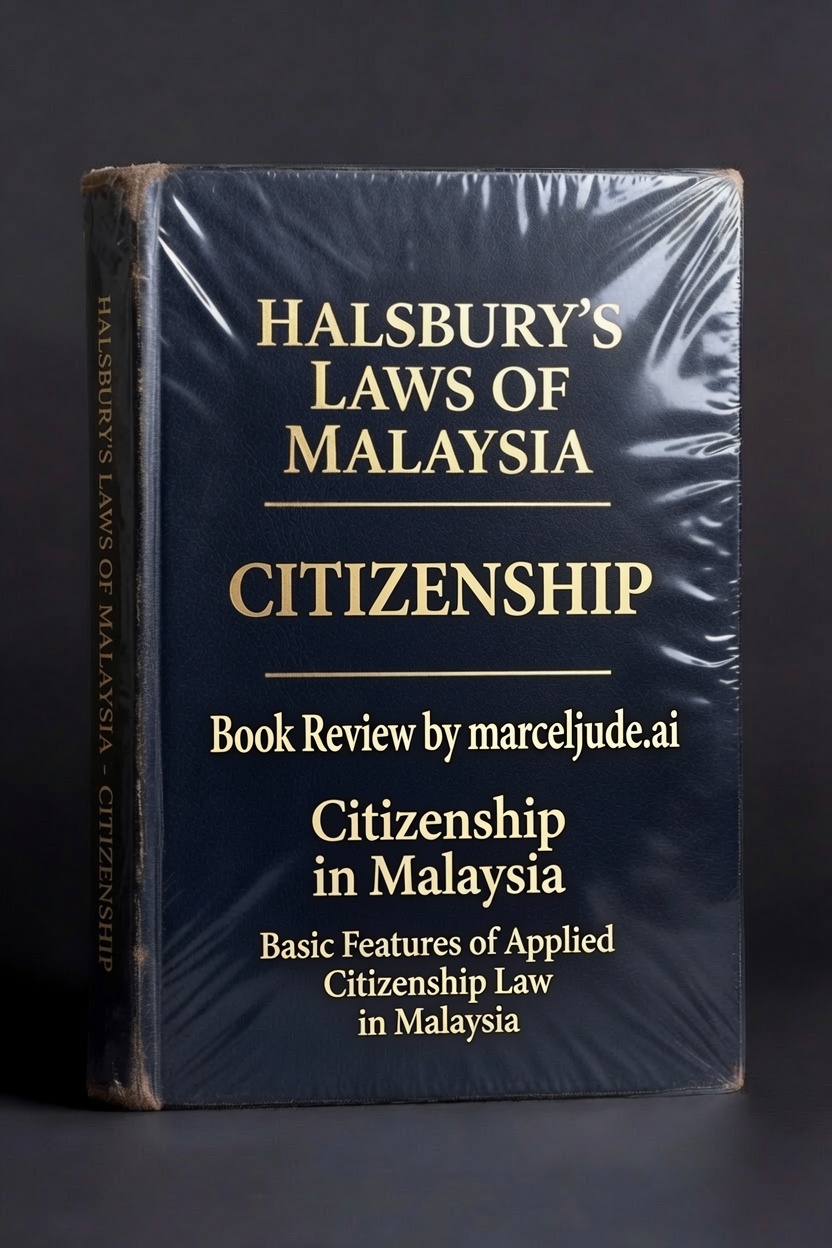


Description
HALSBURY’S LAWS OF MALAYSIA — CITIZENSHIP
AN EXTENSIVE BOOK REVIEW
By marceljude.ai
PRELIMINARY NOTE ON PAGE REFERENCES
I have read the book in full.
The book is arranged by authoritative paragraph numbers from [590.001] to [590.086].
LIST OF CONTENTS
Chapter 1 — Introduction Brief overview of Malaysian citizenship laws — [590.001] — printed page number not reproduced
Exclusive rights of citizens — [590.002] — printed page number not reproduced
Chapter 2 — Acquisition of Citizenship Part A — Citizenship by Operation of Law General principles — [590.003] — printed page number not reproduced
Persons born before Malaysia Day — [590.004] —
Persons born after Malaysia Day — [590.005]
Interpretative provisions concerning citizenship by operation of law — [590.006]
Part B — Citizenship by Registration Wives of citizens — [590.007]
Children — [590.008]
Persons born in the Federation before Merdeka Day — [590.009]
Residents of Sabah and Sarawak on Malaysia Day — [590.010]
Part C — Naturalisation and Incorporation of Territory Naturalisation generally — [590.011]
Residents of Malaysia — [590.012]
Residents of Singapore — [590.013]
Adequate knowledge of the Malay language — [590.014]
Citizenship by incorporation of territory — [590.015]
Part D — General Provisions Oath — [590.016]
Termination of citizenship before Merdeka Day — [590.017]
Applications for citizenship — [590.018]
Chapter 3 — Termination of Citizenship Part A — Renunciation Introduction to termination and renunciation — [590.019]
Declaration of renunciation — [590.020] — l
Part B — Deprivation Acquisition of foreign citizenship — [590.021]
Exercise of rights belonging exclusively to foreign citizens — [590.022]
Non-application of specified deprivation provisions — [590.023]
Deprivation of citizens by registration or naturalisation — [590.024]
Other grounds of deprivation — [590.025]
Wives of citizens — [590.026]
Deemed treatment of certain citizens — [590.027]
Persons becoming citizens on Malaysia Day — [590.028]
Part C — Procedure for Deprivation Notice of deprivation — [590.029]
Reference to Committee of Inquiry — [590.030]
Notice by Committee of Inquiry — [590.
Powers of Committee of Inquiry — [590.032]
Right of representation — [590.033] — printed page number not reproduced
Functions of Committee of Inquiry — [590.034]
Order of deprivation — [590.035]
Part D — Supplementary Provisions The Minister — [590.036]
Ouster clause — [590.037]
Extension of time for registration of birth — [590.038]
Registrar-General, Deputy Registrar-General and Registrars — [590.039]
Registers and indices — [590.040]–[590.043]
Language Board — [590.044]
Certificate of citizenship — [590.045]
Commonwealth citizens — [590.046]
Offences — [590.047] —m
Part E — Interpretation General interpretation — [590.048]
Illegitimate children — [590.049]
Birth after death of the father — [590.050]
Period of residence — [590.051] —l
Chapter 4 — National Registration Registration framework — [590.052]–[590.055]
Issue, custody, production and inspection of identity cards — [590.056]–[590.066]
Correction and alteration of particulars — [590.067]–[590.069]
Re-registration — [590.070]–[590.071]
Register — [590.072]–[590.074]
General provisions, enforcement and offences — [590.075]–[590.081]
Relevant authorities — [590.082]–[590.086] EXECUTIVE REVIEW
Citizenship is not treated in this book as a mere administrative status. It is presented as a constitutional relationship between the individual and the Federation. That relationship determines membership in the political community, access to particular constitutional liberties, eligibility to vote and hold public office, protection against banishment, and liability to lose one’s national status in carefully defined circumstances.
The book’s principal strength is its systematic movement through five legal questions:
First, who is a citizen automatically?
Second, who may acquire citizenship by registration or naturalisation?
Third, how may citizenship be renounced or taken away?
Fourth, what procedural safeguards govern those decisions?
Fifth, how does the national registration system identify and document persons within Malaysia?
The discussion is firmly anchored in Part III of the Federal Constitution, its Second Schedule, the Citizenship Rules 1964, the National Registration Act 1959 and the National Registration Regulations 1990.
Its method is predominantly doctrinal. It states the controlling constitutional provision, explains its statutory or regulatory machinery and supplies cross-references. This produces an exceptionally useful practitioner’s reference. The corresponding weakness is that the book sometimes catalogues rules without fully examining the deeper constitutional values of dignity, equality, family unity, avoidance of statelessness, procedural fairness and proportionality.
CHAPTER 1 — INTRODUCTION 1. Brief Overview of Malaysian Citizenship Laws — [590.001]
The opening subsection places citizenship in its historical, political and constitutional setting. Before a common federal citizenship emerged, legal allegiance depended significantly on whether a person was a subject of a Malay Ruler or a British subject connected to Penang or Malacca.
The introduction explains that federal citizenship first emerged through the constitutional arrangements preceding independence. Citizenship was thereafter placed within the Federal Constitution, which is the supreme law of the Federation.
The principal modes of acquisition identified are:
Citizenship by operation of law;
Citizenship by registration;
Citizenship by naturalisation; and
Citizenship resulting from the admission of new territory.
This classification is fundamental. Citizenship by operation of law follows automatically when constitutional facts are established. Registration and naturalisation involve an application and, to differing degrees, governmental evaluation. Incorporation of territory is a legislative mechanism concerned with constitutional change to the Federation itself.
The subsection also introduces the Citizenship Rules 1964. Those Rules perform the procedural work that the Constitution does not attempt to detail, including applications, prescribed forms, certificates, registers and assessment of language proficiency.
Critical assessment
The opening succeeds because it immediately establishes that citizenship law cannot be understood through ordinary statute alone. Its source is primarily constitutional. Administrative officials therefore do not possess an unrestricted power to decide who belongs to Malaysia; they must act within the categories created by the Constitution.
Its historical account is necessarily compressed. A fuller critical treatment could have explained more directly how colonial subjecthood, Merdeka, the formation of Malaysia and Singapore’s subsequent separation generated different constitutional categories.
2. Exclusive Rights of Citizens — [590.002]
This subsection distinguishes rights enjoyed by every person from rights reserved exclusively to citizens.
Rights generally available to persons include personal liberty, equality before the law, protection against retrospective criminal laws and repeated trials, freedom of religion and property rights.
Rights particularly connected to citizenship include:
Protection against banishment from the Federation;
Freedom of movement and residence within the Federation, subject to constitutional restrictions;
Freedom of speech and expression;
Peaceful assembly;
Freedom of association;
Protection against specified forms of discrimination;
The right to vote;
Eligibility for Parliament and State Legislative Assemblies; and
Eligibility for constitutional offices for which citizenship is a qualification.
The chapter correctly shows that citizenship is both a legal status and a gateway to political participation.
Particularly important is its treatment of freedom of movement. Article 9 does not erase the constitutionally protected immigration position of Sabah and Sarawak. Malaysian citizenship does not necessarily give a citizen an unrestricted right to enter and remain in every part of Malaysia without being subject to the special immigration laws applicable to those States.
Critical assessment
The discussion is doctrinally useful because it prevents the common error of assuming that all fundamental liberties belong exclusively to citizens. Some are guaranteed to “persons,” while others are framed specifically for citizens.
The subsection could have gone further by distinguishing:
The possession of citizenship;
Proof of citizenship;
Exercise of rights consequential upon citizenship; and
Administrative recognition of the status.
That distinction becomes crucial where a person claims citizenship by operation of law but lacks documentation.
CHAPTER 2 — ACQUISITION OF CITIZENSHIP PART A — CITIZENSHIP BY OPERATION OF LAW 3. General Principles — [590.003]
Citizenship by operation of law is automatic. It does not depend upon governmental grace, an oath, naturalisation or a favourable exercise of discretion. Once the constitutional conditions are met, the person is a citizen by force of the Constitution.
This is one of the most important propositions in the book. A certificate or identity card may provide evidence of status, but it does not necessarily create citizenship where the Constitution itself has already conferred it.
The practical enquiry is therefore factual and constitutional:
When was the person born?
Where was the person born?
What was the citizenship or residence status of the relevant parent?
Were the parents lawfully married at the material time?
Was an overseas birth registered within the required period?
Would the person otherwise possess the citizenship of another country?
4. Persons Born Before Malaysia Day — [590.004]
This subsection deals with transitional constitutional classes. It recognises persons who possessed federal citizenship before Merdeka and persons born during particular constitutional periods.
The classes include persons who were citizens immediately before Merdeka Day under the earlier constitutional arrangements; persons born within the Federation during defined periods; persons born abroad to citizen fathers in specified circumstances; and persons whose overseas births were registered at a Federation consulate within the permitted time.
It also addresses persons connected with Sabah and Sarawak at the formation of Malaysia. A person ordinarily resident in Sabah, Sarawak or Brunei on Malaysia Day could fall within the constitutional classes where the required British nationality, territorial birth or paternal connection existed.
Critical assessment
The subsection demonstrates why citizenship disputes cannot always be determined by applying contemporary birth rules retrospectively. The governing law is ordinarily the constitutional law applicable at the time and place of birth.
The transitional provisions are complicated, but that complexity reflects the constitutional transformation from colonial territories and the Federation of Malaya into Malaysia.
5. Persons Born After Malaysia Day — [590.005]
For persons born after Malaysia Day, the book identifies several constitutional pathways.
They include:
Birth within the Federation where at least one parent was a citizen or permanent resident;
Birth outside the Federation where the father was a citizen and was himself born in the Federation;
Birth outside the Federation while the citizen father was serving the Federation or a State;
Birth abroad to a citizen father followed by timely consular or governmental registration;
Birth in Singapore in the specially defined constitutional circumstances; and
Birth within the Federation where the person would otherwise not be a citizen of any country.
The final category performs an anti-statelessness function. It is not simply a broad rule that every child born in Malaysia automatically becomes Malaysian. Its application depends upon whether the child possesses another citizenship and upon the precise constitutional wording.
Critical assessment
This subsection exposes the importance of parentage, legitimacy, territorial birth, permanent residence and foreign nationality law. A court may need evidence of foreign law before deciding whether a child was born a citizen of another country.
The book accurately states the formal structure. A modern treatment should additionally confront the unequal historical transmission of citizenship through mothers and fathers, especially for children born abroad.
6. Interpretative Provisions — [590.006]
The Constitution supplies special rules for determining the place and circumstances of birth.
The principal rules include:
A birth aboard a registered ship or aircraft is attributed to the place of registration;
A birth aboard an unregistered governmental ship or aircraft is attributed to the country of that government;
A newborn child found abandoned is presumed, until the contrary is shown, to have been born where found to a mother permanently resident there; and
Permanent residence requires residence together with unlimited permission to remain, or an appropriate governmental certification.
These deeming provisions are not peripheral. They may decide the entire citizenship claim where the ordinary evidence of birth or parentage is unavailable.
Critical assessment
The abandoned-child presumption is especially important. It should be approached purposively because an unduly strict evidential approach could render a foundling stateless despite the Constitution’s protective structure.
PART B — CITIZENSHIP BY REGISTRATION 7. Wives of Citizens — [590.007]
A married woman whose husband is a citizen may be entitled to registration if the relevant marriage, residence, intention and character requirements are fulfilled.
The marriage must fall within the legally recognised definition. Registration of the marriage under the applicable written law is therefore significant. Special treatment exists for marriages and residence connected with Sabah and Sarawak.
The applicant must generally demonstrate the prescribed period of residence, intention to reside permanently and good character.
Critical assessment
Registration differs fundamentally from automatic citizenship. Although the Constitution may confer an entitlement upon fulfilment of conditions, the applicant must prove those conditions through an administrative process.
The subsection also reflects a historically gendered model in which a wife’s route to citizenship depended upon her husband. A contemporary constitutional analysis would ask whether such classifications remain consistent with substantive equality and present family structures.
8. Children — [590.008]
The Federal Government may register a person under the prescribed age as a citizen in the special circumstances contemplated by the Constitution. Registration of children supplies a remedial mechanism where citizenship did not arise automatically.
This provision is potentially important for:
Children whose parentage or legitimacy creates difficulty;
Children born abroad;
Adopted children;
Children who would otherwise be stateless; and
Children whose births were not registered in time.
The provision, however, is discretionary. The distinction between “shall” and “may” is therefore decisive.
Critical assessment
The book could more strongly have articulated that discretion concerning a child should be exercised by reference to the child’s welfare, family unity, constitutional equality and the serious consequences of statelessness.
9. Persons Born in the Federation Before Merdeka Day — [590.009]
This was a transitional registration route for persons born within the Federation before Merdeka Day. The applicant had to satisfy requirements concerning age, residence, permanent intention, good character and elementary knowledge of Malay.
The stipulated residence was substantial: periods amounting in aggregate to at least five years during the seven years preceding the application.
Critical assessment
This subsection shows citizenship being used as a test of enduring attachment. Birth alone was insufficient; residence, character, language and intention collectively demonstrated membership of the national community.
Many of these provisions are now mainly of historical or residual importance, but they remain relevant when determining older claims or reconstructing citizenship status through family history.
10. Residents of Sabah and Sarawak on Malaysia Day — [590.010]
This subsection is constitutionally significant for East Malaysia. It created a registration route for adults ordinarily resident in Sabah or Sarawak on Malaysia Day, subject to an application within the stipulated historical period.
The conditions included:
An aggregate period of residence within the relevant territories and the Federation;
Residence during the twelve months immediately preceding the application;
An intention to reside permanently;
Good character; and
Sufficient knowledge of an accepted language.
The language provisions recognised the particular position of Sarawak by permitting reliance, in defined circumstances, upon a native language in current use there.
Critical assessment
This is not a minor regional exception. It is part of the constitutional settlement by which Sabah and Sarawak entered Malaysia. The recognition of pre-Malaysia residence and local linguistic realities reveals an effort to integrate existing populations without treating the new Federation as though it began on an empty constitutional slate.
PART C — NATURALISATION AND INCORPORATION OF TERRITORY 11. Naturalisation Generally — [590.011]
Naturalisation is described as a discretionary grant. Meeting the statutory conditions does not necessarily create an automatic entitlement. Citizenship takes effect from the grant of the naturalisation certificate.
This distinguishes naturalisation from citizenship by operation of law. In the former, the certificate is constitutive; in the latter, documentation is generally evidential.
12. Residents of Malaysia — [590.012]
An adult non-citizen may apply for naturalisation if the Federal Government is satisfied that the constitutional conditions are met.
The conditions include:
Residence for an aggregate of at least ten years during the twelve years preceding the application;
Residence during the immediately preceding twelve months;
An intention to reside permanently;
Good character; and
Adequate knowledge of Malay.
Residence in Sabah or Sarawak before Malaysia Day is treated as residence within the Federation for the relevant constitutional purpose.
Critical assessment
The threshold is deliberately demanding. Naturalisation is designed for applicants who can demonstrate sustained connection and integration.
The concepts of “good character” and “adequate knowledge” require transparent and rational administration. Undefined evaluative standards create a risk of inconsistent treatment unless supported by intelligible criteria.
13. Residents of Singapore — [590.013]
The book discusses the specialised constitutional route concerning certain residents of Singapore. It permits naturalisation in special circumstances where the applicant satisfies residence, character and Malay-language requirements.
The subsection is principally transitional and historical, reflecting Singapore’s former constitutional relationship with Malaysia.
Its continuing doctrinal importance is that it demonstrates how territorial constitutional change may leave residual citizenship provisions that cannot be understood solely by reference to current national borders.
14. Adequate Knowledge of the Malay Language — [590.014]
Language proficiency is assessed by the Language Board. The applicant must be able to speak Malay with reasonable proficiency and, subject to physical impediment and specified exceptions, read and write it in Jawi or Rumi.
The standard is not academic excellence. It is a practical measure of linguistic integration.
Critical assessment
The involvement of a specialised Board is sensible. Nevertheless, fairness requires consistent assessment, reasonable accommodation for disability and a clear record of the basis of any adverse conclusion.
15. Incorporation of Territory — [590.015]
Where new territory is admitted to the Federation, Parliament may determine which persons connected with that territory become citizens and the effective date of their citizenship.
This provision recognises that citizenship may follow territorial sovereignty. It supplies constitutional flexibility for future territorial change while leaving the detailed allocation of citizenship to legislation.
PART D — GENERAL PROVISIONS 16. Oath — [590.016]
An adult generally cannot be registered or naturalised until taking the prescribed oath. The oath requires renunciation of foreign allegiance and affirmation of true allegiance to the Yang di-Pertuan Agong and the Federation.
The oath may be administered by designated judicial, registration or diplomatic officers.
The oath is not a decorative ceremony. It marks the legal and political transition from applicant to member of the Malaysian constitutional community.
17. Termination Before Merdeka Day — [590.017]
Earlier loss or renunciation of pre-Merdeka citizenship may affect present constitutional status. This subsection prevents a claimant from relying upon a historical citizenship that had already ceased before the Constitution’s relevant saving or transitional provisions operated.
The provision confirms that citizenship analysis often requires a complete chronological chain rather than proof of a single ancestral fact.
18. Applications for Citizenship — [590.018]
Applications must comply with the prescribed forms and be lodged with the proper registration authority. The administrative requirements differ according to the constitutional route invoked.
A proper application must identify the correct legal basis. Evidence relevant to one route may not satisfy another. Documents may include birth and marriage records, evidence of parental citizenship, residence records, consular registration and language certification.
Critical assessment
Administrative formality serves legitimate evidential purposes, but it should not be permitted to defeat citizenship already conferred by operation of law. Officials must distinguish an application seeking a discretionary grant from a request for recognition of an existing constitutional status.
CHAPTER 3 — TERMINATION OF CITIZENSHIP PART A — RENUNCIATION 19. Introduction — [590.019]
Citizenship may end through the citizen’s voluntary renunciation or through governmental deprivation. Termination does not erase liabilities arising from acts or omissions committed while the person remained a citizen.
The book correctly treats renunciation and deprivation separately. Renunciation is initiated by the citizen; deprivation is an exercise of coercive governmental power.
20. Declaration of Renunciation — [590.020]
An adult citizen who is also, or is about to become, a citizen of another country may renounce Malaysian citizenship by a registered declaration.
The foreign-citizenship requirement guards against statelessness. Renunciation is not complete merely because a person privately declares that he no longer considers himself Malaysian. The prescribed declaration must be registered.
The Government may restrict registration during war where the constitutional conditions for doing so exist.
PART B — DEPRIVATION 21. Acquisition of Foreign Citizenship — [590.021]
The Federal Government may deprive a person of Malaysian citizenship where the person has voluntarily acquired foreign citizenship through registration, naturalisation or another deliberate and formal act.
The key issue is voluntariness. Citizenship automatically attributed by foreign law at birth is conceptually different from citizenship deliberately acquired later.
22. Exercise of Foreign Citizenship Rights — [590.022]
A Malaysian citizen may face deprivation where he voluntarily claims or exercises a right available exclusively to citizens of another country.
Examples may include:
Applying for or using a foreign passport;
Voting in a foreign political election where that right is exclusive to citizens; or
Invoking a foreign national status in circumstances demonstrating allegiance.
The legal enquiry is not merely whether the person interacted with a foreign state. It is whether the right exercised was exclusive to that state’s citizens and whether the exercise was voluntary.
23. Non-application of Specified Provisions — [590.023]
The book identifies constitutional circumstances in which deprivation for acquiring or exercising foreign citizenship does not apply.
This subsection is important because deprivation powers must be read with every express limitation. Citizenship cannot lawfully be taken away through an enlarged or assumed power.
24. Citizens by Registration or Naturalisation — [590.024]
Citizenship obtained by registration or naturalisation may be removed for specified forms of conduct, including:
Disloyalty or disaffection toward the Federation;
Unlawful trading or communication with an enemy during war;
Serious criminal conviction within the stipulated period following acquisition;
Unauthorised acceptance of foreign public office requiring allegiance; and
Continuous residence abroad without qualifying service or annual consular registration.
These grounds reflect the view that a voluntarily acquired citizenship may remain conditional upon allegiance and continuing connection.
Critical assessment
Terms such as “disloyal” and “disaffected” are potentially broad. Because deprivation can destroy political identity and expose a person to statelessness, those terms should be interpreted strictly and applied only upon cogent evidence.
25. Other Grounds — [590.025]
The Government may also deprive citizenship obtained through registration or naturalisation where it was procured by fraud, false representation, concealment of material fact or mistake.
A causal relationship should exist between the wrongdoing or mistake and the grant. A wholly immaterial error should not automatically justify the gravest legal consequence.
The subsection also recognises the constitutional requirement that deprivation must be conducive to the public good where that test applies.
26. Wives of Citizens — [590.026]
A woman registered as a citizen by reason of marriage may be deprived of citizenship if she acquires foreign citizenship through marriage or where the qualifying marriage is dissolved, otherwise than by death, within the stipulated period.
This rule was intended to prevent abuse of marriage-based registration. Nevertheless, deprivation should not be treated as automatic where the Constitution requires a discretionary judgment.
27. Deemed Treatment of Earlier Citizens — [590.027]
Certain persons who acquired pre-Merdeka citizenship under earlier agreements or State laws are treated as citizens by registration or naturalisation for termination purposes.
The provision ensures continuity between historical citizenship categories and the present Constitution.
The book notes an important limitation: the deeming provisions cannot simply be used against every citizen who was born within the Federation. Constitutional protections attached to birth remain material.
28. Persons Becoming Citizens on Malaysia Day — [590.028]
Special rules govern persons who acquired citizenship upon the formation of Malaysia. These provisions reconcile the new federal citizenship with pre-existing nationalities and territorial connections.
The subsection is particularly relevant to Sabah and Sarawak because it explains how Malaysia Day operated as a constitutional bridge rather than merely a change of administrative label.
PROCEDURE FOR DEPRIVATION 29. Notice — [590.029]
Before deprivation, the affected citizen must receive written notice stating the ground upon which deprivation is proposed and informing the person of the right to have the matter referred to a committee of inquiry.
Notice is the foundation of procedural fairness. A vague notice would frustrate the person’s ability to answer the case.
30. Reference to Committee — [590.030]
Where the affected person requests it in the prescribed manner, the matter must be referred to a committee of inquiry.
This converts the procedure from a purely ministerial determination into an adjudicative inquiry with an opportunity to contest the allegations.
31. Notice by the Committee — [590.031]
The committee must notify the person of the time and place of inquiry and provide a proper opportunity to participate.
Adequate time is essential. Formal notification without sufficient time to obtain documents, witnesses and representation would not satisfy the substance of fairness.
32. Powers of the Committee — [590.032]
The committee possesses powers necessary to conduct the inquiry, including receiving evidence and compelling relevant participation in accordance with the governing rules.
Although not necessarily a court, it performs a quasi-judicial function. It must therefore act impartially, consider relevant evidence and avoid predetermined conclusions.
33. Right of Representation — [590.033]
The affected person may appear personally or be represented as permitted by the governing framework.
Legal representation is especially important because citizenship deprivation involves constitutional interpretation, foreign law, historical records and potentially serious allegations of fraud or disloyalty.
34. Functions of the Committee — [590.034]
The committee investigates the grounds and reports its findings to the Government.
Its report does not itself deprive citizenship, but it is a legally significant step. The committee must address the actual grounds notified and assess the evidence fairly.
35. Order of Deprivation — [590.035]
Following the prescribed process, the Government may make a deprivation order if the constitutional conditions are satisfied.
The order should identify the affected person and rest upon a legally permissible ground. Because the consequences are grave, strict compliance with the Constitution and procedural rules is indispensable.
SUPPLEMENTARY CITIZENSHIP PROVISIONS 36. The Minister — [590.036]
Citizenship functions are allocated to the Minister, with specified powers capable of delegation.
Delegation promotes workable administration, but it does not remove ministerial responsibility or permit a delegate to act beyond the statutory instrument of delegation.
37. Ouster Clause — [590.037]
The book discusses provisions intended to make governmental citizenship decisions final and not subject to ordinary review.
An ouster clause should not be read as authorising jurisdictional error, bad faith, constitutional illegality or denial of natural justice. Constitutional supremacy necessarily limits the proposition that an administrative determination can be made wholly immune from judicial scrutiny.
This is one of the book’s most important points for public-law practitioners.
38. Extension of Time for Registration of Birth — [590.038]
The Government may extend the period for registration of an overseas birth in appropriate cases.
This power is important where a person’s citizenship claim would otherwise fail because parents did not register the birth within the ordinary period. The discretion should be exercised rationally and in light of the consequences for the child.
39. Registration Authorities — [590.039]
The machinery includes the Registrar-General, Deputy Registrar-General and Registrars of Citizens.
These officers maintain records, process applications and perform delegated functions. Their decisions must remain connected to the powers conferred by the Constitution, the Citizenship Rules and lawful delegation.
40. Registers, Indices, Corrections and Inspection — [590.040]–[590.043]
The Central Registry maintains:
A register of citizens by registration;
A register of citizens by naturalisation;
A register of persons issued certificates where citizenship was doubtful;
A register of persons who renounced or lost citizenship; and
An alphabetical index.
Errors may be corrected after notice and consideration of representations. The original entry should not simply be erased or rendered illegible; the correction must be authenticated.
The registers are not ordinarily open to public inspection. Authorised public officers and police officers acting within lawful investigations may obtain access in specified circumstances.
Critical assessment
The correction procedure rightly incorporates notice and representation. A register may be evidentially conclusive in the circumstances prescribed by law, making accuracy and procedural fairness exceptionally important.
41. Language Board — [590.044]
The Language Board assesses the linguistic competence required for particular citizenship routes.
Its function is specialised but legally consequential. An adverse assessment may prevent naturalisation or registration. The Board must therefore apply the correct test, accommodate relevant disability and avoid demanding a higher standard than the law prescribes.
42. Certificate of Citizenship — [590.045]
Certificates may be issued in cases of registration, naturalisation or doubt concerning citizenship.
The legal effect depends upon the constitutional route. A naturalisation certificate creates citizenship from its date of grant. A certificate recognising citizenship by operation of law principally records a status already conferred by the Constitution.
That distinction is essential in litigation.
43. Commonwealth Citizens — [590.046]
The subsection explains the constitutional significance of Commonwealth citizenship and its relationship with Malaysian citizenship.
The category reflects Malaysia’s constitutional history. It should not be confused with Malaysian citizenship itself or treated as conferring all rights reserved to Malaysian citizens.
44. Citizenship Offences — [590.047]
Offences include:
Knowingly making false statements to influence a citizenship decision;
Forging or unlawfully altering a certificate;
Possessing or using a forged or altered certificate;
Failing to surrender a certificate when legally required; and
Personating the person to whom a certificate was issued.
These provisions protect the integrity of the citizenship system. Because criminal liability is involved, knowledge, intention and the precise statutory elements must be proved.
INTERPRETATION 45. General — [590.048]
The interpretative subsection gathers definitions used throughout the citizenship provisions.
Its significance is greater than its length suggests. Citizenship cases often turn upon defined expressions such as “citizen,” “Federation,” “State,” “Merdeka Day,” “Malaysia Day,” “consulate” and “written law.”
46. Illegitimate Children — [590.049]
For specified constitutional purposes, references to the father or parent of a child born outside a lawful marriage may be construed by reference to the mother.
This provision can determine whether citizenship is transmitted and exposes the close connection between citizenship law and the legal status of the parents’ marriage.
Critical assessment
The rule must be approached carefully because a child has no control over the parents’ marital status. A rigid application can impose severe consequences on the child for circumstances entirely beyond the child’s responsibility.
47. Birth After the Father’s Death — [590.050]
Where a child is born after the father’s death, the father’s status at the time of death is treated as relevant in the manner prescribed by the Constitution.
This prevents posthumous birth from breaking an otherwise valid line of citizenship transmission.
48. Period of Residence — [590.051]
The book explains how residence is calculated.
Certain absences may count as residence, including qualifying service abroad or absence connected with specified public or international duties.
A person may also be deemed resident on a particular day where the constitutional requirements are satisfied.
Other absences are excluded. Residence in Sabah and Sarawak before Malaysia Day receives special treatment when calculating residence in the Federation.
Critical assessment
Residence is not simply physical presence. It is a constructed constitutional concept involving allowable absences, deemed residence and territorial continuity.
CHAPTER 4 — NATIONAL REGISTRATION 49. Statutory Framework — [590.052]
The National Registration Act establishes a system for registering persons in Malaysia. Regulations govern applications, the Central Registry, photographs, fingerprints, identity cards, re-registration, correction of particulars, surrender and inspection.
Citizenship and national registration are closely connected but legally distinct. An identity card records declared particulars; it is not invariably conclusive of every constitutional question concerning citizenship.
50. Persons Required to Register — [590.053]
Persons within the prescribed age and residence categories must register in the manner required.
The registration obligation supports national identification, public administration and law enforcement.
51. Exempt Persons — [590.054]
Exemptions include specified constitutional office-holders, young children, genuine short-term travellers, holders of diplomatic or consular identity documents, certain military personnel, police officers and persons exempted by ministerial order.
The exemptions demonstrate that national registration is primarily directed at the settled civilian population rather than every person momentarily present in Malaysia.
52. Particulars for Registration — [590.055]
Required particulars include:
Full and former names;
Previous identity-card number;
Residential address;
Race and religion;
Place and date of birth;
Sex;
Physical abnormalities where required; and
Citizenship status.
Photographs and identifying particulars must conform to the prescribed standards.
Critical assessment
The collection of extensive personal data raises questions of accuracy, privacy, proportionality and protection against misuse. Although the book concentrates on the registration rules, modern readers must also consider the constitutional and administrative implications of state-held identity data.
53. Issue of Identity Cards — [590.056]
The identity-card number incorporates information derived from the holder’s date of birth and other prescribed identifiers.
Applications require verification, photographs and supporting records. The card is issued as the principal official instrument of personal identification.
54. Custody of Identity Cards — [590.057]
The registered person is responsible for proper custody of the identity card. Allowing another person to possess or use it may expose both parties to legal consequences.
The duty protects the integrity of individual identification.
55. Production and Inspection — [590.058]
Authorised officers may require production of an identity card in the circumstances prescribed by law.
Production may also be required at National Registration, Road Transport or Immigration offices and other designated premises.
Such powers must be exercised by properly authorised persons and for legally permitted purposes.
56. Protected Places — [590.059]–[590.060]
Additional production requirements may operate within protected or security-sensitive places.
The powers reflect security concerns, but their exercise remains subject to the governing legislation and the identification of the officer’s authority.
57. Production for Licences — [590.061]
An identity card may be required when applying for or receiving licences, permits and other official documents.
This enables public authorities to verify that administrative records relate to the correct person.
58. Prohibition Against Alteration — [590.062]
Unauthorised alteration of an identity card is prohibited.
The rule covers physical and potentially electronic particulars. A person who discovers an error must use the prescribed correction procedure rather than alter the card personally.
59. Lost, Destroyed or Defaced Cards — [590.063]
A person must apply for a replacement where the card is lost, destroyed, damaged or defaced.
The applicant may be required to explain the circumstances and pay the prescribed fee. Repeated losses may attract additional scrutiny.
60. Death of the Holder — [590.064]
Upon death, the identity card must be returned by the person responsible under the Regulations.
This prevents continued use of the deceased’s identity and permits the national register to be updated.
61. Leaving Malaysia — [590.065]
The Regulations prescribe circumstances in which a person leaving Malaysia must surrender the identity card, subject to exemptions.
The provision addresses long-term departure rather than ordinary travel in every instance.
62. Unclaimed Cards — [590.066]
Unclaimed identity cards may be disposed of in the prescribed manner.
Administrative disposal must be secure because identity cards contain sensitive personal information and could facilitate impersonation.
63. Insertion, Correction and Alteration — [590.067]–[590.068]
A person must seek correction where he changes his name, acquires or loses Malaysian citizenship, or knows that a material particular on the card is incorrect.
The person should not alter the card personally. The Department must verify the supporting evidence and issue or amend the official record according to law.
64. Change of Residence — [590.069]
A person who changes residence must notify the registration authority within the prescribed period.
The new address may be shown on a replacement card or inserted electronically into the relevant chip. For official correspondence, that recorded address is treated as the current address.
65. Re-registration — [590.070]–[590.071]
The Minister may direct re-registration of all persons or specified classes. Malaysia may be divided into registration areas, and deadlines and places of registration may be prescribed.
Re-registration enables obsolete cards and records to be replaced and permits migration to new identification systems.
66. The National Register — [590.072]
A Central Register records the particulars supplied through national registration.
The Register performs an evidential and administrative function. It must be distinguished from the specialised citizenship registers maintained under the Citizenship Rules.
67. Public Inspection — [590.073]
The National Register is generally not open to public inspection.
This protects personal data and prevents unrestricted private access to sensitive identifying information.
68. Publication of Information — [590.074]
Information derived from the Register may be published only within the authority conferred by law.
The subsection balances administrative utility against confidentiality. Publication should not exceed the statutory purpose.
69. General Regulatory Provisions — [590.075]
The regulatory framework covers fees, forms, administrative requirements, surrender obligations, record keeping and related matters.
Although procedural, these provisions may determine whether an application is accepted and whether a person has complied with national registration duties.
70. Further Information — [590.076]
A registration officer may:
Require a person to attend and answer necessary questions;
Require additional declarations, particulars or documents; and
Impound a document where its genuineness, correctness or validity is reasonably doubted.
The officer must possess a reasonable basis for these measures. The power is investigatory, not arbitrary.
71. Arrest and Search — [590.077]
An authorised officer may exercise arrest and search powers in the circumstances prescribed, including where a person refuses to provide a name and address or provides information reasonably suspected to be false.
Because these powers affect personal liberty, all statutory preconditions must be strictly satisfied.
72. Proof of Records — [590.078]
Certificates and statements signed by designated registration officers may be admissible as evidence of failures to make required returns, contents of registers and fingerprint identification.
These evidential shortcuts facilitate prosecutions but do not dispense with proof of the statutory conditions for admissibility.
73. No Presumption from Identity-Card Contents — [590.079]
The contents of an identity card do not necessarily create an unrestricted legal presumption regarding every recorded fact.
This is a highly important caution. An identity card is strong administrative evidence of identity and status, but constitutional citizenship may require examination of birth, parentage and the relevant constitutional provisions.
74. Offences and Penalties — [590.080]
Offences include:
Failure to register or re-register;
Knowingly supplying materially false information;
Failure to comply with a lawful summons or requisition;
Tampering with an identity card or register;
Possession or use of multiple, forged or another person’s identity card;
Failure to comply with correction or surrender requirements;
Improper removal of an identity card from Malaysia; and
A parent or guardian contributing to an offence by a minor.
Penalties may include a fine, imprisonment or both, depending upon the offence.
75. Repealed Legislation and Savings — [590.081]
Earlier national registration regimes applicable generally and separately to Sabah and Sarawak were repealed or replaced, with savings for acts, cards and records made under them.
Savings provisions preserve administrative continuity and prevent every earlier registration from becoming invalid merely because the governing regulations changed.
76. Director General and Deputy Director General — [590.082]
These senior officers are appointed to administer the national registration system.
Their authority arises from statute and must be exercised consistently with the Act and Regulations.
77. State Directors — [590.083]
Directors may be appointed for the States to administer the system regionally.
This decentralisation is practically necessary because national registration operates throughout Malaysia, including Sabah and Sarawak.
78. Registration Officers and Agents — [590.084]
The Minister may appoint registration officers and agents in the numbers considered necessary.
An agent’s authority is not unlimited. Persons dealing with registration agents remain entitled to expect that their personal information and documents will be handled according to law.
79. Public Servants — [590.085]
Registration officials are treated as public servants for the relevant legal purposes.
This subjects them to public-law responsibilities and criminal provisions relating to misuse of office, dishonesty and official functions.
80. Magistrates’ Court Jurisdiction — [590.086]
A First Class Magistrate’s Court has jurisdiction over offences under the national registration legislation in the circumstances prescribed.
The provision completes the enforcement architecture by identifying the criminal court competent to hear registration offences.
SABAH AND SARAWAK: SPECIAL CONSTITUTIONAL SIGNIFICANCE
The book is especially relevant to Sabah and Sarawak for four reasons.
First, residence in the territories before Malaysia Day may be treated as residence within the Federation for citizenship purposes.
Second, the Malaysia Day provisions determine how inhabitants of Sabah and Sarawak entered the new federal citizenship structure.
Third, the special immigration position of Sabah and Sarawak qualifies the otherwise general freedom of movement of Malaysian citizens.
Fourth, historical registration and language provisions recognise that the constitutional and social circumstances of the Borneo States differed from those of the States of Malaya.
Citizenship and immigration must therefore not be confused. A Sabahan is a Malaysian citizen, but Sabah’s constitutional immigration authority may regulate entry by other Malaysian citizens. Conversely, immigration permission does not itself establish citizenship.
In historical claims, practitioners should investigate:
Birth records issued under the North Borneo or Sarawak administrations;
British nationality status before Malaysia Day;
Ordinary residence on Malaysia Day;
Parental birth and nationality;
Marriage and legitimacy;
Earlier identity cards and census material;
Consular or citizenship registration; and
Whether citizenship was subsequently renounced or lost.
OVERALL CRITICAL EVALUATION Strengths
The book’s greatest strength is precision. It does not reduce citizenship to birthplace. It shows that status may depend upon territory, date, parental citizenship, permanent residence, legitimacy, marriage, consular registration and foreign nationality law.
Its second strength is its integration of substantive citizenship law with procedure. It explains not only who may qualify but also the oath, forms, registers, certificates, language assessment and deprivation procedure.
Its third strength is its recognition of the constitutional history of Sabah and Sarawak.
Its fourth strength is the careful separation of:
Citizenship by operation of law;
Citizenship by registration;
Citizenship by naturalisation;
Renunciation;
Deprivation; and
National registration.
These distinctions are indispensable in legal practice.
Limitations
The work is primarily descriptive. It gives less attention to broader constitutional doctrines such as proportionality, substantive equality, legitimate expectation, the best interests of the child and the constitutional implications of statelessness.
It also gives limited attention to the evidential hardship suffered by rural, indigenous, abandoned, undocumented and cross-border families, especially in Sabah and Sarawak.
The discussion of gendered transmission would benefit from a fuller equality analysis. Historical rules treating paternal citizenship as controlling may produce severe consequences for children born abroad to Malaysian mothers.
Finally, national registration is discussed mainly as an administrative system. A modern critique should more fully address privacy, data security, informational self-determination and the dangers of treating an identity card as a substitute for constitutional analysis.
FINAL ASSESSMENT OF THE ENTIRE BOOK
This is an authoritative and highly valuable doctrinal account of Malaysian citizenship and national registration law. Its enduring contribution is to demonstrate that citizenship is not determined through intuition, ethnicity or administrative convenience. It is determined through the exact constitutional category governing the person’s birth, descent, marriage, residence or application.
For judges, the book supplies an orderly route through a difficult constitutional field.
For advocates, it provides a framework for pleading and proving citizenship claims.
For administrators, it identifies the legal limits within which registration, certification and deprivation powers must be exercised.
For scholars, it offers a foundation from which to examine equality, statelessness, federalism, national identity and the constitutional position of Sabah and Sarawak.
For Sabah and Sarawak practitioners, it is particularly important because it preserves the connection between citizenship law and the constitutional formation of Malaysia. It reminds the reader that Malaysia Day, pre-Malaysia residence, local languages, historical nationality and special immigration powers are not peripheral matters. They are part of the constitutional architecture of the Federation.
The book’s most important lesson is that citizenship by operation of law comes from the Constitution. Administrative documents may recognise that status, but they cannot lawfully replace the constitutional inquiry.
Overall scholarly assessment: an indispensable practitioner’s exposition, constitutionally grounded and exceptionally systematic, though deserving of supplementation by a modern rights-based analysis of equality, children, gender, statelessness, privacy and judicial review.
Review by marceljude.ai
- MALAYSIA'S 1ST AI LAWYER - CLICK HERE
- ISMAIL – INTEGRATED SINGAPORE/MALAYSIA AI & LAW (Library)
- OPENING OF SINGAPORE MALAYSIA AI CENTRE AND LAW LIBRARY
- LIFT - LAW INSTRUMENTS FORMS & TEMPLATES
- LAWS OF MALAYSIA FOR SINGAPOREAN DUMMIES
- HANNAH YEOH'S ARTIFICIAL INTELLIGENCE LAW ENCYCLOPEDIA
- LEAD CR - Law Ecosystem Archive Databases on CD-ROM
- BREAKING NEWS FROM MJN
- CLICK HERE CO. PROFILE
- EXCITING NEW SERIES - THE ADVENTURES OF BOBBY TAN -ADVOCATE & SOLICITOR IN THE HIGH COURT OF NORTH BORNEO by marceljude.ai
- MEDICO LEGAL - BY PRISKILA AKWILA & GLORIOUS PETAL SDN BHD - powered by marceljude.ai
- MISCELLANOUS
- ANNOTATED STATUTES OF SABAH - A NEW SERIES
- e-library - marceljude.ai
- DRAFT - DOCUMENT RESEARCH & AUTOMATED FILING TECHNOLOGY
- CLARA – Case Law Analysis & Retrieval AI
- FOR RESEARCH REQUEST CLICK HERE
- CLICK HERE TO ASK ANYTHING
- RAMBO'S LAW - THE LAW OF THE LAW JUNGLE - EXCITING NEW SERIES - CASE ANALYSIS BY JOHN RAMBO @ +60138646786
- PRISKILA AKWILA ADVOCATES - High Court of Sabah & Sarawak @ Kota Kinabalu
- COLA - COMMONWEALTH ONLINE LAWCASES AI -marceljude.ai
- THE LAW LIBRARY THAT COMES TO YOU ANYWHERE AND ANYTIME
- marceljude.ai training academy
