
HALSBURY'S LAWS OF MALAYISA - DISTRESS - review by marceljude.ai
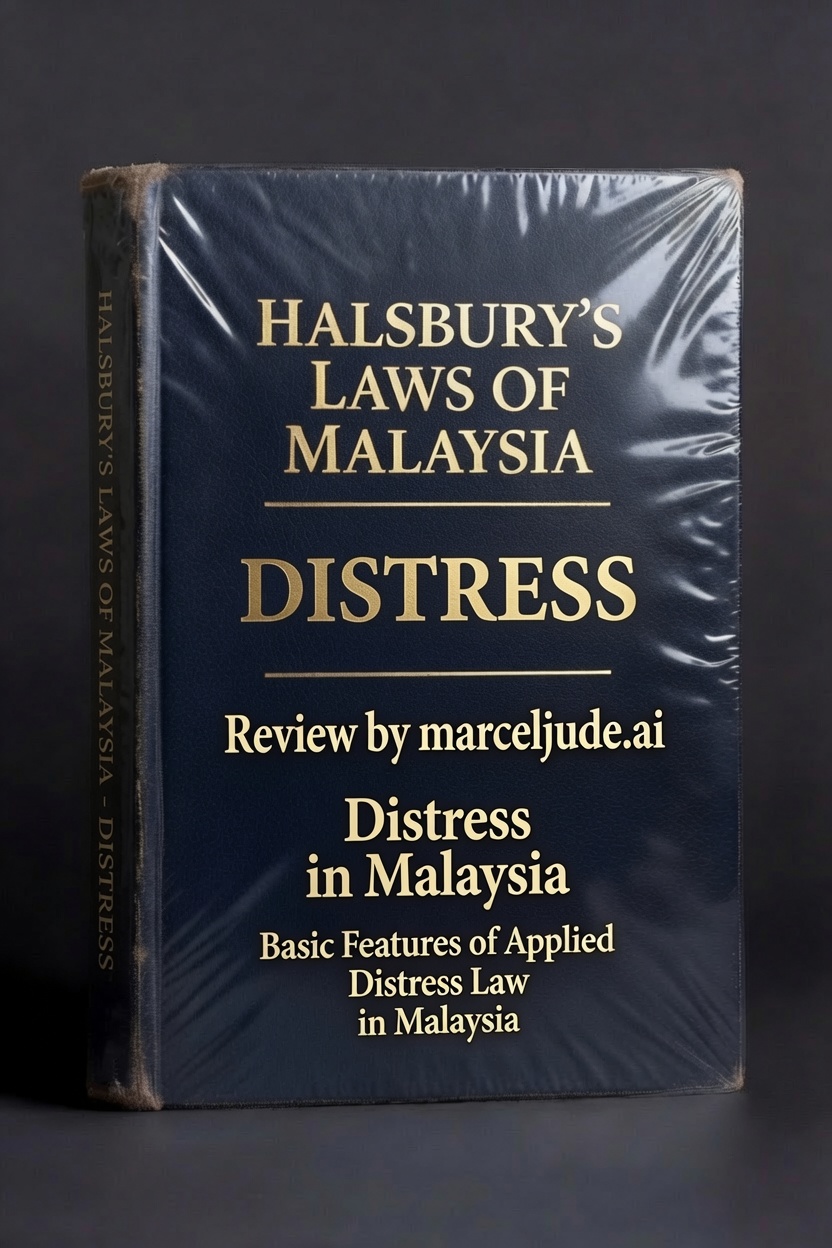


Description
HALSBURY’S LAWS OF MALAYSIA: DISTRESS
An Extensive Chapter-by-Chapter Review
Reviewed by marceljude.ai
A Professorial Review of the Law, Procedure and Jurisprudence of Distress in Malaysia
I have read the book in full. It is a systematic exposition of the Malaysian law of distress, extending from the historical landlord’s remedy for arrears of rent to statutory processes used for recovering fines, public charges, taxes, statutory contributions, immigration expenses, port dues and local-government rates.
LIST OF CONTENTS
Nature of the Remedy of Distress — [280.001]–[280.005]
Distress for Rent — [280.006]–[280.144]
2.1 Jurisdiction — [280.006]–[280.008]
2.2 Procedure — [280.009]–[280.015]
2.3 Remedy by Distress — [280.016]–[280.018]
2.4 The Right to Distrain — [280.019]–[280.024]
2.5 Who May Distrain — [280.026]–[280.031]
2.6 What May and May Not Be Distrained — [280.032]–[280.056]
2.7 When Distress May Be Made — [280.057]–[280.059]
2.8 Loss of the Right to Distrain — [280.060]–[280.062]
2.9 Where Distress May Be Made — [280.063]–[280.064]
2.10 Amount for Which Distress May Be Made — [280.065]–[280.070]
2.11 Levying the Distress — [280.071]–[280.092]
2.12 Proceedings Between Seizure and Sale — [280.093]–[280.096]
2.13 Insolvency, Receivership and Execution — [280.097]–[280.108]
2.14 Sale of the Distress — [280.109]–[280.123]
2.15 Expenses and Costs — [280.124]–[280.125]
2.16 Second Distress — [280.126]–[280.127]
2.17 Fraudulent Removal of Goods — [280.128]–[280.132]
2.18 Illegal, Irregular or Excessive Distress and Remedies — [280.133]–[280.142]
2.19 Deserted Premises — [280.143]
2.20 Notice to Quit — [280.144]
Distress Under the Criminal Procedure Code — [280.145]–[280.166]
Distress for Arrears of Employees’ Provident Fund Contributions — [280.167]–[280.170]
Recovery Under the Street, Drainage and Building Act 1974 — [280.171]–[280.179]
Distress Under the Income Tax (Deduction from Remuneration) Rules — [280.180]–[280.182]
Recovery of Expenses Relating to Prohibited Immigrants — [280.183]–[280.186]
Distress by Port Authorities — [280.187]–[280.198]
Distress Under the Federation Light Dues Act 1953 — [280.199]–[280.200] \ Recovery of Rates and Other Sums Under the Local Government Act 1976 — [280.201]–[280.213]
GENERAL OVERVIEW
The organising idea of the book is that “distress” is not a single, homogeneous remedy. The expression embraces several legally distinct processes.
The first, and historically most important, is distress for rent. It allows movable property found upon rented premises to be seized under judicial authority and sold to satisfy rent arrears.
The second category comprises statutory recovery mechanisms resembling execution. These allow courts, local authorities and statutory bodies to seize property to recover fines, costs, rates, contributions, dues and public expenses.
This distinction is fundamental. The conditions governing a landlord’s remedy cannot automatically be transferred to distress exercised under criminal, municipal, taxation, immigration or port legislation. Each statutory power has its own jurisdictional source, preconditions, protected property, procedure and remedial consequences.
The work’s greatest strength is its integration of substantive entitlement and procedural execution. It does not merely ask whether money is owed. It asks:
Who is legally entitled to distrain?
Against whom can the remedy be exercised?
What property may be seized?
Where and when may it be seized?
What judicial authority is required?
What notice must be given?
How may a third party intervene?
How is the property valued and sold?
How do insolvency and competing executions affect the process?
What remedy exists if the seizure is unlawful, irregular or excessive?
That architecture makes the book useful both as a doctrinal reference and as a litigation manual.
CHAPTER 1
NATURE OF THE REMEDY OF DISTRESS
Paragraphs [280.001]–[280.005]
1. Meaning of distress — [280.001]
The opening proposition defines distress as a summary means by which the personal chattels of another are taken and held as security for performance of a duty or satisfaction of a demand.
Historically, “distress” described the taking itself. Modern usage extends the expression to both the process and the goods seized.
The chapter immediately draws a critical distinction between distress and an action for vacant possession. Distress secures payment of rent through movable property. It does not, merely by its operation, terminate occupation or compel a tenant to deliver possession. An order for vacant possession serves a different legal purpose.
The distinction is particularly important in practice because landlords sometimes treat distress as an indirect eviction device. That is conceptually and procedurally wrong. The landlord must employ the legally appropriate remedy for possession.
2. Historical common-law remedy — [280.002]
The book describes distress as an archaic common-law remedy subsequently placed under statutory control.
Its historical logic is proprietary: rent was treated as issuing from the land, and goods found upon that land could be held as a pledge for payment. Malaysian procedure, however, is not simply the English common-law procedure transplanted unchanged. It is governed by Malaysian legislation and rules of court.
English common-law principles remain relevant where they illuminate the language or underlying assumptions of the Malaysian statutory scheme. They are interpretative aids, not substitutes for the governing statute.
3. Federal statutory foundation — [280.003]
The principal federal legislation is the Distress Act 1951. The provision is nationally important because the Act extends to Sabah and Sarawak as well as Peninsular Malaysia.
For Sabah, the federal legislation displaced the former Distress for Rent Ordinance. Consequently, practitioners in Sabah must not approach the remedy as though the former local ordinance continues independently to regulate modern distress proceedings.
4. Express contractual power to distrain — [280.004]
The work distinguishes statutory distress for rent from a privately conferred power of distress securing a debt or advance that is not rent.
An instrument granting such a security power may amount to a bill of sale. Registration requirements therefore become essential. If the instrument is registrable but unregistered, it may be void in relation to the chattels purportedly seized.
This subsection is important because contractual terminology cannot manufacture a lawful power of seizure. The transaction’s substance, the ownership of the chattels and statutory registration requirements remain controlling.
5. Other statutory remedies — [280.005]
The chapter introduces statutory distress exercised for rates, taxes, public expenses, fines, compensation and costs.
These remedies resemble execution more closely than the traditional landlord’s remedy. A statutory authority must point to its specific enabling legislation and satisfy the conditions imposed by it.
The chapter therefore establishes the controlling principle for the rest of the book: the legality of distress depends upon its source.
CHAPTER 2
DISTRESS FOR RENT
Paragraphs [280.006]–[280.144]
This is the central and most extensive chapter. It covers the entire life cycle of a distress proceeding, from jurisdiction and application to seizure, sale and remedies for abuse.
A. Jurisdiction — [280.006]–[280.008]
1. Superior courts — [280.006]
The High Court possesses power in its original jurisdiction to issue and enforce warrants of distress, subject to written law and the applicable rules of court.
The subsection also explains the appellate structure. Decisions from subordinate courts may proceed to the High Court, while further appellate rights depend upon the governing statutory conditions.
Its jurisprudential lesson is that distress is summary but not extra-judicial. Judicial authority, territorial competence and the correct appellate route remain essential.
2. Sessions Court — [280.007]
The Sessions Court possesses landlord-and-tenant jurisdiction and specific power to issue warrants of distress.
Territorial jurisdiction is material. The proceeding must arise within the local limits assigned to the court. A warrant issued without territorial competence would suffer from a foundational defect rather than a minor procedural irregularity.
3. Magistrates’ Court — [280.008]
A First Class Magistrate may issue a warrant of distress. That power is not generally extended to a Second Class Magistrate.
This subsection warns practitioners to distinguish the court’s civil monetary jurisdiction from the identity and statutory authority of the judicial officer exercising the power.
B. Procedure — [280.009]–[280.015]
1. Judge or registrar — [280.009]
The identity of “judge” and “registrar” varies according to whether proceedings are in the High Court, Sessions Court or Magistrates’ Court.
The provision illustrates a recurring danger in procedural law: a familiar title may carry different legal meanings in different courts.
2. High Court procedure — [280.010]
An application is made ex parte by originating summons supported by affidavit. The landlord, authorised attorney or agent may affirm the affidavit, but an agent must establish written authority.
Because the application is ex parte, the applicant owes a stringent duty of candour. The procedure is swift, but its speed is justified only when the court receives an accurate and complete account.
3. Subordinate-court procedure — [280.011]
The subordinate-court application similarly proceeds through prescribed process and evidence.
Forms are not empty formalities. They structure the jurisdictional facts that must be established before property may be seized without the tenant having first been heard.
4. Affidavit in support — [280.012]
The affidavit must establish the tenancy, entitlement of the landlord, premises concerned, agreed rent, arrears and amount recoverable.
A mere assertion that rent is owing is inadequate. The evidential foundation must enable the court to determine whether every statutory prerequisite exists.
5. Full disclosure — [280.013]
The applicant must disclose all material facts, including facts adverse to the application. This is a central safeguard of the ex parte process.
Suppression of disputes over payment, ownership, termination, set-off or the landlord–tenant relationship may justify discharge of the warrant.
6. Interpleader — [280.014]
Interpleader protects persons claiming ownership of goods seized under the warrant.
It prevents the distress proceeding from summarily extinguishing proprietary rights belonging to third parties and gives the court a mechanism to determine competing claims.
7. Registry — [280.015]
The registrar must maintain the prescribed Distress Book. Supporting affidavits and relevant documents must be properly filed, sealed and dated.
These requirements create an official chain of accountability over an intrusive enforcement process.
C. The remedy itself — [280.016]–[280.018]
1. Different kinds of rent — [280.016]
Not every payment connected with occupation is rent. The legal character of the payment must be identified.
Service charges, compensation, licence fees, interest, damages and other contractual sums cannot automatically be recovered by distress merely because a tenancy agreement mentions them.
2. Definitions — [280.017]
The statutory meanings of landlord, tenant, rent, sheriff, bailiff and related terms govern access to the remedy.
Definitions perform substantive work. Whether a claimant falls within “landlord,” or an occupier within “tenant,” may determine the entire proceeding.
3. Distress between landlord and tenant — [280.018]
Distress for rent presupposes the legally recognised relationship of landlord and tenant. The remedy cannot ordinarily be deployed against a mere licensee.
The subsection confirms that distress is relational: it derives not merely from an unpaid sum but from rent owing within the requisite legal relationship.
D. Right to distrain — [280.019]–[280.024]
1. Requisites — [280.019]
The landlord–tenant relationship must generally exist when rent becomes due and when distress is levied, subject to statutory post-termination exceptions.
2. Landlord and tenant relationship — [280.020]
Whether occupation constitutes a tenancy or licence depends on legal substance, the parties’ intention, their conduct and, importantly, exclusive possession.
A formal written tenancy is not always essential. An oral tenancy may suffice, although an existing written instrument raises stamping and admissibility issues.
3. Recoverable rent — [280.021]
The rent must issue from the premises upon which the goods are found. The warrant cannot ordinarily reach goods at premises unrelated to the tenancy producing the arrears.
The recoverable period is restricted to the prescribed completed months preceding the application. If rent is payable in advance, default may arise at the beginning of the relevant rental period.
4. Certainty — [280.022]
Rent must be certain or capable of being made certain. A genuinely disputed, unascertained or discretionary amount is unsuitable for this summary process.
5. Arrears — [280.023]
The rent must have become due and remain unpaid. Premature distress is unlawful.
6. Reversion — [280.024]
The right historically follows the reversionary interest. A claimant must show the legal interest entitling that person to receive rent and exercise the remedy.
E. Who may distrain — [280.026]–[280.031]
The book addresses:
A person entitled to receive rent — [280.026].
Joint owners — [280.027].
Executors and administrators — [280.028].
A licensee of State land — [280.029].
Corporations — [280.030].
Agents of landlords — [280.031].
These subsections collectively answer the standing question. Joint ownership, death, incorporation or agency does not necessarily defeat the remedy, but the applicant must prove the precise source of authority.
An agent should possess written authority. A corporation must act through a properly authorised officer or agent. An executor or administrator must establish representative capacity.
F. Property that may or may not be distrained — [280.032]–[280.056] 1. General rule — [280.032]
Movable property found on the demised premises is prima facie capable of seizure, subject to extensive statutory protection.
2. Absolutely privileged property — [280.033]–[280.041]
The protected categories include:
Things actually in use — [280.033].
Necessary wearing apparel and bedding — [280.034].
Goods held for work or treatment in the ordinary course of trade — [280.035].
Fixtures — [280.036].
Guests’ goods at an inn — [280.037].
Goods in legal custody — [280.038].
Government property — [280.039].
Property of foreign sovereigns or diplomats — [280.040].
Specified equipment belonging to an electricity supplier — [280.041].
The policy is not simply compassion for the tenant. It also protects trade, public functions, diplomatic immunity, judicial custody and property belonging to innocent outsiders.
3. Conditionally privileged goods — [280.043]
Tools and implements not in actual use may receive conditional protection. The legal treatment depends upon the statutory conditions and the sufficiency of other distrainable goods.
4. Under-tenants, lodgers and strangers — [280.045]–[280.056]
The chapter examines:
Under-tenants — [280.045].
Lodgers — [280.046].
Persons lacking a beneficial interest in the tenancy — [280.047].
Goods excluded from statutory protection — [280.048].
Bills of sale — [280.049].
Hire-purchase goods — [280.050].
Reputed ownership — [280.051].
Assertion of ownership within reasonable time — [280.052].
Application for discharge, suspension or release — [280.053]–[280.054].
Procedure for avoiding distress — [280.055].
Payment capable of being treated as rent — [280.056].
This is among the book’s most valuable sections. Commercial premises commonly contain leased machinery, consigned stock, financed equipment or goods belonging to related companies. Physical presence does not conclusively establish ownership.
At the same time, third-party claims require proof. Documentary title, hire-purchase documentation, invoices, delivery records and timely notice become decisive. The doctrine of reputed ownership prevents artificial or undisclosed arrangements from defeating legitimate enforcement.
G. Time of distress — [280.057]–[280.059]
The book addresses the earliest lawful time for distress, restrictions on execution outside office hours, and cases in which a prior demand is necessary.
These are safeguards against surprise, oppressive timing and premature enforcement.
H. Loss of the right — [280.060]–[280.062]
The right may be affected by:
Expiration of the tenancy or termination of the lessor’s interest — [280.060].
Payment of rent — [280.061].
Obtaining judgment for the rent — [280.062].
Payment extinguishes the factual foundation. Merger in judgment raises the question whether the landlord has elected a different juridical route. The book carefully separates cumulative remedies from impermissible double recovery.
I. Place of distress — [280.063]–[280.064]
The general rule confines seizure to the demised premises.
The important exception concerns goods fraudulently removed to defeat distress. The court may authorise the bailiff, within the prescribed period, to follow and seize those goods, unless they have passed for fair value to a bona fide purchaser.
J. Amount recoverable — [280.065]–[280.070]
The subsections cover:
Amount leviable — [280.065].
Part-payment and lawful deductions — [280.066].
Set-off — [280.067].
Whether double rent may be distrained for — [280.068].
Temporal limitation on arrears — [280.069].
Bailiff’s fees, expenses and costs — [280.070].
The central principle is proportionality. A landlord may recover only what the statute permits, after crediting payments and legally recognised deductions. Double rent arising by operation of law is not necessarily “rent” recoverable by distress.
K. Levying distress — [280.071]–[280.092]
1. Warrant — [280.071]–[280.072]
Separate provisions govern warrants in the High Court and subordinate courts. The warrant is the legal authority for seizure and must accurately identify the parties, premises, arrears and scope of execution.
2. Judicial and enforcement officers — [280.073]–[280.077]
The book considers judicial immunity, the bailiff’s authority, official protection, the landlord’s possible liability for the bailiff’s acts, and authority to accept tender.
Official protection does not legalise conduct outside the warrant. Equally, the landlord cannot always distance himself from wrongful acts committed at his direction.
3. Entry — [280.079]–[280.081]
The distinction between lawful entry and forcible entry is carefully treated. The powers of the sheriff and subordinate-court bailiff are not unlimited.
Forcible re-entry may be possible where an earlier lawful entry has not been abandoned and the officer was expelled by violence, but this is an exceptional situation.
4. Seizure — [280.082]–[280.088]
The book explains what amounts to seizure, the bailiff’s duties, preparation and service of the notice and inventory, the statement of account and the memorandum of particulars.
Seizure is a legally constituted act, not merely physical presence. Proper inventory and notice protect the tenant, third-party owners and the integrity of any later sale.
5. Offences, notice and expenses — [280.089]–[280.092]
The remaining provisions deal with offences connected with interference in the process, notice of distress, defraying expenses and recovering excess money paid into court.
L. Between seizure and sale — [280.093]–[280.096]
Goods may be impounded on or off the premises. The enforcement officer must preserve them and account for custody expenses.
Valuation is a substantive safeguard. Without a defensible valuation, the process risks becoming excessive and may prejudice both tenant and landlord.
M. Insolvency, receivership and execution — [280.097]–[280.108]
The book examines individual bankruptcy, death while insolvent, voluntary winding up, administration, compulsory liquidation, receivership and competing execution.
Distress does not operate in isolation from collective insolvency law. Once insolvency intervention occurs, private enforcement may be stayed, restricted or subordinated to statutory priorities.
Where property is already under execution, special procedures determine custody, competing claims and whether a distress warrant may proceed before sale.
This section is doctrinally demanding because it reconciles two opposing policies: the landlord’s security-like remedy and the insolvency system’s collective distribution principle.
N. Sale — [280.109]–[280.123]
The subsections cover authority to sell, the effect of no claim being made, pre-sale requirements, irregularities, restrictions upon sale for fees, time and place of sale, mode of sale, unsold goods, allocation of proceeds and statutory priorities.
Priority is accorded to specified wage and bankruptcy claims. Any balance remaining after satisfaction of lawful claims must be dealt with according to law; it is not a windfall for the landlord.
The sale must be commercially and procedurally proper. A lawful seizure can be compromised by an unlawful sale.
O. Expenses and costs — [280.124]–[280.125]
Recoverable expenses are regulated. Costs in contested applications may be calculated by reference to the value of the property concerned.
This discourages disproportionate costs in a summary recovery process.
P. Second distress — [280.126]–[280.127]
A second distress for the same rent is generally prohibited, subject to limited exceptions.
The prohibition prevents repeated oppression and piecemeal seizure. The exceptions recognise situations in which the first levy failed without satisfying the debt for legally acceptable reasons.
Q. Fraudulent removal — [280.128]–[280.132]
A landlord may seek authority to follow goods removed to defeat distress. Remedies may include seizure, restoration and statutory penalty.
A bona fide purchaser for value is protected. This balances the landlord’s remedy against commercial certainty for innocent buyers.
R. Illegal, irregular and excessive distress — [280.133]–[280.142]
The work distinguishes three concepts.
An illegal distress lacks lawful authority at its foundation.
An irregular distress is founded on a valid right but carried out defectively.
An excessive distress involves seizure disproportionate to the amount lawfully recoverable.
The distinction matters because remedies differ. Mere wrongful distress does not invariably produce damages. Depending upon the facts, the aggrieved party may need to establish malice, absence of reasonable and probable cause, negligence, breach of statutory duty or actual loss.
Available procedures include setting aside the warrant, suspending execution, release of property, interpleader and intervention by a person asserting an interest.
This is the chapter’s principal remedial lesson: counsel must identify the exact juridical defect before selecting the remedy.
S. Deserted premises — [280.143]
Where a tenant deserts premises leaving insufficient goods to satisfy rent, the statute may permit a special process leading to delivery of possession.
This is the exceptional point at which distress legislation intersects with recovery of possession. It does not erase the general distinction between distress and eviction.
T. Notice to quit — [280.144]
A distress notice is not a notice to quit. The former relates to enforcement of rent; the latter concerns termination and possession.
CHAPTER 3
DISTRESS UNDER THE CRIMINAL PROCEDURE CODE
Paragraphs [280.145]–[280.166]
This chapter shifts from private rent enforcement to the coercive enforcement of criminal orders.
1. General principles — [280.145]
English law may assist only to the extent permitted by Malaysian criminal procedure. The governing authority remains the Criminal Procedure Code.
2. Fines — [280.146]–[280.155]
The chapter covers:
Definitions of “fine” and “court” — [280.146].
Modes of enforcing a fine — [280.147].
Judicial discretion — [280.148].
Relationship between distress and imprisonment — [280.149].
Form and issue of warrant — [280.150]–[280.151].
Effect of defects — [280.152].
Execution — [280.153]–[280.154].
Return of warrant — [280.155].
A fine may include a pecuniary penalty, forfeiture or compensation imposed following conviction. Enforcement may involve distress, imprisonment or both in the manner authorised by law.
The judicial discretion must be exercised proportionately. Imprisonment for default is not merely an administrative substitute for collection; it is a coercive consequence requiring legal justification.
3. Public nuisance costs — [280.156]–[280.158]
Where an order for removal of a public nuisance is disobeyed, the costs incurred may be recovered through distress. The warrant, execution and statutory protection of officers are specifically regulated.
4. Compensation and costs — [280.159]–[280.160]
Compensation or costs ordered in criminal proceedings may attract enforcement by distress and, where statutorily permitted, commitment.
5. Forfeiture of bond — [280.161]–[280.166]
The book discusses distress following forfeiture of a bond, the prescribed warrant, execution, possible commitment, remission of penalty and recovery through civil proceedings.
The power to remit is important. Bond forfeiture is subject to judicial judgment, not merely mechanical collection.
CHAPTER 4
EMPLOYEES’ PROVIDENT FUND CONTRIBUTIONS
Paragraphs [280.167]–[280.170]
1. General framework — [280.167]
The employer’s statutory obligation to contribute is treated as a matter of public and employee protection, not merely an ordinary private debt.
2. Court-ordered recovery — [280.168]
Arrears may be recovered through an order of court and the statutory enforcement machinery.
3. Civil recovery — [280.169]
Civil proceedings remain available for recovery of contributions.
4. Priority — [280.170]
EPF contributions receive protection in execution proceedings. This reflects the beneficial character of the funds: they represent employees’ retirement savings and should not be displaced casually by ordinary creditors.
CHAPTER 5
STREET, DRAINAGE AND BUILDING ACT RECOVERY
Paragraphs [280.171]–[280.179]
1. Recoverable sums — [280.171]
Compensation, damages, costs and expenses incurred under the statutory scheme may be recovered from the person liable.
2. Default and arrears — [280.172]–[280.175]
The book examines proceedings following default, payment by instalments, recovery of arrears and circumstances in which payment may be treated as rent.
3. Goods already under execution — [280.176]
Competing enforcement requires coordination so that different public and private processes do not unlawfully seize or dispose of the same property.
4. Levying attachment — [280.177]
Attachment must follow the statutory warrant and prescribed method.
5. Sale — [280.178]–[280.179]
The chapter explains passing of title and the power to stop a sale upon satisfaction or other legally sufficient intervention.
CHAPTER 6
INCOME-TAX DEDUCTIONS FROM REMUNERATION
Paragraphs [280.180]–[280.182]
General obligation — [280.180]
Employers required to deduct tax from remuneration occupy a statutory intermediary position.
2. Failure to remit — [280.181]
Once tax is deducted, failure to transmit it to the revenue authority triggers statutory liability. The employer cannot treat deducted money as part of its general working capital.
3. Recovery — [280.182]
The sums may be recovered using the authorised statutory processes.
The chapter is short but conceptually significant: distress here enforces a public fiscal obligation rather than rent.
CHAPTER 7
EXPENSES RELATING TO PROHIBITED IMMIGRANTS
Paragraphs [280.183]–[280.186]
1. Prohibited immigrants — [280.183]
The statutory definition determines the class of persons to whom the recovery power applies.
2. Persons liable — [280.184]
Liability may extend to expenses incurred for detention, maintenance, medical treatment and removal of the prohibited immigrant and dependants.
3. Levy by distress — [280.185]
The Government may recover qualifying expenditure by distress where the statutory conditions are met.
4. Excess or shortfall — [280.186]
The enforcement process must account for both surplus proceeds and any remaining deficiency.
This chapter illustrates the breadth of the term “distress,” while reinforcing that public-law recovery must remain confined to its enabling provision.
CHAPTER 8
DISTRESS BY PORT AUTHORITIES
Paragraphs [280.187]–[280.198]
1. Powers of port authorities — [280.187]
Port authorities possess statutory powers necessary to collect rates, charges and other amounts connected with port operations.
2. Undelivered goods — [280.188]–[280.190]
Goods remaining in port custody may be sold after the prescribed period. Notice of sale must ordinarily be advertised, although perishable goods may require an expedited process.
Proceeds must be applied according to the statutory order, with any residue properly accounted for.
3. Rates and charges — [280.191]–[280.192]
Arrears may be recovered by distress, followed by a regulated sale.
4. Penalties, damages and costs — [280.193]–[280.198]
The subsections examine:
Jurisdiction to try offences — [280.193].
Damages for injury to port property — [280.194].
Recovery of penalties — [280.195].
Limitation — [280.196].
Right of appeal — [280.197].
Recovery of damages and costs — [280.198].
The chapter combines civil recovery, regulatory enforcement and limited criminal jurisdiction. Limitation and appeal provisions prevent port authorities’ specialised powers from operating without judicial control.
CHAPTER 9
FEDERATION LIGHT DUES
Paragraphs [280.199]–[280.200]
1. Liability for light dues — [280.199]
The owner, agent or master of a ship entering a relevant port may be required to pay prescribed light dues, subject to exemptions.
The dues finance navigational infrastructure, including lighthouses, buoys, beacons and associated safety systems.
2. Recovery — [280.200]
Unpaid dues may be recovered by the statutorily prescribed distress process.
This brief chapter demonstrates how distress supports maritime safety by securing payment for shared navigational services.
CHAPTER 10
LOCAL-GOVERNMENT RATES AND OTHER SUMS
Paragraphs [280.201]–[280.213]
1. Enforcement of rates and expenses — [280.201]
Local authorities may enforce payment of rates, costs and prescribed expenses against the legally responsible owner or occupier.
2. Attachment — [280.202]–[280.211]
The book addresses:
Recovery by warrant of attachment — [280.202].
Execution of the warrant — [280.203].
Property liable to attachment — [280.204].
Vacant land — [280.205].
Effect of irregularities — [280.206].
Sale of attached property — [280.207].
Amount leviable — [280.208].
Application of sale proceeds — [280.209].
Power to stop the sale — [280.210].
Recovery by a tenant-occupier who pays the owner’s liability — [280.211].
The treatment of vacant land is especially important. Where no movables are available, the authority cannot indefinitely issue ineffective warrants. It may have to seek an order for attachment and sale of the land itself.
The tenant-occupier provision recognises commercial reality. A tenant may pay rates to protect continued occupation and then possess a statutory means of recovery against the person primarily liable.
3. Alternative recovery — [280.212]–[280.213]
Arrears may be recovered by instalments or by an ordinary civil suit.
The availability of alternatives demonstrates that attachment is not necessarily the only or most appropriate method. Public authorities must choose a legally authorised and proportionate route.
CRITICAL PROFESSORIAL ASSESSMENT
The book succeeds because it refuses to treat distress as a narrow appendage to landlord-and-tenant law. It presents the subject as a family of coercive remedies united by seizure but separated by statutory source, purpose and procedure.
Its principal strengths are fivefold.
First, it makes the jurisdictional foundation visible. Distress is never lawful merely because a debt exists.
Second, it integrates doctrine with procedure. Standing, affidavits, warrants, entry, inventory, valuation, sale and distribution are treated as parts of one legal process.
Third, it gives proper attention to third-party ownership. This is indispensable in modern commercial premises filled with financed, leased or consigned goods.
Fourth, it distinguishes foundational illegality from procedural irregularity and excess. That distinction determines pleading, evidence and remedy.
Fifth, it places distress within the wider enforcement system, especially insolvency, receivership, execution and statutory priority.
A limitation of the treatment is that its encyclopaedic arrangement can obscure the constitutional principle underlying the subject: distress authorises state-assisted interference with possession and property, frequently on an ex parte basis. That feature calls for strict legality, procedural fairness, proportionality and careful judicial supervision.
The work supplies the ingredients of that analysis, although the reader must sometimes draw the broader principle from dispersed provisions.
PRACTICAL LITIGATION SIGNIFICANCE
For a landlord seeking distress, counsel should establish:
The existence of a genuine tenancy.
The applicant’s legal entitlement to rent.
The precise demised premises.
The contractual rent distinguished from damages, penalties and other charges.
The exact arrears within the statutory recoverable period.
All payments, credits, deductions and arguable set-offs.
The location and probable ownership of movable property.
The court’s territorial and subject-matter jurisdiction.
The applicant or deponent’s authority.
Complete and candid disclosure in the supporting affidavit.
For a tenant or third-party owner resisting distress, counsel should investigate:
Whether the relationship is truly a tenancy or merely a licence.
Whether the applicant is legally the landlord.
Whether the sum claimed is rent.
Whether rent was due when the application was filed.
Whether the arrears exceed the statutory period.
Whether payments or deductions were omitted.
Whether the goods are fixtures, protected necessities, goods in use or goods in legal custody.
Whether the goods belong to an under-tenant, lodger, financier or stranger.
Whether the warrant accurately identifies the premises and debt.
Whether entry, seizure, notice, inventory, valuation or sale was defective.
Whether insolvency or an earlier execution restricts the distress.
Whether the proper remedy is discharge, suspension, release, interpleader, negligence, breach of statutory duty or malicious prosecution.
RELEVANCE TO SABAH AND SARAWAK
The work is directly relevant to both Sabah and Sarawak because the federal distress legislation applies there. In Sabah, it replaced the earlier Distress for Rent Ordinance.
Nevertheless, practitioners must distinguish ordinary contractual rent from sums arising under State land law. Rent payable to a State Authority in respect of alienated land is not necessarily recoverable through the ordinary landlord’s distress procedure. State land legislation may instead provide forfeiture or another special enforcement mechanism.
This distinction is important in Sabah and Sarawak, where land administration, State titles, licences, native land interests and statutory occupation may not create an ordinary private landlord–tenant relationship.
The practitioner must therefore ask whether the alleged liability arises from:
A private tenancy;
A State lease or title;
A licence to occupy State land;
A local-authority assessment;
A statutory charge;
Or another form of public-law liability.
Only after identifying the legal source can the correct recovery process be selected.
OVERALL EVALUATION OF THE BOOK
Halsbury’s Laws of Malaysia: Distress is an authoritative, technically accomplished and practically valuable treatment of an enforcement remedy whose apparent simplicity conceals substantial legal risk.
Its enduring lesson is that distress is not self-help in the ordinary sense. Malaysian law has transformed the old common-law remedy into a judicially controlled statutory process. The existence of rent arrears is only the beginning. Jurisdiction, standing, legal character of the sum, ownership of the goods, statutory privilege, notice, valuation, sale and competing insolvency rights must all be addressed.
The chapter on distress for rent is the intellectual centre of the work. Its strongest portions concern the landlord–tenant relationship, third-party goods, execution of the warrant, insolvency and remedies for wrongful enforcement. The later chapters demonstrate that statutory distress is also an important instrument of public administration.
As a work for legal practitioners, it is particularly useful when preparing or opposing an ex parte application. As an academic work, it reveals the transformation of an ancient possessory remedy into a controlled statutory enforcement system. As a judicial reference, it provides a disciplined sequence for deciding whether the power exists and whether it has been lawfully exercised.
The book deserves close study because distress proceedings can cause immediate and sometimes irreversible commercial injury. Goods may be removed, businesses interrupted and third-party interests prejudiced before the underlying controversy receives a full trial. That reality justifies the book’s insistence upon statutory compliance and explains why courts should scrutinise these applications with particular care.
Final assessment
This is a comprehensive and highly practical account of Malaysian distress law. Its chief contribution is the demonstration that every lawful distress requires an unbroken chain:
A valid statutory source;
A legally entitled applicant;
A legally liable person;
A recoverable sum;
Property lawfully subject to seizure;
A competent court;
A properly issued warrant;
Lawful execution;
A procedurally valid sale;
And an accurate distribution of proceeds.
If any indispensable link is absent, the apparent efficiency of distress becomes unlawful coercion. That is the book’s most important jurisprudential lesson.
Reviewed by marceljude.ai
ADDENDUM TO THE REVIEW
THE VALUE OF THE BOOK IN SABAH AND SARAWAK
Reviewed by marceljude.ai
The value of Halsbury’s Laws of Malaysia: Distress in Sabah and Sarawak is substantial. The work is not merely a Peninsular Malaysian account that has incidental relevance to East Malaysia. The federal statutory regime governing distress for rent was expressly extended to Sabah and Sarawak, and the book recognises the separate legal histories and institutional circumstances of both States.
Its practical importance is especially pronounced because disputes in Sabah and Sarawak frequently require counsel to distinguish private tenancies from State land occupation, licences, temporary occupation, native customary interests, statutory tenancies, local-authority assessments and other public-law arrangements.
The book supplies the legal discipline needed to make those distinctions.
1. DIRECT APPLICATION OF THE DISTRESS ACT TO SABAH AND SARAWAK
The Distress Act 1951 is the principal federal legislation governing distress for rent in Malaysia. The Act came into force in Sabah and Sarawak on 1 June 1981: [280.001] and [280.003].
This gives the book immediate legal value in both States. Its treatment of the following matters applies directly to distress proceedings brought before the High Court in Sabah and Sarawak and the relevant subordinate courts:
Jurisdiction — [280.006]–[280.008].
Applications for warrants of distress — [280.009]–[280.015].
Existence of a landlord-and-tenant relationship — [280.019]–[280.020].
Rent recoverable by distress — [280.021]–[280.023].
Persons entitled to distrain — [280.026]–[280.031].
Property that may or may not be seized — [280.032]–[280.056].
Execution of warrants — [280.071]–[280.092].
Sale of distrained property — [280.109]–[280.123].
Challenges to illegal, irregular or excessive distress — [280.133]–[280.142].
A practitioner in Kota Kinabalu, Sandakan, Tawau, Lahad Datu, Keningau, Kuching, Sibu, Bintulu or Miri may therefore use the work as a structured guide to the substantive and procedural questions arising in a distress proceeding.
2. PARTICULAR HISTORICAL VALUE IN SABAH
The book records that the extension of the federal legislation to Sabah displaced the former Distress for Rent Ordinance (Cap 37): [280.003].
That observation is important because older tenancy agreements, reported cases and historical land or commercial arrangements may refer to the former Ordinance. Counsel dealing with such materials must distinguish the historical source of a right from the legislation presently regulating its exercise.
The book helps prevent three errors.
First, it prevents reliance upon a repealed local enactment as though it continues to confer an independent modern power of distress.
Second, it assists in determining whether principles developed under earlier legislation remain persuasive when construing the federal statutory regime.
Third, it directs attention to the commencement and transitional history of the remedy in Sabah.
For legal research in Sabah, that historical bridge is particularly valuable. It explains why older instruments and authorities may employ different statutory language while dealing with substantially related concepts.
3. THE DISTINCTION BETWEEN PRIVATE TENANCY AND STATE LAND OCCUPATION
The most important value of the book in Sabah and Sarawak lies in its insistence that distress for rent ordinarily requires a genuine relationship of landlord and tenant: [280.019]–[280.020].
Not every person occupying land in Sabah or Sarawak is a tenant in the private-law sense. Occupation may arise from:
A private tenancy agreement;
A subtenancy;
A licence to occupy;
A temporary occupation arrangement;
A State lease or title;
Permission granted by a public authority;
Native customary rights;
Communal or customary occupation;
An informal family arrangement;
Or possession without contractual tenancy.
The label used by the parties is not conclusive. A payment called “rent” does not necessarily create a tenancy, and occupation described as a “licence” may require examination of its true legal substance.
The book’s discussion of intention, exclusive possession, conduct and the distinction between tenancy and licence at [280.019]–[280.020] is therefore exceptionally valuable in Sabah and Sarawak.
Before granting a warrant, a court should be satisfied that the applicant is a landlord, the respondent is a tenant and the sum claimed is rent within the statutory meaning. A person who is merely a licensee or permit-holder may be subject to another statutory recovery mechanism, but not necessarily to ordinary distress for rent.
4. NATIVE CUSTOMARY RIGHTS AND NATIVE OCCUPATION
The book is valuable in matters involving native land precisely because it shows the limits of distress law.
Neither native customary occupation nor a claim founded upon native customary rights should automatically be characterised as a tenancy. The payment of money, produce, tribute, licence charges or occupation fees does not by itself establish the landlord-and-tenant relationship required for ordinary distress.
In Sabah and Sarawak, a court may need to determine whether occupation is founded upon:
Customary law;
Native customary rights recognised by State land law;
Communal tenure;
Inheritance or ancestral occupation;
Permission given by a native community;
A contractual lease;
Or a bare licence.
These juridical bases are not interchangeable.
The work does not purport to be a treatise on native customary law. Its value lies in providing a warning against using distress until the underlying legal relationship has been correctly classified.
This is especially important where the claimed landlord holds a registered title but the occupier asserts a pre-existing native customary interest. Distress proceedings should not be used summarily to determine complicated questions of customary ownership, compensation, fiduciary responsibility or extinguishment of customary rights.
Where the foundational land relationship is genuinely disputed, the summary nature of an ex parte distress application may be unsuitable for resolving the controversy.
5. STATE RENT MUST BE DISTINGUISHED FROM CONTRACTUAL RENT
The word “rent” can carry different meanings in land law and landlord-and-tenant law.
In private tenancy law, rent is consideration payable by a tenant for the right to occupy demised premises.
Under State land legislation, “rent” may refer to revenue or another amount payable to the State in respect of alienated land.
The two forms of rent do not necessarily attract the same enforcement procedure.
The book is valuable because its discussion at [280.016]–[280.023] requires the practitioner to identify the legal character of the amount claimed. Ordinary distress for rent should not be assumed to govern State land revenue merely because both liabilities are called “rent.”
In Sabah, the relevant provisions of the Sabah Land Ordinance must be considered where the amount arises from State land.
In Sarawak, the Sarawak Land Code and the particular conditions attached to the land must similarly be examined.
The enforcement power must come from the legislation governing the particular liability. A private landlord’s warrant of distress and a State authority’s power to recover land revenue are legally distinct.
6. VALUE IN COMMERCIAL TENANCIES
Sabah and Sarawak contain extensive commercial activity involving:
Shoplots;
Hotels and resorts;
Plantations;
Timber and agricultural operations;
Factories and workshops;
Warehouses;
Ports and shipping businesses;
Oil-and-gas service premises;
Shopping complexes;
Restaurants;
Clinics and professional offices.
Commercial premises often contain assets that do not belong to the tenant. Machinery may be leased. Vehicles may be financed. Equipment may be held under hire-purchase arrangements. Stock may belong to suppliers. Furniture may belong to a related company. Goods may be held for repair, processing or delivery.
The discussion at [280.032]–[280.056] is therefore among the most practically valuable parts of the book for Sabah and Sarawak.
It alerts landlords, bailiffs and courts that physical presence on the premises is not conclusive proof of the tenant’s ownership. It also explains the protection available to under-tenants, lodgers and strangers.
The book is equally useful to third-party owners. It identifies the need to produce documentary evidence promptly, including:
Purchase invoices;
Hire-purchase agreements;
Leasing agreements;
Delivery orders;
Consignment records;
Registration documents;
Asset registers;
Financing statements;
And evidence identifying the true beneficial owner.
Delay in asserting ownership may materially prejudice a third party, particularly once valuation and sale have begun.
7. VALUE TO SMALL BUSINESSES AND RURAL ENTERPRISES
The book has special practical value in East Malaysia because many businesses operate informally. Tenancies may be oral, incompletely documented, unstamped or recorded through correspondence and payment receipts rather than comprehensive written agreements.
The treatment at [280.019]–[280.023] confirms that the absence of a formal written tenancy does not necessarily prevent the existence of a landlord-and-tenant relationship. However, the relationship, rent, premises and arrears must still be established by admissible evidence.
For small enterprises, the seizure of a few essential items may stop the entire business. The statutory protections for tools, equipment in use, trade goods and essential property must therefore be applied carefully: [280.033]–[280.043].
The economic impact of seizure may be considerably greater than the market value of the goods. A generator, freezer, boat engine, agricultural machine or workshop tool may be indispensable to the occupier’s livelihood.
The book consequently supports a careful and proportionate approach to identifying which property may lawfully be taken.
8. GEOGRAPHY AND THE EXECUTION OF WARRANTS
The geography of Sabah and Sarawak creates practical difficulties not experienced to the same extent in compact urban jurisdictions.
Premises may be situated in:
Remote rural districts;
Islands;
Interior settlements;
Plantations;
Logging camps;
River-access areas;
Or districts located far from the issuing court.
These circumstances make the book’s treatment of territorial jurisdiction, execution, timing, notice, inventory, custody and sale particularly important: [280.006]–[280.015] and [280.071]–[280.123].
A warrant must be issued by a court possessing jurisdiction. The enforcement officer must act within the authority conferred by the warrant. Goods must be properly identified, inventoried, secured and valued.
Remote location does not dilute statutory safeguards.
Where goods are removed to another district, the landlord cannot simply pursue and seize them privately. The exception concerning fraudulent removal requires proper judicial authority and compliance with its time and bona fide purchaser protections: [280.063]–[280.064] and [280.128]–[280.132].
9. IMPORTANCE OF TERRITORIAL JURISDICTION
The book’s jurisdictional discussion is particularly valuable where the landlord, tenant, registered office, rental agreement and demised premises are connected with different districts.
The legally significant place is not necessarily the applicant’s residence or corporate office. Counsel must examine:
Where the demised premises are situated;
Where the cause or matter arose;
Which court possesses local jurisdiction;
Which judicial officer is competent to issue the warrant;
And where the property is to be seized.
A procedural shortcut cannot cure an absence of jurisdiction.
In Sabah and Sarawak, where parties may conduct business across several divisions or districts, territorial competence should be checked before the application is filed.
10. EX PARTE APPLICATIONS AND THE DUTY OF CANDOUR
Applications for warrants of distress are ordinarily made without the tenant first being heard. The book’s treatment of supporting affidavits and full disclosure at [280.010]–[280.013] is therefore of great value.
In Sabah and Sarawak, a landlord’s affidavit should candidly disclose any dispute concerning:
The existence of the tenancy;
Termination of the tenancy;
The amount of rent;
Payment or part-payment;
Security deposits;
Set-off;
Repairs or expenditure undertaken by the tenant;
Ownership of goods;
Native customary claims;
State land status;
Occupation under licence;
Or pending litigation concerning the premises.
An ex parte order obtained after withholding a material dispute is vulnerable to discharge.
The obligation of full disclosure is not reduced because the landlord believes the tenant’s defence is weak. The applicant must disclose the defence and explain why the warrant should nevertheless issue.
11. VALUE IN PROTECTING THIRD-PARTY PROPERTY
Extended family businesses, related companies and informal commercial arrangements are common in Sabah and Sarawak. Several persons or businesses may use the same premises, and ownership of assets may be divided among them.
The protection of third-party goods at [280.045]–[280.056] is consequently indispensable.
A bailiff should not assume that:
Goods bearing the tenant’s business name belong to the tenant;
Goods used by the tenant were purchased by the tenant;
Goods kept in a family shop belong to the named tenant;
Machinery installed on the premises belongs to the occupier;
Or stock found in a warehouse is owned by the warehouse operator.
The book provides the doctrinal basis for intervention, interpleader, release, suspension and determination of ownership claims.
It also protects landlords from fraudulent assertions. A third party must prove ownership rather than rely upon a bare declaration made after seizure.
12. VALUE IN INSOLVENCY AND COMPANY DISPUTES
Commercial distress frequently overlaps with liquidation, receivership, administration, bankruptcy and execution by judgment creditors.
The discussion at [280.097]–[280.108] is highly relevant to financially distressed companies in Sabah and Sarawak.
Before proceeding, a landlord should investigate whether:
A winding-up petition has been filed;
A winding-up order has been made;
A liquidator has been appointed;
A receiver or receiver and manager is in possession;
The tenant is subject to bankruptcy proceedings;
Another creditor has already seized the goods;
Or a statutory moratorium applies.
The landlord’s right to rent does not automatically override the collective insolvency regime. Equally, the existence of financial distress does not necessarily eliminate every right of the landlord. The precise statutory timing and legal status of the enforcement process must be determined.
This section of the book is particularly valuable to corporate litigators because it situates distress within the hierarchy of competing creditor rights.
13. VALUE IN PORT AND MARITIME ADMINISTRATION
Sabah and Sarawak possess major ports and extensive maritime economies. The discussion of port authorities at [280.187]–[280.198] is therefore more than peripheral.
It is relevant to:
Port charges;
Goods left in port custody;
Sale of undelivered goods;
Damage to port property;
Recovery of statutory penalties;
Notice of sale;
Distribution of sale proceeds;
And appeals against orders of the competent court.
Sabah’s and Sarawak’s reliance upon sea transport increases the practical importance of a clear understanding of statutory port recovery.
The discussion of light dues at [280.199]–[280.200] is likewise relevant to ships entering applicable Malaysian ports and to the financing of navigational infrastructure.
14. LOCAL-GOVERNMENT RATES
Local authorities in Sabah and Sarawak operate under their respective legal frameworks, and the Local Government Act 1976 does not simply govern every local-authority matter in both States.
The chapter at [280.201]–[280.213] nevertheless has considerable comparative and analytical value.
It explains the structure of rate recovery through:
Notice;
Attachment;
Identification of attachable property;
Sale;
Application of proceeds;
Power to stop a sale;
Recovery by instalments;
And civil action.
For Sabah or Sarawak, counsel must identify the locally applicable ordinance, enactment, by-law or subsidiary legislation rather than mechanically cite the federal Local Government Act 1976.
The book’s method remains valuable even where the precise statutory provision differs. It teaches the practitioner to identify the person liable, statutory notice, issuing authority, attachable property, sale procedure, treatment of proceeds and right of challenge.
15. STREET, DRAINAGE AND BUILDING LEGISLATION
The work’s discussion at [280.171]–[280.179] is similarly useful as a model of statutory recovery, but practitioners must verify whether the Street, Drainage and Building Act 1974 applies to the particular locality in Sabah or Sarawak.
Where State or local legislation governs building, drainage, public works or municipal expenses, that legislation supplies the actual enforcement power.
The value of the book is methodological: it demonstrates that public expenses cannot be recovered by seizure without express statutory authority and compliance with the prescribed procedure.
16. CRIMINAL DISTRESS IN SABAH AND SARAWAK
The Criminal Procedure Code applies to criminal proceedings administered through the Malaysian court system, including courts in Sabah and Sarawak.
The discussion at [280.145]–[280.166] is therefore directly relevant to enforcement of:
Fines;
Compensation;
Costs;
Public-nuisance removal expenses;
And forfeited bonds.
For criminal practitioners, the chapter explains the interaction between distress and imprisonment in default. It also emphasises judicial discretion, the form and execution of the warrant, defects in the warrant and the return made by the executing officer.
This is particularly important where the person against whom the warrant is issued owns little property or depends upon tools and equipment for a livelihood. Courts should ensure that enforcement remains within the statutory power and that property belonging to family members or third parties is not wrongly treated as the offender’s property.
17. IMMIGRATION SIGNIFICANCE
Sabah and Sarawak possess distinctive constitutional and administrative powers concerning immigration. The recovery of expenses relating to prohibited immigrants at [280.183]–[280.186] consequently has particular regional significance.
The chapter deals with expenses for detention, maintenance, medical treatment and removal. In East Malaysia, removal may mean removal from Sabah or Sarawak as the statutory context requires, not merely removal from Malaysia as a whole.
This demonstrates why statutory language must be read with careful attention to the special immigration position of Sabah and Sarawak.
18. CONSTITUTIONAL AND PUBLIC-LAW VALUE
Distress involves coercive interference with property. Where exercised by a court, bailiff, local authority or statutory body, legality requires:
A valid enabling law;
Compliance with jurisdictional limits;
Procedural fairness;
Proper notice where required;
Accurate identification of the debtor’s property;
Proportionality in the amount seized;
And access to judicial challenge.
In Sabah and Sarawak, these principles assume additional importance where federal legislation intersects with State land law, native law, local government and regional immigration authority.
The book helps identify the boundary between federal and State legal competence. It reminds practitioners that similarity of terminology does not establish identity of legal power.
19. VALUE TO JUDGES AND REGISTRARS
For judges and registrars in Sabah and Sarawak, the book provides a useful checklist before a warrant is issued.
The court should ask:
Does the applicant have standing?
Does a genuine tenancy exist?
Is the claimed sum legally rent?
Are the premises within the court’s jurisdiction?
Is the application supported by admissible evidence?
Has the applicant disclosed every material dispute?
Does the amount fall within the recoverable period?
Has the applicant credited all payments and deposits?
Is there evidence that distrainable goods are present?
Is the proposed warrant sufficiently precise?
Would the process improperly decide a serious land-title or native-customary-right dispute summarily?
This judicial discipline is essential because the tenant is not ordinarily present when the initial application is considered.
20. VALUE TO LANDLORDS
For landlords in Sabah and Sarawak, the book explains both the power and the limits of distress.
It shows that distress can provide an efficient remedy where:
A valid tenancy exists;
Rent is clearly due;
The arrears are properly calculated;
Movable property is present on the premises;
The property is legally distrainable;
And the statutory procedure is followed.
It also warns landlords against private seizure, lockouts, removal of goods without a warrant and the use of distress as an eviction mechanism.
A landlord who disregards these limits may face an application to discharge the warrant, release of goods, costs, negligence proceedings, a claim for breach of statutory duty or, in an appropriate case, malicious-prosecution liability.
21. VALUE TO TENANTS
For tenants, the book explains that the existence of arrears does not remove every legal protection.
A tenant may challenge:
The applicant’s title as landlord;
The existence of a tenancy;
The calculation of arrears;
Failure to credit payment;
Inclusion of non-rental sums;
Seizure of protected goods;
Seizure at the wrong premises;
Excessive seizure;
Improper inventory;
Premature sale;
Or non-compliance with the warrant.
The work is particularly valuable because it enables the tenant’s lawyer to classify the defect correctly. A complaint about excessive seizure is not identical to an assertion that the warrant was illegal from its inception.
22. VALUE TO BAILIFFS AND ENFORCEMENT OFFICERS
The detailed discussion at [280.071]–[280.123] provides practical guidance to bailiffs and sheriffs.
An enforcement officer must:
Read the warrant precisely;
Attend the correct premises;
Enter only as authorised by law;
Identify goods capable of seizure;
Avoid protected property;
Prepare a proper inventory;
Serve the prescribed notice;
Safeguard the goods;
Obtain a lawful valuation;
Observe the waiting period;
Conduct a proper sale;
And account for the proceeds.
In remote parts of Sabah and Sarawak, operational difficulty cannot justify departure from these requirements. The officer’s protection applies to lawful execution, not an independent enlargement of the warrant.
23. VALUE TO ACADEMIC STUDY IN BORNEO
For universities, law faculties and researchers in Sabah and Sarawak, the book offers a useful study of legal transplantation.
It demonstrates how an old English common-law remedy was:
Received into local law;
Modified by colonial legislation;
Replaced or consolidated by federal legislation;
Extended to Sabah and Sarawak;
And integrated into the modern Malaysian judicial system.
It also provides material for research on federalism, legal pluralism, native law, creditor remedies, property protection and the interaction between federal statutes and State legislative competence.
The subject is therefore much broader than rent collection. It exposes the layered development of Malaysian law in Borneo.
24. LIMITATIONS OF THE BOOK FOR EAST MALAYSIAN PRACTICE
The book is highly valuable, but it should not be used as the sole reference for every distress-related question in Sabah and Sarawak.
A practitioner must additionally examine:
The Sabah Land Ordinance;
The Sarawak Land Code;
Applicable native laws and customs;
State local-government legislation;
Municipal and district council by-laws;
State building and drainage legislation;
Port-specific legislation;
Special statutory-body legislation;
Current rules of court;
And subsequent judicial decisions.
Its discussion of the federal Local Government Act 1976 and the Street, Drainage and Building Act 1974 must not be applied automatically to Sabah or Sarawak without confirming territorial application.
Similarly, the book’s treatment of ordinary distress cannot resolve native customary ownership, State land forfeiture or public-law occupation disputes that arise under distinct legal regimes.
These are not defects in the work. They define its proper field of operation.
25. OVERALL ASSESSMENT OF ITS VALUE IN SABAH AND SARAWAK
The book has exceptional value in Sabah and Sarawak for three principal reasons.
First, its main treatment of distress for rent directly concerns a federal statutory remedy operating in both States.
Second, it supplies the analytical tools required to distinguish private tenancy from State land occupation, licences and native customary interests.
Third, it warns against transferring one statutory distress regime into another field without confirming legislative authority.
Its most important regional contribution is therefore one of legal classification. Before asking how distress should be carried out, the practitioner must ask whether distress is available at all.
In Sabah and Sarawak, that preliminary question may involve federal legislation, State land law, native customary law, local-government powers and distinctive immigration arrangements. The book provides a sound foundation from which those additional inquiries can be undertaken.
CONCLUSION
For East Malaysian practice, Halsbury’s Laws of Malaysia: Distress is both an authoritative reference and a cautionary work.
It is authoritative because it systematically explains the national law governing distress for rent and several federal statutory recovery mechanisms.
It is cautionary because it demonstrates that seizure is lawful only where the claimant, liability, property, court, warrant and execution all fall within the governing legislation.
Its relevance is especially strong in Sabah and Sarawak, where legal pluralism and separate State land systems make superficial classifications dangerous. A registered proprietor is not necessarily a landlord. An occupier is not necessarily a tenant. A payment called rent is not necessarily contractual rent. Property found on premises does not necessarily belong to the occupier. A public authority does not possess a power of distress merely because money is owed to it.
The book’s value lies in compelling the lawyer to prove each link in the statutory chain.
For judges, it supports careful supervision of ex parte enforcement.
For landlords, it provides an efficient but disciplined path to recovery.
For tenants, it identifies procedural and proprietary safeguards.
For third-party owners, it explains how goods may be protected and recovered.
For public authorities, it reinforces the necessity of acting strictly within statutory power.
For scholars, it reveals how an ancient common-law remedy operates within Malaysia’s federal, State and legally plural structure.
Accordingly, the book should be regarded as an essential starting point for distress practice in Sabah and Sarawak, but one to be read alongside the applicable State land, native-law, local-government and other specialised legislation.
Reviewed by marceljude.ai
- MALAYSIA'S 1ST AI LAWYER - CLICK HERE
- ISMAIL – INTEGRATED SINGAPORE/MALAYSIA AI & LAW (Library)
- OPENING OF SINGAPORE MALAYSIA AI CENTRE AND LAW LIBRARY
- LIFT - LAW INSTRUMENTS FORMS & TEMPLATES
- LAWS OF MALAYSIA FOR SINGAPOREAN DUMMIES
- HANNAH YEOH'S ARTIFICIAL INTELLIGENCE LAW ENCYCLOPEDIA
- LEAD CR - Law Ecosystem Archive Databases on CD-ROM
- BREAKING NEWS FROM MJN
- CLICK HERE CO. PROFILE
- EXCITING NEW SERIES - THE ADVENTURES OF BOBBY TAN -ADVOCATE & SOLICITOR IN THE HIGH COURT OF NORTH BORNEO by marceljude.ai
- MEDICO LEGAL - BY PRISKILA AKWILA & GLORIOUS PETAL SDN BHD - powered by marceljude.ai
- MISCELLANOUS
- ANNOTATED STATUTES OF SABAH - A NEW SERIES
- e-library - marceljude.ai
- DRAFT - DOCUMENT RESEARCH & AUTOMATED FILING TECHNOLOGY
- CLARA – Case Law Analysis & Retrieval AI
- FOR RESEARCH REQUEST CLICK HERE
- CLICK HERE TO ASK ANYTHING
- RAMBO'S LAW - THE LAW OF THE LAW JUNGLE - EXCITING NEW SERIES - CASE ANALYSIS BY JOHN RAMBO @ +60138646786
- PRISKILA AKWILA ADVOCATES - High Court of Sabah & Sarawak @ Kota Kinabalu
- COLA - COMMONWEALTH ONLINE LAWCASES AI -marceljude.ai
- THE LAW LIBRARY THAT COMES TO YOU ANYWHERE AND ANYTIME
- marceljude.ai training academy
