
HALSBURY'S LAWS OF MALAYISA - E COMMERCE - review by marceljude.ai
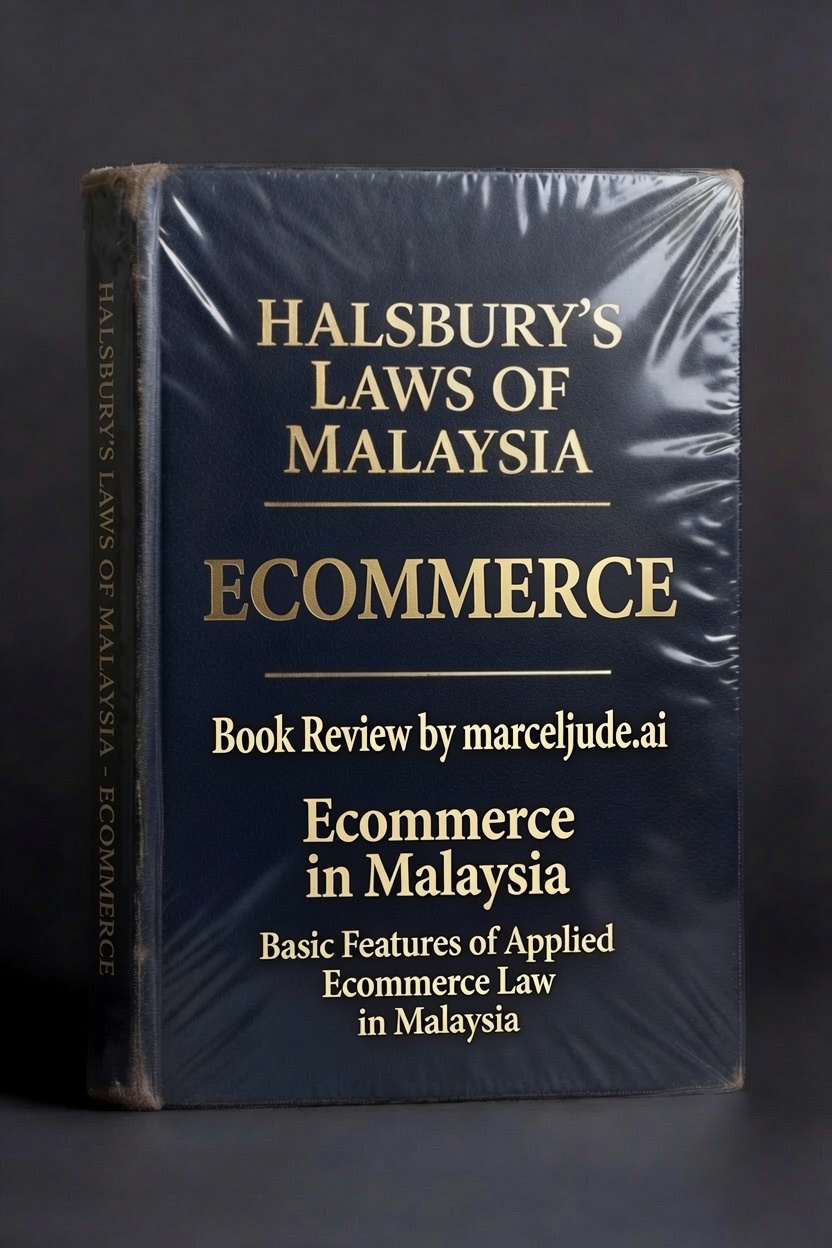


Description
HALSBURY’S LAWS OF MALAYSIA: E-COMMERCE
An Extensive Legal and Academic Review
By marceljude.ai
LIST OF CONTENTS
Introduction — pages 1–9
Key Issues in Electronic Contracting — pages 10–23
Digital Signatures — pages 24–118
Electronic Commerce — pages 119–126
Computer Crimes — pages 127–141
Electronic Payment — pages 142–186
Telemedicine — pages 187–191
Electronic Evidence — pages 192–202
Optical Discs — pages 203–232
Digital Rights — pages 233–248
General Evaluation of the Book
Principal Strengths
Limitations and Areas Requiring Supplementation
Continuing Value to Malaysian Lawyers, Judges and Scholars
Overall Conclusion PRELIMINARY APPRAISAL
I read the book as a systematic legal treatment of the Malaysian framework governing electronic commerce, electronic contracting, digital authentication, computer misuse, electronic payment systems, telemedicine, electronic evidence, optical-disc regulation and digital intellectual-property rights.
The work is not merely a discussion of commercial transactions carried out through the Internet. Its real subject is the legal infrastructure required to make electronic transactions trustworthy. That infrastructure includes contractual validity, attribution, authentication, non-repudiation, payment finality, evidential admissibility, data integrity, licensing, enforcement and intellectual-property protection.
The book’s central jurisprudential problem is easily stated: traditional law assumes identifiable persons, physical documents, handwritten signatures, territorial transactions and tangible evidence. Electronic commerce disrupts every one of those assumptions.
The book therefore asks how law can give electronic communications the same functional reliability that conventional commerce obtains from paper, signatures, seals, witnesses, originals, physical delivery and established banking procedures.
CHAPTER 1
INTRODUCTION
Pages 1–9
Subsections [430.001]–[430.013]
This chapter establishes the technological, economic and jurisprudential setting of Malaysian electronic-commerce law. It explains why ordinary legislation and conventional common-law doctrine frequently lag behind technological development.
[430.001] In general — pages 1–3
The opening subsection advances the proposition that law ordinarily develops after social and technological reality has already changed. Common law is flexible, but its flexibility is incremental. Legislation may respond more comprehensively, yet legislation is also susceptible to rigidity and delay.
The discussion identifies the “lag of legislation”: the period during which technology has altered commercial behaviour but legal rules still reflect an earlier commercial environment.
The importance of this observation extends throughout the book. Electronic-commerce law is not presented as a self-contained collection of statutes. It is a continuing exercise in adapting traditional legal concepts to activities conducted through computers and communications networks.
The subsection introduces the principal legislative pillars of the subject:
the Digital Signature Act 1997;
the Computer Crimes Act 1997;
the Optical Discs Act 2000;
amendments to copyright law;
and the broader electronic-commerce and electronic-government framework.
The discussion of the Multimedia Super Corridor is especially important. It demonstrates that the relevant statutes were part of an economic-development policy rather than isolated regulatory enactments.
The seven flagship applications—Electronic Government, Multipurpose Card, Smart School, Telehealth, Research and Development Clusters, E-Business and Technopreneur Development—show how law, infrastructure and industrial policy were intended to operate together.
The chapter correctly appreciates that confidence is an economic asset. Businesses will not transact electronically merely because the technology is available. They require legal confidence concerning identity, contractual liability, payment, confidentiality, evidence and enforcement.
[430.002] Internet — pages 3–4
This subsection identifies four foundational legal difficulties created by Internet communications.
First is identity. A person communicating through a computer is not necessarily the person he claims to be. An electronic address identifies an account or device more readily than it identifies the human being exercising control over it.
Second is attribution. Even where a person has been identified, the law must determine whether a particular electronic message or act is properly attributable to that person.
Third is authentication. The recipient must be able to establish that the message is genuine and has not been altered.
Fourth is non-repudiation. A system of electronic commerce must reduce the possibility that a participant will later deny sending, signing or authorising an electronic communication.
These four concepts provide the intellectual framework for much of the rest of the book. Digital signatures address authentication and non-repudiation. Electronic-contract rules address attribution and formation. Computer-crime provisions protect system integrity. Electronic-evidence rules determine whether the resulting information can be proved in court.
[430.003] E-commerce — pages 4–5
This subsection places Malaysian law within regional and international developments, particularly ASEAN initiatives and the UNCITRAL model laws.
Four regulatory principles are emphasised:
conformity with international standards;
transparency and predictability;
technological neutrality;
and media neutrality.
Technological neutrality means that legislation should not unnecessarily favour one method of electronic authentication. Media neutrality means that electronic transactions should not be denied legal effect merely because they do not use paper.
This subsection also considers biometrics and quantum cryptography. Its significance is conceptual: the law should regulate functions and legal consequences instead of becoming permanently tied to one technical mechanism.
[430.004] Telemedicine — page 5
Telemedicine is introduced as an illustration of electronic commerce extending beyond the sale of ordinary goods and services. It involves professional licensing, patient consent, confidentiality, cross-border practice and the legal responsibility of healthcare providers.
The subsection anticipates the dedicated discussion at pages 187–191.
[430.005] Payment systems — pages 5–6
Electronic commerce requires a secure mechanism for transferring value. The subsection introduces electronic payment as a regulated financial infrastructure involving systemic risk, clearing, settlement, payment instruments and the supervisory role of Bank Negara Malaysia.
It correctly treats payment systems as more than a private contractual relationship between customer and bank. Failure in a major payment system can affect numerous institutions and the financial system generally.
[430.006] Taxation — page 6
This subsection alerts the reader to the difficulty of applying territorially based tax law to electronic transactions. Electronic activity may involve a buyer, seller, server, payment intermediary and digital product situated in different jurisdictions.
The treatment is introductory, but it identifies a problem that is inseparable from cross-border electronic commerce: determining the relevant place of business, source of income, taxable presence and jurisdiction.
[430.007] Securities — page 6
The subsection notes that electronic systems affect securities trading, communication with investors, market access and the transmission of trading instructions.
Its broader contribution is to show that electronic-commerce law interacts with specialised regulatory regimes. General electronic-contract principles do not displace securities legislation or the duties imposed on licensed intermediaries.
[430.008] Online gambling — pages 6–7
The work recognises the Internet’s capacity to place prohibited or regulated activities within the reach of persons in Malaysia even where the service operator is located elsewhere.
The problem is both substantive and jurisdictional. A transaction cannot acquire legality merely because it is performed electronically. At the same time, enforcement becomes difficult where the operator, server and financial arrangements are outside the jurisdiction.
[430.009] Law reform and development — pages 6–7
This subsection gathers the policy themes of the introductory chapter. Effective reform must recognise international standards, changing technology, commercial practicality and the continued operation of existing law.
It also cautions, implicitly, against treating legislation as the final solution. Technology develops more quickly than highly prescriptive statutory rules.
[430.010] Electronic Commerce Act 2006 — pages 7–8
The Act is introduced as the principal legislation granting legal recognition to electronic messages and transactions.
Its functional method is critical. Instead of demanding paper, it asks whether the electronic process performs the legally relevant function of writing, signature, original form, retention, service or delivery.
The provision does not make every electronic activity lawful. It removes objections based solely on electronic form, subject to exclusions and compliance with applicable substantive law.
[430.011] Electronic Government Activities Act 2007 — pages 7–9
This subsection explains the application of electronic methods to government activity. It addresses the validity of electronic dealings with public authorities and the migration from paper administration to electronic filing, communication and service.
The legal significance is substantial. Private commerce can develop through agreement between parties, but dealings with government usually depend upon statutory authority and prescribed procedures. Express legislative recognition is therefore particularly important.
[430.012] Cyber Court — page 9
The subsection considers the institutional response to disputes involving computers and communications technology. A specialised court or specialised judicial practice may promote consistency, speed and technical competence.
The underlying question remains relevant: whether technological disputes require separate institutions or whether ordinary courts should develop sufficient expertise to handle them.
[430.013] Draft Personal Data Protection Bill — pages 9–10
The discussion recognises that electronic commerce depends upon extensive collection, processing and transfer of personal information.
Data protection is not peripheral to commerce. Consumer confidence may be undermined if personal information can be used without meaningful control. The subject also interacts with authentication systems, certification authorities, payment records, healthcare information and online profiling.
Evaluation of Chapter 1
The chapter succeeds because it begins with problems rather than statutes. Identity, attribution, authentication and non-repudiation are the correct organising concepts.
Its principal limitation is historical. Several technologies and policy initiatives are described at an earlier stage of development. Nevertheless, the chapter’s analytical framework remains sound and valuable.
CHAPTER 2
KEY ISSUES IN ELECTRONIC CONTRACTING
Pages 10–23
Subsections [430.014]–[430.031]
This chapter is one of the most practically useful parts of the book. It demonstrates that electronic contracts are not entirely new legal creatures. They remain contracts, governed by offer, acceptance, intention, terms, legality and proof. What changes is the medium through which those elements are communicated.
Part I: General Principles
[430.014] Introduction — pages 10–11
The chapter begins by rejecting the misconception that contracts made through electronic communications are necessarily outside ordinary contract law.
The central problem is functional translation. Courts must decide how established concepts apply when communications are automated, instantaneous, stored electronically or communicated through an interactive website.
[430.015] Application of the Electronic Commerce Act 2006 — pages 11–12
The subsection explains the statutory recognition of electronic commercial transactions.
The Act assists with legal form, but it does not remove the need to establish agreement, capacity, consideration, legality and certainty. Nor does it necessarily override statutes that prohibit electronic methods for particular transactions.
[430.016] Formation — page 12
Contract formation continues to depend upon identifying an offer and an acceptance. The difficulty is determining which online act possesses which legal character.
A website display may be an invitation to treat rather than an offer. A customer’s electronic order may constitute the offer, and the trader’s later confirmation may constitute acceptance.
Automated processes do not abolish contractual analysis. They make the sequence of communication and the wording of system-generated messages especially important.
[430.017] Offer — pages 12–14
The subsection applies traditional principles governing offers to websites and electronic communications.
A trader may wish to avoid being contractually bound before checking stock, price, delivery location, credit status or regulatory restrictions. For that reason, online terms commonly state that the customer’s order is an offer that the trader may later accept.
The book’s treatment warns practitioners to distinguish between advertising language, an invitation to negotiate and a promise intended to be immediately binding.
[430.018] Acceptance — page 14
Electronic acceptance must correspond with the offer and be communicated in the manner required by the offeror or permitted by law.
The analysis raises difficult questions concerning automated acknowledgements. A message stating that an order “has been received” need not be an acceptance. The legal effect depends upon its words, the surrounding terms and the commercial process.
[430.019] Postal rule — pages 14–15
The postal rule treats acceptance as effective upon posting in certain circumstances. Its application to electronic communications is problematic because electronic messages are usually transmitted through systems more closely resembling instantaneous communications than conventional post.
The subsection correctly approaches the postal rule as an exceptional doctrine rather than an automatic analogy for email.
[430.020] Instantaneous communication rule — page 15
For instantaneous communications, acceptance generally takes effect when received rather than when sent.
Electronic communications complicate this rule. Email may be transmitted rapidly but remain unread, blocked, misdirected or delayed. The distinction between dispatch, arrival at an information system and actual human awareness must therefore be carefully maintained.
[430.021] Electronic communication — pages 15–16
This subsection considers statutory rules addressing the dispatch and receipt of electronic messages.
Such rules reduce uncertainty by identifying when a message leaves the originator’s control, when it enters the addressee’s designated system and where dispatch or receipt is legally deemed to occur.
[430.022] Intention to create legal relations — pages 16–17
The ordinary objective test remains applicable. The court asks whether the parties’ words and conduct objectively demonstrate an intention to assume legal obligations.
Electronic informality does not necessarily negate legal intention. A contract may be formed through brief emails, platform messages or clicks if the communication, considered objectively, records a concluded bargain.
Part II: Terms of the Contract [430.023] Classification of terms — pages 17–18
The subsection examines the classification of contractual provisions and their consequences.
In an electronic transaction, classification remains important to determine whether breach justifies termination, damages or some lesser remedy.
[430.024] Incorporation of terms — pages 18–19
Online terms are enforceable only if properly incorporated.
A trader cannot safely rely on conditions hidden behind obscure links or supplied only after the contract has been concluded. Reasonable notice must be given before or at formation.
This is one of the chapter’s most important practical lessons. Website design is capable of producing legal consequences. The position, visibility and wording of links and assent mechanisms may determine whether a contractual term forms part of the agreement.
[430.025] Implied terms — page 19
Electronic form does not exclude terms implied by statute, common law, custom or the nature of the transaction.
Businesses must therefore avoid assuming that their displayed terms exhaust the parties’ legal rights and duties.
[430.026] Clickwrap contracts — pages 19–20
Clickwrap agreements require the user to indicate assent, ordinarily by clicking an “I agree” button.
The legal strength of a clickwrap process lies in its affirmative act. It is materially stronger than merely placing terms somewhere on a website and assuming that continued browsing signifies consent.
The enforceability of such agreements nevertheless depends upon adequate notice, genuine opportunity to review the terms and compliance with substantive controls on unfair or unlawful provisions.
Part III: Regulatory Issues
[430.027] Formalities — pages 20–21
Some transactions must be in writing, signed, witnessed, sealed or retained in original form.
The Electronic Commerce Act provides functional equivalents for many such requirements, but practitioners must still examine the particular governing statute. Some documents or transactions may be excluded or subject to special formalities.
[430.028] Prohibited and regulated contracts and activities under other laws — pages 21–22
Electronic form does not legalise an otherwise prohibited activity. Gaming, financial services, professional activities, controlled goods and other regulated matters remain subject to their particular statutory regimes.
[430.029] Prohibited and restricted contracts under the Contracts Act 1950 — page 22
The ordinary law of illegality continues to apply. An electronic agreement may be void where its object or consideration is unlawful or contrary to public policy.
[430.030] Governing law — pages 22–23
Cross-border electronic commerce makes governing law especially important.
The physical location of a server is not necessarily decisive. Courts may examine express choice-of-law terms, the parties’ places of business, contractual performance and the system of law with the closest connection to the transaction.
The subsection is valuable because it warns against equating technological location with legal location.
[430.031] Evidencing the contract — page 23
The chapter concludes by connecting formation with proof.
A party may have a valid electronic contract but still fail in litigation if it cannot prove the content, source, timing or integrity of the electronic records. Proper retention of electronic communications, transaction logs, authentication data and system records is therefore essential.
Evaluation of Chapter 2
This chapter is doctrinally strong. It neither exaggerates the novelty of electronic contracts nor treats traditional principles as mechanically sufficient.
Its best insight is that technology changes the facts to which contract doctrine is applied. Lawyers must understand both the legal rules and the architecture of the transaction.
CHAPTER 3
DIGITAL SIGNATURES
Pages 24–118
Subsections [430.032]–[430.187]
This is the longest and most technically detailed chapter. It examines the Digital Signature Act and the institutional framework supporting digital certificates, certification authorities, repositories and time-stamping services.
The chapter distinguishes a “digital signature” in its technical and statutory sense from a general electronic indication of assent. A digital signature operates through cryptographic methods involving private and public keys and a certification process.
Part I: Introduction
[430.032] Legislation — page 24
The subsection introduces the statutory and regulatory regime.
The legislation is directed not merely at recognising signatures but at constructing a trusted system around them.
[430.033] Definition — pages 24–25
This subsection explains the specialised terminology, including digital signatures, asymmetric cryptosystems, public keys, private keys and certificates.
Precise definition is indispensable because statutory consequences attach to technical processes.
[430.034] Parties involved in a digital-signature system — pages 25–26
The principal actors include:
the signer or subscriber;
the relying party;
the certification authority;
the repository;
and the regulatory authority.
The system allocates risks and duties among these participants.
Part II: Digital Signatures [430.035] In general — pages 26–27
A digital signature is presented as a method of authenticating a message and linking it to a signatory.
[430.036] Satisfaction of rule of law — page 27
A compliant digital signature may satisfy a legal signature requirement where the statutory conditions are met.
[430.037] Creation of legal obligations — pages 27–28
The use of a digital signature may provide evidence of an intention to be bound, but contractual obligation still depends upon the surrounding transaction and applicable substantive law.
[430.038] Risk of unreliable digital signatures — page 28
The security of the private key is central. If compromised, the apparent signature may no longer provide dependable attribution.
[430.039] Incorporation in written document — pages 28–29
The digital signature must be linked to the relevant electronic record in a manner capable of demonstrating integrity.
[430.040] Authentication of digital signatures — pages 29–30
Authentication requires verification through the corresponding public key and certificate infrastructure.
[430.041] Presumptions involving digital signatures — pages 30–31
Statutory presumptions can assist a relying party, but their operation depends upon compliance with statutory requirements.
[430.042] Approved digital-signature system — pages 31–32
Approval allows the regulator to impose technical and procedural safeguards.
[430.043] Storage of private keys — page 32
Secure storage protects the attribution function of the signature.
[430.044] Key length — pages 32–33
Key length relates to resistance against cryptographic attack. The provision illustrates the difficulty of legislating in an area where technical standards evolve.
[430.045] Prohibition against duplication of private key — page 33
Duplication would undermine the premise that the private key is controlled uniquely by the subscriber.
[430.046] Disposal of key pairs — page 33
Secure disposal is required to prevent later misuse.
[430.047] Key generation — pages 33–34
Trust begins with the manner in which keys are generated. A defective generation process compromises the entire system.
[430.048] Certification practice statement — pages 34–35
The certification practice statement discloses the authority’s procedures, standards and allocation of responsibility.
[430.049] Duty of instruction — page 35
Subscribers must be properly informed about the use and protection of their keys and certificates.
[430.050] Application for certificate — pages 35–36
The authority must obtain sufficient information to verify the applicant’s identity and entitlement.
[430.051] Issue of certificate — pages 36–38
Issuance represents the certification authority’s formal linkage of an identity with a public key.
[430.052] Certification Revocation List — pages 38–39
The revocation list protects persons who might otherwise rely upon a compromised, suspended or invalid certificate.
[430.053] Chargeable fees — page 39
The subsection addresses the commercial charges associated with certification services.
Part III: The Commission [430.054] Powers and duties — pages 39–40
The regulatory body supervises licensing, standards, recognition and compliance. Its function is essential because users are unlikely to possess the technical ability to audit certification authorities themselves.
Part IV: Licensing of Certification Authorities [430.055] Certification authorities to be licensed — pages 40–41
Licensing is the principal statutory control over market entry.
[430.056] Functions of licensed certification authorities — page 41
These functions include identity verification, certificate issuance, publication, suspension and revocation.
[430.057] Exempted certification authorities — pages 41–42
Exemption powers introduce flexibility while retaining regulatory supervision.
[430.058] Qualification requirements — pages 42–43
Financial, technical, organisational and integrity requirements protect subscribers and relying parties.
[430.059] Formalities for application — pages 43–44
The application process requires prescribed information and supporting materials.
[430.060] Qualification procedure — page 44
Regulatory examination precedes approval.
[430.061] Implied conditions of licence — pages 44–46
Conditions attach to the licence by law, whether or not individually restated.
[430.062] Grant or refusal of licence — page 46
The decision is an administrative act requiring compliance with the statutory framework.
[430.063] Register of licences — pages 46–47
A public register assists verification and market transparency.
[430.064] Certified copy of licence — page 47
Certified copies provide authoritative proof of licensing status.
[430.065] Revocation of licence — pages 47–49
Revocation protects the system where the authority ceases to satisfy regulatory requirements or commits serious defaults.
[430.066] Renewal of licence — page 49
Continuing authority is subject to periodic review.
[430.067] Appeal — pages 49–50
A right of appeal introduces procedural fairness and accountability.
[430.068] Surrender of licence — page 50
Voluntary cessation must be controlled because certificates may remain in circulation.
[430.069] Return of licence — pages 50–51
Formal return prevents continued representation of authority.
[430.070] Effect of revocation, surrender or expiry — pages 51–52
Termination has consequences for subscribers, certificates and records.
[430.071] Effect of lack of licence — page 52
Unlicensed operation may invalidate statutory privileges and attract penalties.
[430.072] Restricted licences — pages 52–53
Restrictions allow tailored authorisation for limited functions or circumstances.
[430.073] Loss of licence — page 53
The loss of the physical instrument does not extinguish regulatory status but must be dealt with formally.
[430.074] Amendment on request — pages 53–54
A licensee may seek alteration of licence particulars or conditions.
[430.075] Power to amend conditions — pages 54–55
The regulator may modify conditions to respond to risk or changing standards.
[430.077] Partnerships in licence — pages 55–56
The subsection considers organisational responsibility where the licensed entity is a partnership.
[430.078]–[430.080] Certification authority disclosure record — pages 56–59
These provisions regulate:
its required contents; the form in which it must be maintained; and its retention.
The disclosure record enables users and regulators to understand the authority’s operational standards, relevant qualifications and history.
[430.081]–[430.088] Performance and compliance audits — pages 59–64
These subsections govern:
performance audits;
exemption from audit;
qualification and registration of auditors;
annual compliance procedure;
the auditor’s report;
additional audits;
obstruction of an audit;
and the consequences of failure.
The audit regime is one of the strongest features of the statutory model. It substitutes professional verification for blind reliance upon private technological claims.
[430.089]–[430.092] Suitable guarantee and claims — pages 64–67
A financial guarantee supports compensation and regulatory responsibility.
The book examines:
the requirement for a suitable guarantee;
return of the guarantee;
collection upon it;
and the procedure for claims.
[430.094]–[430.100] Foreign certification authorities — pages 67–71
These subsections address:
recognition of other licences;
criteria for recognising foreign authorities;
applications for recognition;
grants of recognition;
revocation;
and applications for revocation.
This is crucial to cross-border commerce. A domestic digital-signature regime would be of limited value if certificates issued abroad could never be recognised.
[430.101]–[430.105] Operational regulation — pages 71–73
These provisions cover:
permitted activities;
display of the licence;
submission of business information;
notification of changes;
and advertising requirements.
Their purpose is to ensure continuing transparency and regulatory access to material information.
Part V: Requirements of Licensed Certification Authorities [430.106]–[430.120] Issuance, disclosure and representations — pages 73–81
This group covers:
general requirements;
trustworthy systems;
disclosures upon inquiry;
preconditions to certificate issuance;
publication of accepted certificates;
suspension and revocation;
warranties to subscribers;
continuing obligations;
representations upon nuisuance and publication
subscriber representations;
representations by agents;
indemnification;
limits on disclaimers;
and certification of information accuracy.
The central legal theme is reliance. Certificates are used by persons who may never have dealt directly with the subscriber. The law therefore regulates what the authority and subscriber represent to third parties.
Part VI: Duties of Authorities and Subscribers
[430.121]–[430.128] Security and suspension — pages 81–85
The subsections address:
the subscriber’s duty to secure the private key;
fiduciary responsibility where an authority holds the key;
suspension by the authority;
suspension by the Commission or court;
termination of suspension;
contractual suspension procedures;
false suspension requests;
and the effect of suspension.
The subscriber’s security duty is fundamental. A digital-signature regime cannot operate fairly if a subscriber can negligently expose a private key and later transfer every resulting loss to an innocent relying party.
[430.129]–[430.137] Revocation, expiry and liability — pages 85–90
These provisions cover:
revocation upon request;
death or dissolution of the subscriber;
unreliable certificates;
notice of revocation;
the effect of requests and notifications; expiry;
recommended reliance limits; and liability limits.
The book usefully differentiates suspension, revocation and expiry. Each affects reliance differently and takes effect according to its own legal conditions.
Part VII: Repositories [430.139]–[430.148] Recognition and liability — pages 90–98
The repository provisions deal with:
the functions of a recognised repository;
qualifications;
stages of recognition;
applications;
required information;
issuance and renewal;
revocation and surrender; and liability.
A repository is not a passive archive. It supports the public verification of certificate status and must preserve reliable records.
Part VIII: Date and Time Stamp Services [430.149]–[430.160] Recognition and operation — pages 98–105
These subsections concern:
recognition of time-stamp services;
the legal effect of time stamps;
functions and qualification requirements;
applications;
required information;
issuance, renewal, revocation and surrender of recognition;
and the provision of multiple services.
Reliable time information is vital to priority, dispatch, receipt, expiry, filing deadlines and the chronological reconstruction of electronic transactions.
Part IX: General Regulations
[430.161]–[430.170] Records, security and secrecy — pages 105–112
The relevant matters include:
record-keeping;
retention and custody;
technical components;
data protection;
review of software and systems;
guidelines;
dangerous activities;
and secrecy obligations.
This part demonstrates that legal reliability depends on operational governance. A valid certificate system requires secure software, controlled access, accurate records, confidentiality and continuing technical review.
Part X: Offences, Investigation and Prosecution [430.171]–[430.187] Enforcement and miscellaneous controls — pages 112–119
The final group addresses:
false information;
corporate offences;
investigation powers;
searches under warrant;
searches and seizures without warrant;
access to computerised data;
inventories of seized items;
additional powers;
obstruction;
penalties;
procedural costs;
exclusion of claims for seizure-related loss;
prosecution;
criminal jurisdiction;
exemption powers;
and limits upon contractual exclusion of the Act.
Evaluation of Chapter 3
This chapter is exceptionally comprehensive. It explains not only the legal effect of a digital signature but the institutional machinery required to produce trustworthy digital authentication.
Its weakness is also its strength: the detail is highly technical and heavily tied to a regulated public-key infrastructure. The reader must distinguish enduring legal principles—identity, attribution, integrity and reliance—from technical mechanisms that may change.
CHAPTER 4
ELECTRONIC COMMERCE
Pages 119–126 Subsections [430.188]–[430.207]
This chapter provides a compact but important exposition of the Electronic Commerce Act.
[430.188] Application of the Act — pages 119–120
The Act applies to commercial transactions conducted by electronic means, subject to statutory limitations and exclusions.
[430.189] Legal recognition of electronic messages — page 120
An electronic message is not to be denied legal effect merely because it is electronic.
[430.190] Formation and validity of contracts — page 120
Contracts may be formed through electronic messages. The medium does not itself invalidate agreement.
[430.191] Writing — page 120
An electronic message may satisfy writing requirements where its information is accessible for subsequent reference.
[430.192] Signature — pages 120–121
An electronic method may satisfy a signature requirement where it adequately identifies the person and indicates approval, subject to the required standard of reliability.
[430.193] Seal — page 121
Electronic methods may fulfil a sealing requirement where statutory conditions are met.
[430.194] Witness — pages 121–122
Electronic witnessing must perform the legal functions of observation, authentication and connection with the relevant document.
[430.195] Original form — page 122
The concept of an electronic original depends upon integrity rather than physical uniqueness.
[430.196] Retention — page 122
Electronic retention must preserve accessibility and relevant information about origin, destination, dispatch and receipt.
[430.197] Copies — pages 122–123
A requirement for copies may be met electronically where the information remains accurately reproducible.
[430.198] Prescribed form — page 123
Electronic compliance does not dispense with mandatory content or prescribed legal form.
[430.199] Service and delivery — page 123
Electronic service depends upon statutory recognition, agreed methods and proof of receipt.
[430.200] Attribution — pages 123–124
The Act determines circumstances in which an electronic message is treated as that of the originator.
[430.201] Contents of message — page 124
The legal effect of the message depends upon its communicated contents and the applicable rules of interpretation.
[430.202] Separate messages — pages 124–125
Each electronic message is ordinarily treated separately, preventing duplication or retransmission from automatically producing multiple legal obligations.
[430.203] Time of dispatch — page 125
Dispatch is linked to the message leaving the originator’s control or entering an information system outside that control.
[430.204] Time of receipt — page 125
Receipt concerns entry into the designated system or the system through which the addressee retrieves the message.
[430.205] Place of dispatch — pages 125–126
The legally deemed place may be the originator’s place of business rather than the physical location of a server.
[430.206] Place of receipt — page 126
The addressee’s place of business may determine deemed receipt.
[430.207] Acknowledgement of receipt — pages 126–127
Acknowledgement may affect whether the originator treats the message as successfully received, but it does not necessarily amount to acceptance of a contractual offer.
Evaluation of Chapter 4
The chapter clearly explains the functional-equivalence principle. Its treatment of dispatch, receipt and attribution is especially useful in litigation concerning email service, online contracts and automated systems.
CHAPTER 5
COMPUTER CRIMES
Pages 127–141 Subsections [430.208]–[430.224] [430.208] Overview — pages 127–128
The chapter distinguishes offences against computers from traditional offences merely committed with the assistance of computers.
[430.209] Definition of “computer” — pages 128–129
A broad definition is required to prevent technical form from defeating the statute.
[430.210] Unauthorised access — pages 129–130
The offence protects the confidentiality and controlled accessibility of computer material.
[430.211] Securing access — pages 130–132
This subsection explains the acts capable of constituting access, including causing a computer to perform a function to obtain data or programs.
[430.212] Unauthorised modification — pages 132–133
The provision protects data and system integrity. Modification includes alteration, deletion or impairment without authority.
[430.213] Wrongful communication — pages 133–134
Access credentials and other means of unauthorised access cannot lawfully be communicated to facilitate intrusion.
[430.215] Territorial scope — pages 134–135
Computer offences frequently cross national borders. The statute therefore contains an extended jurisdictional approach where the computer, offender or consequences possess the required Malaysian connection.
[430.216] Search, seizure and arrest — pages 135–137
Investigatory powers permit authorities to secure computer equipment, data and related evidence.
[430.218] Prosecution — page 137
The subsection addresses authority and procedure for commencing criminal proceedings.
[430.219] Theft — pages 137–138
The analysis considers the difficulty of applying traditional theft concepts to intangible information.
[430.220] Cheating and personation — pages 138–139
Online fraud may be prosecuted through conventional Penal Code offences where deception induces the delivery of property or causes legally recognised harm.
[430.221] Unauthorised interception — pages 139–140
The offence protects communications from unlawful acquisition during transmission.
[430.222] Unauthorised disclosure — page 140
Information lawfully or unlawfully acquired may attract separate liability when disclosed without authority.
[430.223] Employment-related interception — pages 140–141
Workplace systems raise questions concerning employee privacy, employer ownership, consent and legitimate monitoring.
[430.224] Offence and penalty — pages 141–142
The chapter concludes with the applicable offence and punishment provisions.
Evaluation of Chapter 5
The chapter correctly shows that cybercrime law operates alongside traditional criminal law. Its enduring contribution is the distinction between confidentiality, integrity and misuse of computer systems.
CHAPTER 6
ELECTRONIC PAYMENT
Pages 142–186 Subsections [430.225]–[430.285]
This chapter treats payment infrastructure as a matter of public financial regulation, not merely private banking contract.
Part I: Introduction [430.225] In general — pages 142–143
Electronic payment systems allow funds and payment instructions to move through interconnected institutions.
[430.226] RENTAS — page 143
The Real Time Electronic Transfer of Funds and Securities system supports high-value interbank transfers and settlement.
[430.227] SPICK — page 143
The subsection explains the relevant cheque-clearing infrastructure.
[430.228] Interbank GIRO — pages 143–144
GIRO enables electronic interbank credit transfers.
[430.229] Shared ATM network — page 144
Shared networks provide customers with access beyond their own bank’s terminals.
[430.230] Financial Process Exchange — page 144
This system facilitates payment processing between participating institutions and merchants.
[430.231] SCANS — page 144
The subsection identifies the relevant securities-clearing or settlement mechanism.
[430.232] Regulation of payment systems — pages 144–145
Regulation responds to operational, liquidity, credit and systemic risks.
Part II: Powers of Bank Negara Malaysia [430.233]–[430.242] Supervisory and intervention powers — pages 145–157
These provisions cover:
the Bank’s functions;
incorporation requirements;
submission of information;
modification powers;
directives;
examination;
intervention upon insolvency;
assumption of assets;
consequences of taking control;
and alteration of share capital.
The breadth of these powers reflects the public importance of continuity in payment operations.
Part III: Investigation, Search and Seizure [430.243]–[430.250] Investigative machinery — pages 156–165
The book examines:
general investigative powers;
entry, search and seizure;
translation requirements;
examination of persons;
seizure of movable property within financial institutions;
the legal effect and validity of seizure;
and assistance from police and public officers.
Part IV: Payment Systems
[430.251]–[430.265] Designated systems and settlement finality — pages 165–174
These subsections cover:
operation of payment systems;
designation;
revocation of designation;
general regulation;
disqualification of directors;
appointment of chief executives;
consequences and exceptions;
governance arrangements;
operational arrangements;
system changes;
application of the settlement provisions;
finality of payment and netting;
non-recognition of certain foreign insolvency orders;
and insolvency notifications.
Settlement finality is the doctrinal centre of this part. Once a payment or netting arrangement becomes final under the statutory framework, later insolvency proceedings should not casually unwind it. This protects the stability of the system and other participants.
Part V: Payment Instruments
[430.266]–[430.272] Designated instruments — pages 174–178
The book discusses:
operation of payment instruments;
designation;
approval;
revocation of approval;
governance;
operational arrangements;
and changes to designated instruments.
The distinction between a payment system and a payment instrument is important. The instrument is the device or method used by the customer, while the system is the institutional network that processes and settles the payment.
Part VI: Offences [430.273]–[430.279] Penal and administrative consequences — pages 178–182
The subsections address:
offences generally;
general penalties;
specific offences;
corporate attribution;
compounding;
administrative penalties;
and appeals.
Part VII: Miscellaneous
[430.280]–[430.285] Regulatory support provisions — pages 182–187
These provisions concern:
exemptions;
monies received by the Bank;
regulations;
guidelines;
secrecy;
and permitted disclosure.
Evaluation of Chapter 6
The chapter’s greatest strength is its recognition that electronic payment law is systemic. The reader is shown how governance, insolvency, investigation and settlement finality combine to sustain public confidence.
CHAPTER 7
TELEMEDICINE
Pages 187–191 Subsections [430.286]–[430.291]
[430.286] Introduction — pages 187–188
Telemedicine is situated at the intersection of technology, professional regulation and patient protection.
[430.287] Meaning of telemedicine — page 188
The definition determines which remote medical activities fall within the regulatory regime.
[430.288] Persons who may practise telemedicine — pages 188–189
Professional qualification remains essential. Technology does not authorise unqualified medical practice.
[430.289] Certificate to practise — pages 189–190
Certification provides regulatory control over practitioners offering medical services through electronic means.
[430.290] Patient consent — pages 190–191
Consent is particularly significant because telemedicine may involve remote diagnosis, electronic records and transmission of sensitive health information.
Consent must be informed and directed to the material nature and consequences of the remote service.
[430.291] Regulations — page 191
The regulation-making power permits detailed technical and professional requirements to be developed.
Evaluation of Chapter 7
The chapter is short but conceptually important. It demonstrates that electronic-commerce law cannot be separated from professional duties, confidentiality, informed consent and patient safety.
CHAPTER 8
ELECTRONIC EVIDENCE
Pages 192–202 Subsections [430.292]–[430.306]
This chapter is of direct importance to litigators.
[430.292] Introduction — page 192
Electronic transactions are legally useful only if the resulting records can be proved in court.
[430.293] Nature of electronic evidence — pages 192–193
Electronic evidence includes messages, logs, databases, computer-generated records and digital files.
Its characteristics differ from paper: it can be copied perfectly, altered invisibly, distributed instantly and accompanied by metadata.
[430.294] Admissibility — pages 193–194
Admissibility depends upon the Evidence Act and the applicable statutory provisions concerning computer-generated documents.
[430.295] Definition of “computer” — pages 194–195
A broad functional definition ensures that admissibility does not depend upon the particular device used.
[430.296] Whether a document is “produced by a computer” — pages 195–196
The classification determines the statutory route by which the record may be proved.
[430.297] Electronic documents as primary evidence — pages 196–197
The work examines whether an electronic record or printout may constitute primary evidence rather than merely a copy of some elusive digital original.
[430.298] Hearsay exception — pages 197–198
Computer records may contain human assertions, automatically generated data or a combination of both. The hearsay analysis must identify the true source of the statement.
[430.299] Real evidence contrasted with hearsay — page 198
Automatically recorded system data may be real evidence of a process or event, whereas information entered by a person may involve hearsay concerns.
[430.300] Ordinary use — pages 198–199
Production in the ordinary use of a computer supports reliability and admissibility.
[430.301] Proof by certificate — pages 199–200
A statutory certificate may establish the required conditions without calling every person involved in operating the computer system.
[430.302] Proof by other means — pages 200–201
Certification is not necessarily the sole route. The relevant matters may be proved through witnesses and surrounding evidence.
[430.303] Proceedings pending or commenced — page 201
The subsection addresses records produced when litigation is already anticipated or underway, where reliability and purpose may require closer scrutiny.
[430.304] Criminal proceedings — pages 201–202
Electronic evidence in criminal cases raises heightened concerns about integrity, continuity, attribution and fairness.
[430.305] Weight — page 202
Admissibility does not settle weight. Courts may consider how the record was created, stored, retrieved, altered and authenticated.
[430.306] Authenticity and recognised digital signatures — pages 202–203
A recognised digital signature may assist in proving authenticity and attribution.
Evaluation of Chapter 8
This is one of the book’s finest chapters. It correctly distinguishes admissibility from evidential weight and electronic information from human assertions contained within it.
For practitioners, its central lesson is preservation. Native electronic records, metadata, access logs, audit trails and chain-of-custody information should be secured at the earliest stage.
CHAPTER 9
OPTICAL DISCS
Pages 203–232 Subsections [430.307]–[430.366]
This chapter examines a detailed licensing and enforcement regime directed at optical-disc manufacture and copyright piracy.
Part I: General [430.307] Introduction — pages 203–204
The legislation is placed within the broader protection of intellectual property.
[430.308] Ministerial regulations — pages 204–205
Regulation-making powers permit detailed manufacturing and marking requirements.
[430.309] Meaning of optical disc — page 205
The statutory definition determines the media caught by the regime.
Part II: Administration [430.310] Controller and officers — pages 205–206
The subsection establishes the administrative and enforcement authority.
Part III: Licensing [430.311]–[430.324] Licence and records — pages 206–214
These provisions address:
the requirement for a manufacturing licence;
applications;
grant or refusal;
variation of conditions;
revocation;
surrender;
consequences of termination;
transfer and renewal;
replacement licences;
certified copies;
display;
registers of licences and manufacturers;
and maintenance of records.
The controls create traceability. Manufacturing capacity capable of mass-producing protected works is brought within a system of identification, record-keeping and inspection.
[430.325]–[430.329] Appeals — pages 214–216
The appeal machinery covers:
notice of appeal;
reasons for decisions;
determination;
withdrawal;
and transmission of documents.
Part IV: Manufacturer
[430.330] Manufacturer’s code — page 216
Optical discs must carry an identifying code.
[430.331] Marking standards — pages 216–217
Standards ensure that the code is usable for tracing the manufacturer.
[430.332] False manufacturer’s code — pages 217–218
False marking is prohibited because it defeats traceability and facilitates piracy.
Part V: Code of Conduct
[430.333] Issuance — page 218
The Controller may establish standards of responsible conduct.
[430.334] Revocation or alteration — pages 218–219
The code may be modified to respond to regulatory needs.
[430.336] Compliance as a defence — page 219
Compliance may possess defensive legal significance in specified circumstances.
Part VI: Offences and Penalties
[430.337]–[430.345] Criminal responsibility — pages 219–223
The offences include:
breach of the statutory regime;
false or misleading information;
disappearance or destruction of items liable to seizure;
unauthorised disclosure of confidential information;
liability of directors, managers and secretaries;
employee and agent offences;
obstruction;
general penalties;
and compounding.
Part VII: Enforcement
[430.346]–[430.361] Investigation and seizure — pages 223–231
These subsections cover:
enforcement powers;
investigation;
additional powers;
searches under warrant;
warrantless search and seizure;
inventories;
defective warrants;
access to computerised data;
attendance and examination of knowledgeable persons;
admissibility of statements;
forfeiture;
exclusion of seizure-related costs and damages;
informer protection; and rewards for information
Part VIII: Miscellaneous
[430.362]–[430.366] Closing provisions — pages 231–233
The final provisions concern:
exemptions;
protection of officers;
jurisdiction to try offences;
and service of records and notices.
Evaluation of Chapter 9
The chapter is an impressive account of a specialised anti-piracy regime. It demonstrates how copyright enforcement may be strengthened by controlling the means of mass reproduction.
Its contemporary relevance depends upon changes in media consumption. Physical optical discs are less central to distribution than they once were, but the regulatory concepts of traceability, manufacturing control, seizure and anti-circumvention remain instructive.
CHAPTER 10
DIGITAL RIGHTS
Pages 233–248 Subsections [430.367]–[430.401]
This chapter explains how copyright and related rights operate in the digital environment.
Part I: Introduction [430.367] Digital rights — pages 233–234
Digital technology permits perfect reproduction and rapid dissemination at extremely low cost. Rights must therefore address reproduction, communication, access and technological protection.
Part II: Copyright in the Digital Environment [430.368] Copyright in general — pages 233–235
The ordinary principles of subsistence, ownership and infringement remain applicable.
[430.369] Publication — page 235
Digital dissemination may constitute publication depending upon the statutory definition and circumstances.
[430.370] Reproduction and copying — page 235
Electronic storage can itself involve reproduction. Copying is not confined to producing a physical object.
[430.371] Temporary or transient reproduction — pages 235–236
Digital systems necessarily create temporary copies. The law must distinguish technically inevitable copies from actionable commercial reproduction.
[430.372] Communication to the public — page 236
Online transmission may engage the copyright owner’s communication right.
[430.373] Sound recordings — pages 236–237
Digital distribution affects the rights attached to sound recordings and their reproduction or communication.
Part III: Works Eligible for Protection [430.374] Computer programs as literary works — page 237
Computer programs receive protection through the literary-work category.
[430.375] Nature of copyright — page 237
Protection concerns the expression embodied in the program rather than every idea, function or method underlying it.
[430.376] Back-up copies — pages 237–238
The law permits or regulates limited copying for legitimate backup purposes.
[430.377] Patents — page 238
The subsection distinguishes copyright protection from patent protection.
[430.378] Nature of film — pages 238–239
Digital audiovisual material may fall within the statutory concept of film.
[430.379] Nature of copyright — page 239
The relevant exclusive rights depend upon the category of protected subject matter.
[430.380] Form — pages 239–240
Digital form does not necessarily deprive a work of protection.
[430.381] Multiple works and subject matter — page 240
A single digital product may contain literary works, artistic works, music, sound recordings, film and computer programs, each with separate ownership and rights.
[430.382] Streaming and downloads — pages 240–241
Streaming and downloading engage different technical processes but may both implicate reproduction and communication rights.
[430.383] Digital audio transmission — pages 240–241
The subsection considers online transmission of recorded sound.
[430.385] Peer-to-peer file sharing — pages 241–242
Peer-to-peer systems decentralise copying and distribution, complicating enforcement and attribution.
[430.386] Authorisation — page 242
A person who facilitates or sanctions infringement may incur liability even without personally making every infringing copy.
Part IV: Rights Management Information [430.387] Rights management information — pages 242–243
Electronic information identifying works, owners and licensing conditions assists digital-rights administration.
[430.388] Removal or alteration — pages 242–243
Unauthorised removal or alteration undermines licensing and may facilitate infringement.
Part V: Circumvention of Technological Measures [430.390] Circumvention — pages 243–244
The law protects technological measures controlling access or preventing unauthorised use.
[430.391] Remedies — page 244
Rights holders may obtain the remedies provided by the statutory framework.
[430.392] Statutory damages — pages 244–245
Statutory damages provide relief where exact proof of actual loss is difficult.
[430.393] Circumvention of access controls — pages 244–245
Bypassing an effective technological access control may create liability independently of conventional copying.
[430.395] Devices, products, components and services — pages 245–246
Liability may extend to trafficking in circumvention tools or offering circumvention services.
Part VI: Offences
[430.389] Offences — page 243
The subsection identifies criminal consequences connected with prohibited interference with rights-management information.
[430.396] Content Code — page 246
Industry codes may supplement legislation by establishing standards for online content and service providers.
Part VII: Innocent Carriers [430.397] Innocent carriers — pages 246–247
The subsection considers intermediaries that transmit or host material without direct involvement in its creation.
The policy problem is one of balance. Imposing absolute liability on intermediaries could inhibit network services, while complete immunity might leave rights holders without an effective remedy.
Part VIII: Domain Names [430.398] Domain names — page 247
Domain names possess both technical and commercial significance. They may conflict with trademarks, business names and passing-off rights.
[430.399] Domain registry — pages 247–248
The registry administers allocation and maintains the authoritative registration system.
[430.400] Registration — page 248
Registration generally operates administratively and does not necessarily confer an absolute proprietary entitlement against persons holding superior legal rights.
[430.401] Dispute resolution — page 248
Specialised domain-name dispute mechanisms offer a faster alternative to ordinary litigation, particularly in cases of abusive or bad-faith registration.
Evaluation of Chapter 10
The final chapter successfully connects conventional copyright doctrine with digital exploitation. Its treatment of temporary copying, streaming, peer-to-peer systems, technological measures and intermediary responsibility demonstrates that digital copyright is not concerned only with unauthorised downloads. It is concerned with control over access, reproduction, communication and distribution.
GENERAL EVALUATION OF THE ENTIRE BOOK
The book’s most important achievement is its construction of electronic-commerce law as an integrated legal system.
The chapters are linked by a coherent sequence:
electronic communications create problems of identity and attribution;
contract law determines whether an agreement exists;
digital signatures provide mechanisms for authentication;
electronic-commerce legislation gives functional recognition to electronic form;
computer-crime law protects systems and information from misuse;
payment regulation secures the transfer and final settlement of value;
telemedicine applies electronic methods to regulated professional services;
evidence law determines whether digital records can be proved;
optical-disc legislation attacks organised physical piracy;
and digital-rights law protects intellectual property distributed through electronic networks.
The work is therefore more than a digest of legislation. It is an account of the legal architecture of trust.
Jurisprudential Value
The book’s jurisprudential value lies in its use of functional equivalence. Electronic law should ask what purpose a traditional formality performs.
A handwritten signature may identify a person, demonstrate assent, authenticate a document and discourage repudiation. If an electronic method performs those functions with sufficient reliability, the absence of handwriting should not automatically invalidate the transaction.
Similarly, an electronic record should not fail merely because it lacks a single physical “original.” The legally relevant inquiry is whether the information has retained its integrity and can be accurately reproduced.
This functional approach permits continuity between established doctrine and new technology.
Doctrinal Value
The book gives practitioners a broad map of the statutes and doctrines likely to arise in electronic disputes. It is especially effective in showing that electronic transactions remain subject to ordinary law.
An electronic contract may still fail for uncertainty, illegality, incapacity, absence of agreement or failure to incorporate terms.
A digital signature may authenticate a message but cannot make an unlawful contract enforceable.
An electronic record may be admissible but carry little weight if its integrity is doubtful.
A payment instruction may be electronically valid but remain subject to banking regulation, fraud rules and statutory intervention.
Regulatory Value
The work recognises that private contract alone cannot provide all necessary protections. Certification authorities, payment systems, healthcare providers, manufacturers and network intermediaries may require regulatory duties because their activities affect persons who are not parties to their immediate contracts.
The detailed examination of licensing, audits, guarantees, record-keeping and enforcement powers makes the book valuable to administrative and regulatory lawyers as well as commercial practitioners.
PRINCIPAL STRENGTHS 1. Comprehensive coverage
The book brings together subjects that might otherwise be scattered across contract, evidence, criminal, banking, intellectual-property, telecommunications and administrative law.
2. Clear statutory organisation
The proposition-number format allows the reader to identify precise legal topics quickly.
3. Strong treatment of electronic evidence
The separation between admissibility, authenticity and weight is doctrinally correct and practically important.
4. Detailed digital-signature analysis
The book explains the entire trust infrastructure rather than merely describing the legal effect of a signature.
5. Recognition of cross-border problems
Governing law, foreign certification authorities, territorial computer offences and domain-name disputes are correctly treated as international or transnational matters.
6. Functional understanding of formalities
The analysis of writing, signature, original form, retention, dispatch and receipt provides a durable framework capable of application to later technologies.
7. Integration of public and private law
The book shows that electronic commerce is governed simultaneously by contract, statutory regulation, criminal law and evidential procedure.
LIMITATIONS AND AREAS REQUIRING SUPPLEMENTATION
The principal limitation is the speed at which the subject changes.
Technologies, payment instruments, digital platforms and cyber threats can change far more rapidly than conventional legal publications. Some institutional and technological descriptions must therefore be checked against later statutory amendments, regulations and judicial decisions before being used as statements of present law.
The discussion of data protection is necessarily preliminary. Modern electronic commerce requires a fuller treatment of data-processing principles, consent, security, disclosure, cross-border transfers and regulatory enforcement.
The book also precedes or does not fully explore several later commercial realities, including:
large online marketplaces;
cloud computing;
mobile applications;
social-media commerce ; electronic wallets;
biometric payment authentication;
platform-generated contracts;
algorithmic decision-making;
distributed ledgers;
digital assets;
artificial intelligence;
large-scale data analytics;
ransomware;
modern phishing operations;
and online consumer dark patterns.
These matters do not destroy the book’s value. They show that its principles must be supplemented by later developments.
PRACTICAL VALUE TO LAWYERS,PROFESSORS,STUDENTS & THE GENERAL PUBLIC
For commercial lawyers, the electronic-contract chapter supplies a checklist for determining when an online agreement is formed and which terms are incorporated.
For litigators, the electronic-evidence chapter assists in identifying the witnesses, certificates, records and chain-of-custody evidence required to prove digital material.
For criminal practitioners, the computer-crime chapter helps distinguish unauthorised access, modification, disclosure, interception, cheating and conventional offences.
For banking lawyers, the payment chapter explains the difference between customer instruments, regulated systems, settlement finality and central-bank supervision.
For intellectual-property practitioners, the digital-rights and optical-disc chapters connect infringement doctrine with reproduction technology and enforcement mechanisms.
For public-law lawyers, the provisions governing licensing, recognition, audits, revocation, investigation and appeal provide examples of statutory administrative power that remain subject to legality, procedural fairness and jurisdictional control.
VALUE TO JUDGES
The book assists judges in avoiding two opposite errors.
The first is to treat every technological dispute as wholly unprecedented.
The second is to force new facts into traditional doctrine without understanding how the underlying technology changes attribution, authenticity, reliability or risk.
The work encourages a balanced judicial method:
identify the legal function performed by the conventional rule;
understand the technological process;
apply the relevant statutory provision;
preserve established substantive doctrine where it remains workable;
and scrutinise the reliability of the electronic evidence actually produced.
VALUE TO LEGAL EDUCATION
The book is suitable for advanced teaching because it demonstrates the interaction of multiple legal subjects.
A course based on the work could move from electronic-contract formation to authentication, regulation, computer offences, electronic evidence and intellectual property. Students would learn that modern legal problems seldom remain within a single doctrinal category.
It is also useful for teaching statutory interpretation. Many provisions employ functional and technologically neutral language. Students must determine how such language applies to devices and systems not specifically contemplated when the provision was drafted.
THE BOOK’S CENTRAL THESIS
Although the work does not reduce its argument to one sentence, its central thesis may be expressed as follows:
Electronic commerce can function effectively only when law supplies reliable rules governing identity, assent, integrity, attribution, payment, proof, regulation and enforcement without discriminating against transactions merely because they occur electronically.
That thesis remains convincing.
FINAL ASSESSMENT
Halsbury’s Laws of Malaysia: E-Commerce is a substantial and carefully structured exposition of the Malaysian legal foundations of electronic activity.
Its greatest value lies in demonstrating that electronic commerce is not a narrow specialism. It is a point of convergence between contract law, evidence, criminal law, financial regulation, professional regulation, intellectual property, administrative law and conflict of laws.
The book is particularly authoritative as an organising work. It tells the reader which questions must be asked:
Who sent the electronic message?
Can it legally be attributed to that person?
Was it authentic and unaltered?
Did the parties form a contract?
Were the contractual terms properly incorporated?
Did the transaction comply with formalities and regulatory restrictions?
Was the payment validly processed and finally settled?
Was any computer access or modification unauthorised?
Can the electronic record be admitted and given sufficient evidential weight?
Were copyright or technological protection measures infringed?
Which court and system of law govern the dispute?
A practitioner who asks those questions will understand the architecture of an electronic dispute before entering its statutory detail.
The book should therefore be regarded as an important foundational work. Its discussion of particular technologies must be read with awareness of later developments, but its principal analytical categories remain durable.
Its ultimate contribution is intellectual discipline. It teaches the reader not to be distracted by the novelty of technology. The correct judicial and professional task is to identify the legal function, examine the reliability of the electronic process, apply the governing statute and preserve fairness between the parties.
Reviewed by marceljude.ai
- MALAYSIA'S 1ST AI LAWYER - CLICK HERE
- ISMAIL – INTEGRATED SINGAPORE/MALAYSIA AI & LAW (Library)
- OPENING OF SINGAPORE MALAYSIA AI CENTRE AND LAW LIBRARY
- LIFT - LAW INSTRUMENTS FORMS & TEMPLATES
- LAWS OF MALAYSIA FOR SINGAPOREAN DUMMIES
- HANNAH YEOH'S ARTIFICIAL INTELLIGENCE LAW ENCYCLOPEDIA
- LEAD CR - Law Ecosystem Archive Databases on CD-ROM
- BREAKING NEWS FROM MJN
- CLICK HERE CO. PROFILE
- EXCITING NEW SERIES - THE ADVENTURES OF BOBBY TAN -ADVOCATE & SOLICITOR IN THE HIGH COURT OF NORTH BORNEO by marceljude.ai
- MEDICO LEGAL - BY PRISKILA AKWILA & GLORIOUS PETAL SDN BHD - powered by marceljude.ai
- MISCELLANOUS
- ANNOTATED STATUTES OF SABAH - A NEW SERIES
- e-library - marceljude.ai
- DRAFT - DOCUMENT RESEARCH & AUTOMATED FILING TECHNOLOGY
- CLARA – Case Law Analysis & Retrieval AI
- FOR RESEARCH REQUEST CLICK HERE
- CLICK HERE TO ASK ANYTHING
- RAMBO'S LAW - THE LAW OF THE LAW JUNGLE - EXCITING NEW SERIES - CASE ANALYSIS BY JOHN RAMBO @ +60138646786
- PRISKILA AKWILA ADVOCATES - High Court of Sabah & Sarawak @ Kota Kinabalu
- COLA - COMMONWEALTH ONLINE LAWCASES AI -marceljude.ai
- THE LAW LIBRARY THAT COMES TO YOU ANYWHERE AND ANYTIME
- marceljude.ai training academy
