
Halsbury’s Laws of Malaysia: Sale of Goods - review by marceljude.ai
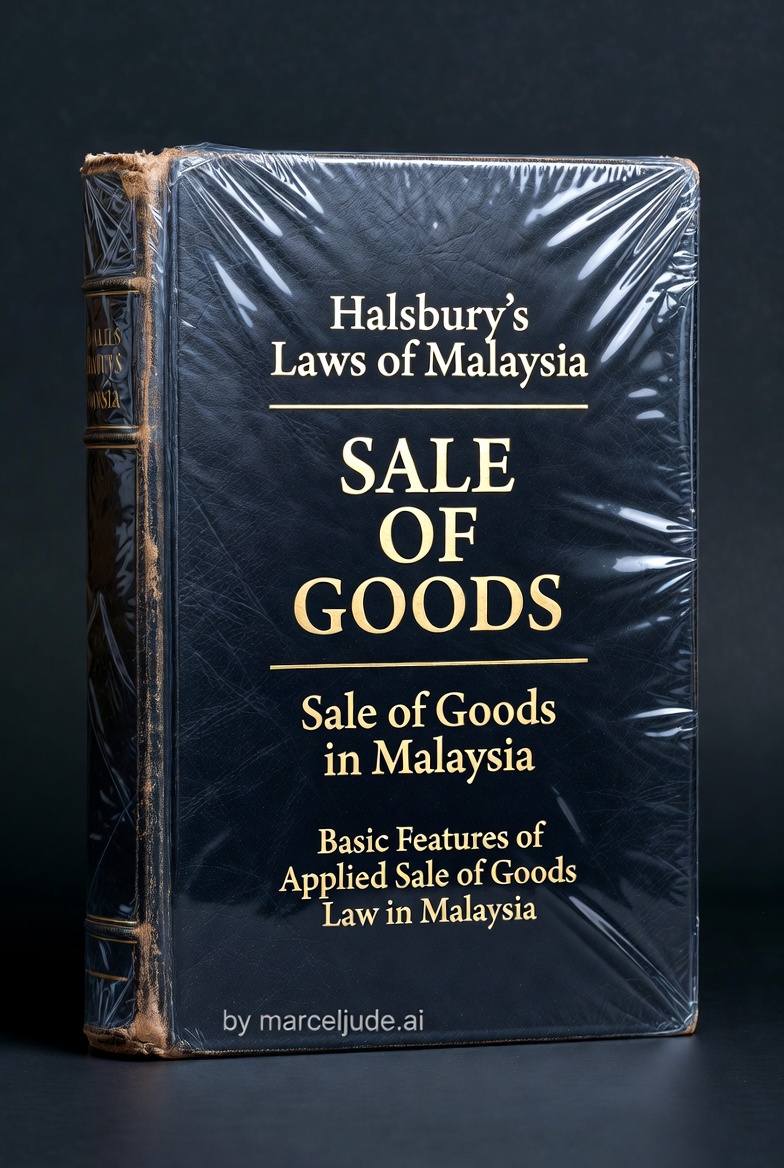


Description
Halsbury’s Laws of Malaysia: Sale of Goods
An Extensive Chapter-by-Chapter Professorial Review
Review author: marceljude.ai
I read the book as a complete doctrinal treatment of Malaysian sale-of-goods law. It is not a conventional narrative textbook built around a single argument. It is an encyclopaedic legal work organised into numbered propositions: each proposition identifies a rule, explains its qualifications, cites supporting authorities and directs the reader to related doctrines. Its subject is therefore much wider than the formation of a sale contract. It covers contractual obligations, ownership, risk, title, consumer guarantees, insolvency protections, carriage, documentary sales, banking instruments and remedies.
For readability, I refer to the book’s eight principal divisions as “chapters,” although several contain numerous lettered and numbered subdivisions.
The territorial premise is crucial. Act 382 applies to Peninsular Malaysia. In Sabah and Sarawak, section 5(2) of the Civil Law Act 1956 directs the court, in the relevant commercial fields and where local written law has not otherwise provided, to the law administered in England in the like case at the corresponding period. That does not mean that every later English statute can simply be imported without analysis; the reception question remains issue-specific and subordinate to Malaysian written law.
LIST OF CONTENTS
Chapter 1 — Introduction
Book locators [420.001]–[420.025]
Sources of law
Legislation relating to sales of goods
Cognate law concerning particular sales
Quasi-contracts of sale
Chapter 2 — The Contract
Book locators [420.026]–[420.093]
Contracts within the Sale of Goods Act 1957
Contracts within the Consumer Protection Act 1999
Capacity of parties
Formalities
Agency and brokers
Subject matter
Prohibited sales
Perishing of specific goods
Price
Conditions and warranties:
construction and effect
stipulations as to time
title and quiet possession
sale by description
quality and fitness
sale by sample
consumer guarantees
express guarantees
supply of services
exclusion of liability
construction of express terms
Chapter 3 — Effects of the Contract
Book locators [420.094]–[420.133]
General principles
Specific goods
Unascertained goods
Undivided shares in bulk goods
Reservation of the right of disposal
Effect of a completed sale
Incidence of risk
Chapter 4 — Transfer of Title
Book locators [420.134]–[420.144]
The nemo dat rule
Estoppel and documents of title
Voidable title
Sellers and buyers remaining in possession
Chapter 5 — Performance of the Contract
Book locators [420.145]–[420.204]
General duties
Delivery
Quantity and mixed deliveries
Instalment contracts
Delivery through carriers
Deterioration in transit
Insurance
Examination, acceptance and rejection
Payment
Chapter 6 — Rights of the Unpaid Seller Against the Goods
Book locators [420.205]–[420.251]
The unpaid seller
Lien
Stoppage in transit
Duration of transit
Exercise of stoppage
Withholding delivery
Dispositions by the buyer
Effect of lien and stoppage
Resale and retaking
Chapter 7 — Breach of the Contract
Book locators [420.252]–[420.287]
Seller’s action for the price
Damages for non-acceptance
Buyer’s damages for non-delivery
Specific performance
Tortious interference
Breach of warranty
Special damages, interest and failure of consideration
Chapter 8 — International Sale Contracts
Book locators [420.288]–[420.347]
Nature and development of international sales
CIF contracts
C & F contracts
FOB contracts
FAS and FOR contracts
Ex-ship contracts
Import and export restrictions
Bills of lading
Documentary credits
Performance bonds and international guarantees
Confirming houses
OVERALL REVIEW OF THE BOOK The book’s central intellectual achievement
The book’s most important contribution is its demonstration that a sale of goods is simultaneously:
a contract containing promises;
a transfer, or proposed transfer, of property;
an allocation of risk;
a potential transfer of title to third parties;
a credit transaction;
and, in international trade, a documentary and banking transaction.
A student who thinks only in terms of offer, acceptance and breach will misunderstand much of sale-of-goods law. The decisive questions often are not merely, “Was there a contract?” but:
Has ownership passed?
Has risk passed?
Have the goods been ascertained and appropriated?
Can the seller retain or recover the goods?
Can a third-party purchaser obtain better title?
Is the claimant entitled to the price, damages, rejection or specific performance?
Does the claim arise under the commercial sale regime or the consumer supply regime?
The arrangement of the book follows that logic. It begins with classification, moves to contractual terms, then ownership and risk, third-party title, performance, seller protection, remedies and finally international documentary trade.
Method and use of authority
The work is authority-rich. It treats decided cases not as decorative illustrations but as the means by which broad statutory phrases acquire precise legal content. Expressions such as “deliverable state,” “merchantable quality,” “reasonable time,” “unconditional appropriation,” “acceptance,” “good faith” and “course of transit” become usable only after the cases are examined.
This density is one of the book’s strengths, but also a limitation. The accumulation of older English cases can conceal the governing Malaysian proposition. A practitioner benefits from the historical chain because it helps explain inherited statutory language. A beginning student may become lost among authorities without first identifying:
the Malaysian statutory section;
the proposition for which each case is cited;
whether the case remains persuasive;
whether consumer legislation changes the result; and
whether the contract is governed by Peninsular or Sabah–Sarawak law.
Commercial law rather than merely consumer law
The book correctly presents the Sale of Goods Act 1957 as a commercial statute rather than a complete consumer code. Its core structure presupposes bargaining, freedom of contract, allocation of risk and the possibility that implied terms may be varied. Consumer protection enters as a supplementary regime through statutory guarantees, restrictions on misleading conduct, safety requirements and remedies.
This dual structure is valuable. It prevents two opposite errors:
treating every buyer as a consumer; and
applying old commercial assumptions to vulnerable household purchasers without considering consumer legislation.
Major strengths
The strongest portions are:
the distinction between a sale and an agreement to sell;
implied terms concerning title, description, fitness and quality;
the passing of property and risk;
retention-of-title arrangements;
nemo dat and its exceptions;
acceptance and rejection;
unpaid-seller remedies;
the assessment of damages;
and CIF, FOB, bills of lading and letters of credit.
The book is particularly good at tracing the legal consequences of classification. Once a transaction is characterised as a sale, agreement to sell, hire purchase, bailment, mortgage, agency, service contract or documentary sale, a different cluster of rights follows.
Significant weaknesses and points requiring independent verification
First, the book sometimes moves too easily between Malaysian legislation and later English statutory developments. English decisions are often highly persuasive because of the historical lineage of Act 382, but English amendments do not automatically rewrite the Malaysian statute.
The clearest example is [420.119]–[420.120], which describe statutory co-ownership of an identified bulk and appropriation by exhaustion. Those propositions resemble later English reforms. Section 23 of Act 382, however, states the Malaysian rule on unconditional appropriation of unascertained or future goods and delivery to a carrier; it does not itself enact the detailed English co-ownership-in-bulk regime described in those paragraphs. The point may assist an English-law inquiry in Sabah or Sarawak, but it should not be attributed to Peninsular Act 382 without further statutory authority.
Second, [420.076] presents “merchantable quality” through a modern reasonable-person formula that includes appearance, freedom from minor defects, safety and durability. That is analytically attractive, but the reader must distinguish judicial development and later English formulations from the actual language of section 16 of Act 382.
Third, the sentence in [420.088] concerning the reasonable price for services appears to omit the word “not.” The statutory sense is that the consumer should not have to pay more than a reasonable price where no price-setting mechanism exists.
Fourth, procedural, insolvency, companies, taxation and regulatory references should always be checked against the legislation in force when advice or proceedings are contemplated. The book remains an excellent doctrinal map, but no encyclopaedic work substitutes for verifying the current statute and rules.
Professorial judgment
As a legal research work, the book is outstanding. As a first teaching text, it is demanding. Its best use in a university course would be alongside:
the statutory language;
a short conceptual textbook;
problem questions;
transaction documents;
and comparative exercises involving Peninsular Malaysia, Sabah and Sarawak.
Its paragraph-numbering system is exceptionally useful. A stable reference such as [420.274] is often more reliable for research and citation than a page number that may change between formats.
CHAPTER 1 — INTRODUCTION
Book locators [420.001]–[420.025]
What the chapter does
The opening chapter identifies the legal sources, defines the boundaries of a sale, separates sale from related transactions, and introduces the statutory and common-law environment in which sale contracts operate. Its central lesson is that there is no single, self-contained “law of sale.” Contract, tort, agency, insolvency, consumer law, intellectual property, taxation, shipping and conflict of laws may all affect the transaction.
Subsection-by-subsection review
[420.001] Sale of Goods Act 1957
This proposition establishes the territorial and historical foundation. Act 382 governs Peninsular Malaysia, while Sabah and Sarawak require an English-law analysis under the Civil Law Act. The statutory genealogy—English codification, Indian legislation and Malaysian reception—explains why English and Indian decisions remain important but must be used carefully.
[420.002] Meaning of “sale”
A sale requires consensual transfer of ownership for a money price. The money element distinguishes sale from barter, while the transfer-of-ownership element distinguishes it from hire. The proposition is fundamental because implied statutory terms do not automatically attach to a transaction that is not legally a sale.
[420.003] Sale distinguished from mortgage
The legal character of a transaction depends on substance rather than its label. A mortgage transfers an interest to secure a debt; a true sale transfers ownership as the commercial end of the bargain. Courts must examine the parties’ actual intention, especially where documents describe a security arrangement as a “sale.”
[420.004] Contracts for the supply of services
This section addresses mixed transactions involving labour and materials. The principal question is whether the transaction’s main object is delivery of a chattel as such or the performance of work and skill. The classification determines whether sale-of-goods implied terms apply or whether the claim belongs principally to services law.
[420.005] Sale and supply distinguished from hire purchase
A true hire-purchase arrangement gives the hirer an option to buy without imposing an immediate obligation to purchase. A credit sale, by contrast, is a sale even if the price is paid by instalments. The distinction affects ownership, third-party title, repossession and statutory regulation.
[420.006] English sale-of-goods legislation
This proposition explains the evolution from the English Sale of Goods Act 1893 to the Sale of Goods Act 1979 and later amendments. Its principal Malaysian importance lies in Sabah and Sarawak, where the “corresponding period” reception formula makes the temporal development of English law legally significant.
[420.007] Consumer Protection Act 1999
Consumer law supplements rather than simply duplicates sale law. The proposition introduces protections against misleading conduct, false representations, unsafe goods and failures of statutory guarantees. Its broader definitions of supply and goods may capture transactions that fall outside a strict sale under Act 382.
[420.008] Price control and anti-profiteering
Sale-of-goods law determines private rights, but price-control legislation introduces public regulation. A contract may therefore be valid as a private agreement while the seller’s pricing conduct attracts regulatory or criminal consequences.
[420.009] Extent of codification and relation to general law
Act 382 is not a complete contract code. Questions of offer, acceptance, consent, mistake, fraud, interpretation, evidence, rescission and substituted performance may require the Contracts Act 1950 and common-law principles. Tort liability may also coexist with contractual liability.
[420.010] Construction of legislation
Because the sale statute is codifying and consolidating in character, the statutory language is the starting point. Historical common law may explain ambiguity or technical terminology, but it should not be used to override clear words.
[420.011] Exclusion of mortgages and securities
Transactions intended to operate as mortgages, pledges, charges or other securities fall outside the Act’s sale provisions. This again emphasises substance over form and prevents parties from evading registration or security-law requirements through drafting labels.
[420.012] Saving for common-law rules
Common law, including the law merchant, survives unless inconsistent with the statute. Agency, fraud, misrepresentation, duress, mistake and other invalidating causes therefore continue to shape sale contracts.
[420.013] Bankruptcy, bills of sale and unrepealed enactments
Act 382 does not displace specialised bankruptcy rules, bills-of-sale legislation or other unrepealed enactments. Sale-of-goods analysis must therefore be coordinated with insolvency and security law.
[420.014] Freedom of contract
Parties may ordinarily vary rights implied by law through express terms, a course of dealing or binding usage. The proposition reflects classical commercial autonomy, but that freedom is now constrained by consumer legislation, narrow judicial construction and other mandatory statutes.
[420.015] International sale contracts
The book introduces CIF, FOB, FAS, FOR and ex-ship transactions. These trade forms alter ordinary rules concerning delivery, payment, documents, property and risk. Their legal incidents arise from commercial usage and express terms rather than labels alone.
[420.016] Common-law powers of sale
Certain persons may sell another’s goods without being ordinary owners: pawnees, personal representatives, sheriffs and shipmasters acting under necessity. These powers are exceptions to the general proposition that only an owner or authorised person may transfer title.
[420.017] Statutory powers of sale
Legislation confers sale powers on sheriffs, distrainors, innkeepers, pawnees, insolvency office-holders, liquidators, warehouse operators, repairers and unpaid sellers. Each power must be exercised within its statutory conditions.
[420.018] Sales by court order
Courts may order urgent sale of perishable property, property in admiralty proceedings and charged property. Judicial sale protects value and can confer title through the authority of the court.
[420.019] Common-law and statutory conditions and warranties
Implied terms may arise not only from statute but from trade usage. Conversely, usage may qualify an implied obligation where both parties are bound by it. Evidence of a genuine, certain and reasonable trade practice is therefore commercially important.
[420.020] Dangerous goods
A seller who knows, or ought to know, that goods are dangerous may owe a duty to warn. Liability may arise concurrently in contract, tort and under consumer-safety legislation. The proposition shows why privity is not always decisive where dangerous products injure third parties.
[420.021] Agricultural products
Agricultural marketing is affected by specialised regulatory bodies and statutes. General sale rules continue to apply, but marketing, grading, licensing and sectoral controls may determine how agricultural goods are lawfully traded.
[420.022] Duty and tax
Customs, excise and sales taxes affect price and performance. The contract should state whether the quoted price includes such charges and who bears changes occurring between contract and delivery.
[420.023] Miscellaneous restrictions on sales
Particular goods—animals, medicines, poisons, rice, vehicles, rubber, timber, pawned property and foreign currency—may be subject to special restrictions. General sale law never answers the prior question whether the transaction is legally permitted.
[420.024] Conflict of laws
Property questions are generally linked to the law of the place where the goods are situated, while contractual rights depend on the governing law chosen by the parties or, absent choice, the system with the closest connection. Mandatory consumer law can limit attempts to evade Malaysian protections through a foreign-law clause.
[420.025] Waiver of tort and estoppel
Where a person wrongfully appropriates or disposes of another’s goods, the owner may sometimes claim their value on a quasi-contractual basis instead of suing only in tort. Conduct may also prevent a person from denying that he assumed the position of buyer or seller.
Professorial assessment of Chapter 1
This is an unusually effective introduction because it refuses to isolate sale law from the rest of private and commercial law. Its weakness is density: regulatory examples are numerous, and some have only indirect relevance to the central architecture of Act 382. Nevertheless, the chapter successfully teaches that correct legal classification must precede application of statutory rights.
Sabah and Sarawak comparison
This chapter contains the book’s most important territorial warning. A lawyer should never begin a Malaysian sale-of-goods opinion by assuming that Act 382 governs merely because the parties and goods are in Malaysia.
For Sabah and Sarawak, the analysis should proceed in this order:
Is there applicable Malaysian or state written law?
Does the issue fall within a commercial subject covered by section 5(2) of the Civil Law Act?
What law would England administer in the like case at the corresponding period?
Does local context require qualification?
Is an English statute being relied on merely persuasive, or is it receivable through the statutory formula?
The book is therefore particularly relevant to lawyers handling transactions across the South China Sea, nationwide supply chains, shipping, timber, agricultural commodities and industrial equipment.
CHAPTER 2 — THE CONTRACT Book locators [420.026]–[420.093] What the chapter does
This is the book’s longest foundational chapter. It identifies what qualifies as a contract of sale, who can contract, what may be sold, how price is determined, which transactions are illegal, and what terms the law implies concerning title, description, quality, fitness, sample, services and consumer guarantees. It is the chapter most likely to determine liability in ordinary defective-goods litigation.
Contracts within the Sale of Goods Act
[420.026] Sale and agreement to sell
A sale transfers property immediately; an agreement to sell contemplates transfer later or upon fulfilment of a condition. An agreement to sell becomes a sale when the stipulated time arrives or condition is fulfilled.
[420.027] Sale and agreement to sell distinguished
A sale creates proprietary rights in rem as well as contractual rights. An agreement to sell ordinarily creates only personal rights. This distinction determines exposure to insolvency, execution creditors, accidental loss, resale by the seller and the availability of proprietary remedies.
[420.028] Meaning of “contract of sale”
The essential elements are a seller, a buyer, goods, transfer or agreement to transfer property, and a money price. Courts examine the transaction’s true substance; a disguised bailment, agency, mortgage or option is not converted into a sale by terminology alone.
[420.029] Meaning of “goods”
Goods are movable property other than actionable claims and money, with statutory inclusions such as shares, crops and items attached to land that are to be severed. The treatment of software is technologically important: the physical medium may be goods even where the encoded program is treated differently.
[420.030] Assignment of sale contracts
Contractual benefits may generally be assigned, subject to ordinary restrictions concerning personal obligations, consent and statutory requirements. A right to receive the price may often be assigned even where the entire contract is not assignable.
Consumer supply contracts
[420.031] Contracts for the supply of goods
The consumer regime reaches sale, exchange, lease, hire and hire purchase. It can apply even where services are also provided, thereby preventing suppliers from avoiding guarantees through mixed-contract drafting.
[420.032] Meaning of “goods” under consumer legislation
The consumer definition is oriented toward personal, domestic and household acquisition. It includes vehicles, vessels, animals, utilities and property incorporated into other property, but excludes financial choses such as shares and money.
[420.033] Contracts for the supply of services
A service contract involves the provision of rights, benefits, facilities or work to a consumer. The category remains distinct from a contract of employment and is subject to statutory guarantees concerning care, fitness, completion time and reasonable price.
Capacity
[420.034] Capacity in general
Capacity is governed by general contract and property law. Minors, persons lacking mental capacity, intoxicated persons, bankrupts and corporations may be subject to special limitations.
[420.035] Necessaries
A person lacking ordinary contractual capacity may nevertheless be liable to pay a reasonable price for necessaries suited to his condition in life and actual requirements. Whether an item is necessary depends on context; an article may be useful yet unnecessary because the recipient is already adequately supplied.
Formalities
[420.036] How a contract is made
A sale contract may be written, oral, partly written and partly oral, or inferred from conduct. Corporate formalities and special statutory requirements remain applicable. Bills of sale require attention to registration and attestation rules.
[420.037] Construction of the contract
A written sale contract is interpreted according to ordinary contractual principles. An invoice is evidence but not necessarily the contract itself. Express terms, course of dealing and binding usage may alter obligations otherwise implied by law.
[420.038] Statutory formalities
Although oral sales are generally enforceable, special transactions may require writing, prescribed forms, cooling-off notices or bills of sale. A sale connected inseparably to an interest in land may also attract land-related formalities.
Agency and brokers
[420.039] Use of agents
A sale may be concluded through an agent possessing actual, implied, apparent, ratified or necessity-based authority. Agency determines whether the principal is bound and whether the intermediary incurs personal liability.
[420.040] Functions of brokers
A broker finds counterparties and negotiates the bargain, ordinarily without possessing the goods. This distinguishes the broker from a factor or mercantile agent who may possess goods or documents and transact in his own name.
[420.041] Formation through brokers
Whether negotiations through a broker create an immediate binding contract or contemplate later formal documentation is a question of intention, usage and fact. Bought and sold notes may record or constitute the agreement.
[420.042] Written contract or memorandum
A broker may have implied authority to sign a written record needed to make the bargain enforceable. That authority extends only to accurately recording the contract actually concluded.
[420.043] Bought and sold notes
Corresponding, complete notes can constitute the written contract. If they materially differ or omit essential terms, they may fail to establish a single written bargain.
[420.044] Material alteration
A material unauthorised alteration by one party can invalidate the note against the other. The rule protects documentary integrity even where the alteration does not immediately change every obligation.
Subject matter
[420.045] Existing and future goods
Parties may contract for existing goods, goods to be manufactured or acquired, or goods dependent on a contingency. The allocation of risk when the contingency fails is a matter of contractual construction.
[420.046] Sale of a chance and present sale of future goods
Parties may sell the chance of obtaining goods rather than the goods themselves. A purported present sale of future goods ordinarily operates only as an agreement to sell because present ownership cannot pass in property that does not yet exist.
Prohibited sales
[420.047] Nature of prohibition
A statutory prohibition may invalidate the contract itself, prohibit only performance, or criminalise possession, offering or supply. The existence of a statutory penalty does not automatically answer whether the private contract is unenforceable.
[420.048] False or insufficient descriptions
False trade descriptions can produce criminal and consumer liability and may also infringe intellectual-property rights. The proposition integrates misdescription, passing off, trade marks, patents, designs and misleading consumer representations.
[420.049] Sales without licences
Where legislation requires a licence, certificate or authorisation, the absence of it may render the sale unlawful. The legal effect depends on the purpose and wording of the legislation, not merely on the existence of a licensing requirement.
Perishing of specific goods
[420.050] Perishing before the contract
A purported sale of specific goods is void if, without the seller’s knowledge, the goods had already perished or ceased to answer their contractual description. The rule rests on the non-existence of the assumed subject matter.
[420.051] Perishing after an agreement to sell
An agreement to sell specific goods is avoided where the goods perish without fault before risk passes. The proposition is a specialised manifestation of impossibility and frustration, but must be coordinated with risk allocation and the Civil Law Act.
Price
[420.052] How price is fixed
Price may be fixed expressly, by an agreed mechanism, through a course of dealing or, failing all three, as a reasonable price. Reasonableness is factual and not necessarily identical to market price.
[420.053] Price dependent on weighing or testing
Where exact price calculation becomes impossible because the goods perish, a buyer otherwise liable may have to pay a reasonable estimate. The rule prevents the pricing mechanism from defeating an otherwise operative obligation.
[420.054] Price involving a wager
A transaction whose price depends on a wager may be void as gaming rather than a genuine sale. The court must distinguish legitimate commercial price variability from a bet on an event.
[420.055] Changes in duties or taxes
The contract should identify whether the price includes duties and who bears later increases or receives the benefit of reductions. Statutory adjustment rules may operate absent contrary agreement.
[420.056] Valuer’s failure
Where the parties make valuation by a named third person essential, failure of that valuation may avoid the agreement. If the buyer has taken and appropriated goods, however, a reasonable price may still be payable.
[420.057] Valuation prevented by a party
A party who wrongfully prevents valuation may be liable in damages. Where valuation is merely machinery for identifying a fair price, the court may preserve the bargain rather than allow the obstructing party to destroy it.
Conditions, warranties and representations
[420.058] Stipulations and representations
The decisive question is whether the parties intended a statement to have contractual force. Expertise, reliance, timing, documentary integration and the importance of the statement all assist in distinguishing a term from an opinion or representation.
[420.059] Meaning of “warranty”
A warranty is collateral to the main purpose of the contract. Breach ordinarily gives damages but not rejection or termination. The same statement may also amount to a misrepresentation, producing distinct remedies.
[420.060] Conditions, warranties and intermediate terms
A condition permits termination for breach; a warranty ordinarily permits damages only. An intermediate term produces a termination right only where the consequences of breach are sufficiently serious. Labels chosen by the parties are relevant but not conclusive.
[420.061] Voluntary election
A buyer entitled to reject for breach of condition may waive that right or elect to treat the breach as one of warranty. Waiver must be assessed from clear conduct reasonably understood and relied upon by the other party.
[420.062] Compulsory election after acceptance
Once goods under a non-severable contract have been accepted, breach of condition is generally reduced remedially to a breach of warranty. The buyer retains damages but ordinarily loses rejection, subject to contrary contractual provision and special title cases.
[420.063] Impossibility and other excuses
Classification as a condition or warranty does not prevent the law from excusing performance through impossibility, prevention by the other party or another recognised discharge doctrine.
Time
[420.064] When time stipulations are conditions
Time of payment is not ordinarily of the essence unless the contract indicates otherwise. Other time stipulations, particularly shipment and nomination dates in mercantile contracts, are more readily treated as conditions because punctuality is essential in a chain of commercial transactions.
Title and quiet possession
[420.065] Title, quiet possession and charges in sales
The seller impliedly undertakes that he has, or will have, the right to sell; that the buyer will enjoy quiet possession; and that the goods are free from undisclosed third-party charges. A complete failure of title can justify recovery of the price despite use of the goods.
[420.066] Title guarantees in consumer supply
Consumer legislation provides parallel guarantees concerning the supplier’s right to dispose of the goods, freedom from undisclosed security and quiet possession. Variations must satisfy the statute’s disclosure and consent safeguards.
Sale by description
[420.067] Meaning of sale by description
A sale is by description when descriptive words form part of the contractual identification of the goods. Specific goods selected by the buyer, including counter sales, can still be sold by description.
[420.068] Conformity with description
Correspondence with description is an implied condition. Goods sold by both sample and description must satisfy both; conformity with the sample cannot cure a failure to meet the contractual description.
[420.069] Meaning of “description”
Description includes substantial elements identifying the contractual thing, not every incidental statement. Courts ask whether the deviation means that what was tendered is commercially a different thing from what was promised.
[420.070] Principle underlying the condition
The rule is grounded in consent: a buyer cannot be compelled to accept a different article. Exclusion clauses are therefore construed narrowly where they would permit the seller to tender something other than the contractual goods.
[420.071] Consumer guarantee of correspondence
Where goods are supplied by description to a consumer, correspondence is guaranteed. Selection from displayed goods does not by itself prevent the transaction from being one by description.
Quality and fitness
[420.072] General rule
The classical starting point is that quality or fitness is not automatically implied, but the statutory exceptions are extensive. Trade usage and consumer legislation further limit the practical reach of caveat emptor.
[420.073] Fitness for a particular purpose
Where the buyer communicates a purpose, relies on the seller and purchases goods of a kind supplied in the seller’s business, the goods must be reasonably fit for that purpose. The condition can cover latent defects and inadequate warnings or instructions.
[420.074] Reliance on skill and judgment
Reliance is factual. Disclosure of purpose commonly supports an inference of reliance, but a knowledgeable buyer who specifies the exact product may be relying principally on his own judgment.
[420.075] Merchantable quality
Goods bought by description from a dealer must be of merchantable quality, subject to defects that a buyer’s actual examination ought to reveal. The standard takes account of usability, saleability, price, description and the reasonable expectations attached to the goods.
[420.076] Meaning of merchantable quality
The proposition expands quality to include state, condition, ordinary fitness, appearance, minor defects, safety and durability. This is commercially sensible, but the reader should distinguish this modern synthesis from the precise and more limited wording of Act 382.
[420.077] Consumer guarantee of acceptable quality
The consumer standard is more explicit. Goods should be ordinarily fit, acceptable in appearance, reasonably free of defects, safe and durable, judged from the position of a fully informed reasonable consumer and in light of price, packaging and representations.
[420.078] Consumer fitness for purpose
Goods must be reasonably fit for a purpose disclosed by the consumer or represented by the supplier, unless the consumer did not rely, or could not reasonably rely, on the supplier’s skill or judgment.
Sale by sample
[420.079] What constitutes a sale by sample
The contract must expressly or impliedly make the sample a contractual standard. Mere exhibition during negotiations does not necessarily create a sale by sample.
[420.080] Implied terms in sample sales
The bulk must correspond with the sample in apparent quality; the buyer must have a reasonable opportunity to compare; and the goods must be free from latent defects rendering them unmerchantable that reasonable sample examination would not reveal.
[420.081] Consumer supply by sample or model
Consumer goods supplied by reference to a sample or demonstration model must correspond in quality, and the consumer must have a reasonable comparison opportunity. A simultaneous description must also be satisfied.
Other consumer guarantees
[420.082] Reasonable price for goods
Where price is neither agreed, determined by an agreed mechanism nor established by dealings, the consumer cannot be required to pay more than a reasonable price.
[420.083] Repairs and spare parts
Manufacturers and suppliers of relevant goods must take reasonable action to ensure availability of repair facilities and spare parts for a reasonable period, unless adequate advance notice limits or excludes that undertaking.
[420.084] Manufacturer’s express guarantee
A manufacturer is bound by an authorised express guarantee relating to quality, performance, service, parts, future availability or refund. Documentary guarantees accompanying the goods can therefore create direct obligations.
Supply of services
[420.085] Reasonable care and skill
Consumer services must be performed with reasonable care and skill. The duty may extend to prudent selection and supervision of subcontractors.
[420.086] Fitness for purpose or result
Where the consumer communicates a desired purpose or result, the service and resulting product must be reasonably capable of achieving it, subject to the limits of reasonable reliance.
[420.087] Reasonable completion time
Where the contract and prior dealings do not determine time, the service must be completed within a reasonable period. Reasonableness depends on the nature, complexity and surrounding circumstances of the service.
[420.088] Reasonable service price
The intended rule is that, absent an agreed price or price-setting mechanism, the consumer need not pay more than a reasonable price. As noted above, the sentence in the book appears to contain a missing negative.
Excluding implied terms
[420.089] Exclusion or variation in commercial sales
Implied rights under a sale contract may be varied by express agreement, course of dealing or binding usage. Effectiveness depends on incorporation, clarity, consistency and any mandatory legislation.
[420.090] Judicial and statutory restrictions
Courts construe exclusion clauses narrowly, especially where the clause would defeat the buyer’s basic right to receive the agreed article. Consumer legislation imposes further restrictions on attempts to contract out.
Express terms
[420.091] Warranty limited in time
A time-limited warranty may mean that goods must conform throughout the stated period or that claims must be notified or commenced within it. The answer depends on construction, commercial context and the nature of the goods.
[420.092] Certification by a third person
Where acceptance depends on certification, the contract determines the certifier’s standard and whether the certificate is conclusive. Fraud, collusion, lack of authority and failure to satisfy exact contractual requirements may undermine the certificate.
[420.093] Patent defects
A general warranty does not ordinarily protect a buyer against an obvious defect of which he was aware when contracting, unless the warranty clearly covers it. An express assurance may, however, override the significance of visual inspection.
Professorial assessment of Chapter 2
This is the doctrinal centre of the book. Its greatest achievement is placing commercial implied conditions and consumer guarantees side by side. It demonstrates that the same factual defect can generate several possible causes of action:
breach of description;
breach of fitness;
breach of merchantable or acceptable quality;
misrepresentation;
breach of express warranty;
negligence;
product-safety liability;
or infringement of quiet possession.
The main pedagogical risk is that readers may treat these causes of action as interchangeable. They are not. Each has different elements, defences and remedies.
Sabah and Sarawak comparison
The contractual questions in this chapter demand particular care in Sabah and Sarawak.
Act 382’s exact terminology—especially “condition,” “warranty,” “merchantable quality” and acceptance—governs Peninsular cases. Sabah and Sarawak may require the corresponding English sale law and English judicial developments. This can produce differences where English legislation has modernised quality standards, remedies or classification of terms.
The Consumer Protection Act creates a Malaysian statutory overlay, but a lawyer should not assume that unrelated English consumer or unfair-contract statutes are automatically imported through section 5(2). The better method is to identify the local written law first and invoke English law only for the remaining commercial question.
CHAPTER 3 — EFFECTS OF THE CONTRACT Book locators [420.094]–[420.133] What the chapter does
Chapter 3 explains when ownership passes and why that moment matters. Ownership affects risk, insolvency, the right to sue third parties, the seller’s entitlement to the price and the buyer’s proprietary remedies. This chapter should be read together with Chapters 4 and 6.
General principles
[420.094] Intention governs
The time of transfer is primarily determined by the parties’ intention as shown by the whole contract, conduct and circumstances. A court should not mechanically apply presumptions where the bargain clearly indicates another result.
[420.095] Retention-of-title clauses
The seller may permit possession while retaining ownership until payment or another condition is fulfilled. The clause’s effect on resale, manufactured products, proceeds and insolvency depends on construction and on whether it creates a registrable security rather than merely retaining legal title.
[420.096] Rules for ascertaining intention
The statutory rules concerning specific goods are presumptions used when intention is not otherwise clear. The rule preventing ownership of unascertained goods from passing before ascertainment is more fundamental.
Specific goods
[420.097] Intention and specific goods
Property in specific or ascertained goods passes when the parties intend. Terms, conduct and circumstances—not physical delivery alone—determine the result.
[420.098] Specific goods in a deliverable state
Under an unconditional sale of identified goods already ready for delivery, property ordinarily passes when the contract is made, even if payment and delivery are postponed.
[420.099] Goods sold with an interest in land
Where goods and an interest in land form one inseverable bargain, transfer of the goods may be conditional on completion of the land transaction. Separate prices do not necessarily make the bargain severable.
[420.100] Goods to be put into a deliverable state
If the seller must perform work to make identified goods contractually deliverable, ownership is suspended until the work is done and the buyer receives notice.
[420.101] Measuring or testing to ascertain price
Where the seller must weigh, measure or test identified goods to calculate the price, property ordinarily remains with the seller until completion and notice. The rule may yield to contrary intention.
[420.102] Item attached to land and severed by buyer
Where the buyer is to sever the item, property ordinarily passes upon severance. Before severance the buyer may possess a contractual or chattel interest but not necessarily full ownership of separated goods.
[420.103] Anticipated instalment payments
Where ownership is retained until the whole price is paid, the buyer may ordinarily pay the balance early and bring about the transfer, unless the agreement prevents anticipation.
[420.104] Option converting an agreement into a sale
An agreement may give one party an option that causes property to pass upon election. A seller who elects to sue for the price may thereby affirm the sale and transfer ownership.
Approval and sale-or-return transactions
[420.105] When property passes
Property passes when the recipient approves, accepts or performs an act adopting the transaction. If no express decision is communicated, retention beyond the agreed or reasonable return period may constitute acceptance.
[420.106] Similar terms
Not every conditional delivery is a sale-or-return transaction. The essential feature is that the recipient has an option to become owner on substantially similar terms.
[420.107] Act adopting the transaction
Sale, pledge, consumption or other conduct inconsistent with an unrestricted right to return may amount to adoption. Conduct consistent with temporary bailment does not.
[420.108] Loss or damage during approval
Accidental loss while goods are held on approval does not automatically convert the bailment into a sale. Liability depends on agreement, fault and bailment principles.
Unascertained and future goods
[420.109] Ascertainment required
No property passes in unascertained goods until the particular goods are identified. Merely identifying a larger bulk from which the goods will later be taken is ordinarily insufficient.
[420.110] Subsequent appropriation
Property passes when conforming goods in a deliverable state are irrevocably appropriated to the contract with mutual assent. Assent may be express, implied, prior or subsequent.
[420.111] Place and authority of appropriation
Appropriation occurs where the goods are situated. Prior authority permits one party to make the selection, but the act must comply with the contract and show final, irrevocable election.
[420.112] Delivery to buyer or carrier
Delivery of conforming goods to the buyer, or to a carrier for transmission without reservation of disposal, ordinarily constitutes unconditional appropriation.
[420.113] Future goods and potential existence
Future goods may pass when acquired and appropriated. Products naturally expected from existing property—such as crops or offspring—may attract special treatment once they come into identifiable existence.
[420.114] Goods to be manufactured
Ownership ordinarily remains with the manufacturer until completion and mutually assented appropriation. Work in progress and raw materials do not automatically become the buyer’s property.
[420.115] Passing before completion
The contract may provide that ownership passes at a particular manufacturing stage. Stage payments, inspection and identification are relevant but not conclusive indications.
[420.116] Materials subsequently added
Where ownership of an incomplete article has passed, materials later incorporated into it may become the buyer’s through accession. Materials merely earmarked but not incorporated remain distinct.
[420.117] Quantity contracts
Whether portions become separately owned depends on whether successive appropriations were contemplated or whether the agreed subject matter is one indivisible cargo or quantity.
[420.118] Delivery at a particular place
Where the seller must deliver unascertained goods to a specified destination, the contract may indicate that ownership is not to pass before arrival and delivery there.
Bulk goods
[420.119] Undivided share in an identified bulk
The paragraph describes a buyer who has paid for an identified portion becoming co-owner of the bulk before physical separation. This is commercially attractive because it protects commodity buyers against the seller’s insolvency.
As a matter of Peninsular statutory law, however, this proposition needs independent verification for the reason already given: Act 382 section 23 contains the appropriation rule, not the detailed English statutory co-ownership regime.
[420.120] Appropriation by exhaustion
Where a bulk is reduced until only the quantity due to one buyer remains, identification may occur by exhaustion. The common-law principle is intelligible, but the statutory attribution again requires territorial and legislative care.
Reservation of disposal
[420.121] Suspension of property
A seller may reserve disposal until specified conditions are fulfilled, despite delivery to the buyer or carrier. Payment is the usual condition, but the reservation may secure other performance.
[420.122] Delivery in exchange for payment
Where documents or goods are to be exchanged against payment or security, the seller ordinarily retains disposal until the stipulated exchange occurs.
[420.123] Effect of documents
Delivery orders, warrants and similar documents do not invariably transfer property by themselves. Their effect depends on mercantile usage, intention and whether the bailee attorns to the buyer.
Effect of completed sale
[420.124] Rights and liabilities of ownership
Once the sale is complete, the buyer ordinarily obtains the powers, benefits and risks of an owner, including rights against third-party interference.
[420.125] Special agreements
Seller and buyer may privately limit how ownership is exercised, but such personal obligations do not ordinarily run automatically with movable property so as to bind later purchasers.
Risk
[420.126] General rule
Unless otherwise agreed, risk follows property rather than possession. Once property passes, the buyer ordinarily bears accidental loss even before physical delivery.
[420.127] Insurance as evidence of risk
An obligation to insure can indicate who bears risk. In CIF sales, risk usually passes from shipment even though payment and documentary tender occur later.
[420.128] Risk in unascertained goods
Parties may allocate risk to a buyer before ownership passes, although clear agreement is needed because the goods may not yet be individually identified.
[420.129] Price conditional on arrival
Where price is payable only on arrival or actual delivery, the seller may retain transit risk to the extent of that contingent payment despite an earlier transfer of property.
[420.130] Prepaid price
Prepayment does not necessarily place risk on the seller. If the bargain makes payment absolute despite failure of a contingency, the buyer may bear loss; if the contract was void from the outset, the payment is recoverable.
[420.131] Buyer’s power to rescind
Where the buyer has a contractual right to return goods and revest ownership, accidental loss before a fair opportunity to exercise that right may remain with the seller as contingent owner.
[420.132] Loss caused by delay
A party whose fault delays delivery bears losses that would not have occurred but for that delay. The rule depends on causation, not merely temporal sequence.
[420.133] Bailment duties
Risk allocation does not eliminate the custodial duties of a party possessing another’s goods. Seller and buyer may remain liable as bailees for negligent handling even where accidental risk lies elsewhere.
Professorial assessment of Chapter 3
This is one of the book’s strongest chapters. Its key pedagogical lesson is that property, possession and risk are distinct. They often coincide, but they need not.
Retention-of-title clauses receive particularly valuable treatment because they reveal the intersection of sale, security and insolvency law. The analysis would be stronger if it more sharply separated:
a clause retaining legal title;
a charge over manufactured products;
a trust or charge over proceeds;
and a merely personal restriction on use or resale.
Sabah and Sarawak comparison
Most traditional passing-of-property rules have close English counterparts, producing substantial practical convergence. Differences become important where English legislation has later modified the common law.
The bulk-goods discussion illustrates the point. The co-ownership rule described in [420.119] resembles English reform and may be relevant when Sabah or Sarawak law directs the court to the corresponding English position. It should not, however, be transported into Peninsular Act 382 under an incorrect section reference.
Nationwide commercial contracts should therefore state expressly:
when title passes;
when risk passes;
how goods are identified;
whether title is retained;
whether resale is authorised;
and what happens to proceeds or manufactured products.
CHAPTER 4 — TRANSFER OF TITLE Book locators [420.134]–[420.144] What the chapter does
Chapter 4 concerns the contest between the true owner and an innocent purchaser. Its starting rule is nemo dat quod non habet: a person cannot give better title than he has. The chapter then explains why commercial law sometimes protects the later purchaser instead.
[420.134] General nemo dat rule
A non-owner acting without authority ordinarily transfers no better title than he possesses. The rule protects ownership but is subject to statutory exceptions and estoppel.
[420.135] Estoppel
A true owner who represents, by words or sufficiently clear conduct, that another is authorised to sell may be prevented from denying that authority against a purchaser who relied to his detriment.
[420.136] Bills of lading and other documents
Documents of title are not universally negotiable in the same sense as negotiable instruments. Transfer of the document does not ordinarily cure a defective title unless statute, estoppel or mercantile usage supplies protection.
[420.137] Seller’s want of title
A seller purporting to sell as owner cannot ordinarily rely against the buyer on his own absence of title. If he later acquires ownership, it may feed the earlier sale. Knowingly concealing want of title may also amount to fraud.
[420.138] Voidable title
A seller with a title that is valid until avoided can pass good title to a good-faith purchaser without notice if the avoidance has not occurred before the resale.
[420.139] Void and voidable titles
A voidable transaction passes title unless rescinded; a void transaction passes none. The distinction is decisive because an innocent sub-purchaser may be protected in the first situation but not the second.
[420.140] Equitable rights
A purchaser in good faith without notice may take free from certain equitable interests. The proposition reflects the protection traditionally afforded to bona fide purchasers.
[420.141] Seller remaining in possession
A seller who has already sold but remains in possession may, in specified circumstances, make a later disposition effective in favour of an innocent recipient. Commercial appearance can therefore defeat the first buyer’s ownership.
[420.142] Buyer in possession
A person who has bought or agreed to buy and obtains possession with the seller’s consent may pass effective rights to a good-faith transferee without notice of the seller’s lien or retained right.
[420.143] Meaning of consent
Consent means actual consent to possession, even if procured by some forms of fraud, provided the fraud does not nullify consent itself. Later withdrawal ordinarily does not undo the statutory appearance already created.
[420.144] Pledge for an antecedent debt
A pledge securing an old debt may receive more limited protection than a new-value transaction. The pledgee cannot necessarily obtain rights greater than the pledgor could enforce.
Professorial assessment
This compact chapter is conceptually excellent. Nemo dat problems should be solved through a disciplined sequence:
Who originally owned the goods?
Did the transferor ever acquire title?
If so, was the title void or merely voidable?
Had it been avoided before the later disposition?
Was the later party in good faith and without notice?
Did the true owner create an estoppel?
Does a statutory possession or mercantile-agent exception apply?
The book’s many authorities are most useful when organised around those seven questions.
Sabah and Sarawak comparison
The basic nemo dat principles are strongly common-law in character and are likely to produce similar results across Malaysia. Differences may arise from:
the precise received English statute;
local bills-of-sale legislation;
agency provisions;
registration requirements;
and state-specific commercial instruments.
The book is especially relevant to Sabah and Sarawak timber, machinery, shipping and commodity transactions, where possession and documents may move through several intermediaries before payment is complete.
CHAPTER 5 — PERFORMANCE OF THE CONTRACT Book locators [420.145]–[420.204] What the chapter does
This chapter turns abstract contractual rights into operational duties. It asks where, when and how goods must be delivered; what happens when quantity is wrong; how instalments are treated; when the buyer accepts or rejects; and when payment becomes due.
General duties
[420.145] General rule
The seller must deliver conforming goods, and the buyer must accept and pay, according to the contract. Each obligation is defined first by the parties’ bargain and then by statutory default rules.
[420.146] Concurrent conditions
Unless otherwise agreed, possession and price are exchanged concurrently. Neither party must perform unconditionally while the other is unready to give the reciprocal performance.
Delivery
[420.147] Meaning of delivery
Delivery is voluntary transfer of possession. It may be physical, symbolic, documentary or constructive; transfer of a key, document of title or bailee’s acknowledgment may suffice.
[420.148] Acts operating as delivery
Any act placing goods under the buyer’s custody or control, or enabling the buyer to obtain control, may constitute delivery. Intention and commercial practice are decisive.
[420.149] Place of delivery
The contract decides whether the buyer collects or the seller sends. Absent agreement, existing goods are generally delivered where they are located and future goods where manufactured or produced.
[420.150] Delivery from the seller’s premises
A collection contract impliedly licenses the buyer to enter and remove the goods. Once ownership has passed, that licence may be irrevocable to the extent necessary to obtain the buyer’s property.
[420.151] Uncertain place
Where one party has the option to nominate the place, notice is generally a condition precedent to the other’s delivery or acceptance obligation.
[420.152] Time of delivery
If no time is fixed, dispatch or availability must occur within a reasonable time. Reasonableness depends on the goods, trade, urgency, prior dealings and surrounding circumstances.
[420.153] Option as to time
Where delivery is “on request” or “as required,” the buyer must call within a reasonable time and the seller must then perform reasonably promptly. Failure to exercise the option may itself become a breach.
[420.154] Goods held by a third person
Delivery generally requires the third-party bailee to acknowledge holding for the buyer. Transfer of an effective document of title may operate independently.
[420.155] Expenses
The seller ordinarily bears the cost of putting goods into a deliverable state and making delivery; the buyer bears the cost of receiving and post-delivery handling, subject to contract and trade usage.
Quantity and mixed deliveries
[420.156] Wrong quantity or wrong goods
A buyer may generally reject short delivery, excess delivery or a mixture of conforming and non-conforming goods, with options to accept appropriate portions and pay at the contractual rate.
[420.157] Quantity terms
Words such as “about” and “more or less” permit reasonable commercial latitude but do not license unlimited variation. Their effect depends on the contractual context and trade.
[420.158] Sale of a cargo
“Cargo” ordinarily means the whole cargo carried on the identified voyage, making stated quantities potentially estimates rather than exact limits. Clear words can impose upper or lower boundaries.
[420.159] Mutual quantity risk
The parties may expressly accept the risk that the actual quantity differs from the estimated quantity on which the price was calculated.
Instalments
[420.160] Instalments not ordinarily permitted
Without agreement, a buyer need not accept instalments and a seller cannot insist on them. Agreement may be express or inferred from conduct.
[420.161] Qualifying words
Whether “about” or similar language applies to the total quantity, each instalment or both is a question of construction.
[420.162] Unapportioned price
Where instalment prices are not separately payable, rejection rights may depend on completion of the whole quantity. Goods already used or accepted must ordinarily be paid for.
[420.163] Separate character of deliveries
For purposes of tender and acceptance, each instalment is treated as a separate performance obligation, even though all instalments form one overarching contract.
[420.164] Rescission from the beginning
A serious instalment failure may amount to total failure of consideration and permit rescission of the whole bargain, potentially requiring return of instalments already received.
[420.165] Amount of instalments
Where instalment size is unspecified, the contract may imply rateable or commercially reasonable portions.
[420.166] Seller’s election
A seller authorised to perform either in one delivery or by instalments may, in some circumstances, revoke an unsuccessful election and make a conforming tender within time.
[420.167] “Average” or “about equal” instalments
Compliance is judged in a reasonable commercial sense rather than through absolute mathematical equality.
[420.168] Pro tanto discharge
Default or an excusing event can discharge the contract concerning a particular instalment without necessarily terminating obligations concerning future instalments.
[420.169] Postponement
An instalment postponed without a new fixed date must be delivered within a reasonable period, calculated from the relevant request or ending of the delaying event.
[420.170] Payment for prior instalments
Prior payment is not ordinarily a condition precedent to later deliveries unless the contract says so or the buyer’s insolvency justifies withholding.
[420.171] Repudiation for partial breach
Whether an instalment default terminates the whole contract depends on proportionality, repetition, seriousness, likelihood of recurrence and the contract’s commercial purpose.
Carriers and transit
[420.172] Delivery to a carrier
Where the seller is authorised to send the goods, delivery to a carrier for transmission ordinarily counts as delivery to the buyer.
[420.173] Buyer’s transmission instructions
The seller must comply with reasonable contractual instructions concerning the mode of transport. Failure can leave transit risk with the seller.
[420.174] Reasonable carriage contract
The seller must make a reasonable carriage or warehousing contract suited to the goods. A deficient contract can allow the buyer to deny that carrier delivery discharged the seller or to claim damages.
Deterioration
[420.175] Destination delivery
Even where the seller undertakes destination delivery at his risk, the buyer may bear deterioration necessarily incidental to ordinary transit. Extraordinary deterioration remains the seller’s responsibility.
[420.176] Perishable goods
A seller dispatching perishables impliedly undertakes that they are fit to withstand ordinary transit and remain conforming on arrival for a reasonable period.
Insurance
[420.177] Buyer’s right to insurance
Insurance effected by the seller does not automatically benefit the buyer after the seller’s insurable interest ends. Assignment, contractual intention and policy terms must be examined.
[420.178] Insurance exceeding the price
Where insurance was procured as part of the contractual performance, the buyer may be entitled to the full benefit, even if it exceeds the contract price.
[420.179] Independent insurance
Insurance independently effected by the seller for his own protection ordinarily remains his benefit unless the contract gives it to the buyer.
Examination, acceptance and rejection
[420.180] Examination
A buyer must receive a reasonable opportunity to inspect before being treated as having accepted, unless examination rights are validly modified.
[420.181] Time and place of examination
Inspection usually occurs at delivery, but latent defects and commercial circumstances may justify later examination at another place.
[420.182] Revocable tender
A non-conforming tender can ordinarily be withdrawn and replaced with a conforming tender within the contractual time unless accepted, repudiatory or no longer curable.
[420.183] Acceptance
Acceptance occurs by express intimation, conduct inconsistent with the seller’s ownership or retention beyond a reasonable time after a proper opportunity to inspect.
[420.184] Conduct affecting rejection time
Repair attempts, negotiations, extended trials, assurances and threats can extend or affect the reasonable period for rejection. The buyer’s use and delay are equally relevant.
[420.185] No duty to return rejected goods
A buyer with a valid right of rejection need only communicate refusal; physical return is not ordinarily a condition.
[420.186] Duties after rejection
The buyer must act reasonably as custodian. Once rejection is valid, risk ordinarily returns to the seller, subject to the buyer’s duty not to damage or misuse the goods.
[420.187] Exclusion of rejection
Rejection rights may sometimes be limited, but clauses purporting to permit misdescription require exceptionally clear language and remain subject to mandatory law.
[420.188] Refusal to take delivery
A buyer who fails to collect after request may be liable for resulting loss and reasonable storage or custody charges. A repudiatory refusal also engages the seller’s wider remedies.
[420.189] Insolvent buyer’s rescission
Before property passes, an insolvent buyer may, with the seller’s consent, reject and rescind without necessarily creating an unlawful preference or undervalue.
Payment
[420.190] When payment is due
Payment ordinarily becomes due when property passes and any delivery condition has been satisfied or excused. Cash-on-delivery transactions require reciprocal readiness.
[420.191] Notice of price amount
Where price depends on facts known only to the seller, the buyer must be informed of the amount before liability to pay crystallises.
[420.192] Payment to the true owner
A buyer facing a superior owner’s claim may withhold payment from the purported seller. Payment made to the true owner can discharge the buyer against the seller.
[420.193] Course of dealing and usage
Past dealings and trade practices can determine the time, place and mode of payment where the express contract is silent.
[420.194] Refusal to arrange payment
Where the parties leave payment machinery for later agreement, a buyer who wrongfully refuses to cooperate may be liable for the price, if due, or damages.
[420.195] Negotiable instruments
A cheque, bill or note is ordinarily conditional payment. The underlying price obligation revives if the instrument is dishonoured, subject to dealings with third-party holders.
[420.196] Credit and charge cards
Card payment may discharge the buyer absolutely, leaving the merchant to bear the issuer’s insolvency risk, or only conditionally. Construction of the payment arrangement decides.
[420.197] Payment event becomes impossible
Where the due date is calculated by reference to an event that can no longer occur, a buyer otherwise liable must generally pay within a reasonable time after impossibility becomes clear.
[420.198] Longer or shorter credit
Failure to pay at the shorter optional date may amount to election for the longer period. Commercial expressions such as “about” can introduce reasonable flexibility.
[420.199] Promised bill or note not given
Failure to issue the agreed instrument may produce immediate damages, but the buyer may retain the intended credit period unless the grant of credit was expressly conditional on issuing it.
[420.200] Acceleration of instalments
A clause making the remaining price immediately due after default in one instalment is not automatically penal; it may simply define the debt’s maturity.
[420.201] Repudiation despite credit
A buyer’s repudiation can permit the seller to terminate before the credit period expires and recover the value of goods retained.
[420.202] Deposit
A deposit is security for performance as well as part payment. A defaulting buyer may forfeit it; a buyer may recover it where the seller defaults, lacks title or the contract is validly avoided.
[420.203] Interest
Interest is contractual only where agreed or implied by dealing or usage, though the court may award interest in proceedings for the price.
[420.204] Interest where a bill or note was promised
Where the agreed credit instrument was not issued, interest may run from the date on which that instrument would have matured.
Professorial assessment
Chapter 5 is highly practical. It teaches that many disputes labelled “defective goods” are actually disputes about procedural conduct:
Was the tender conforming? Was inspection allowed? Did the buyer accept? Was rejection timely and unequivocal? Did repair negotiations preserve the rejection right? Who retained the goods after rejection? Was payment conditional or absolute?
A strong legal opinion should construct a chronology before applying doctrine.
Sabah and Sarawak comparison
Many performance rules derive from common-law concepts and have close English counterparts. The major differences are likely to arise from statutory wording, consumer remedies, carriage legislation and local procedure.
A national supplier should not rely on default rules. Its contract should specify:
delivery location and time;
transfer of risk;
inspection period;
rejection procedure;
repair rights;
instalment consequences;
storage charges;
payment method;
and governing law.
That drafting substantially reduces the importance of territorial uncertainty.
CHAPTER 6 — RIGHTS OF THE UNPAID SELLER AGAINST THE GOODS Book locators [420.205]–[420.251] What the chapter does
Chapter 6 explains the seller’s proprietary and possessory protection when the buyer fails financially. Its doctrines are especially important because an ordinary unsecured damages claim may be of little value after insolvency.
General principles
[420.205] Implied rights
The unpaid seller may possess a lien while retaining goods, stoppage in transit after parting with possession on the buyer’s insolvency, and a qualified right of resale.
[420.206] Property not yet passed
Where ownership remains with the seller, the technically correct right is withholding delivery rather than lien or stoppage. The statute gives a co-extensive protective right.
[420.207] Meaning of unpaid seller
A seller remains unpaid where the whole price is outstanding or where a negotiable instrument taken as conditional payment is dishonoured or otherwise fails.
[420.208] Account-current transactions
Rights depend on whether particular goods were appropriated against a balance and whether the seller drew specifically against them. General fluctuations in an account do not automatically create or destroy unpaid-seller rights.
[420.209] Indivisibility
The seller’s rights ordinarily extend over all goods for the entire unpaid price unless the contract apportions payment. Insolvency may broaden protection across unpaid portions.
[420.210] Persons treated as sellers
Consignors, indorsees, agents responsible for the price and others standing commercially in the seller’s position may invoke these protections.
Lien
[420.211] Right of lien
The unpaid seller in possession may retain goods where there was no credit, credit has expired or the buyer is insolvent. Possession as the buyer’s bailee does not necessarily defeat the lien.
[420.212] Part delivery
Delivery of part does not ordinarily waive lien over the remainder. Waiver depends on whether the circumstances show an intention to treat part delivery as surrender of possession of the whole.
[420.213] Loss of lien
Lien ends when goods are delivered to a carrier without reserving disposal, when the buyer lawfully obtains possession or when the seller waives the right.
[420.214] Judgment for the price
Obtaining judgment does not by itself extinguish the lien. The seller may retain the goods until actual satisfaction unless another rule intervenes.
[420.215] Quasi-lien
Parties may create a contractual interest resembling lien even after possession passes. If it is merely personal and not a registered security, its effectiveness against third parties may be limited.
[420.216] Waiver
Lien may be expressly or impliedly waived through inconsistent security, repudiation, inability to deliver, reliance on another ground or conduct inducing third-party reliance.
[420.217] Redelivery
A lien may revive where goods are intentionally redelivered to the seller for that purpose. Accidental or unrelated reacquisition of possession does not automatically restore it.
Stoppage in transit
[420.218] Buyer’s insolvency
An unpaid seller who has parted with possession may retake goods while they remain in transit if the buyer becomes insolvent.
[420.219] Anticipatory stoppage
Stoppage may be initiated before insolvency is finally established, provided the buyer is insolvent by the time transit terminates and the right is asserted.
[420.220] Solvent buyer
If the buyer proves solvent, he is entitled to the goods and may recover losses caused by an unjustified stoppage.
Duration of transit
[420.221] Course of transit
Transit begins when goods are delivered to a carrier or bailee for transmission and ends when the buyer or his receiving agent takes delivery. Goods need not be physically moving throughout.
[420.222] Knowledge of destination
The seller’s ignorance of the ultimate destination does not necessarily shorten transit. Conversely, knowledge of a further destination does not prolong transit after actual delivery to the buyer’s receiving agent.
[420.223] Bill of lading transferred
Transfer of the bill of lading or naming the buyer as consignee does not automatically end transit. Stoppage often becomes relevant precisely after documents have been transferred.
[420.224] Early possession
If the buyer or his receiving agent obtains actual delivery before the planned destination, transit ends.
[420.225] Carrier’s attornment
After arrival, transit ends when the carrier acknowledges holding for the buyer rather than continuing as carrier for transmission.
[420.226] Capacity of the buyer’s agent
The issue is whether the intermediary possesses as forwarding carrier or as the buyer’s receiving agent. Contractual authority and instructions help determine capacity.
[420.227] Buyer rejects goods
If the buyer rejects and the carrier retains possession, transit may continue even where the seller refuses to take the goods back.
[420.228] Carrier wrongfully refuses delivery
A wrongful refusal to hand goods to the buyer can terminate transit because the carrier no longer holds in the ordinary course of transmission.
[420.229] Separate routes
Stoppage of one parcel does not recover another parcel whose separate transit has ended, though lien over the stopped portion may secure the broader unpaid price.
[420.230] Buyer’s vessel
Loading onto the buyer’s vessel does not necessarily end transit if the master receives as carrier rather than as the buyer’s agent for final possession.
[420.231] Chartered vessel
A demise charter may place the ship and master in the charterer’s possession and alter whether shipment constitutes delivery. Non-demise carriage more readily preserves transit.
[420.232] Part delivery
The seller may stop the undelivered remainder unless the circumstances show that part delivery was intended as constructive delivery of the whole.
Exercise of stoppage
[420.233] Modes
The seller may take actual possession or give effective notice to the carrier or bailee. Notice to a principal must arrive early enough to be communicated to the person controlling delivery.
[420.234] Carrier’s duty
After valid notice, the carrier must redeliver according to the seller’s directions at the seller’s expense. Delivery to the buyer after notice can amount to conversion.
[420.235] Intention
The act must be intended as an assertion of stoppage adverse to the buyer’s claim. Physical interruption for another purpose is insufficient.
[420.236] Carrier’s lien
Stoppage is subject to the carrier’s particular lien for freight on the goods but generally outranks a broad general lien against the buyer.
[420.237] Freight
A seller invoking stoppage may have to bear freight properly due. Repudiating that obligation may expose the seller to a carrier’s claim.
[420.238] Unauthorised stoppage
An unauthorised person’s act can be ratified while transit continues, but not after the right has expired.
Withholding delivery
[420.239] Quasi-lien and stoppage
Before property passes, the unpaid seller may withhold delivery to the same practical extent as lien or stoppage after transfer.
[420.240] Practical effect
The right often adds little because payment and delivery are concurrent by default. It becomes important where special terms would otherwise require delivery before payment.
Buyer’s dispositions
[420.241] Seller’s assent
A buyer’s resale does not ordinarily defeat lien or stoppage unless the seller assents. Assent requires conduct representing that the sub-buyer may receive free from the seller’s rights.
[420.242] Protection of the disponee
Once an effective assent is given while the buyer is entitled to possession, it cannot ordinarily be revoked against the innocent disponee because the buyer later defaults.
[420.243] Transfer of documents of title
A good-faith transfer for value of a lawfully held document of title may defeat lien or stoppage on sale, or subordinate it to a pledgee’s rights.
[420.244] Good faith and notice
Knowledge that the price remains unpaid does not by itself prove bad faith or notice of the seller’s proprietary right. The transferee must have notice of the relevant lien or stoppage claim.
[420.245] Pledgee and unpaid seller
A pledgee is protected only to the extent of the secured advance, not necessarily a general account balance. Equitable marshaling may require resort to other available securities first.
Effect and resale
[420.246] Contract continues
Lien and stoppage ordinarily suspend delivery but do not automatically rescind the sale contract.
[420.247] Title on resale
A purchaser from an unpaid seller exercising a lawful resale power receives good title against the original buyer.
[420.248] Resale after repudiation
A seller may accept the buyer’s repudiation, terminate and resell, while retaining a damages claim for loss caused by the breach.
[420.249] Statutory resale
Perishable goods may be resold, as may other goods after notice and failure to pay within a reasonable time. The seller may recover the resulting loss.
[420.250] Express resale or repurchase power
An express resale following buyer default rescinds the original contract without eliminating damages. A buyer’s express cover-purchase power may operate similarly after seller default.
[420.251] Retaking goods
Lawful retaking under a contractual power ordinarily rescinds the transaction and may end the price obligation. Wrongful repossession is different: it may constitute conversion and breach of quiet possession.
Professorial assessment
This is perhaps the book’s most commercially valuable chapter. It teaches why possession and documents matter after insolvency. A seller who has already delivered without retaining title, security or control over documents may be reduced to an unsecured claim.
The chapter should be studied alongside insolvency legislation. The terminology of “bankruptcy” and older procedural references may not by itself answer modern corporate-insolvency questions, but the underlying distinctions remain essential:
proprietary claim;
possessory lien;
stoppage;
registered security;
trust over proceeds;
and unsecured debt.
Sabah and Sarawak comparison
The core lien and stoppage doctrines come from common commercial law and are likely to be substantially similar. The surrounding law may differ through:
local bills-of-sale legislation;
carrier and shipping statutes;
insolvency law;
registration requirements;
and the English law receivable at the corresponding period.
For Sabah and Sarawak commodity and timber transactions, the chapter is highly relevant because goods often pass through ports, warehouses, carriers and financing banks while the buyer’s solvency remains uncertain.
CHAPTER 7 — BREACH OF THE CONTRACT Book locators [420.252]–[420.287] What the chapter does
Chapter 7 converts primary obligations into remedies. It distinguishes debt from damages, identifies the market-price rules, explains mitigation and remoteness, and sets out the consequences of breach of warranty.
Seller’s remedies
[420.252] Action for price after property passes
Where ownership has passed and the buyer wrongfully fails to pay, the seller may sue for the agreed price as a debt.
[420.253] Price where property has not passed
The seller may exceptionally sue for the price before ownership passes where payment is due on a fixed date irrespective of delivery.
[420.254] Damages for non-acceptance
A seller may claim damages where the buyer wrongfully refuses acceptance and payment. The remedy may be alternative to an action for the price and often reflects acceptance of the buyer’s repudiation.
[420.255] General measure
Damages compensate loss directly and naturally resulting from breach. Express liquidated-damages terms may alter the measure if valid.
[420.256] Market-price rule
Where an available market exists, the prima facie loss is the difference between contract price and market price at the date acceptance should have occurred.
[420.257] Displacement of the market rule
The rule may fail for specially manufactured, unique or limited-market goods, or where resale would not replace the lost transaction. Actual lost profit may then be the better measure.
[420.258] Anticipatory repudiation by the buyer
The seller may accept early repudiation and sue or keep the contract alive. Keeping it alive carries risks because later events may discharge the obligation.
Buyer’s remedies for non-delivery
[420.259] Cause of action
A buyer may claim damages when the seller wrongfully fails to deliver.
[420.260] General measure
The buyer receives compensation for loss directly and naturally resulting in the ordinary course from non-delivery.
[420.261] Market-price rule
Where a market exists, the prima facie measure is the difference between contract price and market price at the contractual delivery date.
[420.262] Buyer’s subcontracts
A resale of the specific goods may be relevant where replacement is impossible, but remoteness still controls whether the original seller bears sub-purchaser losses.
[420.263] Application of the market rule
The buyer must mitigate through reasonable cover purchases where available. Actual avoidance of loss and reasonable substitutes may displace purely theoretical calculations.
[420.264] Goods intended for the buyer’s use
Exceptional business interruption or production loss is recoverable only where sufficiently foreseeable or communicated when the contract was made.
[420.265] Loss of goodwill
Goodwill loss is usually remote but may be recovered if contemplated and proved with sufficient certainty.
[420.266] No available market
Courts may use replacement cost, resale value or other evidence to establish value, excluding peculiar losses outside the parties’ contemplation.
[420.267] Anticipatory breach by the seller
The delivery-date market remains the ordinary reference, subject to the buyer’s duty to mitigate after accepting repudiation.
[420.268] Extended delivery time
Where time is extended, damages are generally assessed at the end of the extended or reasonable period rather than the original date.
[420.269] Delay rather than total non-delivery
For resale goods, loss may be measured by the decline in value between due and actual delivery. For productive assets, lost use or profit may be recoverable where foreseeable and mitigated.
[420.270] Contractually fixed damages
A genuine agreed damages clause may govern, while a penal provision may be unenforceable or subject to relief. Any clause reducing statutory remedies requires clear wording and remains subject to consumer law.
[420.271] Prepaid price
The buyer may recover the prepaid price in addition to compensatory damages, subject to avoiding double recovery.
Equitable and tortious relief
[420.272] Specific performance
The court may order delivery of specific or ascertained goods where damages are inadequate. Relief is discretionary and may be subject to price, damages or other just conditions.
[420.273] Wrongful interference
After property passes, the buyer may sue the seller in tort for conversion or similar interference. Reframing the claim cannot ordinarily produce greater recovery than the contractual loss warrants.
Breach of warranty
[420.274] Buyer’s remedies
The buyer may reduce or extinguish the price or sue for damages. Breach of warranty alone does not ordinarily permit rejection.
[420.275] Further damage
Using the breach defensively against the price does not bar recovery of additional loss that could not reasonably have been resolved in the earlier price dispute.
[420.276] Statutory measure
Loss is that directly and naturally resulting from breach. For quality warranties, the prima facie measure is the difference between actual value at delivery and warranted value.
[420.277] Goods for the buyer’s use
For productive inputs such as seed or materials, damages may be measured by the difference in resulting output, subject to reasonable detection and mitigation.
[420.278] Penalties or third-party damages
A buyer exposed to foreseeable proceedings or third-party liability through normal use of defective goods may recover damages, penalties where legally recoverable, costs and related losses.
[420.279] Continuing warranty
Where a warranty covers an operating period, damages may include lost use or profit during that period, reduced by mitigation and any benefit from superior replacement goods.
[420.280] Resales
Sub-purchaser liability is not automatically passed upstream. Recoverability depends on foreseeability, the contemplated distribution chain and whether the buyer’s settlement was reasonable.
[420.281] Claims arising down a distribution chain
Where resale was contemplated, the buyer may recover foreseeable damages and properly incurred costs arising from a sub-purchaser’s valid claim.
[420.282] Loss of goodwill
Goodwill damage from defective goods is difficult to prove and commonly remote. Clear evidence that such loss was contemplated and actually occurred is required.
[420.283] Return or notice not ordinarily essential
A warranty action does not usually require return of the goods or prior notice, unless the contract validly imposes such a condition.
[420.284] Keeping rejected or defective goods
After tendering goods back, the buyer may recover reasonable preservation and storage expenses pending resale or collection.
[420.285] Contractual substituted remedies
The contract may replace ordinary warranty damages with repair, replacement or return rights, subject to clarity and mandatory law. Exercise of an optional remedy may amount to election.
Special damages and restitution
[420.286] Saving of interest and special damages
The statute preserves rights to interest, special damages and recovery of money paid where consideration has failed.
[420.287] Failure of consideration
A total failure permits recovery of the price; a divisible total failure of part may permit proportionate recovery or defence. Mere defective performance does not always amount to total failure.
Professorial assessment
The chapter’s greatest strength is its separation of:
an action for the price, which is a debt claim;
damages for non-acceptance;
damages for non-delivery;
damages for breach of warranty;
restitution of the price;
and specific performance.
These remedies are not interchangeable. Correct pleading requires the lawyer to determine ownership, acceptance, termination and the nature of the breached term before choosing the remedy.
The chapter could more forcefully emphasise evidential preparation. Market evidence, replacement invoices, expert valuation, mitigation records, downstream claims and proof of lost production are often more decisive than abstract legal argument.
Sabah and Sarawak comparison
The ordinary common-law damages principles are likely to be broadly similar, but statutory wording may affect rejection, classification of terms and specific remedies. Consumer rights must be examined under applicable Malaysian written law rather than assumed from later English consumer reforms.
A nationwide claimant should plead alternative bases where appropriate but avoid double recovery. The governing territorial law should be identified before asserting that a particular statutory section controls the measure or remedy.
CHAPTER 8 — INTERNATIONAL SALE CONTRACTS Book locators [420.288]–[420.347] What the chapter does
The final chapter is a sophisticated treatment of documentary trade. Its central insight is that international sales frequently operate through documents standing in place of goods. Performance therefore depends not only on the physical commodity but on bills of lading, insurance documents, invoices, certificates, letters of credit and bank guarantees.
General principles
[420.288] International sale
Ordinary statutory rights can be modified by trade usage and documentary terms. Maritime sales therefore possess incidents that differ from a domestic over-the-counter sale.
[420.289] Evolution and purpose
CIF and FOB forms developed to keep goods commercially tradable during long sea voyages. Documents enable sellers to receive payment and buyers to finance or resell before physical arrival.
CIF contracts
[420.290] Elements
The CIF seller ships conforming goods or procures goods already afloat, arranges carriage and insurance, prepares the invoice and tenders the contractual documents. The buyer pays against documents rather than waiting for physical delivery.
[420.291] Bill of lading, insurance and invoice
Together these documents place the buyer in a commercially equivalent position to control of the goods, a carriage claim and insurance protection. Defect in one document can make the tender non-conforming.
[420.292] Method of payment
The simple CIF form uses cash against documents, but documentary credits and bills of exchange are common. The payment mechanism must be read as part of the sale contract.
[420.293] Financing
The transaction commonly involves seller, buyer, carrier, insurer and one or more banks. Each relationship is legally separate even though commercially integrated.
[420.294] Special terms
Parties frequently modify standard CIF incidents. Labels are not conclusive; the court must examine whether substituted documents, charterparty clauses or additional obligations alter the contract’s essential nature.
CIF seller’s performance
[420.295] Duties
The seller must ship conforming goods, procure suitable carriage, obtain appropriate insurance, issue an accurate invoice and tender proper documents.
[420.296] Shipment
Shipment ordinarily means placing goods aboard. Shipment time is commonly a condition, so even a commercially small temporal deviation can justify rejection.
[420.297] Time and route
Absent express terms, shipment must occur within a reasonable time by a usual or reasonable route and an appropriate vessel bound for the contractual destination.
[420.298] Acceptable bill of lading
The bill should evidence an effective carriage contract, cover the contractual goods and voyage, permit transfer, avoid disqualifying reservations and give the holder appropriate rights against the carrier.
[420.299] Received-for-shipment bills
A document acknowledging receipt for later loading may not equal an on-board bill. Its acceptability depends on contract, usage and whether actual shipment documentation was required.
[420.300] Liberty to deviate
A bill granting the carrier wide deviation rights may be inconsistent with the seller’s duty to procure reasonable carriage. The buyer’s remedies against the seller and carrier must be distinguished.
[420.301] Transhipment
Transhipment may be permissible where customary, necessary or contractually authorised. The documents and insurance must cover the actual route and risks.
[420.302] Insurance terms
The seller must obtain insurance of the contractual type, amount and risks, ordinarily consistent with trade practice and available for the buyer’s benefit.
[420.303] Alternative insurance documents
A certificate or declaration may substitute for a policy only if the contract, usage and insurance arrangement make it effective for the buyer.
[420.304] Invoice
The invoice identifies goods and calculates the price, including freight, insurance, commission and permitted adjustments. Inconsistency with the contract may invalidate tender.
[420.305] Additional documents
Certificates of origin, quality, weight, inspection, health, customs compliance or export authorisation may be conditions where required by the contract or trade.
Tender, payment and risk under CIF
[420.306] Tender of documents
The seller must tender complete, conforming documents at the proper time and place. The buyer judges documents on their face and need not accept a materially defective set.
[420.307] Price
CIF price ordinarily includes goods, insurance and freight, subject to agreed adjustments. Duties, discharge costs and destination expenses depend on the contract.
[420.308] Time of payment
Payment becomes due against proper documentary tender, not physical arrival, unless special terms provide otherwise.
[420.309] Bills of exchange
Where a draft accompanies documents, the buyer must accept or pay according to its tenor to obtain the documents. The arrangement can preserve the seller’s control pending payment.
[420.310] Discharge, laytime and demurrage
Responsibility for discharge, delay and demurrage depends on the sale contract and its relationship with the carriage contract. Charterparty obligations should not be assumed to bind the buyer unless incorporated.
[420.311] Property and reservation
Property may pass on shipment, appropriation, documentary transfer or payment depending on intention. A bill of lading to the seller’s order commonly indicates retained disposal.
[420.312] Risk
Risk usually passes on shipment, often retrospectively where goods already afloat are appropriated to the contract. Insurance is intended to protect the buyer during this period.
[420.313] Rejection
The buyer may have separate rights to reject documents and goods. Acceptance of documents does not necessarily waive latent non-conformity in the goods, while valid goods do not cure defective documents.
[420.314] Notice of appropriation
Where goods are drawn from a larger shipment, proper notice may be necessary to identify the contractual goods and attach the transaction irrevocably.
[420.315] Remedies
CIF remedies depend on whether the breach concerns shipment, goods, documents, insurance, carriage or payment. The market date may be tied to shipment or documentary tender rather than arrival.
C & F contracts
[420.316] Commercial nature
C & F resembles CIF but the seller does not procure insurance as an integral obligation. The buyer ordinarily bears responsibility for obtaining cover and may require timely notice of shipment.
FOB contracts
[420.317] Commercial nature
The FOB seller places goods aboard the nominated vessel at the agreed port. The buyer ordinarily arranges carriage, although variants can allocate nomination and shipping functions differently.
[420.318] Insurance
The buyer commonly insures because risk passes at shipment. The seller must give sufficient notice where necessary for the buyer to obtain effective cover.
[420.319] Risk
Risk ordinarily transfers when the goods cross the contractual shipment point and are safely loaded, subject to contrary terms and fault.
[420.320] Property
Property may pass on shipment and appropriation, but reservation through bills of lading, payment conditions or documents can postpone it.
[420.321] Payment
FOB payment may occur against shipping documents, letter of credit or another agreed mechanism. Shipment alone does not answer when the price is due.
[420.322] Shipment
The seller must deliver conforming goods at the contractual port, within the shipment period and onto the nominated or otherwise proper vessel.
[420.323] Loading, laytime and demurrage
The parties’ respective duties to nominate, provide a berth, load promptly and bear delay charges depend on the particular FOB variant and incorporated shipping terms.
[420.324] Price
FOB price ordinarily covers goods and loading aboard, while freight, insurance and later charges fall on the buyer, subject to express allocation.
[420.325] Rejection
The buyer may reject for breach of shipment conditions, description, quality or documents, but must observe the contract’s procedure and the consequences of acceptance.
[420.326] Remedies
Damages often use the shipment date as the market reference. Where the seller must arrange shipping documents, documentary breaches may generate additional remedies.
Other trade forms
[420.327] FAS and FOR
Under FAS, the seller delivers alongside the vessel; under FOR, delivery is to rail. Risk, expense and control shift at the contractual delivery point rather than on-board shipment.
[420.328] Ex-ship
The seller bears the obligation and risk of bringing goods to the destination port and making effective delivery from the arrived vessel, unless the contract modifies that position.
Import and export restrictions
[420.329] Licences
The contract and surrounding circumstances determine which party must obtain a licence. Usually the obligation falls on the party best placed to apply, but express drafting is preferable.
[420.330] Prevention and hindrance
A legal prohibition, missing licence or restriction may frustrate the contract where performance becomes impossible without fault. Mere increased difficulty or expense is ordinarily insufficient.
[420.331] Express prevention clauses
Force-majeure, prohibition and hindrance clauses are construed according to their language. Notice, causation, reasonable efforts, alternative performance and the duration of the event are central.
Bills of lading
[420.332] Meaning
A bill of lading is a receipt, evidence of the carriage contract and a document symbolising the goods during transit. Its transfer may transfer constructive possession and contractual rights.
[420.333] Delivery of the bill
Documentary delivery requires an effective, properly indorsed bill corresponding to the contractual goods and terms. A technically defective bill may justify refusal despite physical shipment.
[420.334] Transfer of property
Transfer of the bill with the necessary intention may transfer property during the voyage. The intention can be absolute, conditional or by way of security.
[420.335] Bills issued in sets
Where different originals are transferred to innocent parties, priority may depend on the first transfer, while a carrier delivering in good faith against the first presented original may receive protection.
[420.336] Reservation of disposal
A bill made deliverable to the seller’s order ordinarily indicates that the seller retained control. The inference may be rebutted by the overall transaction.
[420.337] Evidence of intention
Retention of a bill, even one naming the buyer, may indicate that title is withheld until payment. Dealings inconsistent with transfer can prevent the buyer from acquiring property.
[420.338] Buyer protecting title
Where retention is merely security for the price, tender of payment may perfect the buyer’s title and support claims against unprotected third parties.
[420.339] Documents against payment or acceptance
A buyer receiving the bill of lading with a bill of exchange must return the document if he refuses the required payment or acceptance. Wrongful retention does not satisfy the condition for title.
[420.340] Indorsement to a bank
A bank receiving the bill of lading as security can control the goods until the relevant advance or draft is paid or tendered.
Documentary credits
[420.341] General structure
The buyer procures an issuing bank’s irrevocable undertaking to pay the seller against conforming documents, often through an advising or confirming bank.
[420.342] Terms and timing
The credit must be opened punctually and correspond with the sale contract. Materially different conditions can constitute buyer repudiation unless the seller accepts a variation.
[420.343] Bank–seller contract
The credit creates an autonomous obligation. The bank examines documents, not the physical goods or the merits of the underlying sale, subject to recognised exceptions such as fraud.
[420.344] Bank’s breach
Wrongful refusal after conforming tender may expose the bank to the credit amount and foreseeable consequential loss, subject to mitigation and the seller’s treatment of the goods.
[420.345] Credit as primary payment method
The seller ordinarily looks first to the credit but may retain recourse against the buyer unless the contract makes the bank undertaking absolute payment or the seller’s own fault caused non-payment.
Performance security and intermediaries
[420.346] Performance bonds and guarantees
An on-demand bond is legally autonomous from the sale contract and may be payable on demand even where the account party disputes breach, subject principally to fraud or express restrictions.
[420.347] Confirming houses
A confirming house may act as principal toward the supplier and agent toward the overseas buyer. Its exact liabilities depend on the transaction, course of dealing, confirmation wording and trade usage.
Professorial assessment
Chapter 8 is exceptionally strong. It explains why international sales must be analysed as a network of autonomous contracts:
seller–buyer;
shipper–carrier;
insured–insurer;
buyer–issuing bank;
issuing bank–confirming bank;
bank–beneficiary;
and account party–guarantor.
A breach in one relationship does not necessarily excuse performance in another. That autonomy is especially important in letters of credit and on-demand guarantees.
The chapter’s principal limitation is that international practice evolves quickly. Standard trade terms, banking rules and transport conventions must be checked in their currently incorporated form. The doctrinal explanations remain highly valuable, but a modern contract should not rely on a three-letter trade term without expressly identifying the governing version and delivery point.
Sabah and Sarawak comparison
International contracts reduce, but do not eliminate, territorial differences. An express governing-law and jurisdiction clause may select a foreign or Malaysian system, while trade rules and banking customs provide transnational uniformity.
Nevertheless:
proprietary questions may still depend on the goods’ location; mandatory Malaysian statutes remain relevant; local reception of English commercial law may affect Sabah and Sarawak disputes; and port, customs, licensing and bills-of-sale rules may differ.
The book is particularly relevant to Sabah and Sarawak because their economies and geography make shipping, timber, palm products, petroleum-related goods, machinery and cross-border commodity trade especially important.
CONSOLIDATED COMPARISON: PENINSULAR MALAYSIA, SABAH AND SARAWAK 1. Different starting statutes
In Peninsular Malaysia, the starting statute for ordinary sales is Act 382.
In Sabah and Sarawak, the starting exercise is different. The court asks what Malaysian written law governs and, for unresolved commercial matters, applies the Civil Law Act’s corresponding-period English-law formula.
The practical consequence is not necessarily a wholly different result. Many doctrines share a common English ancestry. The difference is one of legal source and the possibility that later English developments may enter the analysis differently.
2. English cases have different functions
In Peninsular Malaysia, an English case may:
explain language inherited by Act 382; be persuasive; or illuminate common law preserved by section 64.
In Sabah and Sarawak, English law may be more directly relevant through section 5(2). Even there, however, counsel must establish:
the corresponding period; the relevant English rule;
whether the rule is statutory or common law;
whether Malaysian written law has occupied the field;
and whether local circumstances require adaptation.
3. Consumer law provides a Malaysian overlay
Consumer guarantees concerning acceptable quality, fitness, description, price, repairs and services are Malaysian statutory protections. They should be examined before attempting to import an English consumer solution.
This is especially important because English consumer law has developed beyond the traditional Sale of Goods Act model. The fact that an English consumer would have a particular remedy does not by itself establish that the same remedy applies in Sabah or Sarawak.
4. Bills of sale and security arrangements
The book repeatedly distinguishes the Peninsular Bills of Sale Act from the respective Sabah and Sarawak Bills of Sale Ordinances. This matters where a purported sale actually creates security, where title is retained over goods, or where a seller seeks rights over manufactured products or proceeds.
A retention-of-title clause effective between the immediate parties may still fail against a liquidator or third party if it is legally a charge requiring registration.
5. Bulk goods
The book’s bulk co-ownership discussion requires territorial differentiation.
For Peninsular Malaysia, the text of Act 382 section 23 should remain the starting point: ascertainment and unconditional appropriation are central.
In a Sabah or Sarawak case, later English bulk-sale reforms may become relevant through the English-law inquiry, but reception should be argued rather than assumed.
6. International contracts
The territorial divergence can often be managed through careful drafting. A cross-Malaysia sale should state:
governing law;
jurisdiction or arbitration;
precise delivery term and named place;
when title and risk pass;
inspection and rejection procedure;
quality and technical specifications;
documentary requirements;
retention of title;
treatment of proceeds;
force-majeure and licensing obligations;
and payment security.
The book is therefore relevant not merely for litigation after a transaction fails, but for preventing disputes when the transaction is drafted.
WHY THE BOOK REMAINS RELEVANT For judges and litigators
It provides a structured route from facts to governing rule. Its paragraph numbers make it easy to identify propositions concerning title, risk, acceptance, stoppage or damages and then verify the cited authorities.
For contract drafters
The book reveals the dangers of silence. If a contract does not expressly allocate property, risk, delivery, inspection, rejection and payment, complex default rules take over.
For insolvency practitioners
Its treatment of title retention, lien, stoppage, resale and documents explains why two sellers with apparently similar debts may occupy entirely different positions after buyer insolvency.
For consumer lawyers
It demonstrates the relationship between old commercial implied terms and the broader statutory guarantees applicable to consumers.
For international-trade lawyers
The treatment of CIF, FOB, bills of lading, documentary credits and guarantees provides a coherent explanation of why documentary compliance is independent of physical conformity.
For Sabah and Sarawak practitioners
Its territorial discussion prevents the serious error of assuming that one sale statute governs every Malaysian state in precisely the same way. The book is therefore especially valuable as a comparative research bridge between Act 382 and received English commercial law.
For legal education
It teaches students to separate:
contract from property;
property from possession;
property from risk;
condition from warranty;
debt from damages;
rejection from rescission;
lien from retained title;
and documentary tender from physical delivery.
Those distinctions are the intellectual foundation of commercial law.
FINAL PROFESSORIAL VERDICT
Halsbury’s Laws of Malaysia: Sale of Goods is an authoritative, ambitious and highly useful legal research work. Its chief virtue is comprehensiveness without conceptual fragmentation. It shows that sale-of-goods law is a system connecting contract, ownership, risk, title, credit, insolvency, consumer protection, carriage and banking.
Its weaknesses arise largely from the same feature that gives it strength: dependence on extensive historical English material. That material is indispensable for understanding inherited doctrine, but it can obscure the need to begin with the Malaysian statutory text and territorial source of law. Several propositions—most notably the identified-bulk discussion—must be independently verified before being presented as provisions of Act 382.
As a reference work for experienced practitioners, judges and advanced students, it is excellent. As a beginner’s sole textbook, it is too compressed, authority-heavy and insufficiently problem-oriented. Properly used alongside statutes and modern authorities, however, it is one of the most valuable maps of Malaysian sale-of-goods law.
The book’s enduring message is that a sale dispute is rarely only about whether goods were bought and sold. The real dispute is usually about what was promised, when ownership and risk moved, whose title prevails, what conduct counted as performance or acceptance, and which remedy survives insolvency or documentary failure. That is why the work remains legally and commercially important.
- MALAYSIA'S 1ST AI LAWYER - CLICK HERE
- ISMAIL – INTEGRATED SINGAPORE/MALAYSIA AI & LAW (Library)
- OPENING OF SINGAPORE MALAYSIA AI CENTRE AND LAW LIBRARY
- LIFT - LAW INSTRUMENTS FORMS & TEMPLATES
- LAWS OF MALAYSIA FOR SINGAPOREAN DUMMIES
- HANNAH YEOH'S ARTIFICIAL INTELLIGENCE LAW ENCYCLOPEDIA
- LEAD CR - Law Ecosystem Archive Databases on CD-ROM
- BREAKING NEWS FROM MJN
- CLICK HERE CO. PROFILE
- EXCITING NEW SERIES - THE ADVENTURES OF BOBBY TAN -ADVOCATE & SOLICITOR IN THE HIGH COURT OF NORTH BORNEO by marceljude.ai
- MEDICO LEGAL - BY PRISKILA AKWILA & GLORIOUS PETAL SDN BHD - powered by marceljude.ai
- MISCELLANOUS
- ANNOTATED STATUTES OF SABAH - A NEW SERIES
- e-library - marceljude.ai
- DRAFT - DOCUMENT RESEARCH & AUTOMATED FILING TECHNOLOGY
- CLARA – Case Law Analysis & Retrieval AI
- FOR RESEARCH REQUEST CLICK HERE
- CLICK HERE TO ASK ANYTHING
- RAMBO'S LAW - THE LAW OF THE LAW JUNGLE - EXCITING NEW SERIES - CASE ANALYSIS BY JOHN RAMBO @ +60138646786
- PRISKILA AKWILA ADVOCATES - High Court of Sabah & Sarawak @ Kota Kinabalu
- COLA - COMMONWEALTH ONLINE LAWCASES AI -marceljude.ai
- THE LAW LIBRARY THAT COMES TO YOU ANYWHERE AND ANYTIME
- marceljude.ai training academy
