
Halsbury’s Laws of Malaysia: Street, Drainage and Building - Review by marceljude.ai
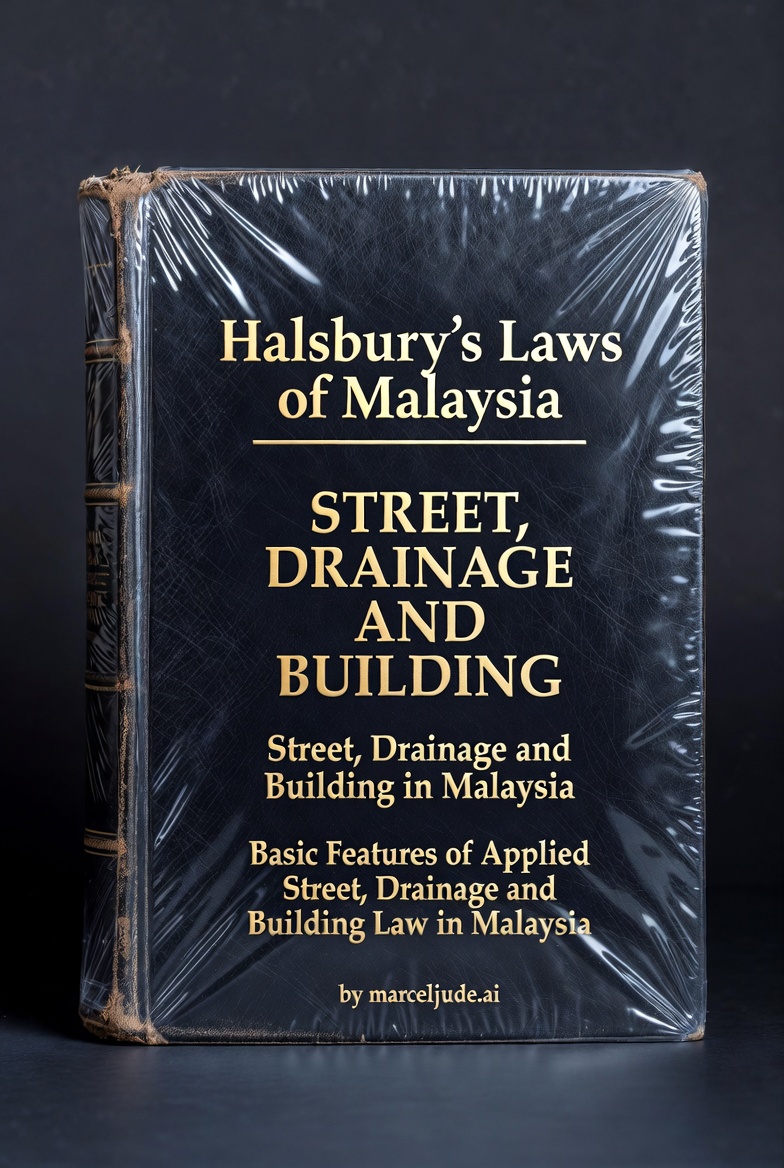


Description
Halsbury’s Laws of Malaysia: Street, Drainage and Building
An Extensive Chapter-by-Chapter Doctrinal Review
Author of Review: marceljude.ai
I read the book in full. It is arranged as fourteen principal Parts containing 175 numbered legal propositions, running from [550.001] to [550.175].
Contents of the Book
Part 1 — Introduction
[550.001]–[550.002]
Legislation; power to make by-laws.
Part 2 — Streets
[550.003]–[550.047]
Maintenance and repair of public streets; making and improving streets; acquisition of land; recovery of street-development costs; private streets; approval of street plans; street works; conversion of private streets into public streets; widening and repair; deposits for street works; development schemes; regular street lines; public footways; street lighting; alteration of utility infrastructure; road damage caused by excavation; street names and building numbers; fire-hydrant markings; outward-opening doors; projections, verandahs and sky-signs; trees and hedges; grass fires; pavement interference; utility lines; public-safety precautions; deposits of building materials; dangerous places; street cleansing; obstruction; and littering.
Part 3 — Drains
[550.048]–[550.066]
Construction and maintenance of drains and watercourses; recovery of drainage costs; drainage as a condition of building; alteration and discontinuance of drains; cleansing; unauthorised connections; pollution; separation of rainwater and sewage infrastructure; sanitary accommodation; water-closets, urinals, sinks and bathrooms; repair obligations; public sanitary facilities; and sewer ventilation.
Part 4 — Back-Lanes
[550.067]–[550.071]
Acquisition of land for back-lanes; State Authority directions; recovery of acquisition and construction costs; conversion into public streets; closure; obstruction; and maintenance.
Part 5 — Buildings New Buildings
[550.072]–[550.086]
What constitutes erection; deemed responsibility of owners; commencement of work; plans and specifications; local-authority directions; amended plans; building lines; applications to the State Authority; unauthorised erection, alteration and use; certificates of completion and compliance; continuing regulatory powers; rectification; and certification offences.
Earthworks
[550.087]–[550.095]
Definition; by-laws; entry; damage; approval; deemed permission by owners; cessation; resumption; and offences.
Reviewing Safety and Stability
[550.096]–[550.103]
Safety reviews; entry and inspection; evaluation of reports; remedial directions; cessation; execution of emergency works; resumption; and penalties.
Inspection
[550.104]–[550.107]
Inspection during construction; sampling of materials; periodic inspection; structural investigations; and acceptance or rejection of engineers’ recommendations.
Building or Earthworks Failure and Unauthorised Buildings
[550.108]–[550.110]
Failure caused by defective construction, supervision, design, calculation or misuse; demolition of unauthorised buildings; and offences relating to sale or letting.
Constructional Requirements
[550.111]–[550.122]
Back-lanes; unsanitary ground; construction over public infrastructure; combustible materials; internal structures; movable sheds; drainage; hoardings; dangerous buildings; demolition; abandoned buildings; and cleanliness of buildings open to the public.
Nuisance
[550.123]–[550.132]
Statutory nuisances; notices; abatement, prohibition and closing orders; ejectment; penalties; demolition of uninhabitable houses; and execution of demolition orders.
Modification and Waiver
[550.133]
Modification or waiver of building by-laws.
Part 6 — Mandatory Orders
[550.134]–[550.139]
Nature and terms of mandatory orders; unknown owners; urgent ex parte orders; appeals; penalties after unsuccessful appeals; and work pending appeal.
Part 7 — Powers and Duties of Authorities
[550.140]–[550.142]
Entry on land; temporary occupation of adjoining land; and provision of alternative roads, drains, channels and watercourses.
Part 8 — Protection of the State Authority and Its Officers
[550.143]
Personal immunity; institutional immunity; approval and inspection of building works; and limits on liability.
Part 9 — Compensation, Expenses and Costs
[550.144]–[550.149]
Court determination; execution of works by occupiers; protection of agents without funds; first charges on property; payment by instalments; and liability following transfer.
Part 10 — Recovery of Arrears
[550.150]–[550.156]
Attachment; seizure; public auction; tenant payments; application of proceeds; recovery costs; stopping a sale; and court applications.
Part 11 — Improvement Service Fund
[550.157]
Establishment, income and expenditure of the Improvement Service Fund.
Part 12 — Notices
[550.158]–[550.161]
Prescribed forms; authorised officers; modes of service; and general penalties for non-compliance.
Part 13 — Prosecution, Offences and Penalties
[550.162]–[550.167]
Consent to prosecute; prosecution under other laws; jurisdiction of the Magistrates’ Court; identification of alleged offenders and owners; general penalties; and obstruction of authorities.
Part 14 — Miscellaneous
[550.168]–[550.175]
Occupiers obstructing owners’ works; disposal of removed property; licensing discretion; arrest; compensation for damage to authority property; inaccuracies in documents; evidential presumptions; and certificates proving registered ownership.
Review of the Entire Book 1. The Nature of the Work
This is not a conventional legal monograph in which an author advances one central thesis over a sequence of argumentative chapters. It is an encyclopaedic doctrinal work. Its purpose is to organise the law, identify the operative statutory rules, connect those rules to subsidiary legislation and case law, and show how apparently technical municipal provisions interact with administrative law, property law, tort, land acquisition, planning law and criminal procedure.
Its achievement must therefore be measured by different standards from those applied to a narrative textbook. The appropriate questions are whether it:
identifies the governing legal powers accurately;
explains who may exercise them;
distinguishes powers from duties;
identifies the procedural preconditions to valid action;
explains the rights and liabilities of owners, occupiers, developers and professionals;
connects enforcement powers to constitutional and administrative-law controls; and
permits a practitioner to move from a practical problem to the relevant statutory provision, notice, appeal, remedy or offence.
On those criteria, the work is substantially successful.
2. The Book’s Central Jurisprudential Theme
The book’s deeper theme is that street, drainage and building law is a branch of coercive administrative law.
The local authority is not merely a service provider. It may:
control the construction and use of streets;
require owners and developers to pay for infrastructure;
enter private land;
direct alterations to buildings;
stop earthworks;
withhold occupation certification;
remove obstructions;
close dangerous premises;
demolish unauthorised or dangerous buildings;
recover expenses as a charge against land;
attach movable property;
sell property to recover arrears;
seek mandatory court orders; and
initiate criminal enforcement.
The regulatory subject is correspondingly exposed to a dense network of obligations. Ownership carries not only private rights but also public responsibilities. An owner may become liable even where the physical work was carried out by a contractor, tenant or unidentified person. An occupier may be required to clean, repair, vacate, identify the owner or permit statutory works. Developers and frontagers may be required to finance infrastructure from which their land benefits. Architects and engineers may incur professional and criminal responsibility through certification, supervision or design.
Yet these powers are not legally absolute. The book repeatedly returns to:
statutory purpose;
proper exercise of discretion;
relevant and irrelevant considerations;
reasonableness;
notice;
an opportunity to be heard;
compensation;
constitutional protection of property;
judicial review; and
the principle that an ouster clause does not necessarily immunise illegality.
The result is a work about the legal constitution of the built environment: who may build, who pays, who certifies, who bears risk, and who may intervene when private construction threatens public safety.
3. Principal Strengths
The first major strength is comprehensiveness. The work does not treat a building as an isolated physical structure. It follows development through its full regulatory life cycle:
land preparation;
street access;
storm-water drainage;
back-lane provision;
plan approval;
structural design;
construction;
professional supervision;
completion and occupation;
subsequent alteration;
periodic inspection;
dangerous condition;
nuisance;
closure; and
demolition.
The second strength is its use of case law to discipline statutory discretion. Provisions that appear to confer broad or even final authority are interpreted in the light of judicial review. Expressions such as “as it thinks fit”, “conclusive evidence”, “final”, or “not subject to appeal or review” are not treated as licences for arbitrary government.
The third strength is its integration of public and private law. A drainage failure may involve statutory power, negligence, nuisance, land rights, causation and public-authority immunity. An unauthorised structure may involve criminal liability, demolition, lease obligations, contractual consequences and a neighbouring owner’s rights. A dangerous building may engage statutory notices, constitutional property protection, natural justice and professional negligence.
The fourth strength is its attention to cost allocation. Many legal treatments of building regulation concentrate on permission and enforcement but neglect the financial machinery. This book explains who pays for streets, drains, back-lanes, emergency works, demolition, storage, inspection and remediation. It also explains how those liabilities become charges on land and how arrears may ultimately be enforced through seizure or sale.
The fifth strength is its treatment of the certificate of completion and compliance, which is presented not as a mere administrative document but as a central device for reallocating responsibility to the principal submitting person while preserving the supervisory powers of the local authority.
4. Principal Weaknesses
The work’s first weakness is density. Some notes become so elaborate that the governing rule is temporarily obscured by extended discussion of administrative law, English authority, tort doctrine or statutory interpretation. Those discussions are often valuable, but the reader sometimes has to reconstruct the hierarchy between:
the statutory text;
the editor’s explanation;
comparative authority;
commentary; and
broader doctrinal observations.
The second weakness is repetition. Definitions of “owner”, “occupier”, “person”, “building”, “premises” and “local authority” recur constantly. Cross-referencing is necessary in an encyclopaedia, but the cumulative effect can impede continuous reading.
The third weakness is that the book is considerably stronger at describing formal legal powers than at examining the institutional conditions under which those powers are exercised. It says relatively little about:
staffing and technical capacity of local authorities;
inconsistency between local authorities;
inspection resources;
corruption risks;
digital submission systems;
reasons for enforcement delay;
informal settlements;
accessibility in enforcement;
community participation; or
the relationship between legal standards and practical compliance.
The fourth weakness is its limited normative engagement with contemporary environmental challenges. The material on storm-water drainage, slopes, earthworks, watercourses and dangerous buildings is highly relevant to climate resilience, but the work does not systematically frame those provisions around:
intensifying rainfall;
urban heat;
sea-level risk;
nature-based drainage;
catchment-wide planning;
cumulative development effects;
embodied carbon;
energy performance; or
climate adaptation.
The fifth weakness, especially important in a national title, is that Sabah and Sarawak appear principally as jurisdictional qualifications. Their legal regimes are signposted, but not subjected to a sustained section-by-section comparison. That omission matters because the book’s central statute applies to Peninsular Malaysia, while Sabah and Sarawak retain distinct local-government and building-control structures.
5. Overall Scholarly Judgment
As a doctrinal resource, the book is authoritative, highly useful and impressively integrated. As a critical scholarly account of urban governance, it is more limited. It excels at answering, “What power exists, under what provision, against whom, and with what remedy?” It is less concerned with asking, “Should the power be designed this way, is it exercised fairly, and does the institutional structure produce safe, inclusive and environmentally resilient settlements?”
That is not a fatal criticism. It identifies the work’s genre. The book is best used as the doctrinal foundation on which critical analysis can be built.
Part 1 — Introduction Paragraphs [550.001]–[550.002] Chapter Function
The introductory Part establishes the constitutional, territorial and delegated-legislation foundations of the whole subject. It explains that the governing framework is intended to consolidate and standardise the law of streets, drainage and buildings in local-authority areas in Peninsular Malaysia, while allowing State Authorities substantial control over commencement, territorial application, exemption and extension.
This Part is indispensable because every later enforcement provision depends upon three preliminary questions:
Does the governing law apply in the relevant locality? Has the relevant provision been brought into operation there? Was the subsidiary rule or by-law validly made within the enabling power? [550.001] Legislation
This subsection explains the purpose and territorial operation of the governing Act. The legislation consolidates earlier street, drainage and building laws and seeks a uniform system for local-authority areas in Peninsular Malaysia.
The subsection nevertheless reveals that “uniformity” is qualified. Commencement may differ between States, provisions may be introduced on different dates, and a notification may apply to all or only some local-authority areas. A State Authority may exempt an area or extend provisions beyond an existing local-authority area, with necessary modifications.
The important constitutional point is that the legislation functions as an adoptive or uniformising federal measure in a field closely connected with State and local government. It is not a self-executing code that applies identically everywhere merely because Parliament enacted it.
The subsection also addresses the effect of repeal. Earlier rights, liabilities, privileges and acts are not simply erased. This is practically important where a street, approval, liability or enforcement process originated under pre-existing municipal legislation.
It also introduces the interpretive significance of “consultation”. Consultation is not satisfied by symbolic communication. It requires sufficient information, a genuine opportunity to advise, adequate time and genuine consideration of the advice received.
Professor’s assessment. This is a strong opening because it prevents the reader from treating the legislation as territorially automatic. Its weakness is that the constitutional difference between Peninsular Malaysia and East Malaysia is identified but not developed into a fully comparative account.
[550.002] Power to Make By-Laws
This is one of the most important propositions in the entire book. It catalogues the extensive subjects that may be regulated through by-laws, including:
utility lines in streets;
licensing of cables and wires;
street construction and maintenance;
control of back-lanes;
arcades and footways;
water and sanitary facilities;
wells and tanks;
obstructions and encroachments;
dangerous openings and works;
construction and demolition;
submission of plans and calculations;
duties of principal submitting persons and submitting persons;
structural stability;
retaining walls and embankments;
certification records;
certificates of completion and compliance;
material sampling;
periodic inspection;
ventilation, lighting, parking and access;
dimensions of rooms and staircases;
drainage;
fire resistance, escape and firefighting systems;
remedial works;
emergency intervention;
responsibility for building failure;
fees and charges; and
compounding of offences.
The subsection properly emphasises that delegated legislation cannot exceed the parent Act. A by-law may be challenged for substantive ultra vires, procedural invalidity or inconsistency with federal legislation. A valid by-law has legal force, but it cannot override the statute from which its authority is derived.
Professor’s assessment. This subsection shows that the primary Act supplies the regulatory skeleton while by-laws provide much of the technical substance. Its jurisprudential value lies in reminding authorities that breadth of delegated power is not the same as absence of legal limits.
Part 2 — Streets Paragraphs [550.003]–[550.047] Chapter Function
The Streets Part is the book’s most extensive treatment of public space. It deals not merely with road construction but with the legal production, financing, management and policing of the urban public realm.
Five themes run through it:
the distinction between public and private streets;
the transformation of private development infrastructure into public infrastructure;
allocation of costs to developers and benefiting landowners;
control of physical encroachments and hazards; and
summary enforcement in public places.
[550.003] Maintenance and Repair of Public Streets
The local authority is expected, so far as available funds permit, to maintain and repair public streets and their footways. Its powers include paving, metalling, kerbing, drainage, lighting, altering levels, constructing footways and installing protective barriers.
The words concerning available funds are crucial. They weaken any suggestion that every defective public street automatically gives rise to an absolute enforceable duty. The subsection is therefore best understood as establishing a public function whose performance depends partly on resources and administrative judgment.
The subsection also authorises boundary stones and alignment marks. Owners and occupiers must protect them and may bear replacement expenses.
The extensive definition of “local authority” situates street regulation within statutory corporate government. A local authority may act only within powers expressly or impliedly conferred by law.
[550.004] Power to Make and Improve Streets
With State Authority consent, a local authority may construct streets, back-lanes, bridges and tunnels; divert or discontinue a public street; and widen or improve existing streets.
The book correctly distinguishes a statutory power from a private-law duty of care. The existence of authority to improve a street does not alone establish that an individual landowner is owed compensation whenever the authority declines to exercise that power.
The subsection also introduces misfeasance in public office. Liability requires more than a poor decision. It ordinarily involves unlawful action combined with malice or knowledge and foreseeable injury.
[550.005] Acquisition of Land Adjoining New Streets for Building Purposes
This provision allows land to be acquired not only for the carriageway or footway itself but also for buildings needed to form or regularise the street frontage. The authority may erect or alter buildings and later dispose of land subject to development conditions.
The power illustrates that road planning historically involved the shaping of the built frontage, not merely the laying of asphalt. It is a form of urban redevelopment power.
The expression permitting the authority to act as it “thinks fit” remains legally controlled. Discretion must be exercised for the statutory purpose, reasonably, in good faith and by reference to relevant considerations.
[550.006] Compulsory Acquisition
Where privately owned immovable property is required for street or associated building purposes, acquisition must proceed under the governing compulsory-acquisition law.
This subsection protects the integrity of land law. The street legislation identifies the public purpose but does not create an unregulated power of confiscation. Formal acquisition, valuation and compensation procedures remain necessary.
[550.007] Recovery of the Cost of New or Improved Streets
With State approval, a local authority may recover land and construction costs from the relevant developer, frontagers or both.
Apportionment may consider:
frontage;
land area;
degree of benefit;
existing works;
survey and supervision costs;
voluntarily surrendered land; and
other relevant matters.
This is a benefit-based infrastructure-financing model. It rejects the assumption that the general ratepayer must bear the full cost of infrastructure primarily serving a particular development.
An aggrieved developer or frontager may appeal to the State Authority. Although the statutory decision is described as final, legality, procedural fairness and jurisdiction remain conceptually distinct from a merits appeal.
[550.008] Private Persons Making New Streets
No private person may make a new street without prior written permission. The application must include plans showing level, construction, adjoining-house levels, drainage and intended use.
Approval of the detailed street plan depends on planning approval for the underlying land use. This is a vital coordination provision: engineering approval cannot substitute for planning permission.
The authority may direct alignment, width, gradient, drainage, footpaths, back-lanes, culverts, lighting and connection with existing or proposed streets.
Approved streets must be laid out and demarcated within the stipulated period. The authority may enter and do the work at the owner’s expense if the obligation is not performed.
The subsection also regulates pedestrian-only streets and prohibits obstructions.
[550.009] Penalties for Non-Compliance with Approved Plans
Unauthorised deviation from approved street plans, improper hedges, culverts or bridges may result in criminal punishment and a mandatory order requiring alteration, removal or conformity.
The provision’s significance lies in the combination of punishment with physical remediation. A fine alone does not legalise a non-conforming street.
[550.010] Expiry of Earlier Approvals
Street plans approved under previous legislation expire after the prescribed transitional period unless renewed.
This prevents historic approval from becoming an indefinitely exercisable development right after the regulatory framework has changed.
[550.011] Paving and Improvement of Private Streets
This is one of the best procedural provisions in the Part. Where private streets require works, the local authority must prepare plans, specifications, estimates and a provisional apportionment.
Affected frontagers and developers receive notice and may inspect the material. They may object on grounds including:
the way is not legally a street;
it is already public;
procedural irregularity;
excessive or unreasonable works;
excessive estimated expense;
wrongful inclusion or exclusion of premises; or
incorrect benefit allocation.
Objectors must be heard. The authority may confirm or amend the scheme. If costs rise because of an amendment, fresh notice is required. Following completion, a final apportionment is made, but liability is generally protected against an increase exceeding the estimate plus ten per cent.
Professor’s assessment. The subsection is a model of administrative fairness within infrastructure law: disclosure, objection, hearing, reasoned allocation and protection against uncontrolled cost escalation.
[550.012] Declaration of Public Streets Following Works
Where satisfactory works have been completed on a sufficiently wide private street, frontagers representing the required majority of annual value may compel its declaration as a public street.
Once declared, future maintenance becomes the local authority’s responsibility.
The subsection demonstrates the legal transition from privately financed development infrastructure to permanent public infrastructure.
[550.013] Discretionary Declaration of Private Streets as Public
A local authority may initiate the conversion of a satisfactory private street into a public street. Notice must be posted and frontagers may object.
Lighting may be required as a condition.
This is a less owner-driven route than [550.012], but it retains a period for objection before the transfer of long-term maintenance responsibility.
[550.014] Widening of Private Streets
The authority may plan the widening or improvement of a private street and acquire necessary premises under compulsory-acquisition law.
Where partial acquisition leaves a building or parcel practically useless, the owner may require acquisition of the remainder. This protects against the creation of uneconomic remnants.
Costs may be recovered from developers and frontagers according to frontage, area, benefit, prior works, surrendered land and other relevant factors.
The “pay first, appeal later” arrangement strengthens administrative collection but can burden a landowner with a serious cash-flow obligation even where the apportionment is ultimately reduced.
[550.015] Repair of Dangerous or Defective Private Streets
A developer, frontager or person responsible for the dangerous condition may be ordered to repair the private street. If work is not commenced or completed, the authority may intervene and recover costs.
The authority may also perform works at public expense where public safety, health, convenience or comfort requires immediate action. That intervention does not necessarily eliminate private liability.
A certificate identifying the person responsible operates as prima facie evidence rather than irrebuttable proof.
[550.016] Restricting Use by a Person Causing Damage
Where heavy use or particular vehicles have caused a private street to become dangerous, the authority may prohibit further use until the responsible person deposits an amount reflecting expected repair costs.
This is preventive regulation. It does not wait for further collapse or deterioration before intervening.
[550.017] Payments Before Building in Respect of Street Works
Before construction begins on land fronting a relevant private or proposed street, the person erecting the building may be required to deposit money or provide security for street works.
Construction begun in breach may be stopped. The person served may disclaim responsibility, but failure to comply can result in punishment and a daily fine.
The subsection links building approval to the delivery of adequate access infrastructure.
[550.018] Determination of the Deposit
The intended builder must obtain an order specifying both the required deposit and the completion date for street works.
The amount should reflect what the authority would spend if it carried out the works itself. A prompt appeal lies to the State Authority.
[550.019] Execution of Street Works by the Authority
Where street works are not commenced or are unsatisfactory, the authority may execute them after notice and meet the cost from the deposit or security.
The arrangement makes the deposit genuinely protective rather than merely fiscal.
[550.020] Refund or Retention of Deposit
A deposit must be refunded where satisfactory works have been completed, but the authority may retain all or part of it where:
work is defective;
further construction will require additional works; or
a maintenance period is necessary.
The permitted maintenance period is limited, preventing indefinite administrative retention.
[550.021] Refund Where Building Operations Do Not Begin
A person abandoning the development before construction may notify the authority. The plans may then be cancelled and the deposit or security returned in whole or part.
The provision closes the financial loop when the underlying project disappears.
[550.022] Preparation of a Building Scheme
Where land is likely to be developed, the authority may prepare a scheme of streets, back-lanes and open spaces consistent with planning law.
Public notice and an objection period are required. Objectors may seek a hearing. The scheme is then submitted for State confirmation, modification or conditions.
This is an early form of area-based development control. It recognises that coherent street and open-space systems cannot always be produced through isolated applications for individual lots.
[550.023] Regular Line of a Street
With State sanction, the authority may prescribe a regular line beyond which future construction may not project.
The rule protects long-term alignment and prevents piecemeal building from frustrating future widening or orderly frontage.
[550.024] Possession of Land Within the Regular Line
When a structure within the regular line falls, burns or is demolished, the authority may take possession of the affected land and have it formally acquired.
Open land or external structures may similarly be taken after notice.
The provision is powerful because it allows urban realignment to occur incrementally when redevelopment opportunities arise.
[550.025] Provision of Footways
Where sufficient vacant frontage exists, an owner may be required to allow a public footway without compensation for the use of the strip. The local authority, however, bears the cost of construction and necessary setting back of walls or fences.
The owner retains the right to build in the future as though the temporary public use had not extinguished the development entitlement.
This is an unusual legal compromise between immediate pedestrian need and underlying ownership.
[550.026] Lamp-Posts and Roof Water
The authority may attach or erect lighting apparatus while minimising damage.
The same subsection requires owners to install gutters and pipes so roof water does not fall on pedestrians or improperly enter a sewer.
Its pairing of lighting and roof drainage reflects the older legislative habit of grouping practical street inconveniences rather than modern subject-based drafting.
[550.027] Relocation of Utility Infrastructure
Water pipes, cables, telegraph apparatus and similar infrastructure may be required to be raised, lowered or moved for statutory street works.
The alteration must not permanently injure the utility or impair its service. The local authority bears expenses and reasonable compensation.
A mandatory order may be sought if the utility controller does not comply.
[550.028] Road Damage Caused by Excavation
Where excavation on adjoining land damages a road, drain or verandah-way, the authority may repair it and recover costs from the landowner.
This is a direct application of the polluter-pays or damage-causer-pays principle to municipal infrastructure.
[550.029] Street Names
Street naming and renaming require State approval. The authority may mark names on nearby buildings, and interference with an official inscription is an offence.
Street naming is legally significant for addressing, service, emergency response and land administration—not merely ceremonial identity.
[550.030] Fire-Hydrant Markings
The authority may place hydrant-location plates and fire alarms in public places. Destruction or concealment is punishable.
This modest provision reveals how building façades may be used to support collective emergency infrastructure.
[550.031] Numbers on Houses
The authority may allocate and display building numbers. Owners and occupiers must protect them and may bear replacement costs.
Reliable numbering is a basic infrastructure of taxation, emergency response, postal service, enforcement and property identification.
[550.032] Doors Not to Open Outwards
Doors, gates, bars and ground-floor windows opening onto a street should not create an obstruction. An owner may be ordered to alter them.
The provision balances private building design against the pedestrian’s right to unobstructed public passage.
[550.033] Projections and Encroachments
The authority may require the removal or alteration of anything projecting into a public street, drain, aqueduct or sewer.
The subsection carefully allocates cost between owner and occupier according to who created the obstruction. Where the projection was lawful, the authority bears removal expenses and compensation.
That compensation distinction is important: regulatory necessity does not retrospectively convert lawful construction into owner misconduct.
[550.034] Verandahs, Balconies, Sunshades and Signboards
Projections may be permitted over sufficiently wide public streets, subject to conditions.
Breach may lead to notice, a mandatory removal order and continuing fines.
The rule accommodates traditional covered walkways and commercial frontages while preserving safety and street capacity.
[550.035] Sky-Signs
A conspicuous sign visible against the skyline requires prior permission. Removal may be ordered after notice.
This is both a safety provision and an early form of visual-environment control.
[550.036] Hedges and Trees Along Streets
Owners and occupiers may be directed to reduce hedge heights and trim overhanging trees, especially near corners.
The regulatory concerns are visibility, passage, vehicle safety and public convenience.
[550.037] Prevention of Grass Fires
Combustible vegetation may be ordered removed. If the owner or occupier defaults, the authority may do the work and recover its expense.
Where a fire occurs during non-compliance, firefighting costs may also be recovered.
The subsection turns failure to manage private vegetation into a recoverable public-safety cost.
[550.038] Trees Near Streets
Planting within the prescribed distance is restricted unless the species is approved. Existing trees may be removed by order.
Limited compensation is available for certain pre-existing fruit trees.
The provision is administratively simple but ecologically underdeveloped. A modern account would also consider shade, biodiversity, urban heat, root systems and replacement planting.
[550.039] Taking Up Pavement
Interference with pavement, flags, fences or posts without permission is an offence. Wilful damage to streets or footways is separately punishable.
The subsection protects public capital against private appropriation or damage.
[550.040] Rails, Mains, Pipes and Electric Lines
Private laying of infrastructure through streets requires written permission and may be conditioned or refused.
Unauthorised installations may be removed at the offender’s expense.
The rule confirms that the subsurface and airspace of a street are regulated public assets.
[550.041] Precautions Against Accident
Those constructing or repairing streets, back-lanes, sewers and drains must shore adjoining buildings, control vehicle passage and illuminate and guard works.
Interference with safety barriers or lights is an offence.
This is one of the clearest expressions of preventive construction-site responsibility in the Streets Part.
[550.042] Building Materials and Holes in Streets
Materials may not be deposited and holes may not be made without permission. Where permission is granted, fencing, enclosure, lighting and timely removal or filling are required.
The authority may secure the danger itself and recover costs.
[550.043] Dangerous Wells, Tanks and Holes
An owner may be ordered to repair, protect or enclose a dangerous place. Failure permits both prosecution and direct municipal intervention.
The subsection extends street-safety law to hazards originating on adjoining property.
[550.044] Cleaning Private Streets
An owner or occupier with access to a private street must, so far as reasonably practicable, clean the adjoining half of the street and its footways.
The authority may specify times, undertake the work on default or contract with the responsible person for cleaning services.
This is a classic example of a municipal burden attached to occupation and frontage.
[550.045] Watering Streets
The authority may water streets for public convenience and provide the machinery and facilities necessary.
Historically associated with dust suppression, the provision now invites broader questions about water scarcity, road cleaning and environmental health.
[550.046] Obstruction
The concept of obstruction is defined broadly. It includes walls, fencing, goods, refuse, derelict vehicles, trade materials and vehicles resting on footways.
Authorised officers may arrest offenders without warrant in the stipulated circumstances. The authority may remove and detain the obstruction until expenses are paid.
Temporary structures for festivals or ceremonies may be authorised, recognising that public space has social as well as transport functions.
[550.047] Depositing Dirt and Refuse
This subsection criminalises a wide variety of littering and pollution conduct, including:
throwing refuse into public places;
allowing material to migrate from private land;
drying goods in public places;
spilling offensive liquids;
dropping soil or construction material from vehicles;
creating windborne dust; and
leaving food containers or glass.
Special rules identify the driver or controller of a vehicle and require owners to provide driver information. Construction activities creating falling fragments or dangerous dust attract more serious consequences.
The subsection also uses presumptions against nearby occupiers and imposes derivative liability on principals and employers, subject to proof of lack of consent and due diligence.
Overall assessment of Part 2. This is an impressively complete municipal code of public-space production and control. Its strongest material concerns cost apportionment and private-street procedure. Its principal weakness is that it reflects a vehicle-and-frontage model of urbanism. Contemporary street law would give more explicit attention to universal accessibility, cycling, public transport priority, heat mitigation, trees, storm-water retention and equitable use of public space.
Part 3 — Drains Paragraphs [550.048]–[550.066] Chapter Function
The Drains Part lies at the intersection of engineering, sanitation, environmental protection and property rights. Its central distinction is between:
surface or storm water; and
sewage, sullage and trade effluent.
Confusing those systems creates public-health and environmental risks. The chapter therefore regulates both public infrastructure and private plumbing.
[550.048] Construction and Maintenance of Drains and Watercourses
The local authority may construct and maintain surface-water and storm-water drains, culverts, gutters and watercourses. It may acquire property or carry works through streets and, after notice, through private land.
The authority must minimise damage and compensate for physical harm, though loss of business resulting from the works is excluded.
The book’s discussion of “watercourse” is particularly important. It supports a broad interpretation that includes natural as well as artificial channels. A narrow construction would fragment drainage responsibility where natural and engineered systems interconnect.
[550.049] Recovery of Drainage Costs
The authority may recover construction, acquisition and compensation costs from frontagers.
Where proposed development requires existing drainage to be improved, a developer may be required to deposit money or provide security before proceeding.
Apportionment considers:
land area;
intended use;
condition before, during and after development;
degree of benefit;
prior works;
land surrendered; and
other relevant matters.
The subsection also illustrates the continuing importance of judicial review despite statutory language purporting to make an administrative decision final.
[550.050] No Building Without Drainage
A building may not be erected, reconstructed at ground level or occupied unless adequate surface-water drainage is provided.
The authority may require a group of premises to be drained collectively. Existing drainage may be ordered altered, enlarged, repaired or cleansed.
Default permits entry, execution of works and recovery of expenses.
This provision properly treats drainage as a precondition to lawful development, not an optional afterthought.
[550.051] Repair, Alteration or Discontinuance of Drains
The authority must maintain drainage under its control and may enlarge, alter, cover, close or destroy obsolete infrastructure.
It must minimise damage, compensate where appropriate and avoid creating a nuisance. If a person loses lawful drainage access because of the alteration, an equally effective alternative must be supplied with due diligence.
The accompanying discussion of public-authority liability is substantial. It distinguishes harm caused by positive intervention from loss attributed to a failure to exercise a statutory power. The latter category has historically faced greater doctrinal resistance in negligence.
[550.052] Cleansing and Emptying Drains
Drains and watercourses under authority control must be constructed and maintained so they do not become nuisances or injure health.
The authority may install reservoirs, sluices and other cleansing works. Entry into private property requires reasonable notice, minimum damage and compensation.
Discharge into the sea or another suitable place requires State sanction and must not itself create a nuisance.
[550.053] Unauthorised Connections
A person may not connect a drain to a public drain, canal or stream, or close, stop or divert drainage, without permission.
A Magistrates’ Court may order demolition, alteration or reconstruction.
The provision protects system capacity and prevents private action from disrupting the broader catchment.
[550.054] Water-Closets and Trade Effluent
Water-closets and privies may not communicate with rivers, canals, streams, lakes, the sea or storm-water drains without approval. Trade effluent is similarly controlled.
Unauthorised discharge may result in punishment and a mandatory order requiring steps to prevent further communication or discharge.
This is one of the book’s clearest pollution-control provisions, although contemporary environmental regulation now involves additional specialised legislation and agencies.
[550.055] Rainwater Pipes Not to Carry Soil Waste
A pipe carrying roof water may not be used to carry human waste or sullage.
The rule enforces the physical separation of storm-water and foul-water systems.
[550.056] Water Pipes Not to Serve as Ventilation Shafts
A pipe or downspout conveying surface water may not be used as a drain or sewer ventilating shaft.
Again, the principle is separation of functions to avoid odour, contamination and system malfunction.
[550.057] Water Supply, Closets and Urinals
Where sufficient water and a sewer are reasonably available, the authority may require adequate water-closets, urinals, sinks and bathrooms connected to the sewer.
A sewer within the prescribed distance of the premises is treated as reasonably available.
Where water exists but no sewer is available, an approved sewage-purification system or approved chemical closets may be required.
The subsection links building occupation, sanitation and infrastructure availability.
[550.058] Insufficient Sanitary Accommodation
Where a house or building lacks sufficient closets, sinks, urinals or bathrooms, the owner may be ordered to provide them.
If the owner fails to act after the prescribed period, the authority may execute the work and recover expenses.
[550.059] Provision Where Water and Sewer Exist
Where infrastructure is available, an owner may be required to provide appropriate water-closets, urinals, sinks and bathrooms.
The distinction from [550.058] is that this subsection focuses on converting available public infrastructure into functioning private sanitary accommodation.
[550.060] Installation of Water Pipes
Where the building lacks domestic water, the authority may install pipes and fittings to serve sanitary accommodation and recover the cost from the owner.
The occupier may be charged for actual consumption and may also face a minimum monthly charge.
This provision distributes capital cost to ownership and consumption cost to occupation.
[550.061] Replacement of Water-Closets
The authority may require an existing closet or its apparatus to be removed and replaced at the owner’s expense.
Default permits the authority to do the work and recover its cost.
[550.062] Maintenance of Sanitary Facilities
Owners bear the ordinary expense of maintaining and renewing water-closets, urinals, sinks and bath-waste fittings.
Where repair becomes necessary because of an occupier’s negligent or wilful damage, the owner may recover the cost from the occupier.
This is a sensible allocation between structural responsibility and fault-based damage.
[550.063] Putting Drains and Sanitary Facilities in Order
The authority may order an owner to repair or renew a defective drain, urinal, closet, sink or bathroom.
Default again triggers municipal execution and cost recovery.
[550.064] Offensive Urinals
A urinal opening onto a street may be required to be removed or altered where its design or location creates a nuisance or offends public decency.
The provision combines sanitary, spatial and public-order considerations.
[550.065] Facilities at Public Venues
Public houses, eating premises, theatres, cinemas and places of entertainment may be required to provide and maintain sufficient urinals and water-closets.
The subsection recognises that sanitary demand is generated by public congregation, not only by permanent residential occupation.
[550.066] Sewer Ventilation Pipes
The authority may attach ventilation pipes to buildings where needed for public drains and sewers, provided the installation does not cause nuisance or unreasonable inconvenience.
Overall assessment of Part 3. This chapter is technically coherent and founded on sound public-health principles. Its great strength is the strict conceptual separation of storm water, sewage and effluent. Its limitation is that drainage is treated mainly as municipal engineering rather than catchment ecology. Contemporary application should also ask how development changes runoff volume, flood peaks, erosion, water quality and downstream vulnerability.
Part 4 — Back-Lanes Paragraphs [550.067]–[550.071] Chapter Function
Although short, this Part is conceptually significant. Back-lanes support:
drainage;
waste collection;
ventilation;
emergency access;
servicing;
fire separation; and
secondary movement behind buildings.
They are therefore part of the sanitary and safety structure of urban blocks.
[550.067] Acquisition of Land for a Back-Lane
When building plans reveal land capable of forming part of a back-lane, the authority may request acquisition.
Acquisition should not produce an improper severance. Where partial acquisition renders the remaining building or site useless, the owner may require acquisition of the remainder.
This protects owners against the externalisation of unusable fragments.
[550.068] State Authority May Order a Back-Lane
On local-authority recommendation, the State Authority may order a back-lane of specified width through identified land.
Land may then be acquired, with protection for useless remnants comparable to [550.067].
[550.069] Recovery of Acquisition and Construction Costs
Once the back-lane has been acquired and constructed, costs may be recovered from frontagers, developers or both.
The allocation considers frontage, area, degree of benefit, voluntarily surrendered land and other relevant considerations.
After construction, maintenance rests with the local authority.
[550.070] Declaration as a Public Street
A back-lane may be converted into a public street through the prescribed procedure.
This permits its legal function to evolve as the surrounding urban area develops.
[550.071] Closure and Obstruction
The local authority may close or condition access over a controlled back-lane. Unauthorised obstructions may be removed and costs recovered from the responsible person.
Overall assessment of Part 4. The Part is compact and effective, but it reflects a conventional urban-block form. A more nationally comparative treatment would examine how equivalent access, sanitation and emergency functions operate in rural settlements, villages, customary land and longhouse environments.
Part 5 — Buildings Paragraphs [550.072]–[550.133] Chapter Function
This is the intellectual and practical centre of the book. It regulates the entire building life cycle and shows how planning, engineering, professional responsibility, administrative enforcement and public safety interact.
The Part’s governing principle is that building regulation is not exhausted when plans are approved. Control continues through construction, certification, occupation, alteration, inspection, deterioration and demolition.
Part 5, Division 1 — New Buildings A. General [550.072] What Constitutes “Erecting a Building”
No building may be erected without prior written permission. “Erection” is defined broadly and includes more than construction from an empty site.
It extends to:
new foundations or substantial superstructure;
conversion to residential use;
subdivision into multiple dwellings;
conversion away from residential use;
deviation from approved plans;
infringement of governing legislation or by-laws;
substantial reconstruction of walls, floors or roofs; and
additional storeys.
Work performed on separate occasions within ten years may be aggregated.
This anti-avoidance definition prevents an owner from escaping regulation by describing substantial redevelopment as repair, alteration or phased work.
[550.073] Owner Deemed Responsible
Construction is presumed to have been undertaken by the landowner unless the contrary is proved.
Where an unauthorised building appears on vacant land and the actual builder is unknown or cannot be found, responsibility is attributed to the owner.
The presumption is administratively useful, but it makes due diligence essential for owners who permit occupation or construction by others.
[550.074] Commencement of Work
Construction or resumption after a prolonged suspension must occur within the validity period of the approved plans, and advance written notice must be given.
Detailed structural plans, calculations and required reports must be submitted before commencement.
The provision prevents approval in principle from being treated as sufficient authority to construct without completed structural documentation.
B. Requirements for Erecting Buildings [550.075] Plans and Specifications
A principal submitting person or submitting person must lodge the plans required by the local authority and any other relevant statutory authority.
Approval may be withheld where:
the building depends on an unapproved new street;
required street-work deposits have not been made; or
lawful conditions remain unfulfilled.
The subsection demonstrates that development approval is interdependent. A building cannot be considered independently of access, drainage, planning and other statutory systems.
[550.076] Directions by the Local Authority
The authority may issue directions concerning:
statutory compliance;
site and open space;
light and ventilation;
foundation and floor levels;
site filling and stability;
frontage alignment;
elevation;
regular street lines;
design and appearance;
water supply;
building lines; and
arcades or footways.
The lengthy administrative-law discussion attached to this proposition is justified. Such directions may profoundly affect land value and design. They must therefore be used for proper statutory purposes, based on relevant considerations and applied reasonably and in good faith.
A direction cannot be justified merely because the authority considers the desired outcome aesthetically or politically attractive. It must fall within the legal subject matter of the power.
[550.077] Amended Plans
The submitting professional must amend and resubmit plans in accordance with lawful directions.
Failure to resubmit within the specified or extended period results in deemed withdrawal, though fresh plans may later be lodged.
This gives finality to dormant applications while avoiding permanent forfeiture of the right to reapply.
[550.078] Setting Buildings Forward or Back
Where a building must be set forward, an approved wall or fence may satisfy the regular-line requirement while preserving the necessary arcade or footway.
Where it must be set back, land within the regular street line may be taken and formally acquired for incorporation into the public street.
This ensures that regulatory setback does not silently become uncompensated permanent acquisition.
[550.079] Application to the State Authority
If the local authority fails within the stipulated period to approve, reject or requisition amendments, the applicant may apply to the State Authority, which then assumes the relevant powers.
This is a statutory remedy against administrative silence. It is important because delay itself can effectively defeat development without a formal appealable refusal.
C. Unauthorised Erection, Alteration and Use [550.080] Unauthorised Erection
Offences include:
beginning or resuming in breach of commencement requirements;
deviating from approved plans;
contravening legislation or by-laws; and
disobeying lawful directions or waiver conditions.
The penalties are substantial and may include imprisonment and continuing daily fines.
Where prosecution has not begun, later submission of plans attracts a multiple of the ordinary prescribed fee. This is not an automatic right to regularisation; it is a financial and procedural consequence of seeking retrospective approval.
The discussion of Eu Lian Hang is instructive. Criminal prosecution for deviation and a mandatory order to remove unlawful work are distinct enforcement routes. One does not necessarily depend on prior use of the other.
[550.081] Unauthorised Alteration
An alteration made outside the statutory and by-law framework or without permission is an offence. A Magistrates’ Court may order alteration or demolition.
The subsection prevents an owner from treating post-completion changes as exempt merely because the original building was lawfully approved.
[550.082] Unauthorised Use
Using a building for a purpose different from that for which it was constructed requires permission.
Continuing use after notice attracts daily liability.
This is an important bridge between building control and planning. Physical safety may be affected by a change of use because occupancy, fire load, access, ventilation and sanitary demand may all change even when no structure is altered.
D. Certificate of Completion and Compliance [550.083] Issuance and Professional Responsibility
Only the principal submitting person may issue the certificate of completion and compliance.
Before doing so, that professional must ensure:
construction conforms to approved plans;
statutory and by-law requirements have been fulfilled;
technical conditions have been satisfied; and
the building is safe and fit for occupation.
The shift to professional certification is one of the most consequential features of the modern framework. It relocates immediate certification responsibility from municipal administration to a regulated professional with direct knowledge of the work.
The certificate is therefore neither a courtesy nor a clerical form. It represents a professional legal judgment backed by possible disciplinary, civil and criminal consequences.
[550.084] Local-Authority Powers Remain
Professional certification does not displace municipal authority.
The local authority retains powers to inspect, direct compliance and ensure conformity with approved plans and legal requirements.
This is essential. Self-regulation without residual public supervision would create an unacceptable accountability gap.
[550.085] Non-Compliance with Approved Plans
Where non-compliance appears, the authority may:
require rectification within a specified period; and direct the principal submitting person to withhold the certificate until rectification.
If the direction is ignored, the authority may execute necessary work and recover the cost from the owner.
The statutory description of the authority’s cost certificate as conclusive must still be understood in the broader administrative-law context: fraud, jurisdictional error, improper purpose and procedural unfairness cannot ordinarily be transformed into legality merely by certification.
[550.086] Certification Offences
Serious offences include:
issuing a certificate without being the principal submitting person;
issuing without prescribed forms;
issuing contrary to a withholding direction;
making false or fraudulent declarations;
using forged or altered documentation; and
occupying a building without the required certificate.
The severity of punishment reflects the public reliance placed on certification.
Professor’s assessment of the CCC division. The structure sensibly combines professional responsibility with continuing public control. Its effectiveness, however, depends on professional independence. Where the certifier is commercially dependent on the developer, law must be supported by strong professional discipline, insurance, audit and protection against pressure to certify prematurely.
Part 5, Division 2 — Earthworks A. General [550.087] Meaning of Earthworks
Earthworks include excavation, levelling, filling, piling, foundations, tree felling and other disturbance of land.
The definition is appropriately broad. Slope failure or drainage harm can result from apparently preliminary operations long before a building emerges.
[550.088] Earthworks By-Laws
The local authority may regulate plans, submissions, professional responsibility, fees, offences and exemptions for minor or temporary work.
This is another area in which technical by-laws supply much of the operational law.
[550.089] Entry to Execute or Inspect Earthworks
The authority or an authorised person may enter land, buildings or premises at any time of day or night without notice for earthworks execution or inspection.
The section also confers broad protection from claims arising from the exercise of those powers.
This is an exceptionally intrusive power. It should be construed in light of necessity, statutory purpose and proportionality, particularly where occupied residential premises are involved.
[550.090] Damage Caused by Earthworks
Where earthworks damage a public street or government or municipal property, the authority may repair the damage and recover costs from the landowner.
The cost certificate is described as conclusive and immune from appeal or review. The book rightly treats that language cautiously and places it against authorities affirming the supervisory jurisdiction of the courts.
B. Commencement and Cessation [550.091] Approval Before Commencement
Earthworks require prior submission and approval of plans and specifications.
Where earthworks form part of building, street, drainage, sewerage, embankment, cable or pipe works, the related plans must be submitted together.
This prevents fragmented approval in which land disturbance begins before the authority can evaluate the complete project.
[550.092] Owner Deemed to Permit Earthworks
The owner is deemed to have permitted earthworks conducted on the land.
Like the building presumption, this facilitates enforcement but places a heavy monitoring duty on ownership.
[550.093] Cessation of Work
Where life or property is or may be endangered, the authority may order immediate cessation.
It may issue directions, execute emergency measures, recover expenses, eject persons, remove machinery and obtain police assistance.
The statutory assertion that the authority’s safety certificate is conclusive cannot eliminate the public-law requirement that the decision be genuine, legally authorised and rationally connected to safety.
[550.094] Resumption
Earthworks may resume subject to conditions after the authority is satisfied that safety and compliance requirements have been met.
Resumption is therefore not automatic upon the contractor’s assertion that the immediate problem has been corrected.
[550.095] Failure to Comply
Breach of the earthworks regime, disobedience of directions or obstruction of authorised entry is a serious offence.
Approval may be revoked after conviction, and cessation may be physically enforced.
Overall assessment of the Earthworks division. This is among the book’s most practically important material, particularly in hilly and high-rainfall environments. It treats earthworks as an independent regulatory risk rather than merely a subsidiary stage of building. Its strongest feature is immediate preventive intervention; its potential weakness is the breadth of entry, certification and immunity provisions.
Part 5, Division 3 — Reviewing Safety and Stability [550.096] The Review
Where topography or surrounding conditions have changed, or where structural defect, deformation or deterioration is suspected during construction, the authority may order a safety and stability review.
The review must be carried out by a qualified person other than the professional responsible for the original submissions.
That independence requirement is excellent. A review designed to test prior work should not be performed solely by the person whose design or supervision is in question.
[550.097] Inspection Without Notice
The authority may enter the construction site and building without notice to inspect safety and stability.
The power recognises that advance warning may permit concealment or continuation of dangerous operations.
[550.098] Evaluation of the Review
The report must be delivered within the specified period.
If danger is identified, the owner must receive notice of the proposed cessation order and be informed of the right to object within fourteen days. Where objections are made, the authority must hear the objector before deciding whether to stop work or issue directions.
This subsection contains an important procedural balance: urgent risk regulation is preserved, but the owner is ordinarily given an opportunity to contest a final cessation decision.
[550.099] Written Directions
Directions may require:
slope stabilisation;
additional drainage;
strengthening or construction of retaining walls;
additional structural supports;
amended plans; and
other necessary measures.
Failure to comply may lead to cessation.
This is a particularly modern subsection because it recognises that the safety of a building includes its foundations and surrounding terrain.
[550.100] Failure to Obey Cessation
The authority may eject persons, remove equipment and seek police assistance to enforce a stop-work order.
A paper order is thus backed by immediate physical enforcement.
[550.101] Authority May Execute Work
The authority may carry out remedial work or demolish work under construction to prevent imminent danger or respond to non-compliance.
Reasonable expenses are recoverable from the owner.
This is an emergency police power in the true administrative-law sense: intervention is directed at immediate protection of life and property.
[550.102] Resumption After Remediation
The authority may permit resumption after directions are obeyed or necessary measures completed.
It may withhold resumption until its reasonable expenses have been reimbursed.
[550.103] Penalty
Failure to obey an order, direction or condition, or obstruction of the authority, attracts severe criminal liability and continuing fines.
Approval may also be revoked.
Professor’s assessment. This division is one of the strongest in the book. It integrates independent review, procedural fairness, slope safety, emergency action and cost recovery into a coherent regulatory sequence.
Part 5, Division 4 — Inspection A. Inspection During Erection [550.104] Inspection and Material Sampling
The authority may inspect construction at any stage, identify deviations, issue notices and order rectification.
It may take reasonable material samples for analysis without payment, although a receipt must be issued.
The provision reinforces the distinction between approval of plans and verification of actual construction.
B. Periodical Inspection [550.105] Notice Requiring Inspection
Buildings exceeding the statutory storey threshold may be required to undergo inspection after ten years and thereafter at intervals not exceeding ten years.
The owner appoints an engineer. If the owner defaults, the authority may appoint one and recover the expense.
This subsection introduces lifecycle regulation. A building that was safe on completion may become unsafe through corrosion, alteration, overloading, poor maintenance or ground movement.
[550.106] Inspection and Report
The engineer begins with visual inspection of the building, its structural elements and subsequent alterations.
Where defect or deterioration is reasonably suspected, permission may be sought for a full structural investigation involving:
collection of design and maintenance history;
examination or reconstruction of plans and calculations;
non-destructive testing;
material testing; and
load testing where necessary.
A report and recommendations must then be delivered.
The graduated method is proportionate: inexpensive visual review first, intensive investigation where evidence justifies it.
[550.107] Evaluation of Recommendations
The authority may accept, reject, partially accept or obtain a second opinion on the engineer’s findings.
It may order repairs or, instead of a separate dangerous-building inquiry, order closure and demolition.
Failure to comply is a serious offence, and the authority may undertake the ordered measure and recover its expenses.
Professor’s assessment. Periodic inspection is indispensable for high-rise safety. The remaining policy question is whether a system activated by municipal notice produces sufficiently consistent inspection in practice or whether inspection should become automatically due by operation of law.
Part 5, Division 5 — Building or Earthworks Failure and Unauthorised Buildings [550.108] Failure of Building or Earthworks
Where failure results from defective construction, inadequate supervision, misdesign, miscalculation or misuse, the responsible person commits a serious offence.
The provision is notable because it separates several forms of responsibility:
the constructor;
the supervisor;
the designer or calculator; and
the user who misuses the building or earthworks.
This reflects the distributed nature of construction risk.
[550.109] Demolition of an Unauthorised Building
Where a building has been, is being or is about to be erected unlawfully, the authority may require:
cessation; demolition; or other specified steps.
An owner unable to demolish may request municipal execution, but must ordinarily provide money, indemnity and any prescribed relocation sum.
Where the authority demolishes, occupants must receive the stipulated notice to vacate, and removed movable property must be stored and claimable before disposal.
The case law discussed under this subsection is of exceptional constitutional importance. Demolition is not merely an engineering operation; it is a deprivation of property. Even where a structure lacks approval, an affected person may be entitled to be heard before destruction. Natural justice may fill a statutory silence, and arbitrary demolition may engage constitutional property protection.
[550.110] Sale or Letting of an Unauthorised Building
Persons who sell, agree to sell, let or agree to let an unlawfully erected building may commit offences.
A court may order repayment of purchase money and compensation.
The rule protects purchasers and tenants from being drawn into occupation of property that is legally vulnerable to enforcement or demolition.
Professor’s assessment. These provisions appropriately treat unauthorised development as more than a dispute between the owner and the authority. Purchasers, tenants, neighbours and the public may all be harmed. At the same time, demolition must remain procedurally fair and proportionate.
Part 5, Division 6 — Constructional Requirements [550.111] Land for Back-Lanes
Building plans may be refused unless the necessary back-lane land is shown, set apart or acquired.
The owner may have to reimburse acquisition costs attributable to the development.
The subsection integrates individual building approval into the larger service structure of the block.
[550.112] Unsanitary Ground
A new building may not be erected on ground contaminated by faecal, animal or vegetable matter until the material is removed or rendered harmless.
This is a basic but enduring public-health rule against construction over uncontrolled waste deposits.
[550.113] Building Over Public Infrastructure
Construction over public sewers, drains, culverts, rivers, water mains, cables and similar infrastructure requires approval from the relevant authority.
The rule protects maintenance access, structural safety and utility integrity.
[550.114] Combustible Roofs and Walls
Owners may be required to remove roofs or walls made from specified combustible materials where proximity creates a fire risk.
Repairing or renewing with the same prohibited material can lead to punishment and a mandatory demolition order.
Modern enforcement should apply this provision carefully in relation to traditional materials and indigenous architecture. Fire safety may require improvement, but cultural form should not be dismissed without consideration of technically appropriate alternatives.
[550.115] Compartments, Galleries, Lofts and Similar Structures
Internal structures require permission. The owner is presumed responsible unless the contrary is proved.
The authority may enter and remove unauthorised works, recover demolition, transport and storage costs, and rely on a statutory indemnity.
The discussion of Tropiland is valuable because it distinguishes between constructing a building under the general erection provision and installing internal structures under this more specific provision. Authorities should not select a charge merely because another section offers a stronger demolition remedy.
[550.116] Movable Sheds
A movable shed or roof structure may not be erected or kept without permission.
A court may order removal.
The provision prevents nominal mobility from being used to evade building control.
[550.117] Drains for Improperly Drained Premises
Where adequate drainage is available within the prescribed distance, the owner may be required to construct a connecting drain or pipe.
Default permits a mandatory order or direct execution by the authority.
[550.118] Hoardings During Building Operations
Construction, demolition, exterior alteration and repair require permission and protective hoardings or fences unless formally exempted.
The person performing the work must maintain, illuminate and later remove the protective structure.
This is a direct public-safety obligation toward street users.
[550.119] Ruinous and Dangerous Buildings
After appropriate inquiry, the authority may order repair, demolition or protective hoardings where a building is ruinous, likely to fall or otherwise dangerous.
Occupiers and lodgers may be ordered to vacate.
The discussion of the Highland Towers litigation is central. Broad statutory discretion must still be:
exercised in good faith;
directed to the correct statutory owner;
based on relevant evidence;
realistically capable of compliance;
consistent with equality; and
attentive to property rights.
A notice that directs a person to repair land he does not own, allows an irrationally short period or departs from expert recommendations without explanation may be unlawful.
[550.120] Demolition by the Authority at the Owner’s Request
An owner unable to comply may request the authority to undertake demolition.
The owner must provide a sufficient deposit, indemnify the authority and meet any prescribed relocation payment.
The subsection ensures that inability to organise demolition does not leave a dangerous building standing, while preserving the financial responsibility of ownership.
[550.121] Deserted Buildings
Abandoned or disputed premises that attract disorderly persons or become a public nuisance may be ordered secured, enclosed or abated.
Where the owner is unknown, notice may be attached conspicuously to the building.
The authority may perform the work and recover the cost.
[550.122] Buildings Open to the Public
Owners and occupiers must keep buildings accessible to the public clean, repaired and free from conditions endangering employees, visitors and users.
The authority may prescribe remedial steps, prosecute non-compliance and perform work at the responsible person’s expense.
This provision moves beyond structural collapse to ordinary operational safety and hygiene.
Overall assessment of the Constructional Requirements division. This is a broad and practical collection. Its dangerous-building material is particularly strong because the book does not treat safety as a justification for legally uncontrolled action. Its weaker aspect is the limited treatment of disability access, heritage conservation, traditional building forms and relocation consequences.
Part 5, Division 7 — Nuisance in Relation to Buildings [550.123] Statutory Nuisances
The statutory categories include:
unhealthy or dangerous premises;
foul pools, drains, closets, septic tanks or sewers;
buildings contaminated by effluvia or inadequately ventilated;
overcrowded huts or sheds;
poorly drained or inaccessible settlements; and
harmful excavations, brickfields and sandpits.
These nuisances may be dealt with summarily.
The subsection translates the general idea of nuisance into concrete municipal conditions.
[550.124] Notice Requiring Abatement
The authority serves notice on the person whose act, default or sufferance causes the nuisance. If that person cannot be found, notice may go to the occupier or owner.
The notice may require present abatement and measures to prevent recurrence. It may be issued even after temporary abatement where recurrence is likely.
Where no responsible private person can be identified, the authority may act itself.
[550.125] Nuisance Order After Default
If the notice is ignored or the nuisance is likely to recur, the authority may complain to a Magistrates’ Court for a summary nuisance order.
Judicial involvement gives additional legitimacy to coercive measures affecting occupation or property.
[550.126] Forms of Nuisance Order
A nuisance order may combine:
abatement; prohibition; and closure.
This flexibility permits the remedy to match the nature and persistence of the condition.
[550.127] Abatement and Prohibition Orders
An abatement order requires compliance or other steps to remove the nuisance.
A prohibition order prevents recurrence.
The order may specify the works to be undertaken, reducing uncertainty about what compliance requires.
[550.128] Closing Order
A court may prohibit human habitation where nuisance makes a dwelling unfit.
Notice of the hearing must be posted so occupants may show cause.
The order may later be cancelled when the dwelling is rendered fit.
This is a strong example of procedural fairness directed not only to the owner but also to people whose homes will be affected.
[550.129] Ejectment Following Closure
After notice, occupiers and their families must leave the closed dwelling. Continued occupation attracts daily liability and may lead to a court order for ejectment.
A tenant whose tenancy has not lawfully ended may receive a reasonable removal allowance from the owner.
The subsection acknowledges, albeit modestly, that public-health enforcement imposes private relocation costs.
[550.130] Failure to Obey Orders
Failure to comply with abatement, prohibition or closing orders attracts daily penalties.
The authority may enter, abate the nuisance and recover expenses. The court may also order payment of costs incurred in obtaining the order.
[550.131] Demolition of an Unfit House
Where a closed dwelling remains unfit, repair is not pursued diligently, or continued existence is dangerous or injurious, the authority may seek a summary demolition order.
The order may require destruction of contaminated materials.
[550.132] Execution of Demolition
The owner must carry out the demolition within the ordered period.
On default, the authority may perform it and recover costs.
Overall assessment of the Nuisance division. The procedural progression is sound: information, notice, opportunity to comply, court order, closure and finally demolition. The weakness is social rather than doctrinal: the regime says comparatively little about rehousing, vulnerability, poverty or whether enforcement disproportionately affects persons with the least capacity to repair.
Part 5, Division 8 — Modification and Waiver [550.133] Modification or Waiver of By-Laws
An owner may apply in writing for modification or waiver, stating the scope and reasons and providing supporting plans.
The authority may grant relief only where safety is not compromised and may impose conditions.
Where adjoining owners should be consulted, notice and an opportunity to make representations are required. If the authority allows a waiver despite objections, the matter is referred to the State Authority and becomes confirmed unless reversed or modified within the stipulated period.
Professor’s assessment. This provision avoids rigid application of technical rules while protecting safety and neighbouring interests. It should not become a route for normalising non-compliance or granting preferential treatment. Transparent reasons are especially important even though the provision does not always expressly require them.
Part 6 — Mandatory Orders Paragraphs [550.134]–[550.139] Chapter Function
The mandatory-order Part brings the Magistrates’ Court into the enforcement system. It transforms an unperformed statutory obligation into a judicially enforceable command.
[550.134] Mandatory Order and Its Terms
Where an owner or occupier fails after notice to perform required work, the authority may complain to a Magistrates’ Court.
The order specifies the work and time for completion and may require payment of the authority’s costs.
Continued failure attracts daily punishment. The authority may then enter, execute the work and recover expenses.
The order is remedial rather than merely punitive.
[550.135] Unknown Owners
Where the owner’s identity or address cannot be discovered with reasonable diligence, a summons may be addressed generally to the owner and served through the statutory method.
An order may be made in absence, although a fine cannot be imposed on a person who did not appear under this procedure.
[550.136] Urgent Ex Parte Orders
Where delay would endanger public health or safety and immediate work will not cause irreparable injury, the court may authorise the authority to act without first hearing the other party.
If the eventual application fails, damages must be paid. If it succeeds, the authority may recover its costs.
This is a careful emergency arrangement: immediate intervention is possible, but the public body assumes financial risk if the substantive order is not justified.
[550.137] Appeal
An appeal to the High Court generally suspends fines, proceedings and work under the order until determination or abandonment.
The stay protects the utility of the appellate right.
[550.138] Unsuccessful Appeal
Where an appeal is dismissed or abandoned, daily penalties may cover the period of non-compliance unless the appellant shows substantial grounds and that the appeal was not brought merely for delay.
The provision discourages tactical appeals without punishing genuine legal challenges automatically.
[550.139] Work Pending Appeal
If non-execution during appeal would endanger health or safety, the original court may authorise immediate work.
Where the appeal later succeeds, the authority bears execution costs and resulting damages. Where it fails, costs may be recovered from the appellant.
Overall assessment. This Part achieves a good balance between urgent public protection and judicial oversight. It is superior to a purely administrative enforcement model because the most coercive remedial command is ordinarily grounded in a court order.
Part 7 — Powers and Duties of Authorities Paragraphs [550.140]–[550.142] [550.140] Entry on Land
The local authority may enter land or buildings during reasonable daytime hours for inspection, survey or authorised work.
Entry into an occupied dwelling generally requires the occupier’s consent or prior notice. Certain declared classes of premises may be subject to authorised night inspection.
The distinction recognises the heightened privacy of the home.
[550.141] Entry on Adjoining Land
Land near authorised works may be temporarily occupied for materials or purposes connected with construction.
The authority must minimise damage, give prior notice, fence the occupied portion and compensate both temporary and permanent injury.
This subsection is a useful model of legally structured temporary occupation rather than informal encroachment by public contractors.
[550.142] Alternative Roads, Drains and Channels
When public works interrupt existing routes, watercourses, drains or channels, the authority must provide sufficient alternatives and compensate resulting damage.
The provision expresses a principle of functional equivalence: the public body may alter existing arrangements but should not leave affected land without adequate substitute access or drainage.
Overall assessment. These are operationally necessary powers accompanied by sensible safeguards of notice, limited entry, damage minimisation and compensation.
Part 8 — Protection of the State Authority and Its Officers Paragraph [550.143] [550.143] Protection from Personal and Institutional Liability
Actions taken and contracts entered into bona fide for statutory purposes do not ordinarily expose the State Authority or its officers to personal liability.
The provision also grants substantial protection to State and local authorities for buildings or works constructed in accordance with the legislation and for plans or works subjected to approval or inspection. It further states that the statutory system does not necessarily oblige the authority to verify every building, certificate, plan or notice.
This is among the book’s most controversial areas. Immunity may be justified where it prevents public authorities from becoming insurers of every privately designed building merely because plans passed through an approval process. But immunity should not be extended beyond its clear language.
The cases discussed in the book draw important distinctions. Immunity relating to approval or inspection does not necessarily protect:
failure to formulate or implement an entirely separate public scheme;
conduct falling outside the statutory activity;
bad faith;
misfeasance in public office; or
acts for which the statute gives no clear immunity.
Professor’s assessment. The provision creates an accountability asymmetry: authorities exercise intrusive powers but enjoy broad protection against damages. Judicial insistence on clear statutory language and narrow construction is therefore constitutionally and institutionally important.
Part 9 — Compensation, Expenses and Costs Paragraphs [550.144]–[550.149] [550.144] Court Determination
Unless another mechanism applies, disputed compensation, damages, fees, costs, expenses and liability are determined summarily by a Magistrates’ Court.
Unpaid amounts may be recovered like fines, and an appeal lies to the High Court.
This supplies a general adjudicative mechanism for financial disputes scattered throughout the legislation.
[550.145] Occupier Acting Where Owner Defaults
An occupier may, with authority approval, execute work that the owner has failed to perform.
The occupier may recover the expense, deduct it from rent and, absent contrary agreement, retain possession until reimbursed.
This is a powerful statutory protection because it prevents the owner’s default from exposing the occupier to unsafe or unlawful conditions without remedy.
[550.146] Agent Without Funds
A rent receiver or agent is not personally liable to perform the owner’s work where, within the statutory period, the agent informs the authority that insufficient owner funds are held.
The authority may then execute the work and recover expenses under the statutory machinery.
The rule avoids imposing owner-level capital liability on a mere collecting agent.
[550.147] Recovery from Owners
Municipal expenses recoverable from an owner become a first charge on the premises.
Liability generally rests with the owner when the work is completed. Notice is required before arrears enforcement, but the charge and enforcement powers continue despite later changes in ownership or occupation.
This is one of the strongest financial provisions in the book. The liability attaches to the property in a manner resembling secured debt.
[550.148] Payment by Instalments
The authority may accept instalments with interest over a prescribed maximum period.
Default may accelerate the full outstanding balance.
This provides flexibility for substantial remedial costs while protecting the authority’s recovery position.
[550.149] Liability of a Transferor
A seller or transferor remains liable for expenses and obligations that became payable or performable before notice of transfer.
The purchaser’s liability and the authority’s rights against the property are not extinguished.
Overall assessment. This Part is essential to understanding the practical force of the Act. Enforcement is supported not merely by fines but by property charges, rent deductions, reimbursement rights and continuity of liability through transfers.
Part 10 — Recovery of Arrears Paragraphs [550.150]–[550.156] [550.150] Recovery Proceedings
The local authority may use attachment and seizure of movable property and crops, followed by public auction.
It may also declare an intention to sell the premises after the prescribed period. Land sale should not proceed where sufficient owner property is available for seizure.
Where property is already under court execution, the authority may claim priority from sale proceeds without first obtaining an ordinary judgment.
This gives municipal claims a highly privileged position.
[550.151] Payment by Tenant or Occupier
A tenant, subtenant or occupier who pays owner arrears to avoid seizure of personal property may deduct the payment from rent and retain possession until reimbursed.
The right passes through chains of subtenancy.
The rule prevents the owner’s municipal default from being shifted unfairly onto an innocent occupier.
[550.152] Attachment
An authorised person may inventory and publicly notify attached property and may enter a house or building during daytime to effect attachment.
The officer is treated as a public servant.
Given the intrusiveness of forced entry and seizure, strict compliance with appointment, warrant and notice requirements is essential.
[550.153] Application of Sale Proceeds
Proceeds are first applied to arrears, interest and costs.
Surplus may be paid to a person who establishes entitlement or held in trust pending proof. Unclaimed surplus eventually passes to the Improvement Service Fund.
[550.154] Costs of Recovery
Recovery costs form part of the arrears.
The defaulting debtor therefore bears the financial consequences of enforcement in addition to the original liability.
[550.155] Stopping the Sale
A person with an interest in the property may halt the sale by tendering arrears, interest and costs before completion.
This protects redemption up to the last lawful stage.
[550.156] Application to Court
A person disputing attachment or sale may seek a stay.
However, the applicant must deposit the arrears and costs or provide satisfactory security.
The condition protects municipal revenue but may restrict access to judicial review for persons unable to raise the disputed amount.
Overall assessment. This Part is financially formidable. The authority is effectively a secured and priority creditor. The principal rule-of-law concern is ensuring that notice, ownership identification, valuation, attachment and sale procedures are scrupulously observed before a person loses property.
Part 11 — Improvement Service Fund Paragraph [550.157] [550.157] Establishment and Use
Each local authority must maintain an Improvement Service Fund comprising:
money paid for statutory purposes;
sums recovered under the legislation or by-laws; and
contributions toward beautification or construction of streets, drains, culverts, gutters and watercourses.
The authority administers the Fund and may use it to meet statutory expenses.
Professor’s assessment. Earmarking recovered and contributed money for improvement services is conceptually sound. The book, however, gives little attention to budgeting transparency, audit, public reporting, geographical equity or whether money recovered in one area should be spent in that area.
Part 12 — Notices Paragraphs [550.158]–[550.161] Chapter Function
Notice is not a procedural afterthought. Many coercive powers become lawful only after proper notice. A defective notice can invalidate prosecution, demolition, cost recovery or mandatory-order proceedings.
[550.158] Prescribed Forms
The State Authority may prescribe forms for notices and other documents.
Use of the correct form promotes consistency, but substantive fairness still requires that the recipient understand the alleged condition and required action.
[550.159] Authorised Officers and Authentication
Documents may be issued by authorised officers or employees.
Where authentication is required, the prescribed signature or facsimile is sufficient.
The issuing officer must actually possess the necessary delegation. An unauthorised signature cannot be cured merely because the document resembles the correct form.
[550.160] Service
Permitted methods include:
personal delivery; delivery at the last known residence to an adult household member or servant; leaving the document at the usual or last known residence or business; and prepaid post.
Documents concerning premises may be addressed simply to “the owner” or “the occupier”. They may also be delivered to an adult on the premises or affixed conspicuously where no such person can reasonably be found.
The section prioritises effective connection between notice and premises over perfect knowledge of the recipient’s identity.
[550.161] General Penalty for Default
Where a notice requires action and no specific penalty applies, a general fine and, in appropriate cases, a daily fine may be imposed.
Where the statute does not specify a compliance period, the notice must allow a reasonable time.
Overall assessment. This Part is short but foundational. The legality of municipal enforcement often turns on authority, content, service and time. Courts should resist treating notice defects as trivial where they impair the recipient’s ability to understand or contest the allegation.
Part 13 — Prosecution, Offences and Penalties Paragraphs [550.162]–[550.167] [550.162] Consent to Prosecute
A prosecution requires institution by, or written consent of, the Public Prosecutor.
The requirement centralises prosecutorial control and guards against unauthorised local prosecution.
[550.163] Prosecution Under Other Laws
Conduct may also be prosecuted under another applicable law, such as planning or local-government legislation.
However, no person may be punished more than once for the same offence.
The subsection recognises overlapping regulatory regimes while preserving the principle against double punishment.
[550.164] Trial Court
A Magistrates’ Court may try offences under the legislation and its by-laws.
This places ordinary municipal enforcement within the lower criminal courts.
[550.165] Names and Addresses
An alleged offender must provide identifying information to authorised officers. An occupier may be required to identify the owner where known.
False statements or refusal constitute offences.
This supports service and prosecution but must be exercised within the limits of the statutory demand.
[550.166] General Penalties
Where an offence has no express penalty, the general penalty and continuing daily fine apply.
The provision prevents a substantive prohibition from becoming unenforceable because the draftsman omitted a specific punishment.
[550.167] Obstruction of an Authority
Hindering or molesting an authority, officer, employee, agent or contractor in carrying out statutory duties is an offence. Removal of survey or level marks is similarly prohibited.
Overall assessment. This Part combines criminal law with administrative enforcement. A modern critical treatment would devote greater attention to mens rea, proportionality, corporate responsibility, sentencing principles and when remediation should be preferred over prosecution.
Part 14 — Miscellaneous Paragraphs [550.168]–[550.175] [550.168] Occupier Preventing Owner’s Work
Where an occupier prevents an owner from performing statutory work after notice, the owner may seek a court order requiring access.
Continued refusal attracts daily liability, while the owner is protected from penalties attributable to the occupier’s obstruction.
This resolves a practical conflict between ownership obligations and control of occupied premises.
[550.169] Disposal of Removed Property
Items removed during statutory work become subject to municipal custody and may be sold or otherwise disposed of.
Sale proceeds may be retained against expenses, with surplus paid to the owner or eventually transferred to the Improvement Service Fund if unclaimed.
Items belonging to different persons should be sold separately.
[550.170] Licensing Discretion
Licences, approvals, consents, permits and permissions may be granted, renewed, refused, conditioned, suspended or revoked under the statutory discretion.
Further information may be required, licences are ordinarily time-limited and transfer requires consent.
A person aggrieved by refusal, suspension or revocation may appeal to the State Authority.
Although the authority may not be expressly required to give reasons in every case, discretion is still subject to legality, proper purpose, relevance, consistency and rationality. “No reasons required” is not equivalent to “no legal standard”.
[550.171] Power of Arrest
Police and authorised municipal officers may arrest a person believed to have committed an offence where identity is unknown, refused or doubtful.
Detention is limited to the period necessary to establish identity or bring the person before a court.
The power is identification-oriented, not a general authority for indefinite municipal detention.
[550.172] Damage to Authority Property
A person whose offence damages local-authority property must make good the damage in addition to any criminal penalty.
The court may determine the disputed amount, which is recoverable like a fine.
[550.173] Inaccuracies in Documents
A misnomer or inaccurate description does not invalidate a document where the person, building, premises, street or place remains identifiable.
Proceedings are not invalid merely for want of form.
This is a practical anti-technicality rule, but it should not save a defect that genuinely misleads the recipient or conceals the case to be answered.
[550.174] Evidence
Statutory documents are presumed correct until the contrary is proved.
Books containing apportionments provide prima facie proof of their making and validity. Official records are public documents, and properly certified copies are admissible.
The presumption depends on valid preparation and authentication. A document issued by a person lacking delegated authority does not become lawful merely through evidential presumption.
[550.175] Evidential Certificates
Certificates signed by the relevant land or road-transport authority may prove the registered proprietor of land or registered owner of a vehicle unless rebutted.
This simplifies proof in enforcement proceedings.
Overall assessment. The Miscellaneous Part supplies the machinery without which the substantive regime would function poorly. Its evidential presumptions promote efficiency, but courts must preserve the distinction between prima facie proof and irrebuttable administrative assertion.
Comparison with Sabah and Sarawak
1. The Constitutional Starting Point
The law reviewed in the book is not automatically the street, drainage and building law of Sabah or Sarawak. The book expressly identifies its principal statutory framework as applying to Peninsular Malaysia and points to separate East Malaysian legislation. It also notes the constitutional protection of Sabah and Sarawak from the ordinary federal uniform-law mechanism for local government.
This means that a lawyer must not begin with the phrase “Malaysian building law” and assume a single nationwide answer. The correct starting question is: In which State is the land situated, which authority has jurisdiction, and under which State enactment or by-law is the power being exercised?
2. Sabah
A. Legislative Structure
Sabah’s principal local-government framework is the Local Government Ordinance 1961. It provides for District Councils, Town Boards, Municipal Councils and City Councils and permits their functions and territorial jurisdiction to be structured through formal instruments.
Detailed building regulation is now substantially supplied through the Sabah Uniform Building By-Laws 2022. Their arrangement covers prior approval, deemed erection, plan submission, structural plans, mechanical and electrical plans, permits, projections, open spaces, ventilation, construction requirements, building operations, fire safety, completion, occupation, demolition and periodic inspection.
Thus, compared with the integrated structure described in the book, Sabah operates through:
an umbrella local-government ordinance;
instruments establishing and defining local authorities;
uniform and local by-laws; and
additional State laws concerning planning, land, public health, drainage and the environment.
B. Building Approval
The Sabah by-laws, like the book’s Peninsular framework, prohibit erection without prior approval and define erection broadly. They require plans to be submitted and signed by appropriate persons and regulate amendments, structural information and commencement.
The functional similarity is considerable. In both systems, substantial alteration, change of use and phased construction cannot be assumed to fall outside building control merely because no wholly new building is constructed.
C. Certificate of Completion and Compliance
Sabah now uses the certificate-of-completion-and-compliance model. The principal submitting person is central to certification, non-compliance must be rectified, and the certificate may be withheld until deficiencies are corrected. Partial certification is permitted where necessary services and public-safety conditions are satisfied.
This closely resembles [550.083]–[550.086].
The practical implication is that both the Peninsular framework reviewed in the book and the Sabah system place substantial responsibility on regulated construction professionals while preserving local-authority intervention.
D. Periodic Inspection
Sabah’s current uniform by-laws permit the authority to require inspection after the tenth year following the relevant completion or occupation certification and thereafter at intervals not exceeding ten years. The owner appoints the engineer, subject to municipal intervention on default.
That sequence closely parallels [550.105]–[550.107].
E. Local By-Law Dimension
Sabah’s official legal framework includes both uniform by-laws and local-authority by-laws. Consequently, the general State rule may not be the end of the inquiry. A practitioner must examine whether a particular local authority has adopted, supplemented or operationalised the relevant rule and which local instruments govern licensing, waste, public places or premises.
F. Principal Difference from the Book’s Framework
The most important difference is institutional form. The book describes an Act that itself consolidates extensive street, drainage and building powers. Sabah’s comparable legal material is more visibly distributed between the Local Government Ordinance, uniform building by-laws, local by-laws and other State enactments.
This can allow local sensitivity, but it can also make legal research more fragmented.
3. Sarawak
A. Legislative Structure
Sarawak uses an even more functionally divided structure.
The Local Authorities Ordinance 1996 governs the constitution, powers, services, rating and public-place functions of local authorities. It recognises City Administrations, Municipal Councils and District Councils and provides the general local-government framework.
Building control is principally governed through the Buildings Ordinance 1994, together with the building by-laws contained in its Fourth Schedule.
Drainage, nuisance and sewerage functions also interact with separate Sarawak legislation. The result is not one consolidated code identical in form to the book’s Peninsular framework.
B. Erection and Plan Approval
Sarawak’s Buildings Ordinance employs a broad conception of erection and places responsibility on owners and qualified persons. Plans, calculations and professional supervision are central.
The legal logic is very similar to [550.072]–[550.079]:
prior approval;
professional submission;
responsibility for supervision;
regulation of amendments;
notice of commencement;
power to reject deficient plans; and
escalation where the local authority does not determine an application.
C. Earthworks
Sarawak’s earthworks provisions closely resemble the sequence reviewed at [550.087]–[550.095]. Prior plans and approval are required; connected development plans must be submitted together; the authority may impose conditions, stop dangerous work, issue directions, execute protective measures, remove persons and machinery, and recover expenses.
A notable Sarawak feature is the express interaction with land and environmental controls, including licensing for removal of rock material and regard to environmental legislation. That makes the earthworks regime more explicitly interconnected with resource and environmental administration.
D. Occupation Permit Rather Than the Same CCC Form
Sarawak’s Fourth Schedule continues to organise lawful occupation around an occupation permit, with temporary and partial occupation permits also available.
Qualified persons certify completion and compliance, but the local authority issues the permit following the stipulated process and inspection. The prescribed Form G records that the building has been inspected and found satisfactorily completed in accordance with approved plans.
This differs institutionally from the certificate-of-completion-and-compliance model described at [550.083], under which the principal submitting person is the issuer and the local authority retains supervisory and enforcement powers.
The difference is not merely terminological:
the Peninsular framework and Sabah place direct issuance responsibility on the principal submitting person; Sarawak retains a more authority-issued occupation-permit structure, although professional certification remains indispensable. E. Periodic Inspection and the Chief Inspector of Buildings
Sarawak provides for a Chief Inspector of Buildings, who advises the State Government and assists local authorities.
Periodic inspection applies to buildings exceeding five storeys or fifteen metres in height, beginning after ten years and recurring at intervals not exceeding ten years.
The additional fifteen-metre criterion is a significant drafting difference from a test based solely on storeys. It catches a tall building whose internal storey arrangement might otherwise fall outside the regime.
The Chief Inspector also supplies a State-level source of technical coordination that is less prominent in the book’s presentation of the Peninsular framework.
F. Streets, Public Places, Drainage and Nuisance
The Sarawak Local Authorities Ordinance defines public places broadly and gives local authorities powers concerning public roads, cleanliness, obstruction, drainage and nuisance. The Buildings Ordinance separately addresses dangerous buildings, public-access buildings and building-related nuisance.
Functionally, many outcomes are comparable to Parts 2, 3 and 5 of the book, but the legal source may be different. A notice concerning a drain, public place, dangerous building or nuisance may arise under a different Ordinance or by-law, with a different issuing authority and enforcement path.
4. Principal Similarities Across the Three Systems
Despite constitutional and institutional differences, several common regulatory principles appear.
Prior Permission
Buildings, substantial alterations and earthworks generally require prior approval.
Broad Deeming Provisions
The definition of erection extends beyond wholly new construction, and owners may be presumed responsible for work on their land.
Professional Responsibility
Architects, engineers and other qualified submitting persons are responsible for plans, calculations, supervision and certification.
Public-Safety Intervention
Authorities may inspect, direct rectification, stop dangerous work, secure a site, remove equipment and order evacuation.
Dangerous-Building Powers
All three systems provide mechanisms for repair, closure or demolition of buildings threatening life, health or property.
Drainage and Sanitation
Development must have adequate drainage and sanitary arrangements, and unauthorised pollution or connections are prohibited.
Periodic Inspection
Older and taller buildings may be subjected to recurring structural inspection.
Cost Recovery
Authorities may recover expenses from owners and, in various circumstances, attach recovery to land or rates.
Nuisance Control
Unhealthy premises, foul drains, inadequate sanitation and dangerous excavations may be addressed through notice and coercive orders.
5. Principal Differences Constitutional Source
Peninsular uniformity is grounded in a federal statute operating through State adoption and local administration. Sabah and Sarawak exercise constitutionally protected State competence over local government and have their own legislative structures.
Consolidation
The book’s governing framework brings streets, drains, back-lanes, buildings, notices, cost recovery and enforcement together in one principal title.
Sabah distributes comparable rules between its Local Government Ordinance, uniform by-laws and local instruments.
Sarawak divides them more sharply between the Local Authorities Ordinance, Buildings Ordinance, Fourth Schedule building by-laws, sewerage legislation and other State laws.
Completion and Occupation
The book’s Peninsular model centres on a professional-issued certificate of completion and compliance.
Sabah’s current uniform by-laws also use the CCC model.
Sarawak retains an occupation-permit structure issued through the local authority after professional certification and inspection.
Technical Coordination
Sarawak expressly provides for a Chief Inspector of Buildings. That creates a State-level technical office supporting local authorities.
Periodic-Inspection Threshold
Sarawak expressly includes the alternative criterion of fifteen metres in height. The book’s discussion of the Peninsular provision focuses on buildings exceeding five storeys. Sabah’s current by-laws should be read according to their own wording and application rather than by importing the Peninsular threshold.
Forms, Time Limits and Appeal Routes
Even where the substantive principle is similar, the required form, compliance period, appellate authority, prescribed fee and offence may differ.
6. Practical Consequence for Lawyers
A lawyer dealing with land in Sabah or Sarawak should never copy a Peninsular notice, pleading or opinion merely by replacing the name of the authority.
The lawyer must verify:
the territorial application of the State law;
the status and jurisdiction of the relevant local authority;
the source of the power;
the governing uniform or local by-law;
the prescribed form;
who must sign or issue the notice;
the permitted mode of service;
the compliance period;
the correct appeal or objection route;
whether a court order is necessary;
the applicable penalty; and
whether cost recovery attaches to rates or land.
A substantively reasonable order may still be invalid because it was made under the wrong enactment, issued by the wrong officer or served through the wrong procedure.
Why This Work Is Relevant 1. It Demonstrates That Building Law Is Not Merely Technical Law
The subject involves constitutional structure, administrative discretion, property rights, criminal liability, professional discipline, tort, nuisance and compulsory acquisition.
A dispute about a retaining wall may become a question of:
approved plans;
earthworks;
drainage;
negligence;
nuisance;
professional certification;
municipal directions;
property damage; and
judicial review.
The book gives the reader the doctrinal map needed to recognise those intersections.
2. It Is Relevant to Flooding and Climate Resilience
The provisions on watercourses, storm-water drainage, development contributions, site levels, combined drainage and slope stabilisation are central to contemporary flood governance.
The book’s material helps answer:
who controls the drain;
whether a natural channel is included;
whether development required drainage upgrading;
who should have paid for the upgrade;
whether the authority created a nuisance through alteration;
whether private discharge was authorised; and
what remedy is available.
Its framework can be applied to modern climate problems even though the book does not itself develop a full climate-resilience theory.
3. It Is Relevant to Slope and Earthworks Disasters
The earthworks and structural-review provisions are directly relevant to hillside development, retaining walls, erosion and construction-related instability.
They establish that intervention need not wait for collapse. Reasonable suspicion, changed topography or danger to life or property may justify review, directions and cessation.
That preventive orientation is one of the work’s most valuable contributions.
4. It Is Relevant to High-Rise Building Safety
Periodic inspection provisions show that regulatory responsibility continues after occupation.
Ageing towers, unauthorised alterations, corrosion, water ingress and poor maintenance may require renewed engineering examination long after the original approval.
The book also clarifies the potential responsibilities of:
parcel owners;
management bodies;
engineers;
local authorities; and
persons obstructing inspection.
5. It Is Relevant to Professional Accountability
The certificate-of-completion-and-compliance regime gives architects and engineers a public regulatory function.
The principal submitting person does not act only as the developer’s consultant. In issuing the certificate, that person assumes responsibility toward the legal system and the ultimate occupants.
The book is therefore important to professional-liability teaching and construction practice.
6. It Is Relevant to Unauthorised Development
The book distinguishes between the offence, retrospective submission, physical removal, mandatory orders and liability of an owner, seller, landlord or occupier.
That distinction prevents the mistaken view that payment of a fine automatically legalises the structure.
7. It Is Relevant to Natural Justice and Judicial Review
The book’s most enduring legal lesson is that statutory power must be exercised lawfully even when public safety is invoked.
A local authority should identify:
the correct legal owner;
the actual defect;
the evidence supporting danger;
the work required;
a realistic compliance period; and
the opportunity to object or be heard.
The dangerous-building and demolition cases demonstrate that public interest and procedural fairness are not opposites. Proper procedure produces more legitimate and more defensible safety decisions.
8. It Is Relevant to Property Transactions
Purchasers, lenders and conveyancers need to know whether a property contains:
unauthorised structures;
unpaid municipal costs;
a first charge;
a dangerous-building notice;
outstanding street or drainage contributions;
a prohibited use; or
missing occupation certification.
Because statutory expenses may attach to the premises and survive changes in ownership, a title search alone may not reveal the full regulatory risk.
9. It Is Relevant to Sabah and Sarawak Precisely Because the Law Differs
The work supplies an analytical vocabulary that remains useful across Malaysia:
public versus private street;
owner and occupier;
prior approval;
earthworks;
structural safety;
nuisance;
notice;
cost recovery;
dangerous buildings; and
occupation certification.
But it also teaches the importance of jurisdiction. The legal vocabulary may be similar while the source of power, decision-maker, prescribed form and remedy differ.
The book is therefore valuable as a comparative baseline, not as a substitute for Sabah or Sarawak law.
Final Evaluation
Halsbury’s Laws of Malaysia: Street, Drainage and Building is an exceptionally useful doctrinal account of how law constructs, maintains and controls the physical environment.
Its strongest achievement is not simply the collection of statutory provisions. It reveals the architecture of municipal regulation:
permission precedes development; private development carries public-infrastructure obligations; professional certification does not eliminate public supervision; ownership carries continuing regulatory responsibility; danger justifies preventive intervention; coercive action requires lawful procedure; public expenditure may be recovered from benefiting or defaulting property; and statutory finality does not necessarily extinguish judicial review.
The book is strongest as a practitioner’s and teacher’s guide to statutory powers, notices, orders, certification, responsibility and remedies. It is less successful as a normative critique of urban policy, institutional capacity, environmental justice or federal diversity.
From a law professor’s perspective, the most important teaching value lies in the relationship between apparently technical rules and general public-law principles. A direction about a drain or wall may engage legality. A demolition notice may engage natural justice and constitutional property protection. A certificate may engage professional and criminal responsibility. A street-contribution demand may engage reasonableness and judicial review. A municipal cost may become a proprietary charge surviving transfer.
The work should therefore be read not merely as “building law”, but as a detailed study of administrative power over land, infrastructure, safety and occupation.
Final assessment: doctrinally excellent, practically indispensable, constitutionally illuminating, but in need of sustained contemporary supplementation on Sabah and Sarawak, climate resilience, inclusive design, digital administration, institutional accountability and the social consequences of enforcement.
Review authored by marceljude.ai.
- MALAYSIA'S 1ST AI LAWYER - CLICK HERE
- ISMAIL – INTEGRATED SINGAPORE/MALAYSIA AI & LAW (Library)
- OPENING OF SINGAPORE MALAYSIA AI CENTRE AND LAW LIBRARY
- LIFT - LAW INSTRUMENTS FORMS & TEMPLATES
- LAWS OF MALAYSIA FOR SINGAPOREAN DUMMIES
- HANNAH YEOH'S ARTIFICIAL INTELLIGENCE LAW ENCYCLOPEDIA
- LEAD CR - Law Ecosystem Archive Databases on CD-ROM
- BREAKING NEWS FROM MJN
- CLICK HERE CO. PROFILE
- EXCITING NEW SERIES - THE ADVENTURES OF BOBBY TAN -ADVOCATE & SOLICITOR IN THE HIGH COURT OF NORTH BORNEO by marceljude.ai
- MEDICO LEGAL - BY PRISKILA AKWILA & GLORIOUS PETAL SDN BHD - powered by marceljude.ai
- MISCELLANOUS
- ANNOTATED STATUTES OF SABAH - A NEW SERIES
- e-library - marceljude.ai
- DRAFT - DOCUMENT RESEARCH & AUTOMATED FILING TECHNOLOGY
- CLARA – Case Law Analysis & Retrieval AI
- FOR RESEARCH REQUEST CLICK HERE
- CLICK HERE TO ASK ANYTHING
- RAMBO'S LAW - THE LAW OF THE LAW JUNGLE - EXCITING NEW SERIES - CASE ANALYSIS BY JOHN RAMBO @ +60138646786
- PRISKILA AKWILA ADVOCATES - High Court of Sabah & Sarawak @ Kota Kinabalu
- COLA - COMMONWEALTH ONLINE LAWCASES AI -marceljude.ai
- THE LAW LIBRARY THAT COMES TO YOU ANYWHERE AND ANYTIME
- marceljude.ai training academy
