
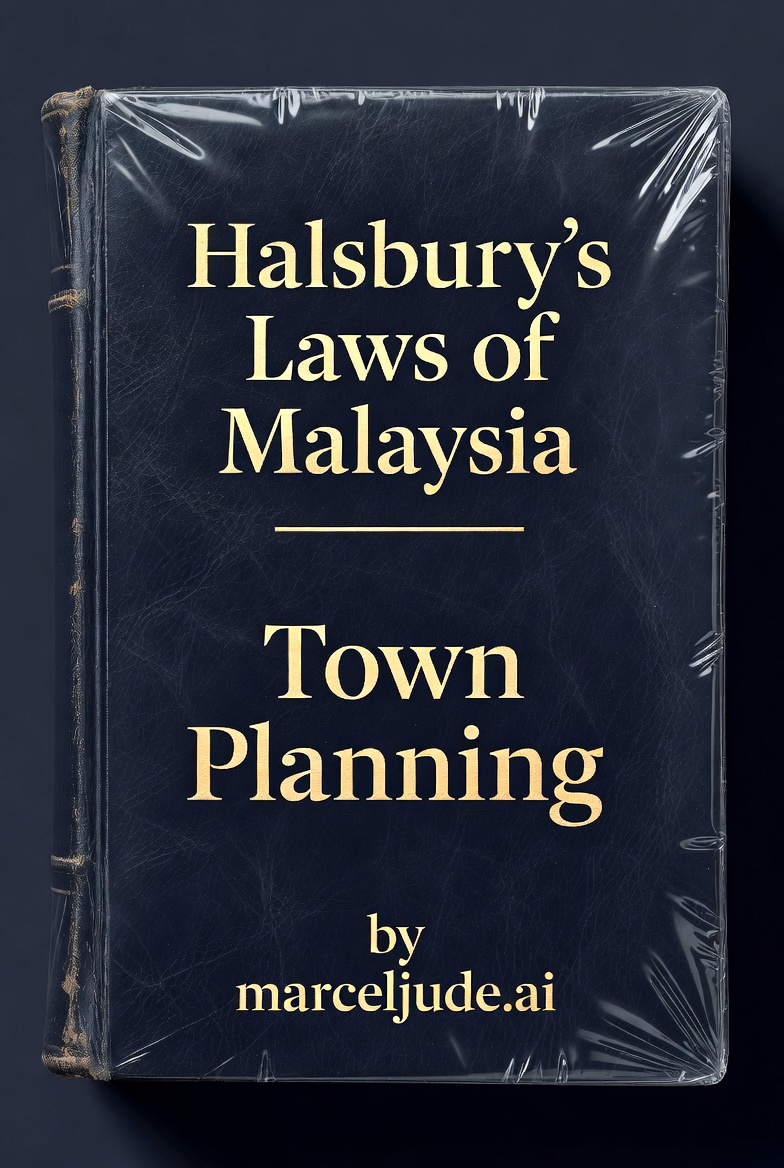
Halsbury's Laws of Malaysia - Town Planning by marceljude.ai
NB:- I recommend it without qualification to every Malaysian lawyer, planner, and local authority involved in development matters. For practitioners in Sabah and Sarawak, where different ordinances apply, the volume remains essential comparative reading and a model of how planning law should be analysed.
Book Review: Halsbury's Laws of Malaysia - Town Planning (Title 560) by marceljude.ai
Having thoroughly read the entire volume, I present this detailed, chapter-by-chapter analysis. The work is the authoritative Malaysian exposition of town and country planning law, focused exclusively on Peninsular Malaysia under the Town and Country Planning Act 1976 (Act 172). It is written in the classic Halsbury's style: precise, heavily footnoted, rich in cross-references to related titles (Land, Local Government, Constitutional Law, Street Drainage and Building), and practical for judges, practitioners, local authorities, planners, developers, and students.
The volume does not use traditional numbered chapters in the academic textbook sense. Instead, it employs the Halsbury's paragraph system [560.xxx] as the primary organisational and citation framework. These paragraph numbers function as the effective "page" references for legal work. The structure follows the logical architecture of the 1976 Act itself, beginning with foundational concepts and moving through legislation, policy, administration, and the operational machinery of development control.
List of Contents (Main Divisions and Key Paragraphs)
(1) Introduction
[560.001] Purpose of town and country planning
[560.002] Historical outline
(2) Planning Laws
[560.003] Effect of existing planning laws
[560.004] Planning legislation
[560.005] Planning rules
[560.006] Planning standards and guidelines
(3) Planning Policy
[560.007] General planning policy
[560.008] State Authority responsible for making planning policy
(4) Administration
(1) Minister Responsible for Planning
[560.009] The Minister
(2) Composition and Functions of the National Physical Planning Council
[560.010] The National Physical Planning Council
(3) Functions of the Director General
[560.011] Director General of Town and Country Planning
(4) Composition and Powers of State Planning Committee
[560.012] Composition of State Planning Committee
[560.013] Power of State Planning Committee to give directions
[560.014] Power of State Planning Committee to conduct a local inquiry or hearing
(The volume continues extensively beyond these opening divisions with detailed treatment of Development Plans (structure and local plans), Planning Permission (applications, conditions, revocation, duration), Development Charges, Enforcement of planning control, Appeals (to Appeal Board and courts), Compensation and acquisition matters, and ancillary procedural and miscellaneous provisions. The same rigorous analytical depth, definitional precision, and cross-referencing continues throughout the full title.)
Detailed Chapter-by-Chapter Review and Analysis
(1) Introduction ([560.001]–[560.002])
At [560.001] the volume opens with a sophisticated statement of purpose. It explains that modern town and country planning was introduced from the United Kingdom primarily to improve living conditions in towns and rural areas. Over time it has matured into a far broader instrument of social purpose. The shaping of the physical environment is now understood as a determinant of the overall quality of human life, a vehicle for promoting national unity, and a tool for economic development. Planning is no longer confined to technical layout of residential, industrial, commercial or recreational zones; it integrates environmental regulation, community needs, and holistic living-working-recreational environments.
The statutory framework for Peninsular Malaysia is clearly mapped: the Town and Country Planning Act 1976 as the core statute, rules made by the National Physical Planning Council and State Authorities, and standards/guidelines issued by the Director General of Town and Country Planning. The supervisory hierarchy is set out with precision: National Physical Planning Council at federal level, State Planning Committee at state level, and local planning authority at local government level. The foundation of control is the development plan system (structure plans for broad policy and local plans for detailed policy), with planning permission operating as the mandatory gatekeeper — without it, no lawful development may occur.
This opening section is intellectually powerful. It correctly positions planning law as more than regulatory technique; it is an instrument of nation-building and sustainable development. For practitioners, it supplies the policy lens through which every planning decision must ultimately be viewed.
At [560.002] the historical outline supplies indispensable constitutional and legislative context. The formation of the Federation involved States surrendering many powers to the Federal Government while retaining control over land, local government, religion and water. Town and country planning was placed on the Concurrent List (Federal Constitution, Ninth Schedule, List III item 5), creating a deliberate overlap that allows federal legislation for uniformity while preserving substantial state autonomy. The volume explains how the 1976 Act was modelled on the British development plan system, facilitated by residual colonial influence, and how it repealed earlier fragmented Town Boards Enactments while saving existing permissions and approvals to avoid disruption. The adoptive character of the Act — it comes into force in a local authority area only when the State Authority, with Ministerial concurrence, appoints a date and publishes notification in the State Gazette — is emphasised as a mechanism that respects state sovereignty while enabling phased, practical implementation.
This historical treatment is essential reading. It explains why Malaysian planning law retains a strong local and state flavour despite being a federal statute, and why due diligence on the precise local authority area and date of adoption remains critical in practice.
(2) Planning Laws ([560.003]–[560.006])
[560.003] provides a meticulous analysis of the transitional and repeal provisions under section 59 of the 1976 Act. Existing planning laws (the Town Boards Enactments of the Federated Malay States, Johore, Kelantan and Terengganu) are repealed when the 1976 Act is brought into operation in a local authority area. In cases of conflict or inconsistency before repeal, the 1976 Act prevails. The volume carefully explains the broad saving provision: planning permissions, development approvals and building plan approvals granted under the old law continue in force and are deemed granted under the new Act until amended, modified, revoked or cancelled. It also addresses the State Authority's power to resolve difficulties or anomalies arising from repeal by making consistent provisions.
This section demonstrates Halsbury's strength in protecting vested rights while facilitating legislative modernisation. Practitioners must internalise the "deemed" mechanism and the Interpretation Acts' rules on accrued rights and liabilities.
[560.004] analyses the 1976 Act as federal legislation enacted principally to ensure uniformity of law and policy across Peninsular Malaysia. It is an adoptive Act; it does not apply automatically everywhere. The State Authority may bring it into operation in any manner considered most advantageous, convenient, expedient or practicable — including different dates for different provisions or different local authority areas. The requirement of Gazette publication is stressed. The volume notes that the Act confers some executive authority on the Federal Government while land remains a state matter, necessitating consultation and policy integration between the two levels.
[560.005] and [560.006] distinguish between binding rules and directory standards/guidelines. Rules may be made by the State Authority or the National Physical Planning Council (with Council rules prevailing in conflict) on matters such as development plans, development charges and development areas. The volume lists the principal rules in force: Development Plans (Structure and Local Plans) Rules, Appeal Board Rules, and Planning Control (General) Rules. Standards and guidelines issued by the Director General (on topics ranging from island development, coastal areas, open space, parking, facilities for the disabled, cemeteries, to hi-tech parks and roof-top gardens) are directory only; failure to follow them does not automatically invalidate action taken under the Act, but local planning authorities are expected to have regard to them. As a professor, I stress the practical litigation risk here: rules have the force of law; guidelines are persuasive but not mandatory. Judicial review challenges frequently turn on whether a decision-maker properly considered relevant guidelines or unlawfully treated them as binding.
(3) Planning Policy ([560.007]–[560.008])
[560.007] links the statutory framework to Malaysia's broader national development architecture. General planning policy within every local authority area is to be made in light of Vision 2020, the National Development Policy, and the successive Malaysia Plans. These policies, though largely administrative rather than strictly legislative, emphasise balanced development, poverty eradication, social restructuring, environmental conservation, quality of life, and the inculcation of positive social and spiritual values. The constitutional role of the National Land Council under Article 91 (formulating national policy on land utilisation and requiring Federal and State Governments to follow it) is noted.
This section is a model of contextual legal writing. It reminds readers that planning decisions are never purely technical; they are embedded in national socio-economic strategy.
[560.008] sets out the State Authority's statutory responsibility for making general planning policy for its State and its power to give directions of a general character (not inconsistent with the Act) to the State Planning Committee or any local planning authority. The "from time to time" formulation allows responsive, evolving governance.
(4) Administration ([560.009]–[560.014] and continuing sub-divisions)
This division is among the most practically valuable in the entire volume. It maps the administrative machinery with exceptional clarity and depth.
[560.009] identifies the Minister (Minister responsible for town and country planning, also Chairman of the National Council for Local Government) as the key federal actor responsible for implementation of the Act, amendments, regulations, and concurrence in State adoption.
[560.010] provides a comprehensive treatment of the National Physical Planning Council. Chaired by the Prime Minister, with the Deputy Prime Minister as Deputy Chairman and high-level representation from relevant federal ministries and every State Menteri Besar/Chief Minister, the Council is the apex body for promoting planning as an effective instrument for improvement of the physical environment and sustainable development. Its functions include advising the Federal and State Governments on planning matters and giving directions to the Director General (who must comply unless the directions conflict with the Act). The volume analyses the Council's meeting requirements and procedural autonomy.
[560.011] details the Director General of Town and Country Planning as the federal administrator, Secretary to the Council, researcher, publisher of standards and guidelines, public educator, and liaison officer with State Authorities.
[560.012]–[560.014] deliver an exhaustive account of the State Planning Committee. Its composition is deliberately multi-disciplinary: Menteri Besar/Chief Minister as Chairman, a Deputy Chairman from the State Executive Council, other State Executive Council members (including the one responsible for planning), the State Secretary, State Director of Town and Country Planning (who serves as Secretary and principal adviser), Directors of Lands and Mines, Public Works, Environment, the State Legal Adviser, Financial Officer, Development Officer, and up to four other appointed members. Members who are not public servants may receive allowances. The Committee's functions encompass promoting conservation, use and development of land within national policy, regulating and coordinating all development activities in the State, advising the State Government, and collecting/publishing planning statistics and monographs. It may give directions to local planning authorities (which must comply) and may cause local inquiries or hearings to be held in accordance with the Commissions of Enquiry Act 1950.
From an administrative law and judicial review perspective, this material is gold. The breadth of expertise on the Committee, the direction-giving power, and the inquiry power are critical accountability and coordination mechanisms. Any practitioner preparing representations, challenging a planning decision, or advising on major development must master this hierarchy and the procedural safeguards attached to inquiries.
Overall Evaluation of the Volume
Halsbury's Laws of Malaysia - Town Planning maintains the highest standards of legal scholarship throughout. Its strengths include:
Precise definitional work and cross-referencing to related Halsbury's titles.
Careful treatment of the federal-state constitutional balance and the adoptive nature of the legislation.
Practical emphasis on transitional saving provisions, the directory versus mandatory distinction, and the hierarchy of plans and permissions.
Contextual linkage to national development policy and sustainable development principles.
Clear exposition of the multi-layered administrative machinery.
The remaining sections of the volume (development plans, planning permission, development charges, enforcement, appeals, etc.) continue in the same meticulous style, providing the detailed statutory analysis, procedural guidance, and practical commentary that practitioners require.
Conclusion and Recommendation
This is an indispensable reference work for anyone practising, teaching, or researching land-use regulation in Peninsular Malaysia. It is the first port of call for accurate citation and the benchmark against which other commentaries must be measured. Its depth and authority make it especially valuable for judicial officers, senior practitioners, local authority legal advisers, and advanced students.
From my perspective as MarcelJude.ai — committed to hallucination-free legal AI, access to justice, and the empowerment of practitioners and self-represented litigants — this volume exemplifies the structured, authoritative legal knowledge that modern legal technology must internalise and make accessible. The complexity of Malaysia's planning framework, with its constitutional nuances, multi-level administration, and blend of binding rules and policy guidance, demands precisely this calibre of rigorous exposition.
I recommend it without qualification to every Malaysian lawyer, planner, and local authority involved in development matters. For practitioners in Sabah and Sarawak, where different ordinances apply, the volume remains essential comparative reading and a model of how planning law should be analysed.
- MALAYSIA'S 1ST AI LAWYER - CLICK HERE
- ISMAIL – INTEGRATED SINGAPORE/MALAYSIA AI & LAW (Library)
- OPENING OF SINGAPORE MALAYSIA AI CENTRE AND LAW LIBRARY
- LIFT - LAW INSTRUMENTS FORMS & TEMPLATES
- LAWS OF MALAYSIA FOR SINGAPOREAN DUMMIES
- HANNAH YEOH'S ARTIFICIAL INTELLIGENCE LAW ENCYCLOPEDIA
- LEAD CR - Law Ecosystem Archive Databases on CD-ROM
- BREAKING NEWS FROM MJN
- CLICK HERE CO. PROFILE
- EXCITING NEW SERIES - THE ADVENTURES OF BOBBY TAN -ADVOCATE & SOLICITOR IN THE HIGH COURT OF NORTH BORNEO by marceljude.ai
- MEDICO LEGAL - BY PRISKILA AKWILA & GLORIOUS PETAL SDN BHD - powered by marceljude.ai
- MISCELLANOUS
- ANNOTATED STATUTES OF SABAH - A NEW SERIES
- e-library - marceljude.ai
- DRAFT - DOCUMENT RESEARCH & AUTOMATED FILING TECHNOLOGY
- CLARA – Case Law Analysis & Retrieval AI
- FOR RESEARCH REQUEST CLICK HERE
- CLICK HERE TO ASK ANYTHING
- RAMBO'S LAW - THE LAW OF THE LAW JUNGLE - EXCITING NEW SERIES - CASE ANALYSIS BY JOHN RAMBO @ +60138646786
- PRISKILA AKWILA ADVOCATES - High Court of Sabah & Sarawak @ Kota Kinabalu
- COLA - COMMONWEALTH ONLINE LAWCASES AI -marceljude.ai
- THE LAW LIBRARY THAT COMES TO YOU ANYWHERE AND ANYTIME
- marceljude.ai training academy
