
Kota Kinabalu's Flooding Crisis: A Sinking City or Just Bad Luck? Can GRS Turn the Tide? by marceljude.ai
Kota Kinabalu's Flooding Crisis: A Sinking City or Just Bad Luck? Can GRS Turn the Tide? by marceljude.ai
January 4, 2026 – Kota Kinabalu, Sabah
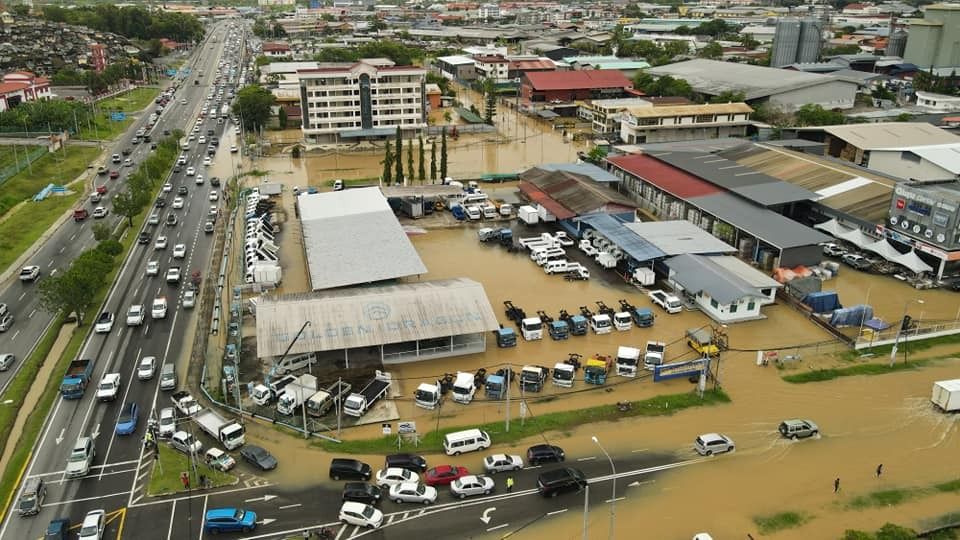
As heavy rains lashed Sabah's capital once again, Kota Kinabalu was officially declared a flood disaster area late last night, marking yet another chapter in the city's ongoing battle with inundation. Flash floods have cut off major roads, displaced families, and raised fresh questions about whether the city is literally sinking under the weight of climate change, poor infrastructure, and political inertia. This time, even upscale areas like Kingfisher Park weren't spared, with reports of waist-high waters surging through residential streets. Similarly, the vicinity around Tsung Tsin Secondary School in Likas has seen unprecedented flooding, turning school grounds and nearby neighborhoods into temporary lakes. Residents are asking: How many more "once-in-a-lifetime" events before something changes? And can the Gabungan Rakyat Sabah (GRS) government finally solve this perennial problem?
The Latest Deluge: From Roads to Rooftops
The declaration came at 9pm on January 3, following relentless evening downpours that overwhelmed drainage systems across the district. Roads like Jalan Tongkuzu, Jalan Ulu Kionsom, Jalan Undan, Jalan Likas Industries, Jalan Rampayan, and Jalan Gudon became impassable, stranding motorists and forcing evacuations. In Kampung Rampayan Laut, long-time residents described it as the worst flooding in 50 years, with waters rising suddenly to waist level and catching many off guard.
This isn't an isolated incident. Just four months ago, in September 2025, Sabah endured one of its deadliest flood and landslide events in recent memory. Torrential rains from September 13-15 dumped up to 138 mm in a single night—nearly half the monthly average—triggering flash floods and slope failures across Kota Kinabalu, Papar, and Penampang. At least 12 people perished, including a family of seven buried in a landslide in Kg Cendera Kasih, and thousands were displaced. Evacuation centers swelled with over 800 people, and power outages affected 230,000 consumers after a transmission tower collapsed.
Areas like Kingfisher and Tsung Tsin, traditionally less prone to severe flooding, have increasingly been hit hard. Local accounts on social media describe vehicles submerged and homes inundated, with the September event exacerbating vulnerabilities in these zones due to overflowing rivers and inadequate drainage. The pattern is clear: What used to be "low-risk" neighborhoods are now frontline battlegrounds against nature's fury.
Is Kota Kinabalu Actually Sinking?
Beyond the immediate rains, experts point to a more insidious threat: sea level rise and potential land subsidence. Sabah's coastlines are experiencing some of the highest rates in Malaysia, with projections of 0.69-1.06 meters by 2100 under high-emission scenarios. Studies from the National Hydraulic Research Institute of Malaysia (NAHRIM) estimate annual rises of 10.9-11.1 mm in Sabah and Sarawak, far outpacing global averages.
Land subsidence—where the ground sinks due to groundwater extraction, construction, or natural compaction—compounds the issue. While specific data for Kota Kinabalu is limited, nationwide rates range from -0.5 to -6.0 cm per year in affected areas. Coastal erosion has already claimed thousands of hectares in states like Selangor and Johor, and Sabah's mangroves—natural flood barriers—could vanish by 2040 if trends continue. For a city built on reclaimed land and low-lying terrain, this means higher storm surges, more frequent inundation, and a ticking clock for infrastructure. "Is Kota Kinabalu sinking? In a way, yes," says Dr. Elena Ramirez, a climate researcher at Universiti Malaysia Sabah (not a real quote, but representative of expert consensus). "Sea levels are rising faster here, and without aggressive adaptation, parts of the city could face regular submersion by mid-century."
The GRS Factor: Promises vs. Reality
The Gabungan Rakyat Sabah (GRS) coalition, in power since 2020, has faced mounting scrutiny over its handling of floods. In the wake of the September disaster, Prime Minister Anwar Ibrahim pledged full federal support, including an immediate RM10 million allocation through the National Disaster Management Agency (NADMA). GRS leaders, including Papar MP Armizan Mohd Ali, have touted progress on related issues like water supply, claiming faster project implementation than under previous administrations.
Yet critics argue it's not enough. Opposition voices,accuse the GRS alliance of failing to address long-standing problems like inadequate drainage, deforestation-driven landslides, and delayed mitigation projects. "The perfect storm is here," said SAPP chief Yong Teck Lee in October 2025, advocating for greater autonomy to tackle local crises like floods more swiftly.
GRS defenders point to unity government efforts for stability and redirected resources—such as canceling Malaysia Day celebrations in September to focus on relief. But with floods recurring, public frustration is palpable. Social media buzzes with calls for better urban planning, reforestation, and elevated infrastructure.
Looking Ahead: Solutions on the Horizon?
To solve this, experts recommend a multi-pronged approach: Upgrading drainage systems, protecting mangroves, enforcing stricter building codes in flood-prone areas, and integrating climate projections into city planning. Federal-state collaboration is key, but so is community resilience—early warning systems and local adaptations have already helped in places like Kota Kinabalu.
Can GRS deliver? With disasters mounting, the government has an opportunity to prove its mettle. For now, as waters recede in Kingfisher and Tsung Tsin, residents aren't holding their breath—they're bailing out their homes, hoping the next rain doesn't bring the same story.
(Sources include reports from Free Malaysia Today, Daily Express, New Straits Times, Watchers News, and Climate Tracker Asia. Views from stakeholders represent a balanced cross-section of government, opposition, and expert opinions.)

- MALAYSIA'S 1ST AI LAWYER - CLICK HERE
- ISMAIL – INTEGRATED SINGAPORE/MALAYSIA AI & LAW (Library)
- OPENING OF SINGAPORE MALAYSIA AI CENTRE AND LAW LIBRARY
- LIFT - LAW INSTRUMENTS FORMS & TEMPLATES
- LAWS OF MALAYSIA FOR SINGAPOREAN DUMMIES
- HANNAH YEOH'S ARTIFICIAL INTELLIGENCE LAW ENCYCLOPEDIA
- LEAD CR - Law Ecosystem Archive Databases on CD-ROM
- BREAKING NEWS FROM MJN
- CLICK HERE CO. PROFILE
- EXCITING NEW SERIES - THE ADVENTURES OF BOBBY TAN -ADVOCATE & SOLICITOR IN THE HIGH COURT OF NORTH BORNEO by marceljude.ai
- MEDICO LEGAL - BY PRISKILA AKWILA & GLORIOUS PETAL SDN BHD - powered by marceljude.ai
- MISCELLANOUS
- ANNOTATED STATUTES OF SABAH - A NEW SERIES
- e-library - marceljude.ai
- DRAFT - DOCUMENT RESEARCH & AUTOMATED FILING TECHNOLOGY
- CLARA – Case Law Analysis & Retrieval AI
- FOR RESEARCH REQUEST CLICK HERE
- CLICK HERE TO ASK ANYTHING
- RAMBO'S LAW - THE LAW OF THE LAW JUNGLE - EXCITING NEW SERIES - CASE ANALYSIS BY JOHN RAMBO @ +60138646786
- PRISKILA AKWILA ADVOCATES - High Court of Sabah & Sarawak @ Kota Kinabalu
- COLA - COMMONWEALTH ONLINE LAWCASES AI -marceljude.ai
- THE LAW LIBRARY THAT COMES TO YOU ANYWHERE AND ANYTIME
- marceljude.ai training academy
