
The Law Reform (Marriage and Divorce) Act 1976 Commentary and Cases by Nuraisyah Chua Abdullah - marceljude.ai 066


 Act 1976 Commentary and Cases by Nuraisyah Chua Abdullah - marceljude.ai 066 "Pin It")
Description
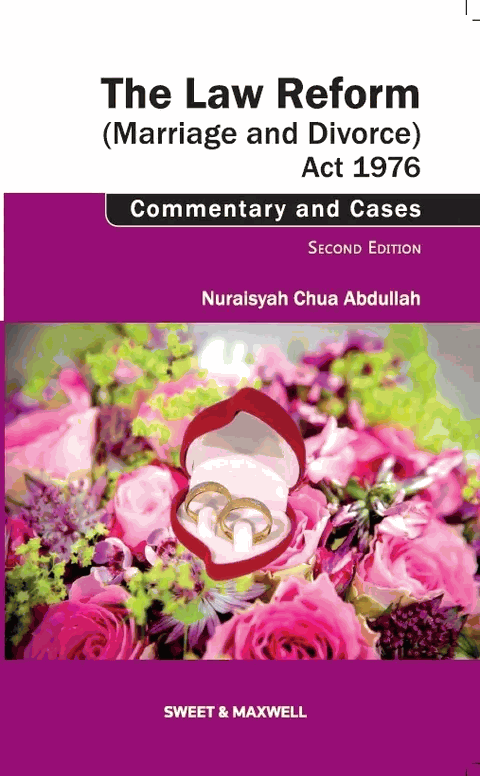
The Law Reform (Marriage and Divorce) Act 1976 Commentary and Cases
Nuraisyah Chua Abdullah
LLB (Hons) (HUM), MCL (HUM), PhD (HUM) Associate Professor Faculty of Law Universiti Teknologi MARA
review by marceljude.ai
This is a law-professor-style review of The Law Reform (Marriage and Divorce) Act 1976: Commentary and Cases, written as an analytical review rather than a bare summary. The book is best understood as a statutory commentary: it moves through the Law Reform (Marriage and Divorce) Act 1976 section by section, explains the legal purpose of each provision, and then tests those provisions against Malaysian and comparative case law.
List of Contents Reviewed
The book’s structure may be read as follows:
Prefatory material and author background
Table of cases, table of statutes, and abbreviations
Introduction
Historical background of the Law Reform (Marriage and Divorce) Act 1976
Application of the Act
Arrangement of statutory sections
Part I: Preliminary provisions
Part II: Monogamous marriages
Part III: Marriage
Part IV: Registration of marriages
Part V: Penalties and miscellaneous provisions relating to solemnisation and registration
Part VI: Divorce
Judicial separation
Nullity of marriage
Part VII: Matters incidental to matrimonial proceedings
Maintenance of spouse
Part VIII: Protection of children
Other reliefs
Part IX: Miscellaneous provisions
Schedule
Appendix on amended provisions
Index
Comparative review material for selected family law concepts
Overall Review of the Book
This book is a serious doctrinal work on Malaysian non-Muslim family law. Its central value lies in the way it treats the Law Reform (Marriage and Divorce) Act 1976 not simply as a statute, but as a living legal framework shaped by judicial interpretation, social pluralism, constitutional limits, religious conversion, custom, domicile, matrimonial property, maintenance, and child welfare.
As a law professor, I would classify this work as a case-rich statutory commentary rather than a theoretical family-law monograph. Its method is practical: it reproduces or paraphrases statutory provisions, then explains how courts have interpreted them. The book is especially useful for law students, practitioners, judges, and researchers who need to understand not merely what the LRA says, but how the Act operates in disputes.
The book’s major intellectual achievement is its insistence that the LRA cannot be read mechanically. Malaysian family law sits at the intersection of civil law, religious identity, customary practice, constitutional structure, and social reality. The author repeatedly shows that apparently simple words such as “wife,” “domicile,” “registration,” “custody,” “maintenance,” and “conversion” become legally complex once real families, real property, and real children are involved.
Its strongest chapters are the discussions on application of the Act, registration and customary marriages, conversion to Islam, domicile, division of matrimonial assets, and custody of children. These are the places where the book does more than explain black-letter law: it exposes uncertainty, judicial tension, and the limits of legislative drafting.
The book’s weakness is also connected to its strength. Because it is arranged as a commentary on statutory provisions, it sometimes reads more like a legal reference work than a flowing scholarly argument. Readers who want a narrative theory of family law may find the structure dense. But for readers who want to understand how Malaysian courts approach the LRA, the density is an advantage.
Introduction and Historical Background
The introductory section performs an important function. It places the LRA within Malaysia’s legal history. Before the LRA, non-Muslim marriage and divorce law was fragmented across race, religion, custom, locality, and inherited colonial laws. The book explains that the Act emerged from reform efforts aimed at producing a more uniform statutory framework for non-Muslim marriages and divorces.
This introduction is not merely historical. It frames the book’s entire legal problem: how does a multiracial, multireligious society create a single civil family-law system without erasing local custom, religious practice, and personal-law differences?
The author’s answer is careful but not simplistic. The LRA is presented as a reform statute, but not a perfect one. The commentary repeatedly shows that the Act attempted to modernise the law while preserving enough flexibility to avoid social shock. That compromise explains why certain provisions are unclear, why customary marriage issues continue to arise, and why the courts have sometimes had to choose between technical statutory compliance and equitable justice.
From a law-professor perspective, the introduction succeeds because it teaches students that statutes do not appear in a vacuum. The LRA was not just legal drafting; it was social engineering, legal consolidation, and political compromise.
Part I: Preliminary
Part I introduces the Act’s foundational concepts: commencement, interpretation, application, and the treatment of earlier valid marriages.
The most important issue in this part is scope. The Act applies broadly to persons in Malaysia and persons domiciled in Malaysia, but it excludes Muslims and persons married under Islamic law, while still preserving certain civil-court powers where one party to a civil marriage later converts to Islam. This is one of the most legally sensitive areas in the entire book.
The author’s treatment of section 3 is especially valuable. She does not treat the Muslim exclusion as a simple jurisdictional wall. Instead, she shows that the civil court may still have to deal with consequences flowing from a civil marriage, especially where one spouse converts after the marriage. This is where the book becomes constitutionally significant. The civil court, the Syariah court, and the non-converting spouse’s rights cannot be understood separately.
The discussion of native customary law and aboriginal custom is also important. The LRA does not automatically displace all forms of native or aboriginal family law. This preserves legal pluralism, but it also creates boundary questions: who is within the LRA, who is outside it, and when does election into the Act occur?
The author’s discussion of pre-LRA marriages is one of the more practically useful parts of the book. The Act preserves valid marriages solemnised before its operation under law, religion, custom, or usage. This matters greatly for inheritance, legitimacy, pension rights, dependency claims, and divorce jurisdiction. The book carefully shows that the courts often had to determine whether a customary union was a true marriage or merely cohabitation, social recognition, or another kind of relationship.
Part I therefore establishes the book’s central theme: family law is status law. Once a person is legally a spouse, widow, child, parent, or dependant, major legal consequences follow.
Part II: Monogamous Marriages
Part II is one of the book’s conceptual anchors. The LRA is built around monogamy. The provisions disable a person from contracting another valid marriage while an existing marriage continues. The book explains the effect of this rule in both domestic and overseas contexts.
The commentary is especially strong in showing that monogamy is not merely a moral declaration. It has legal consequences. A second marriage during the subsistence of the first may be void. It may also attract criminal consequences. It may affect succession rights, maintenance claims, and the legal status of family members.
The book uses case law to show the tension between customary practice and statutory monogamy. Before the LRA, some communities recognised forms of customary marriage that did not fit neatly into modern statutory monogamy. After the LRA, the law’s insistence on monogamous civil marriage becomes stronger.
A key strength of this chapter is that it does not pretend the transition was clean. The author shows that the courts sometimes had to deal with parties who underwent customary ceremonies but failed to register or solemnise the marriage properly. This creates difficult questions: should the court prioritise statutory form, or should it protect vulnerable parties who believed themselves to be married?
As a law professor, I would tell students that Part II is not just about “one spouse only.” It is about the state’s decision to make civil marriage legally exclusive, administratively traceable, and judicially dissoluble only through recognised legal processes.
Part III: Marriage
Part III is a detailed and important chapter because it deals with the formation of marriage. The author divides the discussion into restrictions, preliminaries, and solemnisation.
The chapter covers minimum age, prohibited relationships, consent, notice, publication, declarations, certificates, caveats, licences, civil solemnisation, religious or customary solemnisation, entry in the marriage register, and solemnisation abroad through Malaysian missions.
The discussion on minimum age is legally and socially significant. The book explains that a marriage may be void where either party is below the statutory minimum, subject to specific licensing rules. The author also links this issue to child protection, international norms, and policy concerns. This gives the discussion a human-rights dimension, rather than treating age as a mere technical condition.
The section on prohibited relationships demonstrates how family law protects the structure and integrity of family relationships. The author approaches this carefully by recognising that different traditions may have different rules, while still explaining the statutory restrictions.
The discussion on consent is one of the best parts of this chapter. Consent operates at two levels. First, the parties must freely consent to marriage. Second, persons below the specified age threshold may require parental or court consent. The author explains the function of consent as protective: it prevents immature or coerced marriages while still allowing the court to intervene where refusal of consent is unreasonable.
The section on notice, caveat, and licence is doctrinally technical but practically important. The notice requirement makes marriage public and administratively verifiable. The caveat procedure allows objections where there is a legal impediment. The licence provisions give flexibility for special circumstances.
The discussion on solemnisation is crucial because it shows the Act’s attempt to accommodate civil, religious, and customary forms of marriage while bringing them under a statutory system. The book explains that religious or customary solemnisation is not simply private ritual; it must be connected to the statutory role of a Registrar or Assistant Registrar.
This chapter is useful because it teaches that marriage under the LRA is both personal and public. It is personal because it concerns intimate family life. It is public because the law insists on capacity, consent, registration, and traceability.
Part IV: Registration of Marriages
Part IV may appear administrative, but the book shows that registration is one of the most contested issues in Malaysian family law.
The chapter deals with registration obligations, the appointment and role of Registrars, marriage registers, foreign marriages, unlawful registers, voluntary registration of older marriages, and the legal effect of registration.
The author’s analysis of section 34 is especially important. That provision says that a marriage is not made valid or invalid merely because it has or has not been registered. At first glance, that looks simple. But the case law reveals a major tension: if registration is not always decisive, how far can an unregistered customary marriage be recognised? Conversely, if the Act requires solemnisation and registration, can parties rely on custom alone?
The author handles this tension carefully. She shows that the courts have not always spoken with one voice. Some cases recognised the practical reality of customary unions, especially for dependency claims. Other cases insisted that after the LRA, marriage must comply with the statutory framework. The book’s discussion is valuable because it shows that “registration” is not just paperwork. It can determine inheritance, divorce rights, legitimacy, maintenance, and access to legal remedies.
The treatment of foreign marriages is also useful. Malaysians and persons domiciled in Malaysia may marry abroad, but the Act imposes rules for recognition and registration. The book explains that a foreign marriage cannot simply bypass Malaysian capacity rules where Malaysian domicile or citizenship is involved.
As a professor, I would describe Part IV as the chapter where legal form meets lived reality. It asks whether the law should punish people for defective compliance or protect them where they acted as spouses in good faith.
Part V: Penalties and Miscellaneous Provisions Relating to Solemnisation and Registration
Part V gives the Act enforcement power. Without penalties, the registration and solemnisation system would be weak.
The chapter covers failure to appear before a Registrar, unlawful keeping of registers, interference with marriage, false declarations, false caveats, unauthorised solemnisation, offences by Registrars or parties, destruction or falsification of register books, prosecution requirements, correction of errors, inspection, proof, damaged registers, and missing registers.
The author’s explanation shows that family law is not only about divorce and custody. It is also about administrative integrity. Registers must be accurate because legal status depends on them. A marriage certificate may affect property, succession, legitimacy, immigration, pensions, and court jurisdiction. False entries or unauthorised ceremonies can therefore cause serious legal harm.
The penalties for interference with marriage also reflect a deeper principle: marriage must be based on free will. The law punishes both coercion into marriage and improper prevention of a valid marriage. This gives the chapter a rights-based character.
The discussion of correction, inspection, damaged registers, and missing registers may seem minor, but it is practically important. The author recognises that records are the infrastructure of family law. If records are lost, corrupted, or falsified, rights become uncertain.
Part VI: Divorce
Part VI is the largest and most doctrinally complex part of the book. It is also the heart of the commentary.
The chapter begins with the principles of law to be applied, including the relationship between Malaysian law and English matrimonial principles. The author is alert to the danger of overreliance on English law. She recognises that section 47 permits reference to English principles, but she also shows that Malaysian family law must develop according to Malaysian statutory text and Malaysian social realities.
The discussion of jurisdiction and domicile is especially strong. Divorce jurisdiction under the LRA depends heavily on domicile, registration, and monogamous character. The author explains domicile of origin, domicile of choice, domicile of children, and the historically problematic rule of a wife’s dependent domicile. This is one of the book’s most scholarly sections because it does not merely list cases; it critiques the continuing relevance of older common-law concepts in modern Malaysia.
The chapter’s treatment of additional jurisdiction for wives reveals a gendered remedial structure. The Act gives certain protections to wives where the husband is not domiciled or resident in Malaysia, especially in desertion or residence-based cases. The author presents this as an exception to the strict domicile rule, designed to prevent hardship.
The discussion of the two-year restriction on divorce petitions is balanced. The law seeks to protect the stability of marriage by preventing immediate divorce petitions, but the author also recognises that exceptional hardship may justify early access to divorce. This is a good example of family law balancing institutional policy against individual justice.
The treatment of conversion to Islam is among the most important parts of the entire book. The author explains that where one party to a civil marriage converts, the non-converting spouse may petition for divorce, and the court may make consequential orders. The book’s discussion shows the deep difficulty of fitting civil marriage obligations into a dual legal system. The author’s strength is that she does not reduce the issue to religious identity alone. She focuses on legal obligations arising from the civil marriage: maintenance, property, custody, and the protection of the non-converting spouse and children.
The chapter also explains mutual consent divorce, where both parties agree that the marriage should be dissolved. The book presents this as a more consensual route, but still one supervised by the court. The court must be satisfied that proper provision has been made for spouse and children.
The discussion of irretrievable breakdown is doctrinally important. The Act uses breakdown as the sole ground, but breakdown must be proved through facts such as adultery, behaviour making continued cohabitation unreasonable, desertion, or living apart. The author demonstrates that although modern divorce law speaks in terms of breakdown, fault has not fully disappeared. Fault continues to influence how breakdown is proved and how courts understand responsibility.
The sections on reconciliation, divorce petitions, damages for adultery, hearing, decree nisi, remarriage, and presumption of death provide the procedural architecture of divorce. The book is particularly useful for practitioners because it connects statutory requirements with pleadings, evidence, and court orders.
Overall, Part VI is the book’s centre of gravity. It teaches that divorce law is not a single event. It is a sequence: jurisdiction, petition, proof, reconciliation, decree, ancillary relief, and post-divorce consequences.
Judicial Separation
The book treats judicial separation as a distinct remedy from divorce. This is important because judicial separation does not dissolve the marriage. It relieves parties from the obligation to live together, but the marital bond remains.
The author explains that a person who has obtained judicial separation may later petition for divorce. The earlier decree may assist in proving facts, but the court still requires evidence. This preserves judicial seriousness while avoiding unnecessary repetition.
The section on property after judicial separation is interesting because it shows how separation affects succession and property consequences without ending the marriage. The author notes that the marital relationship remains legally significant, but certain consequences are modified.
As a teaching chapter, this section is useful because students often assume that separation and divorce are simply different degrees of the same thing. The book shows that they are legally distinct remedies with different consequences.
Nullity of Marriage
The nullity section explains when a marriage is void or voidable.
A void marriage is treated as having no legal validity from the beginning. A voidable marriage is valid unless and until annulled. The author explains the grounds for both, including issues of capacity, prohibited relationships, existing marriage, consent, and other statutory defects.
This chapter is doctrinally strong because it shows that nullity is not the same as divorce. Divorce ends a valid marriage. Nullity questions whether the marriage was legally valid at all, or whether it should be annulled because of a defect.
The discussion of legitimacy where a nullity decree is made is especially important. It shows the law’s concern to avoid unfairly harming children because of defects in the parents’ marriage.
From a professor’s perspective, this section teaches a classic family-law distinction: the law must regulate entry into marriage, exit from marriage, and the legal consequences of invalid marriage separately.
Part VII: Matters Incidental to Matrimonial Proceedings
Part VII turns from status to consequences. Once a marriage breaks down, the court must address property and financial support.
The discussion of matrimonial assets under section 76 is one of the strongest parts of the book. The author explains the distinction between assets acquired by joint effort and assets acquired by the sole effort of one party. For jointly acquired assets, the court inclines toward equality, subject to contribution, debts, and children’s needs. For assets acquired by one party, the court recognises indirect contributions such as caring for the home or family, but the acquiring party is generally to receive a greater proportion.
This section is valuable because it recognises unpaid domestic contribution. Family wealth is not created only by salary, title deeds, or direct payments. A spouse who cares for the home or children may make a legally relevant contribution to the welfare of the family.
The author also explains procedural timing: claims for division of matrimonial assets must be made at the proper stage. This is a crucial practical point because failure to claim in time may cause serious prejudice.
The chapter then moves to maintenance of spouse. The author explains the court’s power to order maintenance, the assessment of maintenance, security for maintenance, compounding, duration, cessation upon remarriage, variation, inalienability, and recovery of arrears.
The discussion of maintenance is nuanced. It is not treated as punishment. The author presents maintenance as a needs-and-means exercise, shaped by responsibility for the breakdown of the marriage where relevant. Courts consider earning capacity, standard of living, duration of marriage, sacrifices made during marriage, and the realistic ability of a spouse to become self-sufficient.
The book is especially good at showing that maintenance is not rigid. It can be varied where circumstances change. It can be secured. Arrears may be recovered. Agreements may be varied if justice requires.
Part VII is therefore not just about money. It is about fairness after marital breakdown.
Part VIII: Protection of Children
Part VIII is one of the most humane parts of the book. The author places child welfare at the centre of custody and maintenance.
The chapter begins by defining “child” for the purposes of the Part. It then discusses custody, conditions attached to custody orders, unfitness of a parent, legitimacy, maintenance, security for maintenance, duration, variation, arrears, accepted children, welfare officers, and restraint against removing children from Malaysia.
The key principle is that the welfare of the child is paramount. The author explains that custody includes more than physical possession. It may include legal authority over upbringing, education, religion, and general welfare.
The discussion of children’s wishes is particularly strong. The Act allows the court to consider the wishes of a child who is old enough to express an independent opinion. The author shows that age alone is not decisive. Courts must consider maturity, understanding, and whether the child’s view aligns with long-term welfare.
The chapter also examines the presumption that a young child should be with the mother, while stressing that the presumption is rebuttable. This is important. The law does not make motherhood automatically conclusive. The court must still examine welfare.
The discussion of siblings is also valuable. The court is not required to place all children with the same parent, but it must consider each child independently. This reflects the reality that children in the same family may have different needs.
The maintenance provisions are equally important. A parent has a duty to maintain children whether or not the child is in that parent’s custody. This prevents a parent from using custody arrangements as an excuse to avoid financial responsibility.
The sections on varying custody and maintenance orders show that children’s needs change. Orders made at one time may become unsuitable later. The court therefore retains continuing supervisory power.
This chapter is excellent for students because it shows that child law is not simply an appendage to divorce. The child is not a prize won by one parent. The child is the legal subject whose welfare guides the court.
Other Reliefs
The “Other Reliefs” portion deals mainly with protective orders.
The power to set aside or prevent dispositions intended to defeat maintenance claims is important. A spouse or parent should not be able to move, sell, gift, mortgage, or otherwise dispose of property simply to avoid financial obligations. The book explains that the court may intervene where property dealings are designed to defeat maintenance or property rights.
The injunction against molestation is another important protective mechanism. It shows that matrimonial proceedings may require immediate protection, not merely final divorce orders.
This section is shorter than the divorce and child chapters, but its practical importance is high. Family litigation often involves urgent financial and personal protection issues. The author correctly treats these remedies as part of the court’s broader duty to prevent abuse of legal process and protect vulnerable parties.
Part IX: Miscellaneous
Part IX deals with recognition, conciliation, registers, rules, and repeal.
The sections on recognition of marriages contracted abroad and marriages contracted in foreign missions in Malaysia are important in a mobile world. The author explains that foreign marriages may be recognised if they comply with the law of the place of celebration, the domicile-based capacity rules, and the LRA’s requirements where Malaysian citizenship or domicile is involved.
The discussion of conciliation before divorce is one of the most interesting parts of the book. The Act generally requires matrimonial difficulty to be referred to a conciliatory body before a divorce petition, except in specified cases. The author explains the policy: the law seeks to encourage reconciliation before litigation. But the book also recognises that reconciliation cannot be forced where it is impracticable, unsafe, pointless, or where statutory exceptions apply.
This is a sophisticated treatment. It avoids two extremes. It does not treat divorce as something parties should enter casually, but it also does not romanticise reconciliation where the marriage is genuinely beyond repair or where referral would be unfair.
The sections on the register of divorces and annulments, rule-making powers, and repeal complete the statutory architecture. They show how the Act replaced earlier fragmented laws and created an integrated system for civil marriage and divorce.
Schedule and Appendix
The Schedule identifies the earlier laws displaced or affected by the LRA. This is important because the Act did not merely add a new statute; it reorganised the field.
The Appendix is significant because it allows readers to see amended or new provisions connected to later legislative reform. For legal research, this is useful because family law is not static. Statutory interpretation must account for amendments, transitional provisions, and the difference between law as enacted and law as brought into force.
Critical Assessment of the Book
The book’s main strength is doctrinal completeness. It covers the LRA from beginning to end, but it does so with cases, commentary, comparative references, and statutory cross-references. It is very useful for anyone who needs to understand the Act in litigation or academic study.
Its second strength is practical realism. The author understands that family-law disputes often arise from messy facts: informal ceremonies, failed registration, conversion, desertion, foreign residence, property transfers, children’s wishes, and maintenance disputes. The commentary is strongest when it shows how legal doctrine responds to those facts.
Its third strength is sensitivity to Malaysian legal pluralism. The book recognises that Malaysia’s family-law system cannot be explained by one legal tradition alone. Civil law, Islamic law, customary law, English influence, constitutional jurisdiction, and local social practice all appear in the analysis.
Its fourth strength is the treatment of case law as legal development. The author does not merely cite cases decoratively. Cases are used to show uncertainty, correction, disagreement, and legal evolution.
The main weakness is that the structure can feel heavy. Because the book follows statutory sections, the reader sometimes moves from one issue to another without a broader thematic pause. A student reading it for the first time may need guidance to see the larger themes: status, capacity, registration, jurisdiction, breakdown, financial justice, and child welfare.
Another limitation is that the book’s intense focus on doctrine may leave some broader social questions underdeveloped. For example, the discussions of marriage age, gendered domicile, conversion, and custody invite deeper theoretical treatment. But this is not a fatal flaw, because the book’s purpose is commentary and cases, not pure theory.
Final Evaluation
As a work of Malaysian family-law scholarship, this book is highly valuable. It is detailed, case-driven, and doctrinally careful. It explains the Law Reform (Marriage and Divorce) Act 1976 as a statute that governs more than marriage and divorce: it governs legal status, family identity, property consequences, parental responsibility, court jurisdiction, and the civil-law consequences of personal relationships.
A law student should read it to understand the architecture of the LRA. A practitioner should use it to identify issues, authorities, and procedural traps. A judge or researcher should value it for its careful mapping of statutory provisions against decided cases. A reformer should read it to see where the Act remains uncertain or socially strained.
My overall assessment: this is a strong, authoritative, and practically useful commentary. Its greatest contribution is showing that Malaysian non-Muslim family law is not merely a set of statutory rules, but a contested legal field where formal validity, social reality, religious conversion, gender, property, and child welfare constantly interact.
 marceljude.ai |
- MALAYSIA'S 1ST AI LAWYER - CLICK HERE
- ISMAIL – INTEGRATED SINGAPORE/MALAYSIA AI & LAW (Library)
- OPENING OF SINGAPORE MALAYSIA AI CENTRE AND LAW LIBRARY
- LIFT - LAW INSTRUMENTS FORMS & TEMPLATES
- LAWS OF MALAYSIA FOR SINGAPOREAN DUMMIES
- HANNAH YEOH'S ARTIFICIAL INTELLIGENCE LAW ENCYCLOPEDIA
- LEAD CR - Law Ecosystem Archive Databases on CD-ROM
- BREAKING NEWS FROM MJN
- CLICK HERE CO. PROFILE
- EXCITING NEW SERIES - THE ADVENTURES OF BOBBY TAN -ADVOCATE & SOLICITOR IN THE HIGH COURT OF NORTH BORNEO by marceljude.ai
- MEDICO LEGAL - BY PRISKILA AKWILA & GLORIOUS PETAL SDN BHD - powered by marceljude.ai
- MISCELLANOUS
- ANNOTATED STATUTES OF SABAH - A NEW SERIES
- e-library - marceljude.ai
- DRAFT - DOCUMENT RESEARCH & AUTOMATED FILING TECHNOLOGY
- CLARA – Case Law Analysis & Retrieval AI
- FOR RESEARCH REQUEST CLICK HERE
- CLICK HERE TO ASK ANYTHING
- RAMBO'S LAW - THE LAW OF THE LAW JUNGLE - EXCITING NEW SERIES - CASE ANALYSIS BY JOHN RAMBO @ +60138646786
- PRISKILA AKWILA ADVOCATES - High Court of Sabah & Sarawak @ Kota Kinabalu
- COLA - COMMONWEALTH ONLINE LAWCASES AI -marceljude.ai
- THE LAW LIBRARY THAT COMES TO YOU ANYWHERE AND ANYTIME
- marceljude.ai training academy
