
Occupational Safety and Health Act
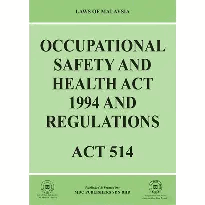


Description
ASM – Occupational Safety and Health Act (Act 514)
Author of this analysis: marceljude.ai
This book is best understood as an annotated statutory companion, not as a conventional narrative work. Its method is simple and effective: it opens with an interpretive introduction, walks through the Act part by part, and then appends the subsidiary instruments that actually make the regime work on the ground. That structure is the book’s greatest strength. It teaches that occupational safety law is not a single duty or a single offence. It is a system made of broad duties, internal workplace governance, reporting obligations, approved codes, inspection powers, sanctions, appeals, and delegated technical regulation. The introduction also makes clear that the Act is built on a self-regulatory philosophy, but one backed by a very real coercive state presence.
As a legal book, it is impressive. Its strongest chapters are those dealing with the general duties of employers, the role of safety and health committees, the evidential force of approved codes, the enforcement notice regime, and the broad regulation-making power. Its weakest feature is not inaccuracy but restraint: it explains the law better than it criticises it. It is excellent at telling the reader what the machinery does, but less willing to ask whether the balance it strikes between managerial control, worker protection, prosecutorial leverage, and administrative discretion is always justified. Even so, it succeeds as a serious doctrinal guide.
Introduction
The introduction is one of the most useful parts of the book because it identifies the Act’s governing idea before the reader gets buried in sections and penalties. The book presents the legislation as a response to workplace injury, occupational illness, compensation claims, and civil disputes, but its sharper point is conceptual: this statute is meant to shift safety law away from a narrow machinery model and toward a more comprehensive system of workplace responsibility. The introduction is also right to emphasize the Act’s self-regulatory philosophy. Employers and employees are expected to build safety into the workplace through policy, committees, and systems of work, rather than waiting for inspectors to appear after harm has already occurred.
Part I — Preliminary
Part I is deceptively important. It looks like a standard opening set of provisions, but it actually fixes the entire legal horizon of the Act. The book shows that the Act applies across a wide range of industries while excluding ships and the armed forces, and that it is both supplementary and paramount: it operates alongside other safety laws, yet prevails where there is conflict or inconsistency. That is a strong drafting choice, because it lets the Act function as the organizing statute of the field without pretending to be the only statute in the field.
The interpretation section is even more significant. The definitions of employee, employer, principal employer, immediate employer, occupier, plant, substance, place of work, and especially “practicable” give the Act much of its reach. The book is particularly good on “practicable,” because it highlights that the Act ties the standard to severity of risk, state of knowledge, suitability of control measures, and cost. That makes the duty standard flexible, but not empty. Part I culminates in the objects clause, and that clause is unusually ambitious: it protects workers, protects others, aims at an occupational environment suited to physiological and psychological needs, and seeks to replace associated legislation progressively with regulations and approved codes. That last objective quietly explains the structure of the whole book.
Part II — Appointment of Officers
This part gives the statute its administrative spine. The Minister appoints the Director General and other officers, and the Director General may also appoint an independent inspecting body or person to advise or assist in carrying out the Act’s objects. The book handles this well because it shows that occupational safety law here is not just internal workplace self-management. It is also a public administration regime with hierarchy, authorization, certificates, delegation, and technical assistance. The law trusts internal responsibility, but it does not rely on trust alone.
Part III — National Council for Occupational Safety and Health
The Council provisions widen the field beyond accidents and prosecutions. The Council is composed of employer, employee, governmental, and professional representatives, and its functions are policy-facing: recommending legislative reform, improving administration and enforcement, fostering consultation between labour and management, addressing special problems affecting particular groups, developing chemical control methods, analysing occupational deaths and injuries, supporting health facilities, encouraging codes of practice, and promoting rehabilitation. The book is strongest here when it shows that the Act is not merely punitive. It is also institution-building. This part gives the statute a policy brain, not just enforcement muscles.
Part IV — General Duties of Employers and Self-Employed Persons
This is the core chapter of the book and the normative center of the Act. The book itself treats this part as the “main thrust” of the legislation, and that judgment is correct. Section 15 imposes the central duty: employers and self-employed persons must ensure, so far as is practicable, the safety, health, and welfare of employees. The listed particulars matter because they turn the general duty into concrete obligations: safe plant and systems of work, safe handling and transport of plant and substances, proper information and training, safe premises and access, and adequate welfare facilities. This is not a narrow anti-accident duty. It is a duty to build a safe work environment as an operating condition of the undertaking.
The book is at its best in its discussion of the phrase “so far as is practicable.” It recognises that this phrase is the hinge on which much of the Act swings. The standard is demanding without being absolute. It requires judgment about seriousness of risk, available knowledge, suitability of precautions, and cost. That makes the Act simultaneously principle-based and fact-sensitive. Section 16 then requires a written safety and health policy, but notably leaves the form and content flexible. That is practical, yet it also means that much depends on employer seriousness. Sections 17 and 18 deepen the law by extending duties beyond employees to persons affected by the undertaking and by placing obligations on occupiers of non-domestic premises. The book is right to emphasize that this destroys any simple idea that occupational safety law only protects contractual employees. It protects persons exposed to workplace risk.
Part V — Duties of Designers, Manufacturers and Suppliers
Part V is one of the most sophisticated parts of the Act because it moves responsibility upstream. The book explains that the law does not wait until the workplace user has already encountered danger. It imposes duties on those who design, manufacture, import, supply, erect, or install plant, and on those who formulate, manufacture, import, or supply substances. These actors must ensure safety when properly used, carry out testing and research, and provide adequate information. The explanatory section sensibly prevents needless duplication of testing where reliance on earlier testing is reasonable, and it limits duties to matters within the person’s undertaking and control. That balance is sensible. It expands responsibility without making it infinite.
The legal importance of this part is large. It means the Act is not only about safe conduct at work; it is also about safe design before work begins. The book captures that point well. It shows that occupational safety is being treated as a lifecycle problem rather than a shop-floor problem alone.
Part VI — General Duties of Employees
This part is shorter, but it matters because it shows that the Act is not written as a one-way charter of employer responsibility. Employees must take reasonable care, cooperate with compliance efforts, use protective equipment, and follow safety instructions. They must not interfere with or misuse safety measures, and employers may not charge employees for safety provisions. The book treats this as a necessary counterpart to employer duties, and that is right.
But the most important provision here is the anti-discrimination rule. The Act protects employees who complain about unsafe conditions, serve on a safety and health committee, or carry out committee functions. The court may award damages or order reinstatement. This is a major feature of the statute, because without protection against retaliation, “self-regulation” would collapse into managerial self-protection. The book is right to treat this as more than a side note. It is one of the Act’s most important safeguards for worker voice.
Part VII — Safety and Health Organisations
Part VII operationalizes the self-regulatory philosophy. It provides for medical surveillance, safety and health officers, and safety and health committees. The book is very good on the logic here: the statute does not merely order workplaces to be safe; it requires them to build internal organs of safety governance. Medical surveillance can be required in risk-heavy settings. Certain workplaces must employ a competent safety and health officer. Committees must be established and consulted so that employer and employees can cooperate in creating and checking safety measures.
The separate committee regulations make this part even stronger. They specify committee composition, employee representation, investigations, complaint systems, meetings, minutes, training, and access to relevant documents and information. That detail is one of the book’s strengths. It shows that the law of committees is not ceremonial. It is procedural, documentary, and enforceable. Committees inspect, investigate, recommend, escalate complaints to the Director General when unresolved, and become regularised sites of consultation. This is one of the book’s most practically useful sections.
Part VIII — Notification of Accidents, Dangerous Occurrences, Occupational Poisoning and Occupational Diseases, and Inquiry
This part is the law’s information-gathering engine. The book correctly treats notification as central rather than incidental. Employers must notify accidents, dangerous occurrences, occupational poisoning, and occupational diseases; medical practitioners and medical officers also have reporting duties in relevant cases; and the Director General may direct inquiries. The legal point is deeper than bureaucracy. A safety regime that cannot see harm cannot learn from harm. This part creates the channel through which workplace events become regulatory knowledge.
The appended notification regulations sharpen the entire regime. Serious cases require immediate notice and then a formal report. Occupational disease and poisoning are reportable. Accident scenes must not be interfered with except for urgent protective reasons. Registers must be maintained, annual extracts sent, and further information supplied on request, including plant design, safety systems, staff qualifications, training, and exposure data. The book is very effective here because it shows that reporting law is also evidence law, prevention law, and organizational memory.
Part IX — Prohibition Against Use of Plant or Substance
This part is brief but very powerful. The Director General may prohibit the use of plant or substances believed likely to affect safety and health, and there is an appeal route for aggrieved persons. The book’s treatment shows that the statute is willing to act pre-emptively. This is not a regime that only punishes completed harm. It can halt dangerous use before injury occurs. That makes this part one of the clearest expressions of the Act’s preventive logic.
Part X — Industry Codes of Practice
This is one of the finest legal chapters in the book because it shows how modern regulation often works. Codes may be approved and revised, and they can consist of standards, rules, specifications, or incorporated documents. But the decisive point is evidential. In proceedings, an approved code is admissible, and failure to follow a relevant provision may allow the matter to be taken as proved unless the court is satisfied that the Act was otherwise complied with. The code is therefore neither mere advice nor exactly the same as a regulation. It is soft in form but hard in evidential consequence. The book explains that beautifully.
Part XI — Enforcement and Investigation
This is the Act at full strength. The book’s review of entry, inspection, examination, seizure, investigation, witness examination, search warrants, and assistance obligations makes clear that enforcement is not an afterthought. It is structurally built into the statute. Officers may inspect workplaces, take samples, make recordings, detain dangerous plant or substances, and seek police assistance when necessary. Search powers extend with or without warrant depending on urgency. The law is designed to prevent evidence loss and to intervene before danger compounds.
The most important devices in this part are the improvement notice and prohibition notice. The book rightly singles them out. An officer can require danger to be removed or defects rectified, and where there is immediate danger, can prohibit use or operation outright. Directions may refer to approved codes, and non-compliance carries serious penalties. The key point is that the regime is preventative before it is punitive. The law would rather stop the unsafe activity than merely prosecute it later. That makes this one of the strongest chapters in the entire book.
Part XII — Liability for Offences
This part reveals the statute’s public-law character. The book explains general penalties, corporate liability, trade union liability, liability of agents, due diligence defence, limits on sanctions against bodies corporate and trade unions, aiding and abetting, and protection against further personal liability in some circumstances. Two provisions deserve special emphasis. First, the Act says that its core duty parts do not themselves create new civil causes of action or civil defences. Second, in prosecutions concerning what was “practicable,” the accused bears the burden of proving that more was not practicable. That reverse burden is one of the regime’s most formidable features. It gives the statute real prosecutorial bite.
Part XIII — Appeals
The appeal machinery is compact and tightly controlled. Appeal committees appointed by the Minister hear appeals in specified cases, may confirm, revoke, or vary decisions and notices, and must communicate their decisions expeditiously. The book’s most important observation here is not procedural detail but finality: the committee’s decision is stated to be final and conclusive and not to be questioned in court. That gives the regime internal decisiveness, though it also narrows the space for prolonged external challenge.
Part XIV — Regulations
Part XIV proves that the Act is a framework statute. The Minister may regulate plant, substances, processes, protective equipment, exposure standards, monitoring, welfare facilities, record-keeping, committee structure, inquiries, appeals, compounding, medical officers, and safety officers. The book is entirely right to emphasize this part, because without delegated regulation the Act would remain too general. With it, the regime can become highly technical, sector-sensitive, and operational. In practical terms, this part is what allows the statute to govern real workplaces rather than remain an abstract declaration of safety values.
Part XV — Miscellaneous
The final section imposes secrecy obligations on persons who acquire information, including manufacturing or commercial secrets, while performing duties under the Act, subject to exceptions for inquiries and court proceedings relating to offences. This is a fitting ending. The statute grants strong investigative access; the book shows that it also builds in a confidentiality obligation to prevent abuse of that access. The legal field closes where many regulatory fields close: with a tension between transparency for enforcement and secrecy for protected information.
The Appendix — The operational law behind the Act
The appendix is not ornamental. It contains the law that gives the Act technical specificity. In many ways, the appendix is where the statute stops speaking in principles and starts speaking in operational rules. That makes it indispensable to understanding the book as a whole.
Employers’ Safety and Health General Policy Statements (Exception) Regulations
This appendix is short, but conceptually important. It narrows the policy-statement obligation by exempting the very smallest undertakings. The legal significance is that the Act’s policy requirement is broad, but not universal in the same way across all enterprise sizes. The appendix therefore marks a threshold judgment about regulatory burden.
Control of Industrial Major Accident Hazards Regulations
This is one of the most serious and sophisticated appendices. It deals with hazardous substances, threshold quantities, major hazard installations, identification and notification of industrial activities, demonstration of safe operation, detailed reporting, and emergency planning. Its most important move is to require manufacturers not only to comply and maintain systems, but to act immediately when imminent danger appears and to prepare adequate on-site emergency plans. The appendix pushes the law from general workplace safety into catastrophe prevention. It is one of the strongest technical chapters in the whole book.
Safety and Health Committee Regulations
This is perhaps the best appendix in the book because it converts the committee idea into a genuine governance mechanism. It regulates representation, nomination and ballot, inspection cycles, accident investigation, complaint resolution, meetings, quorum, minutes, training, and access to documents. It also recognizes a controlled sphere of confidentiality by listing what employers need not disclose. The appendix makes clear that committees are not symbolic worker-engagement devices. They are procedural institutions embedded in daily safety administration.
Classification, Packaging and Labelling of Hazardous Chemicals Regulations
This appendix provides the language of chemical risk. It classifies hazards, imposes packaging standards, requires labels, danger symbols, risk phrases, safety phrases, and Chemical Safety Data Sheets, and creates a structure for disclosure and limited confidentiality. Its legal importance is enormous, because safety depends not only on physical controls but on intelligible communication of hazard. The appendix is effectively the semiotics of chemical regulation: it tells the workplace how danger must be named, packaged, and warned against.
Prohibition of Use of Substance Order
This is a small appendix with sharp force. It moves from risk management to outright prohibition in relation to specified substances or uses. Legally, that matters because it shows the regime has not committed itself to mere managed exposure in every case. Where necessary, it can forbid use altogether or confine it to tightly limited purposes. The Order therefore functions as the hard edge of the preventive system.
Use and Standards of Exposure of Chemicals Hazardous to Health Regulations
This is the most technically developed appendix in the book. It requires registers of hazardous chemicals, written risk assessments, control measures, engineering controls, training, access to data sheets, exposure monitoring, health surveillance, medical removal protection, warning signs, and long retention of records. In effect, it creates a continuous compliance cycle: identify, assess, control, inform, monitor, examine, record, and review. This appendix is where the Act becomes a modern occupational hygiene regime rather than a simple legal duty. It is one of the strongest chapters in the book.
Notification of Accident, Dangerous Occurrence, Occupational Poisoning and Occupational Disease Regulations
This appendix expands Part VIII into a robust reporting code. It defines the reportable events, requires immediate and follow-up reporting in serious cases, covers disease and poisoning reporting, prevents interference with serious accident scenes, imposes record-keeping duties, allows the Director General to demand further information, and provides penalties for breach. It is one of the clearest examples in the book of how delegated legislation turns a broad statutory duty into an operational compliance framework.
Final judgment
This is a very strong legal book. Its greatest achievement is that it presents occupational safety and health law as a complete regulatory system rather than a set of isolated duties. The best parts are the chapters on employer duties, workplace organisations, codes of practice, enforcement, liability, and the chemical and notification appendices. Those are the places where the law is most alive.
My overall verdict is that this is first-rate as a practitioner’s and student’s guide. Its deepest lesson is that workplace safety law here rests on a paradox: it is self-regulatory in design, but coercive in enforcement. Employers must write policies, build systems, appoint officers, consult committees, and manage risks; employees must participate, cooperate, and raise concerns; the state stands behind all of it with inspection, notice, seizure, prosecution, and delegated technical rulemaking. The book captures that architecture very well.
- MALAYSIA'S 1ST AI LAWYER - CLICK HERE
- ISMAIL – INTEGRATED SINGAPORE/MALAYSIA AI & LAW (Library)
- OPENING OF SINGAPORE MALAYSIA AI CENTRE AND LAW LIBRARY
- LIFT - LAW INSTRUMENTS FORMS & TEMPLATES
- LAWS OF MALAYSIA FOR SINGAPOREAN DUMMIES
- HANNAH YEOH'S ARTIFICIAL INTELLIGENCE LAW ENCYCLOPEDIA
- LEAD CR - Law Ecosystem Archive Databases on CD-ROM
- BREAKING NEWS FROM MJN
- CLICK HERE CO. PROFILE
- EXCITING NEW SERIES - THE ADVENTURES OF BOBBY TAN -ADVOCATE & SOLICITOR IN THE HIGH COURT OF NORTH BORNEO by marceljude.ai
- MEDICO LEGAL - BY PRISKILA AKWILA & GLORIOUS PETAL SDN BHD - powered by marceljude.ai
- MISCELLANOUS
- ANNOTATED STATUTES OF SABAH - A NEW SERIES
- e-library - marceljude.ai
- DRAFT - DOCUMENT RESEARCH & AUTOMATED FILING TECHNOLOGY
- CLARA – Case Law Analysis & Retrieval AI
- FOR RESEARCH REQUEST CLICK HERE
- CLICK HERE TO ASK ANYTHING
- RAMBO'S LAW - THE LAW OF THE LAW JUNGLE - EXCITING NEW SERIES - CASE ANALYSIS BY JOHN RAMBO @ +60138646786
- PRISKILA AKWILA ADVOCATES - High Court of Sabah & Sarawak @ Kota Kinabalu
- COLA - COMMONWEALTH ONLINE LAWCASES AI -marceljude.ai
- THE LAW LIBRARY THAT COMES TO YOU ANYWHERE AND ANYTIME
- marceljude.ai training academy
