
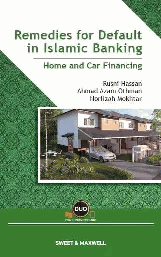
Remedies for Default in Islamic Banking: Home and Car Financing


Description
Book Review: Remedies for Default in Islamic Banking: Home and Car Financing
By Rusni Hassan Ahmad Azam Othman Norlizah Mokhtar
Preface
The rapid development of Islamic banking in Malaysia has given rise to legal disputes between the parties involved. This has indirectly pressured the Islamic banks to seek remedies for breach of contract when a default in payment of the Islamic financing facilities has occurred. Islamic banking does not have its own law on this matter. Therefore, the law of remedies is needed to ensure that a contract is made and enforced in accordance with the agreed terms and the remedy is adequate to compensate the Islamic banks. In facing the conflict between Shariah, civil and common law on remedies in Islamic banking in the Malaysian current legal environment, neither Shariah nor civil law provides the ultimate answer. Thus it follows that the remedies in Islamic banking upon default in payment of instalments are decided by the court.
In dealing with the Islamic banks' remedies in the events of default in payment of the financing facilities, the question of applicability of civil law and common law in Islamic banking is vital. The court generally views that the law applicable in Islamic banking is the same with that is applicable to conventional banking and thus the civil law and common law should be applied so long as it is not against Shariah.
Islamic banking has often been described as the application of Shariah principles in modern finance. Compliance with Shariah principles is the factor that distinguishes Islamic banking transactions from conventional banking transactions. However, remedies in Islamic banking cannot be said to be exclusively an application of Islamic law. Instead it should be seen as a contractual practice that has evolved in the law of banking. The current laws that are being applied in determining remedies are Malaysian law and common law. They are ideal for Islamic banking remedies as long as they are consistent with Shariah. In order to resolve the conflict of the law of remedies between Malaysian law and the principles of Shariah, the suitable approach is by harmonising these two laws.
This book is written on the premise that the law on remedies for both Islamic and conventional banking are the same. The main purpose of remedies in the context of Islamic banking facilities is to express the bank's rights upon default of payment by the customers and for this purpose the law has to provide a range of remedies to enable the bank to obtain either the performance contracted for or some compensation for breach of contract. Realising that purpose, the following effect of inadequ icy of the law of remedies in case of damages, rescission, restitution, specific performance, injunction, rectification and reformation are significant to delve into.
This book starts with the introduction of the concepts of Islamir asset financing and remedies. The overview of Islamic banking and finance is covered in comprehensive explanation on the salient features as i veil as the legal and regulatory framework of Islamic banking asset fina ncing. Three common Islamic banking asset financing facilities such as baf bithaman ajil (BBA), al-ijarah muntahia bi al-tamlik (AIMAT) and musyarakah mutanaqisah (MM) are discussed. These represent different methods of asset financing that include sale, lease and partnership respectively. Following that, Chapter Two sets out the concept of remedies under civil law and common law as practiced in Malaysia. The emphasis is on legal damages, equitable remedies and statutory remedies. It lays down the principles of remedies on damages, rescission, specific performance, restitution, rectification and injunction.
Subsequently, Chapters Three, Four and Five focus on remedies in relation to three common Islamic asset financing facilities namely baf bithaman ajil, al-ijarah thumma al-bai', al-ijarah muntahia bi al-tamlik and musyarakah mutanaqisah. Remedies for the bai bithaman ajil include the compensation (ta'widh and gharamah), damages and remedies in cases of non-existence of subject matter and void contract. Since baf bithaman ajil is a sale-based kind of contract, the discussion on remedies for BBA takes into consideration the application of the Sale of Goods Act 1957. As for the ijarah asset financing, the remedies upon default in payment by the customers include damages that the lessor or the bank may claim, remedies of rescission under section 73 of the Contracts Act 1950, injunction and restitution as well as statutory remedies available under the Hire-Purchase Act 1967. On the other hand, the musyarakah mutanaqisah financing contracts allow parties to claim remedies in the form of certain amount to be paid upon default in various stages of disbursements such as payment during construction period, completed property, penalty levied for late payment of rental. The option of purchasing the bank's portion of the asset share is also another type of remedies of which the bank and the customer may have sought from court in the case of default of payment.
About the Authors
Dr Rusni Hassan graduated with LLB (Hons), LLB (Shariah) (First Class), Master of Comparative Laws (MCL) and PhD in Law from International Islamic University Malaysia ("HUM"). Currently a Professor at the Institute of Islamic Banking and Finance, HUM, she is also a Shariah committee member for a number of financial institutions in Malaysia, such as Hong Leong Islamic Bank, Etiqa Family Takaful and Etiqa General Takaful, EXIM Bank and the Association of Islamic Banking Institutions Malaysia (AIBIM). Internationally, she is a Shariah Committee member for HDFC Bank Maldives and also the advisor to the Women on Boards Maldives. She is a registered Shariah advisor with the Securities Commission Malaysia. She is also active in the Association of Shariah Advisors in Islamic Finance Malaysia (ASAS) and the International Council of Islamic Finance Educators (ICIFE), where she is the secretary and the assistant secretary for both associations respectively.
She has spoken extensively in seminars, workshops, conferences and trainings on various Islamic finance issues, along with authoring many books within the area of Islamic finance. Her past publications include Islamic Banking and Takaful, Islamic Banking under Malaysian Law, Islamic Banking Cases and Commentaries and Corporate Governance of Islamic Financial Institutions. In addition to that, she has been an active contributor to many Islamic finance articles in local and international journals. She has been awarded as a Promising Researcher at HUM in 2012. Her works and contribution to Islamic finance has also been recognised internationally when she was listed in the Top 10 Women in Islamic Finance by CPI Financial in 2013 and has been awarded as the Most Talented Women Professional in Islamic Banking at the Asia Islamic Banking Excellence Awards by CMO Asia in 2014; awarded as the Women of Distinction in 2016 for her contribution in the field of Islamic finance and law; and she was honoured as the Distinguished Woman in Management in 2018 by Venus International Women Awards (VIWA 2018). Recently, she was also listed in The 50 Influential Women 2017 in Business and Finance by ISFIRE, which is an official publication of Islamic Bankers Association based in London; and was awarded the Top 50 Most Influential Women in Islamic Finance 2018 by Cambridge International Financial Advisory.
Dr Ahmad Azam Othman obtained his LLB (Hons), LLB (Shariah) (Hons), MCL degrees from the HUM and PhD from the University of Wales, United Kingdom. Upon completion of his PhD in 2001 he took up an assistant professor position at the HUM. Presently, Dr Ahmad Azam Othman is an Associate Professor at the Department of Islamic Law of Ahmad Ibrahim Kulliyyah of Laws (AIKOL), HUM since November 2015. He co-authored for the books Islamic Banking in Malaysia: Cases and Commentaries (2017) and Islamic Banking and Takaful, 3rd edn (2016).
He has written numerous articles published in both local and international journals and has also presented papers at local and international conferences in the area of Islamic banking and finance, Shariah Governance and Islamic personal bankruptcy. His areas of interests include Islamic Banking, Takaful, Islamic Microfinance, Shariah Governance and Shariah Risk Management.
He was the Director of Harun M Hashim Law Centre of AIKOL of HUM for the period June 2011 to June 2012 and was the Head of Department of Islamic Law of AIKOL for the period June 2006 to May 2008. He has vast experience in teaching for postgraduate as well as undergraduate courses. Besides, he is an external examiner, internal examiner and supervisor to numerous of PhD thesis and masters' dissertation in various areas including Islamic banking, Islamic microfinance, Islamic capital markets, takaful, Shariah governance, waqf, taxation anc land acquisition.
Dr Norlizah Mokhtar holds LLB (Hons) degree from the Uni\ersity Teknologi MARA Malaysia, LLM (Law) in Islamic Banking and Finance from the International Islamic University Malaysia (HUM) anc PhD (Law) from HUM. She is an advocate and solicitor of the High Court of Malaya, being called to the Malaysian Bar in 1992, and curre itly a partner of Nashili & Co. Prior to setting up her legal practice, sr e was a magistrate in Bintulu, Sarawak. Her involvement in Islamic ba nking started as early as 1993. Throughout her 26 years of legal practice, she had prepared abu adant Islamic financing documents under the Shariah principles of baf bit'i
This review is based on the main text and the appendices. The main text states the book’s central premise: remedies for default in Islamic banking are largely worked out through Malaysian civil and common law, but those remedies must remain consistent with Shariah principles. The appendices supply Bank Negara Malaysia Shariah resolutions and standards that give the doctrinal background for many of the book’s conclusions.
Basic Islamic finance terms used in the book
Shariah means Islamic law and principles. In this book, it does not simply mean religious ethics in the abstract; it is treated as a legal and regulatory standard that affects whether a banking product is valid.
Riba means interest or an unlawful excess in a financial transaction. The book treats avoidance of riba as a core dividing line between Islamic and conventional banking.
Gharar means uncertainty. In ordinary legal language, it is a problem of uncertainty in the subject matter, price, delivery, or legal effect of a contract.
Maysir means gambling or chance-based gain. Islamic banking must avoid financing that depends on this kind of speculative gain.
Bai’ means sale. A sale-based financing product is therefore structured as a buying and selling arrangement, not as a loan.
Bai’ bithaman ajil, often shortened to BBA, means a deferred-payment sale. A bank sells an asset to a customer at an agreed price, and the customer pays later, usually by instalments. Ijarah means lease. The customer pays rent for the use of an asset.
Al-ijarah thumma al-bai’, often shortened to AITAB, means “lease followed by sale.” It is commonly discussed in the book in connection with car financing.
Al-ijarah muntahia bi al-tamlik means a lease that ends with ownership passing to the customer, usually through a sale, gift, or promise to transfer ownership.
Musyarakah mutanaqisah, often shortened to MM, means diminishing partnership. The bank and customer jointly own an asset at first; over time, the customer buys the bank’s share until the customer becomes full owner.
Ta’widh means compensation for actual loss caused by late payment.
Gharamah means penalty. The book treats it differently from ta’widh because gharamah is not supposed to become income for the bank.
Ibra’ means rebate or waiver. In the book, it is especially important when a customer settles early or when the bank’s full selling price includes profit that has not yet been earned.
Rahn means pledge or charge, basically collateral given to secure payment.
Takaful means Islamic insurance.
Wa’d means promise. In Islamic finance documents, a promise can become very important because some structures depend on a promise to buy, sell, or transfer an asset later.
Istisna’ means a contract to manufacture, build, or construct something in the future.
Ijarah mawsufah fi al-dhimmah means forward lease: a lease of a future asset or future benefit described by agreed specifications.
List of contents
The book’s contents are organised as follows: Preface, About the Authors, Table of Cases, Table of Statutes, Glossary, Chapter 1 on Islamic banking asset financing, Chapter 2 on remedies under Malaysian law, Chapter 3 on remedies under BBA financing, Chapter 4 on remedies under ijarah financing, Chapter 5 on remedies under musyarakah mutanaqisah financing, eleven appendices, and an index. The contents list identifies the eleven appendices as Shariah resolutions or Shariah standards on ijarah, musyarakah, ibra’, ta’widh and gharamah, rahn, bai’ inah, updated ijarah and rahn resolutions, and standards on ijarah, murabahah, and musyarakah.
The substantive chapter and appendix structure is:
Chapter 1: Islamic Banking Asset Financing: An Overview
Chapter 2: Concept of Remedies Under Malaysian Law
Chapter 3: Remedies Under Bai’ Bithaman Ajil Financing
Chapter 4: Remedies Under Ijarah Financing
Chapter 5: Remedies Under Musyarakah Mutanaqisah Financing
Appendix One: Shariah Resolutions in Islamic Finance: Ijarah
Appendix Two: Shariah Resolutions in Islamic Finance: Musyarakah
Appendix Three: Shariah Resolutions in Islamic Finance: Ibra’
Appendix Four: Shariah Resolutions in Islamic Finance: Ta’widh and Gharamah
Appendix Five: Shariah Resolutions in Islamic Finance: Rahn
Appendix Six: Shariah Resolutions in Islamic Finance: Bai’ Inah
Appendix Seven: Compilation of Shariah Resolutions in Islamic Finance: Ijarah
Appendix Eight: Compilation of Shariah Resolutions in Islamic Finance: Rahn
Appendix Nine: Shariah Standards on Ijarah
Appendix Ten: Shariah Standards on Murabahah
Appendix Eleven: Shariah Standards on Musyarakah
Overall thesis of the book
The book’s thesis is practical rather than merely theoretical. It asks: when a customer defaults in Islamic home or car financing, what can the bank legally do? The authors’ answer is that the court normally decides remedies using Malaysian contract, land, banking, hire-purchase, and remedial law, while checking that the result does not contradict Shariah. That is the book’s central harmonisation project: Islamic banking contracts are not treated as living outside ordinary law, but ordinary law must be shaped so that it does not defeat the Islamic character of the transaction.
As a law professor, I would describe the book as a doctrinal banking-law work with a strong remedies focus. It is not a devotional introduction to Islamic finance. It is also not a consumer-rights manual. Its recurring concern is the bank’s remedial position when default occurs. That choice gives the book coherence, but it also gives it a bank-facing emphasis. The best parts of the book are where the authors show that the legal remedy must follow the legal structure of the product: sale-based finance should not be remedied exactly like lease-based finance, and partnership-based finance should not be treated as if it were merely a disguised loan,
Chapter 1 Review: Islamic Banking Asset Financing: An Overview
Chapter 1 performs the necessary groundwork. It explains what Islamic banking asset financing is, then introduces the legal and Shariah architecture behind the three product families later discussed in the book: BBA, ijarah, and musyarakah mutanaqisah. The chapter explains that Islamic banking financing must be founded on Shariah principles, must avoid riba, gharar, maysir, and prohibited goods or services, must be based on recognised Shariah contracts, must rest on mutual consent, and must be funded from Shariah-compliant sources.
The chapter is valuable because it teaches the reader not to treat “Islamic banking” as a label pasted on ordinary lending. The authors explain that the relationship between bank and customer changes depending on the contract. In a sale-based product, the relationship is seller and buyer. In a lease-based product, it is lessor and lessee. In a partnership product, it is partner and partner. This is not a minor technicality; it determines the remedy. A seller claims a price. A lessor claims rent. A partner claims rights arising out of shared ownership and agreed purchase undertakings.
The chapter’s explanation of riba is essential. For a beginner, the simplest point is this: conventional lending often earns money from time-based interest on money lent. Islamic finance, as presented here, tries to earn profit through a recognised transaction such as sale, lease, or partnership. The chapter also explains gharar, which is uncertainty serious enough to undermine a contract. For example, if the asset does not exist, cannot be delivered, or is inadequately described, that uncertainty may create legal and Shariah problems. The authors connect this to actual litigation, showing that courts have had to decide whether a disputed Islamic financing arrangement is sufficiently certain and valid.
The chapter also explains maysir, or gambling, and prohibited commodities and services. This matters because the legitimacy of Islamic financing is not only about the contract form; it is also about what is being financed. The financing cannot be directed toward prohibited activities or goods. The chapter is therefore not merely about remedies after default; it first asks whether the financing is validly Islamic in the first place.
The chapter’s treatment of recognised Shariah contracts is one of its strengths. It identifies sale-based, lease-based, and partnership-based structures and explains that some products combine several contracts. For instance, musyarakah mutanaqisah may combine partnership, lease, and sale. This helps a non-specialist reader understand why Islamic banking documents can be more complex than a simple loan agreement. The complexity is not accidental; it is part of the attempt to avoid interest-based lending and to locate profit in an asset transaction.
The legal and regulatory framework section anchors the discussion in Malaysian law. The book explains that licensed Islamic banks, authorised conventional banks operating Islamic windows, investment banks, and development financial institutions may all be relevant actors, depending on their authority. It also explains the role of Shariah committees and the need to segregate Islamic funds from conventional funds in certain institutional settings. This is important because Islamic finance is not presented as a private moral promise only; it is a regulated banking activity.
The chapter’s discussion of BBA, ijarah, and musyarakah mutanaqisah is a bridge to the later remedial chapters. BBA is presented as deferred sale. Ijarah is presented as lease or lease ending in ownership. Musyarakah mutanaqisah is presented as diminishing partnership, where the customer gradually acquires the bank’s share until full ownership is reached. The book’s overview of musyarakah mutanaqisah explains the basic stages: customer contributes a down payment, the bank finances the remaining share, the parties enter a partnership, the bank leases its share to the customer, and the customer gradually buys the bank’s share.
As a law professor, I would say Chapter 1 is doctrinally strong because it insists on classification. Classification is everything in remedies. If the court misclassifies a lease as a loan, or a partnership as a debt, the remedy may become conceptually wrong. The chapter’s weakness is that it necessarily compresses very large concepts into a single overview. Terms such as riba, gharar, and mutual consent are introduced with enough detail for the book’s purposes, but a beginner may still need slow guidance. The book provides a glossary, but the legal effect of these terms becomes clearer only in later chapters.
Chapter 2 Review: Concept of Remedies Under Malaysian Law
Chapter 2 is the remedies-law foundation. It explains what a remedy is: the legal method by which a court enforces a right, protects a right, recovers a right, or gives redress for breach. This is the chapter that turns the book from Islamic finance description into litigation analysis. It distinguishes substantive law, remedy law, and procedural law. In plain terms: substantive law tells us whether the bank has a right; remedy law tells us what the court may give for violation of that right; procedural law tells us how the claim is brought. The chapter divides remedies into legal remedies, equitable remedies, statutory remedies, and remedies under security documents. The main legal remedy is damages. Damages are money awarded to compensate loss. The chapter explains ordinary damages principles: the injured party should, so far as money can do it, be placed in the position it would have occupied if the contract had been performed. It also discusses remoteness, mitigation, general damages, special damages, nominal damages, exemplary damages, liquidated damages, and the date for assessing damages.
This chapter’s key importance for Islamic banking is that damages cannot be understood only by reading Islamic finance documents. Courts use ordinary remedial principles. But the book repeatedly shows that ordinary remedial principles must be checked against Shariah concerns, especially the prohibition on riba and the requirement that compensation should not become disguised interest. The text notes that Islamic banking often uses conventional measurement methods for damages, but also recognises the tension caused by Shariah’s concern with actual and direct loss.
The chapter’s discussion of rescission is important. Rescission means undoing or ending a contract in certain circumstances. The chapter distinguishes rescission for breach from rescission from the beginning of the contract. This matters because if a contract is void or voidable, the remedy may involve restitution: returning benefits received. For example, if a party received money or property under a contract later treated as void, the court may require restoration.
The equitable remedies section is well chosen. Specific performance is an order requiring a party to do what was promised. Injunction is an order requiring a party to stop doing something, or sometimes to do something. Restitution prevents unjust enrichment. Reformation and rectification concern correcting or reshaping documents so that they reflect proper legal standards or the parties’ true intention. These remedies are especially relevant to banking disputes because bank documents are often long, technical, and security-heavy.
The statutory remedies section connects Islamic banking to ordinary Malaysian statutes, including contract law, sale of goods law, hire-purchase law, land law, and procedural rules. This is one of the book’s most practical points: Islamic banking disputes do not float outside ordinary statutory law. If the security is land, land law matters. If the financing resembles hire-purchase for a vehicle, hire-purchase legislation may matter. If goods are sold, sale of goods principles may matter.
The discussion of security documents is especially useful. The chapter explains foreclosure, public auction, and private treaty. To a beginner, these are ways a bank may realise collateral. If land is charged to the bank and the customer defaults, the bank may seek sale of the land. If title has not been issued, assignment structures may be used. Private treaty is treated more cautiously because it may reduce the customer’s protection compared with public auction procedures.
As a law professor, I would praise Chapter 2 for doing what many Islamic finance discussions fail to do: it teaches remedial law before applying it. That order is correct. You cannot assess Islamic banking remedies unless you understand damages, rescission, restitution, injunctions, and security enforcement. The chapter’s limitation is that it sometimes states broad remedial principles without fully exploring how deeply those principles may conflict with Shariah-based limits on profit, penalty, and actual loss. That tension becomes more visible in Chapters 3 to 5.
Chapter 3 Review: Remedies Under Bai’ Bithaman Ajil Financing
Chapter 3 is the book’s sale-based financing chapter. Bai’ bithaman ajil, or BBA, is explained as a deferred-payment sale. The customer wants an asset, such as a house or car. The bank’s structure is not framed as lending money at interest. Instead, the bank buys or is treated as buying an asset and sells it to the customer at a selling price payable later. The selling price includes the bank’s profit.
The chapter begins by explaining BBA’s conceptual background and its relationship with bai’ inah, which involves sale and buy-back transactions. It then distinguishes home financing from car financing. This is important because a house normally raises land and charge issues, while a car may raise sale of goods, pledge, and possession issues.
The most difficult issue in Chapter 3 is the selling price. In a BBA contract, the selling price is not just the principal amount advanced. It includes the bank’s profit for the whole financing period. The problem arises when the customer defaults early. Can the bank claim the entire selling price, including profit for years that have not yet passed? The book discusses Malaysian cases that moved back and forth on that question. Some decisions gave effect to the contractual selling price. Other reasoning questioned whether unearned profit should be recoverable. This is where ibra’, or rebate, becomes central.
For a beginner, ibra’ can be understood this way: if the bank’s sale price includes profit for the whole future period, but the transaction ends early, fairness may require a rebate of the part that should not be treated as earned. Chapter 3 shows that the law has wrestled with whether ibra’ is discretionary, implied, mandatory, or formula-based. The discussion is doctrinally important because it reveals the tension between strict contract enforcement and Shariah-sensitive fairness.
The chapter’s discussion of ta’widh is equally important. Ta’widh is compensation for actual loss caused by late payment. In conventional banking, late payment is often addressed by interest. Islamic banking cannot simply do that because interest is treated as riba. Therefore, the book explains ta’widh as a device to address late payment while avoiding riba. The authors also explain that Bank Negara Malaysia mechanisms limit and structure how ta’widh may be charged.
The chapter distinguishes ta’widh from gharamah. Gharamah is a penalty for late payment. Its key feature is that it is not supposed to be income for the bank; it should be channelled to charity or treated in a way that avoids profit from default. This distinction is one of the book’s most important practical contributions. A bank may be compensated for actual loss, but it should not profit from a customer’s default in a way that recreates interest.
The section on exit penalty is also significant. The book treats compensation for early settlement as inconsistent with the Islamic encouragement of settling debt early. That is a strong Shariah-policy point. A customer who pays early should not be punished merely for doing so, although the book recognises that certain costs and ibra’ calculations may still matter.
The discussion of late payment charges on judgment debt connects Islamic finance to court procedure. Once a court gives judgment, the question becomes whether late payment on that judgment can attract charges. The chapter explains that the mechanism must use ta’widh and gharamah principles rather than conventional interest logic. This shows the court’s continuing role in harmonising civil procedure with Islamic finance.
The chapter then considers rescission, specific performance, restitution, reformation, and rectification. These sections are valuable because they move beyond the usual assumption that the bank simply sues for money. Rescission matters where the contract is terminated for serious breach. Specific performance matters where a party seeks performance rather than money. Restitution matters where the subject matter does not exist or the agreement is void. Reformation and rectification matter where documents fail to reflect the correct legal arrangement.
The non-existence of subject matter discussion is especially important for Shariah compliance. If the asset being sold does not exist or cannot be identified properly, the sale may be attacked for uncertainty. This is not just a technical pleading point; it goes to whether the sale-based structure is real. Without a valid subject matter, the product risks being treated as something other than a genuine sale. For home financing, the chapter also examines remedies under security documents: charge and statutory lien. A charge is a security interest over land. A statutory lien is a security device connected with title documents. These remedies matter because even if the bank has a contractual claim, it usually also wants a property-based route to recover the debt.
For car financing, the chapter explains that BBA car financing is not the same as hire-purchase. It is treated as a sale of goods structure, with the car pledged as security. The bank’s remedies include claiming the selling price, ta’widh, security deposit treatment, rescission, restitution in cases such as stolen goods or agreements involving minors, and security enforcement through pledge. The bank may have the right to sell the pledged car or claim proceeds from a third party.
As a law professor, I would say Chapter 3 is the most litigation-heavy and doctrinally contentious chapter. Its strength is that it does not pretend BBA is simple. It shows how BBA’s sale form creates difficult remedial consequences. The bank wants the selling price because the contract says so. The customer may argue that unearned profit should not be recoverable. The court must decide whether formal sale doctrine, contractual certainty, Shariah fairness, and consumer protection can be reconciled. The chapter’s weakness is also its strength: it is deeply bank-remedy focused. The customer’s perspective appears mainly as a defence to the bank’s claim. A fuller law-reform treatment might have asked more directly whether BBA documentation should be redesigned to reduce disputes over unearned profit, ibra’, and default consequences. Still, as a doctrinal account of remedies, Chapter 3 is strong.
Chapter 4 Review: Remedies Under Ijarah Financing
Chapter 4 shifts from sale to lease. Ijarah means the transfer of the use or benefit of an asset in exchange for rent. The key conceptual difference from BBA is that ijarah is not primarily about selling an asset on deferred payment. It is about leasing an asset, sometimes with a later transfer of ownership. The chapter explains ijarah muntahia bi al-tamlik as a lease ending in ownership and AITAB as lease followed by sale. For a beginner, this chapter is best understood through the difference between ownership and use. The lessor owns the asset. The lessee uses it. The customer pays rent. The remedy for default therefore begins with rental obligations, not with a sale price in the BBA sense.
For home financing, Chapter 4 identifies damages such as arrears of lease rental, balance of total lease rental, changes in lease rental, and takaful-related sums. Rental arrears are straightforward: if rent is due and unpaid, the bank may claim it. The balance of total lease rental is more difficult because the court must consider whether the bank is claiming rent that has accrued or trying to accelerate future rent. The distinction matters because the lessor’s remedy should not become a disguised claim for unearned profit. The chapter’s treatment of changes in lease rental is important because ijarah can use fixed or variable rental. The book shows that rental variation must be structured properly. A unilateral, unclear, or open-ended right to increase rent can create Shariah and contractual problems. In lease-based finance, certainty of rent is a major validity issue.
The takaful discussion concerns who bears the cost of Islamic insurance or protection. Because ijarah separates ownership risk from usage risk, the allocation of takaful cost is not just accounting; it reflects the legal nature of the relationship. If the bank is truly the owner, it may bear ownership risks. But if the customer is using the asset and benefits from protection against use-related liabilities, the allocation may differ depending on the structure and agreed terms.
The chapter then considers rescission, injunction, and restitution. Rescission matters where the lease arrangement is terminated. Injunction matters where the bank needs to stop conduct or protect the asset. Restitution matters in situations such as change of circumstances or money paid by mistake. The chapter’s inclusion of restitution is helpful because lease disputes may involve payments made before the customer receives the intended benefit.
The remedies under security documents are among the chapter’s strongest sections. The bank may have the right to re-enter and take possession, let or lease the property, sell and assign, or sue. The book emphasises that these options are not neutral; choosing one remedy may affect other remedies. If the bank terminates the lease and takes possession, the bank may face a duty to mitigate loss and may lose the ability to claim some future losses as if the contract had continued. The book’s standard remedies clause for ijarah home financing identifies rights to possess, lease, receive rents, sell, assign, and sue. For car financing, Chapter 4 discusses AITAB and the Hire-Purchase Act framework. This is highly practical. Car financing is not only a Shariah structure; it is also a consumer asset-financing transaction. The chapter addresses damages, hire-purchase price, late payment charges, other sums payable by the hirer, deposits, return of part of monies paid, rescission, restitution, impossibility, frustration, repossession, and guarantee.
The sections on repossession and al-kafalah are important. Kafalah means guarantee. If a guarantor promises to answer for the customer’s liability, enforcement of that guarantee becomes an additional remedy. Repossession, however, must be handled carefully because consumer protection rules and Shariah principles both matter.
As a law professor, I would call Chapter 4 the book’s cleanest example of contract-specific remedial analysis. The lease structure makes the authors ask the right questions: who owns the asset, who uses it, who bears ownership risk, who bears use risk, when is rent earned, and what happens when the asset is damaged or returned early? The chapter is stronger than a simple banking-law treatment because it respects the internal logic of ijarah.
Its limitation is that the treatment is still heavily document-driven. The book reviews standard clauses and legal consequences, but it could have done more to evaluate fairness in cases where customers may not understand that a lease ending in ownership is still legally a lease before ownership passes. Still, Chapter 4 succeeds in showing that lease-based Islamic finance cannot be remedied like a conventional loan without distorting the transaction.
Chapter 5 Review: Remedies Under Musyarakah Mutanaqisah Financing
Chapter 5 is the most conceptually ambitious chapter. Musyarakah mutanaqisah means diminishing partnership. The bank and customer jointly own the asset, but the customer gradually buys the bank’s share. The customer may also lease the bank’s share and pay rent. Over time, the bank’s share decreases and the customer’s share increases. The book describes this as different from a conventional loan because the bank participates in ownership, at least in form and doctrine.
The chapter first addresses property under construction. This is difficult because the asset may not yet exist in completed form. The book therefore discusses ijarah mawsufah fi al-dhimmah, or forward lease, and istisna’, a construction/manufacturing contract. In simple language, if the house is still being built, the financing structure must explain why the customer is paying before the completed house is available. The book explains that advance rentals may be used and must be accounted for when actual leasing begins. It also raises the question whether the bank is entitled to rental merely because the contract has started, or only when the customer has received usable benefit.
This is a crucial issue. In a lease, rent should correspond to use or benefit. If the customer has not received the benefit because the property is still under construction or not delivered, the bank’s claim to rent becomes legally and Shariah-sensitive. The book’s discussion of different juristic views on when rent is claimable shows the complexity behind what might look like a simple instalment.
The istisna’ discussion is also important because construction finance often needs a contract for something to be built. If a developer fails, delays, or abandons the project, the bank and customer face risks that cannot be solved merely by demanding monthly payments. The chapter’s treatment of construction-stage remedies is therefore one of its best contributions.
For completed property, Chapter 5 discusses damages including outstanding monthly rental payment, balance of total monthly rental payment, increase of monthly rental payment, remaining acquisition payment, takaful, solicitors’ fees, and maintenance. Each item reflects the hybrid nature of musyarakah mutanaqisah. Some claims arise from lease. Some arise from gradual acquisition. Some arise from ownership expenses. Some arise from security enforcement.
The discussion of the balance of total monthly rental payment is especially important. The book notes that where musyarakah mutanaqisah is properly understood as co-ownership under sharikat al-milk, the bank should not simply claim the entire balance of future monthly rental as loss of profit. Its claim should be tied to arrears up to termination and to the contractual structure.
The chapter’s discussion of increases in monthly rental is one of its strongest critical moments. It indicates that a clause allowing the bank to review monthly rental as and when required may be problematic if it is not tied to an agreed variable formula or proper periodic review. In plain terms, the bank cannot simply reserve an unlimited power to increase rent and call it Shariah-compliant. Certainty and prior agreement matter.
The remaining acquisition payment is also central. Because the customer has promised to acquire the bank’s share over time, default may trigger a claim connected to that purchase obligation. But this must be handled carefully because musyarakah is supposed to involve risk sharing. If the bank’s capital and profit are fully guaranteed in all circumstances, the partnership character becomes questionable.
The chapter then examines rescission and restitution, including fraud and illegality. The fraud discussion connects musyarakah mutanaqisah to land title and indefeasibility issues. The illegality discussion connects the financing documents to statutory and regulatory compliance. This is sophisticated banking-law analysis because it recognises that an Islamic finance remedy may fail not because the Arabic term is wrong, but because land law, contract law, or regulatory law prevents enforcement.
The remedies under security documents are especially notable. The book explains legal charge and trust deed structures. It discusses sale by trustee, purchase of the bank’s share, purchase of the customer’s share, and sale by auction. The trust deed discussion is important because it shows an innovative security method but also raises uncertainty. If the property is registered in the bank’s name as trustee, the bank may have direct powers, but the customer may face risks if the structure is not clearly regulated. The sale by auction discussion is doctrinally rich because it reveals the conflict between partnership theory and security enforcement practice. If sale proceeds are less than the outstanding amount, the customer may owe the shortfall. If proceeds exceed the amount outstanding, the surplus may go to the customer. If proceeds match the outstanding amount, set-off occurs. The authors then raise a deeper criticism: this distribution may show that banks are not applying musyarakah mutanaqisah as a full partnership in substance.
As a law professor, I regard Chapter 5 as the book’s most important critical chapter. It exposes the central problem of modern Islamic finance documentation: form and substance must match. If the product is called partnership, the remedies must not eliminate all partnership risk and convert the arrangement into a debt claim in everything but name. The book explicitly recognises drafting problems where documents mix features of sharikat al-milk and sharikat al-aqd. That is a serious doctrinal criticism and one of the book’s strongest scholarly contributions.
The chapter’s weakness is that it is demanding for beginners. Musyarakah mutanaqisah combines ownership, lease, purchase promise, security, and sometimes construction contracts. A non-specialist reader may need to reread this chapter slowly. But the difficulty is caused by the subject matter, not by unnecessary complication. The chapter is doing hard work.
Appendix One Review: Shariah Resolutions in Islamic Finance: Ijarah
Appendix One is not a mere supplement. It is a regulatory and Shariah-law foundation for Chapter 4. It explains ijarah as a lease or hiring arrangement involving the exchange of benefit or use for payment over an agreed period. It then reviews several Shariah Advisory Council resolutions on lease-based products. The appendix begins with AITAB for vehicle financing. It approves lease followed by sale, provided the lease and sale are separate contracts. That separation is vital. If the sale and lease collapse into one inseparable arrangement, the structure may become legally confused. The resolution also addresses appointment of the customer as agent, end-of-term purchase clauses, early redemption, deposit treatment, risk allocation, and refinancing.
The appendix then deals with transfer of rights and liabilities in AITAB. In ordinary language, if the original hirer no longer wants to continue, another person may take over the rights and obligations, provided the transfer is recognised. This supports practical mobility in vehicle financing.
The beneficial ownership discussion is important. It states that the lessor may be treated as owner even if the lessor’s name is not on the registration document. This helps explain how Islamic finance can recognise beneficial ownership separate from registered legal ownership.
The cancellation of ijarah section explains that the lease may be cancelled if the asset no longer functions or loses its benefit, if contract terms are not fulfilled, or if both parties agree. That is doctrinally sound because the subject matter of a lease is the benefit of the asset. If the benefit disappears, the lease basis collapses.
The appendix also addresses ijarah-based negotiable notes, variable rent, ownership-related costs, third-party liability, priority for the lessee to purchase after default, and surplus from sale of a leased asset. These topics show how granular Shariah governance must be. It is not enough to say “lease is permitted”; the law must decide who bears cost, who bears risk, who receives sale surplus, and what happens after default.
The appendix’s treatment of third-party assets in sukuk ijarah is especially instructive. One proposed structure using assets obtained through mudarabah is not allowed because the profit determination does not fit mudarabah principles. Another structure using sale and purchase is allowed because the sale is clearer. This shows that the Shariah analysis is not formalistic in the shallow sense; it asks whether the profit logic fits the contract.
As a law professor, I would say Appendix One is essential because it supplies the Shariah-policy decisions behind the lease remedies. It also shows the practical evolution of Islamic finance: the problems are not abstract; they arise from cars, homes, deposits, insurance, sukuk, default, and refinancing. Appendix Two Review: Shariah Resolutions in Islamic Finance: Musyarakah
Appendix Two supports Chapter 5. It defines musyarakah as partnership where parties contribute capital and share profit according to an agreed ratio, while losses are borne according to capital contribution. This is the foundation of partnership finance.
The appendix approves musyarakah financing products so long as there is no guarantee of capital or profit by one partner for another. That is the central Shariah principle. If a partner’s capital and profit are guaranteed, the arrangement starts to look less like partnership and more like debt.
The appendix then discusses musyarakah mutanaqisah for home financing. It permits combining musyarakah and ijarah in one document, provided the two contracts are separate and clear. This is a practical compromise. Modern finance needs workable documentation, but Shariah requires that the legal relationships not be blurred.
The most important part is the use of wa’d, or promise, to deal with default. The appendix allows a customer’s promise to buy the musyarakah asset to be used as a mechanism against default, but it must be implemented fairly and must not deny the profit-and-loss-sharing element. That is crucial. A promise cannot be used as a weapon to erase the partnership character of the transaction.
As a law professor, I would say Appendix Two provides the normative standard by which Chapter 5’s drafting criticisms should be judged. If the bank’s documents make the customer bear nearly all downside while the bank receives debt-like certainty, the transaction risks contradicting the partnership logic this appendix protects.
Appendix Three Review: Shariah Resolutions in Islamic Finance: Ibra’
Appendix Three is one of the most important appendices for fairness in sale-based finance. Ibra’ is rebate or waiver. In Islamic banking, it matters because a sale-based financing price may include profit calculated over a long period. If payment is made early or the contract ends early, a question arises: should the bank keep the entire profit component?
The appendix explains that Islamic financial institutions may be required to grant ibra’ to customers who settle early in sale-based financing. This avoids uncertainty and disputes about whether the customer has a right to a rebate. It also supports fairness by preventing the bank from keeping profit that no longer corresponds to the financing period.
The appendix also permits two forms of ibra’ in one agreement: early-settlement ibra’ and monthly ibra’ used to align the effective profit rate with market conditions. This is practically important for variable-rate sale-based financing.
The appendix’s treatment of home financing linked to deposit accounts is subtle. It allows a structure linked to a mudarabah deposit account if the cost of the ibra’ benefit is borne by the Islamic financial institution. But it does not allow the same structure linked to a wadiah deposit account because it may resemble a benefit attached to a loan, raising riba concerns.
As a law professor, I would describe Appendix Three as a consumer-fairness appendix, even though it is written in technical Shariah terms. It corrects the harshness that could arise from rigid enforcement of a full sale price. It is also doctrinally important because it shows that Shariah compliance is not only about avoiding interest at the beginning of the contract; it also concerns fair adjustment when the contract ends. Appendix Four Review: Shariah Resolutions in Islamic Finance: Ta’widh and Gharamah
Appendix Four explains how Islamic finance handles late payment without using conventional interest. Ta’widh is compensation for actual loss. Gharamah is penalty for delay without needing proof of actual loss. The appendix explains that conventional finance addresses default through interest, but Islamic finance cannot simply adopt that method because of riba.
The appendix allows late payment charges using ta’widh and gharamah. But it draws a strict line: ta’widh may be recognised as income because it compensates actual loss; gharamah may not be recognised as income and must be channelled to charity. This is one of the clearest examples of harmonisation in the book.
The appendix also rejects compensation charges against customers who make early settlement. The reason is straightforward and principled: Islam encourages early debt settlement. Penalising early settlement would contradict that policy. The appendix recognises that if the bank gave privileges at the start of the financing, the issue can be managed through ibra’ calculation rather than punishment. The appendix further addresses late payment charges on judgment debts. It permits the court to impose late payment charges in Islamic banking and takaful cases, but the charge must be handled through ta’widh and gharamah logic rather than interest.
As a law professor, I would say Appendix Four is indispensable to the book’s remedial theory. It shows how Islamic finance can deter strategic default without turning late payment into a profit centre. That is a delicate balance: too little consequence encourages non-payment; too much consequence recreates riba-like economics.
Appendix Five Review: Shariah Resolutions in Islamic Finance: Rahn
Appendix Five concerns rahn, meaning pledge or collateral. Collateral is central to banking because a bank often wants security if the customer defaults.
The appendix allows one asset to secure more than one facility, subject to conditions such as consent of the first security holder, sufficient value, and no harm to parties. This is commercially practical because one valuable asset may support several obligations.
The appendix then discusses dealing with an asset already under charge. It allows sale or further collateralisation of part of the asset’s value, with proper consent and recognition of shared rights. This connects Islamic finance to ordinary secured transactions.
The appendix also allows the principal amount of a conventional fixed deposit certificate to be used as collateral for Islamic financing, excluding the interest element. It permits Islamic debt securities to be used as collateral. It allows sale of collateral when the customer fails to pay, but any surplus must be returned to the customer. Finally, it states that profits or returns generated by the collateral belong to the collateral owner, not automatically to the security holder.
As a law professor, I would say Appendix Five is practical and commercially mature. It recognises that secured finance cannot function without collateral flexibility. But it also preserves the idea that collateral is security, not a transfer of ownership or a hidden source of bank profit.
Appendix Six Review: Shariah Resolutions in Islamic Finance: Bai’ Inah
Appendix Six addresses bai’ inah, a sale and buy-back structure. It is one of the most controversial structures in Islamic finance because critics may see it as economically similar to lending with interest if the sale and repurchase are too closely linked.
The appendix permits bai’ inah for certain instruments and interbank money market transactions, but imposes conditions. The two sale contracts must be clear and separate. There must not be a condition requiring repurchase inside the sale contract. The contracts must occur in proper sequence. Ownership and possession must transfer in a valid way.
The appendix also distinguishes a “sale and buy-back” arrangement from bai’ inah where the second sale depends on a later decision and is structured as a conditional sale arrangement rather than a predetermined repurchase. Most importantly, it states that inserting a repurchase condition into a bai’ inah contract makes the contract void.
As a law professor, I would say Appendix Six is crucial for understanding why the book is so concerned with documentation. In Islamic finance, drafting is not cosmetic. A single repurchase condition may change the Shariah validity of the transaction. The appendix therefore supports the book’s repeated warning that form, sequence, ownership, and possession matter.
Appendix Seven Review: Compilation of Shariah Resolutions in Islamic Finance: Ijarah
Appendix Seven updates and refines the ijarah discussion. It addresses takaful cost in Islamic hire-purchase, maintenance and takaful costs, combining fixed and floating rental, minimum and maximum limits for variable rental, proof of non-negligence when the asset is damaged, death of a contracting party, and early termination by the lessee.
The takaful discussion is especially important because it refines the earlier position on cost allocation. It recognises that takaful in vehicle financing may protect the lessee from use-related risk, so the lessee may bear that cost.
The appendix also allows parties to negotiate who bears maintenance and takaful costs. This is significant because it shows movement from a rigid owner-pays-all approach toward a more contractual approach, provided the agreement is clear and mutually accepted.
The variable rental sections are highly relevant to modern finance. The appendix permits a combination of fixed and floating rental and requires minimum and maximum limits for variable rental. That reduces excessive uncertainty.
The appendix shifts the evidential burden in damaged-asset cases by allowing the lessee to be required to prove absence of negligence. In everyday terms, if the asset was in the customer’s control and is damaged, the customer may have to show that the damage was not caused by misuse or negligence. The appendix also states that ijarah does not automatically terminate on death of a contracting party and that early termination by the lessee may dissolve the lease, but the lessor may claim compensation according to agreed terms.
As a law professor, I would say Appendix Seven modernises the lease analysis. It shows that Shariah governance is not static. It adapts to practical problems: insurance, maintenance, variable pricing, evidential burden, death, and early termination.
Appendix Eight Review: Compilation of Shariah Resolutions in Islamic Finance: Rahn
Appendix Eight updates the rahn discussion. It addresses auction procedures for pledged goods, mixed collateral, capitalised interest in conventional financial assets, use of collateral by pledgor and pledgee, storage/documentation/liquidation costs, charges in qard-based rahn, third-party collateral, and future assets.
The auction procedure section is important because pledged assets still belong to the pledgor. Sale requires consent, agreed contractual authority, or court process. If there is surplus after sale, it must go back to the owner. If there is a shortfall, the debtor remains liable.
The mixed-asset discussion allows shares or assets with both Shariah-compliant and non-compliant components to be used as collateral under conditions. The value of collateral must be limited appropriately to the compliant or recognised value.
The appendix allows a pledgor to use collateral with the pledgee’s permission, and it allows the pledgee to use collateral only with the owner’s permission. But if the underlying obligation is qard, meaning loan, the pledgee’s use cannot be made a condition because that could become a prohibited benefit from a loan. The appendix also states that direct costs of storage, documentation, and liquidation may be allocated by agreement, and that third-party assets may be used as collateral with permission. It even allows future assets to be collateral, recognising that rahn is a supporting security contract and can tolerate some uncertainty that would not be acceptable in a sale contract.
As a law professor, I would describe Appendix Eight as one of the most commercially useful appendices. It expands the collateral toolkit while preserving the owner’s residual rights and the prohibition on extracting loan-based benefits.
Appendix Nine Review: Shariah Standards on Ijarah
Appendix Nine is a formal standards chapter on ijarah. It defines ijarah, identifies its nature, lists its components, and sets requirements for parties, offer and acceptance, asset and usufruct, rental, use of the leased asset, rights and liabilities, lease period, sub-lease, lease and lease-back, forward ijarah, sale-and-lease structures, ijarah ending in ownership, wa’d, istisna’, assurances, ta’widh and gharamah, dissolution, completion, governance, structuring, risk management, business conduct, and disclosure.
The most important doctrinal rule is that the asset and its benefit must be recognised by Shariah, valuable, identifiable, accessible, deliverable, not debt-based, and non-perishable, with special treatment for forward ijarah. The lessor must own the asset or its usufruct. Rent must be determined and agreed at the start, and if a benchmark or formula is used, minimum and maximum limits apply.
The standards also allocate rights and liabilities: ownership risks belong to the lessor, while usage liabilities belong to the lessee. The lessee may be liable for loss or damage if misconduct, negligence, or breach of terms is shown. Takaful may be used to mitigate risk.
The standards’ treatment of ijarah muntahiyah bi tamlik is especially relevant to the book. Ownership may transfer by sale, conditional gift, or promise to gift. A promise to purchase may be triggered by default or breach. This supports the book’s analysis of remedies in lease-ending-ownership structures.
As a law professor, I would say Appendix Nine gives Chapter 4 its regulatory backbone. It is less narrative than the chapter, but more precise. It tells banks what must be documented, what must be disclosed, and how risk must be managed. For litigation, it supplies the standard against which courts and lawyers can measure whether the ijarah product was properly structured.
Appendix Ten Review: Shariah Standards on Murabahah
Appendix Ten concerns murabahah, a cost-plus sale. In simple terms, the seller discloses the asset’s cost and adds an agreed profit. Murabahah is important because BBA is connected to sale-based financing logic, and murabahah standards help explain what a valid sale-based financing structure should contain. The appendix covers definition, nature, contracting parties, asset, price, murabahah to the purchase orderer, agency, assurances, ibra’, ta’widh and gharamah, dissolution, completion, oversight, documentation, disclosure, and risk management.
The asset and price rules matter greatly. A sale-based product must have a real asset, a valid sale, and a known price. If the bank never properly owns or possesses the asset, or if the price is uncertain, the sale-based structure becomes vulnerable.
The appendix’s treatment of wa’d and wakalah is practical. In many Islamic banking structures, the customer may promise to buy an asset after the bank acquires it, or may act as the bank’s agent to acquire the asset. These tools make modern financing workable but also create risk: the documents must not make the sale fictional.
The ibra’ section connects directly to Chapter 3. Sale-based financing may need a rebate mechanism to deal with early settlement or default. The ta’widh and gharamah section again separates compensation for actual loss from penalty that cannot become bank income.
As a law professor, I would say Appendix Ten is essential for sale-based financing discipline. It prevents murabahah and related sale structures from becoming mere paperwork wrapped around a loan. It insists on asset, price, ownership, promise, agency, rebate, and default rules. That is exactly the discipline Chapter 3 needs.
Appendix Eleven Review: Shariah Standards on Musyarakah
Appendix Eleven is the standards chapter for musyarakah. It covers definition, nature, parties, offer and acceptance, management, capital, profit, loss, guarantee, wa’d, agency, musyarakah mutanaqisah, asset acquisition, profit-generating ventures, dissolution, structuring, risk management, and business conduct. The core rules are clear. Partners contribute capital. Profit is shared according to the agreed profit-sharing ratio. Loss is borne according to capital contribution. A partner should not guarantee another partner’s capital or profit. This is the heart of partnership finance.
The appendix’s musyarakah mutanaqisah provisions are especially important. They distinguish MM for asset acquisition from MM for profit-generating business. For asset acquisition, it may be combined with ijarah, forward lease, sale, istisna’, and wa’d. But gradual acquisition must not become a disguised guarantee of capital. If a partner breaches a promise to acquire shares, remedies may include invoking the promise, sale to a third party, and claiming actual costs. The standards also address dissolution and liquidation.
The operational requirements are particularly important for litigation and compliance. Legal documents must be enforceable, clearly describe terms, state the Shariah principles used, identify lease of the institution’s share where applicable, record gradual acquisition, state default events, state the institution’s rights on default, and specify each party’s responsibility for the asset. The standards also require consistent sequencing where musyarakah is arranged with another Shariah contract.
The risk-management provisions are among the strongest parts of the appendix. In MM, ownership ratios must be recorded and updated. For assets under construction, the institution must assess the developer, identify construction risk triggers, establish replacement procedures where applicable, and monitor progress. The business-conduct rules also require consideration for genuinely distressed defaulting customers and prevent developer failure from automatically triggering a promise against the customer. As a law professor, I would say Appendix Eleven is the corrective lens for Chapter 5. It tells us what musyarakah must remain: a partnership structure with proper capital, profit, loss, documentation, and risk allocation. It also confirms the book’s concern that documentation must not erase the risk-sharing nature of partnership.
Entire Book Review
The book’s great strength is that it treats Islamic finance as law, not slogan. It does not merely say that Islamic banking avoids interest. It asks what legal rights arise when things go wrong. That is the correct question for lawyers, judges, bankers, and students.
The book’s second strength is its remedies-first structure. Many Islamic finance books explain products but do not ask what happens at default. This book does. It asks what a bank can claim, when a bank can terminate, how security is enforced, when a rebate is required, whether penalties are income, and whether future profit can be recovered.
The third strength is its insistence that the remedy must match the contract. In BBA, the main problem is selling price and rebate. In ijarah, the main problem is rent, possession, ownership risk, and use risk. In musyarakah mutanaqisah, the main problem is partnership substance, purchase undertakings, rent on the bank’s share, and security enforcement. This contract-specific approach is the book’s best legal method.
The fourth strength is the integration of court cases, statutes, Shariah concepts, and Bank Negara Malaysia materials. The appendices are particularly useful because they show that the authors’ analysis is not merely personal opinion. It is anchored in regulatory Shariah materials that define how these products should operate.
The book’s main weakness is its bank-facing orientation. That is not hidden; the preface itself frames the book around remedies available to Islamic banks when customers default. But because home and car financing directly affect ordinary consumers, a fuller account of customer protection, bargaining inequality, disclosure, and comprehension would have improved the work.
A second weakness is readability. The book contains many Arabic legal terms, Malaysian statutory references, and case citations. It is excellent for lawyers, bankers, and advanced students, but a beginner will need guidance. The glossary helps, but the reader still has to understand how terms operate inside legal remedies.
A third weakness is that the book sometimes accepts the premise that remedies in Islamic and conventional banking are broadly the same, while the chapters themselves show that the matter is more complicated. BBA, ijarah, and MM produce different remedial consequences because they create different legal relationships. The book knows this, and its best analysis proves it. A sharper theoretical conclusion might have said: ordinary remedial law applies, but it must be re-characterised through the Islamic contract actually used.
The book’s most important contribution is its warning about form and substance. Islamic finance documents must not use Islamic contract names while producing conventional debt consequences in substance. Chapter 5 makes this point most powerfully in relation to musyarakah mutanaqisah. If a transaction is partnership, then risk, profit, loss, ownership, and default remedies must reflect partnership. If they do not, the product becomes vulnerable both legally and ethically.
My final assessment as a law professor: this is a serious, technical, and useful book for understanding default remedies in Malaysian Islamic home and car financing. It is strongest when it analyses the exact remedy that follows from the exact contract. It is most valuable for readers who want to understand how courts, banks, and Shariah governance interact when Islamic financing fails. It is not light reading, but it is an important contribution because it shows that the real test of Islamic finance is not only how the contract begins, but what the law allows when the customer defaults.
 marceljude.ai |
- MALAYSIA'S 1ST AI LAWYER - CLICK HERE
- ISMAIL – INTEGRATED SINGAPORE/MALAYSIA AI & LAW (Library)
- OPENING OF SINGAPORE MALAYSIA AI CENTRE AND LAW LIBRARY
- LIFT - LAW INSTRUMENTS FORMS & TEMPLATES
- LAWS OF MALAYSIA FOR SINGAPOREAN DUMMIES
- HANNAH YEOH'S ARTIFICIAL INTELLIGENCE LAW ENCYCLOPEDIA
- LEAD CR - Law Ecosystem Archive Databases on CD-ROM
- BREAKING NEWS FROM MJN
- CLICK HERE CO. PROFILE
- EXCITING NEW SERIES - THE ADVENTURES OF BOBBY TAN -ADVOCATE & SOLICITOR IN THE HIGH COURT OF NORTH BORNEO by marceljude.ai
- MEDICO LEGAL - BY PRISKILA AKWILA & GLORIOUS PETAL SDN BHD - powered by marceljude.ai
- MISCELLANOUS
- ANNOTATED STATUTES OF SABAH - A NEW SERIES
- e-library - marceljude.ai
- DRAFT - DOCUMENT RESEARCH & AUTOMATED FILING TECHNOLOGY
- CLARA – Case Law Analysis & Retrieval AI
- FOR RESEARCH REQUEST CLICK HERE
- CLICK HERE TO ASK ANYTHING
- RAMBO'S LAW - THE LAW OF THE LAW JUNGLE - EXCITING NEW SERIES - CASE ANALYSIS BY JOHN RAMBO @ +60138646786
- PRISKILA AKWILA ADVOCATES - High Court of Sabah & Sarawak @ Kota Kinabalu
- COLA - COMMONWEALTH ONLINE LAWCASES AI -marceljude.ai
- THE LAW LIBRARY THAT COMES TO YOU ANYWHERE AND ANYTIME
- marceljude.ai training academy
