
A REVIEW OF BOURKE’S CRIMINAL LAW VICTORIA - marceljude.ai
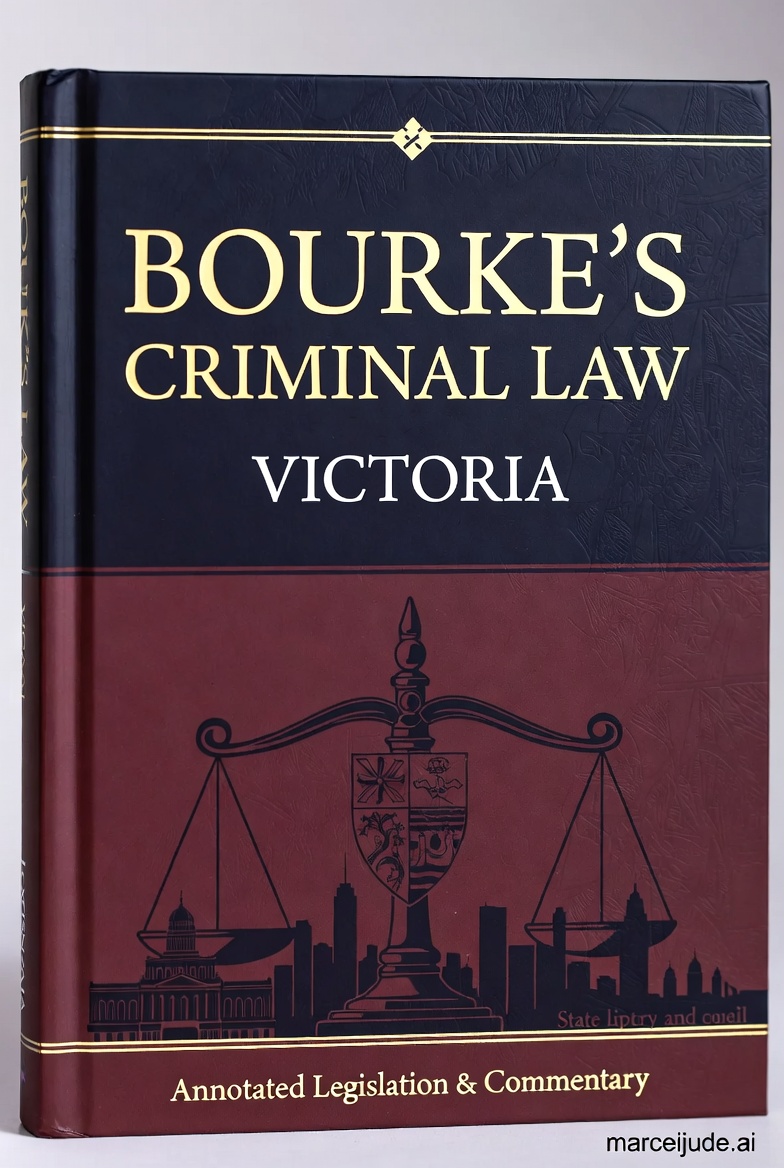
A REVIEW OF BOURKE’S CRIMINAL LAW VICTORIA
Introduction
Bourke’s Criminal Law Victoria is a leading practitioner’s reference work on the criminal law, procedure and evidentiary framework of the Australian State of Victoria. It is not simply a conventional textbook intended to explain criminal-law theory from beginning to end. Its principal function is more practical: it brings together Victoria’s major criminal statutes and connects individual legislative provisions with judicial decisions explaining how those provisions operate.
The publication is especially valuable because criminal practice cannot be understood by consulting the Crimes Act 1958 (Vic) alone. A criminal proceeding may engage rules relating to arrest, investigation, bail, committal, indictment, trial, evidence, mental impairment, sentencing, appeal, confiscation and human rights. These rules are spread across numerous statutes and regulations. Bourke’s attempts to place the legislation necessary for the conduct of a criminal matter within one coordinated research service.
LexisNexis describes the work as comprising principally annotated legislation and covering more than 70 Victorian Acts and Regulations. It is available in online, digital and hardcopy formats and is accompanied by Bourke’s Criminal Law News Victoria. LexisNexis Australia.
Origins of the Work
The title originates from the work of John Peter Bourke, an important writer on Victorian criminal and summary-offence law. The National Library of Australia records J. P. Bourke as the original author and Gerard Nash as the author responsible for the third edition published by Butterworths in 1981. That edition was issued in loose-leaf form under ISBN 0409352039. National Library of Australia.
The loose-leaf format was essential rather than merely stylistic. Criminal legislation is amended frequently, and a bound text can become outdated soon after publication. A loose-leaf service allows replacement pages, supplementary commentary and newly decided cases to be incorporated while preserving the publication’s overall structure.
The earlier third-edition service was discontinued in 1996, but the title continued in a revised publication associated particularly with Gerard Nash. The National Library records the later work as a three-volume loose-leaf service published by Butterworths from 1996 onwards. National Library of Australia.
The modern service therefore represents both continuity and transformation. It retains Bourke’s name and practitioner-oriented tradition while evolving through later authors, legislative amendments and digital publication.
Authors and Contributors
The current publication identifies a group of experienced criminal-law practitioners as authors and editors:
Gerard Nash KC; Felicity Gerry KC; David Grace KC; Paul Holdenson KC; Jack O’Connor; and Andrew Norris.
The presence of several contributors is necessary for a work of this breadth. Modern criminal law extends beyond the traditional definition of offences. It incorporates trial procedure, forensic evidence, human rights, mental impairment, sentencing, regulatory offences and specialised areas such as trafficking and modern slavery.
A multi-author work may occasionally reveal differences in style or depth between its divisions. Nevertheless, it also permits the relevant subjects to be addressed by writers possessing specialist knowledge and practical experience.
Nature and Organisation of the Work
The central feature of Bourke’s Criminal Law Victoria is its annotated-legislation format. The relevant statutory provision is reproduced or identified, followed by explanatory commentary and references to the cases interpreting it.
This differs from the structure of a traditional criminal-law textbook. A textbook ordinarily organises the law by doctrine—such as actus reus, mens rea, attempts, complicity, defences and homicide. Bourke’s is more closely aligned with how a practitioner encounters the law in an actual file: by identifying the governing statutory provision and determining how the courts have interpreted it.
The annotation method allows the reader to move through four connected stages:
identify the applicable statutory provision; determine its constituent requirements; locate the principal judicial interpretations; and understand how the provision has been applied in practice.
This structure is particularly effective in a jurisdiction where offences and procedures have been extensively codified but continue to be shaped by common-law reasoning.
Principal Legislation Covered
The publication deals with the major enactments governing Victorian criminal practice, including the:
Crimes Act 1958; Criminal Procedure Act 2009; Evidence Act 2008; Sentencing Act 1991; Charter of Human Rights and Responsibilities Act 2006; and legislation governing mental impairment and unfitness to stand trial.
Its coverage is not confined to the statutes ordinarily found in an introductory criminal-law course. It also includes specialised material relating to animal offences, sex work, modern slavery and human trafficking. Among the more unusual legislation annotated are the Domestic Animals Act 1994 and the Prevention of Cruelty to Animals Act 1986.
The breadth of the collection is a major strength. It recognises that criminal practice extends beyond serious indictable offences prosecuted under the Crimes Act. A practitioner may encounter summary, regulatory or specialised offences located in legislation that is easily overlooked in a general criminal-law textbook.
Substantive Criminal Law
The substantive-law component assists the reader in identifying the elements of Victorian criminal offences and the authorities governing their interpretation. In criminal litigation, the language of the statutory provision is the starting point. The prosecution must prove each element of the offence, generally beyond reasonable doubt, while the operation of any defence must be considered under the applicable statutory and common-law rules.
The annotations are useful in distinguishing between:
the physical and fault elements of an offence; intention, knowledge and recklessness; principal and secondary participation; completed and inchoate offences; statutory excuses and common-law defences; jurisdictional requirements; and circumstances affecting the classification or seriousness of an offence.
This provision-by-provision treatment is particularly helpful when apparently ordinary words have acquired a specialised judicial meaning. A dictionary definition may not reveal the meaning that appellate courts have attributed to a term within a particular offence. The annotations direct the practitioner to those decisions.
Criminal Procedure
One of the work’s most important features is its extensive treatment of the Criminal Procedure Act 2009 (Vic). Criminal liability cannot be separated from the procedure through which liability is adjudicated. A meritorious argument may be lost if it is raised through the wrong procedure or outside the prescribed time.
Procedural questions may include:
commencement of criminal proceedings; filing and service of charges; summary disposition; committal proceedings; joinder and severance of charges; discontinuance; indictment; pre-trial applications; disclosure; admissibility hearings; jury empanelment; trial management; no-case submissions; verdicts; appeals; and costs.
By annotating the governing provisions, Bourke’s helps the practitioner determine not merely what the court may do but also the conditions under which its powers may be exercised.
This is particularly important in criminal proceedings, where procedural error may affect the fairness of the trial, the admissibility of evidence or the safety of a conviction.
Evidence
The Evidence Act 2008 (Vic) is central to criminal litigation. Its application involves more than identifying whether evidence is relevant. Questions frequently arise concerning hearsay, tendency and coincidence evidence, credibility, identification evidence, admissions, expert opinion, privileges and judicial discretions to exclude evidence.
The practical advantage of annotated evidence legislation is that the reader can examine a statutory provision together with authorities addressing:
its purpose; the conditions for admissibility; the applicable burden of proof; mandatory and discretionary exclusions; procedural notice requirements; limiting directions; and appellate consequences of an erroneous ruling.
Evidence law is especially dependent upon factual context. An annotation cannot replace careful analysis of the facts of the case, but it can identify the controlling principles and leading authorities much more efficiently than an unannotated statute.
Sentencing
Sentencing is not a mechanical exercise performed after conviction. It requires the court to consider statutory purposes, offence seriousness, the offender’s personal circumstances, aggravating and mitigating factors, parity, totality, proportionality, guilty pleas, assistance to authorities and available sentencing orders.
The annotation of the Sentencing Act 1991 (Vic) makes Bourke’s useful to both prosecution and defence counsel. It assists in identifying the matters that must or may be considered, the limits of the sentencing court’s discretion and the appellate principles governing sentencing error.
Its sentencing coverage is valuable in preparing:
written sentencing submissions; plea-in-mitigation outlines; prosecution submissions; parity arguments; applications concerning time already served; submissions on concurrency and cumulation; and sentence appeals.
The work nevertheless should be supplemented by current sentencing statistics and recent comparable cases. Sentencing is intensely fact-sensitive, and an annotated statutory provision cannot by itself establish the appropriate numerical sentence.
The Victorian Charter of Human Rights
The extensive annotation of the Charter of Human Rights and Responsibilities Act 2006 (Vic) distinguishes Bourke’s from criminal-law works confined to offences and procedural rules.
The Charter may affect criminal justice through rights relating to:
liberty and security; humane treatment in detention; privacy; freedom of expression; equality; children in the criminal process; minimum guarantees in criminal proceedings; a fair and public hearing; protection against retrospective criminal liability; and the presumption of innocence.
The importance of the Charter is not limited to an application alleging a direct violation. Charter-consistent interpretation may influence the construction of legislation, the exercise of public powers and the evaluation of procedural fairness.
This aspect of the publication is also valuable to comparative researchers. It demonstrates how a statutory human-rights instrument operates within an established common-law criminal justice system without constituting a constitutionally entrenched bill of rights.
Mental Impairment and Fitness to Stand Trial
The law concerning mental impairment and unfitness to stand trial is among the most difficult parts of criminal practice. It lies at the intersection of criminal responsibility, medical evidence, procedural capacity, public safety and individual liberty.
Bourke’s includes annotations to the Victorian legislation formerly known as the Crimes (Mental Impairment and Unfitness to be Tried) Act, now titled the Mental Health and Wellbeing Act 2022–related framework as amended and reorganised through Victorian legislation. Because the statutory scheme and nomenclature can change, practitioners must ensure that they consult the currently updated service and legislation.
The annotations assist in understanding:
the legal test for fitness; the distinction between fitness and criminal responsibility; procedures for determining unfitness; the mental-impairment defence; special hearings; supervision orders; and review or variation of orders.
This material is valuable because ordinary criminal-law concepts cannot simply be applied without reference to the special statutory scheme.
Practical Strengths 1. A comprehensive working resource
Its greatest strength is consolidation. The reader can begin with the main offence, proceed to trial procedure and evidence, and conclude with sentencing without changing to a wholly different research system.
2. Connection between statutory language and case law
Bare legislation states the rule but rarely explains all its implications. Bourke’s connects legislative provisions to the cases that have interpreted them.
3. Practitioner-oriented treatment
The service is directed to legal problems arising in actual criminal proceedings. It is therefore especially useful when preparing advice, submissions, cross-examination or an appeal.
4. Coverage of specialised legislation
The inclusion of less frequently consulted statutes makes the work more useful than a publication confined to the principal criminal enactments.
5. Regular updating
The continuing-service format is suitable for an area subject to frequent legislative amendment and appellate development.
6. Supporting news service
A subscription includes Bourke’s Criminal Law News Victoria, which provides updates on significant cases and legislative developments. This helps bridge the period between formal updates to the main commentary.
7. Multiple formats
Availability in hardcopy, digital and online formats permits different methods of research. The hardcopy service is useful for sustained reading; the digital service assists rapid searching and cross-referencing.
Limitations 1. It is jurisdiction-specific
The work concerns Victoria. It should not be assumed that its statements apply without qualification in New South Wales, Queensland, Western Australia or another jurisdiction. Australian criminal law is substantially affected by state and territorial legislation.
2. It is not an elementary textbook
A reader entirely new to criminal law may find a provision-by-provision commentary less accessible than a doctrinal textbook. Bourke’s is strongest when the reader already understands the basic concepts and needs precise statutory and case authority.
3. Updating is essential
An outdated loose-leaf set can be dangerous. Criminal legislation changes frequently, and an old annotation may refer to a repealed provision or superseded procedure.
4. An annotation is not a substitute for the judgment
A case summary may identify the relevant proposition, but counsel must read the complete judgment before relying on it in court. The facts, procedural context or qualifications in the reasons may materially restrict the proposition.
5. Research may begin—but should not necessarily end—with the work
The practitioner should still examine the current authorised legislation, the latest appellate authorities, subordinate legislation, applicable practice directions and any relevant sentencing data.
6. Size and cost
A multi-volume subscription service may be expensive and physically substantial. Its value is greatest for regular criminal practitioners, courts, prosecution offices, legal-aid organisations and institutional libraries.
Value to Victorian Criminal Practitioners
For a Victorian criminal practitioner, Bourke’s is best regarded as a first-reference work. When confronted with an unfamiliar statutory problem, counsel can use it to identify the governing provision and principal authorities before undertaking more focused research.
Defence lawyers may use it to analyse the elements of the charge, challenge the admissibility of evidence, identify procedural irregularities and prepare sentencing submissions. Prosecutors may use it to verify offence requirements, disclosure obligations, evidential foundations and available orders. Judges and judicial officers may use it to locate the statutory framework and relevant appellate interpretations.
Its usefulness is greatest where the question is precise:
What must the prosecution prove under this provision? Does this court possess the power sought? What notice must be given? Is the proposed evidence admissible? What factors govern the exercise of discretion? What sentencing options are legally available?
These are the daily questions of criminal practice, and Bourke’s is organised to answer them.
Value to Law Students
For students, the work is valuable but should be used alongside a structured criminal-law textbook. A textbook explains the relationship between doctrines. Bourke’s demonstrates how those doctrines operate through statutory provisions and reported cases.
It can teach students:
how to read legislation closely; how cases alter the apparent meaning of statutory language; how substantive law interacts with evidence and procedure; how to trace the development of a legal proposition; and why the currentness of legal materials matters.
Students preparing a research paper, moot or problem answer may find its annotations particularly useful for identifying relevant cases. They should nevertheless retrieve and read the judgments cited.
Value to Academics
For academics, Bourke’s supplies a detailed map of Victorian criminal legislation and its judicial treatment. It can assist research into statutory interpretation, criminalisation, evidence, sentencing, procedural fairness and human rights.
Its practical orientation also provides a useful counterbalance to purely theoretical scholarship. Criminal-law theory may discuss autonomy, culpability, harm and punishment at a high level. An annotated service shows how these ideas are translated—sometimes imperfectly—into legislative language and daily judicial practice.
Value to Malaysian Lawyers and Researchers
Although Victorian authorities are not binding in Malaysia, Bourke’s Criminal Law Victoria may have comparative value to Malaysian lawyers.
Australia and Malaysia share aspects of the common-law tradition, including adversarial criminal procedure and historically related evidentiary concepts. Australian cases may offer useful reasoning where a Malaysian court is considering a general principle for which the statutory frameworks are sufficiently similar.
The work may be helpful in areas such as:
criminal intention and recklessness; complicity and joint liability; evidential discretion; improperly or unlawfully obtained evidence; expert evidence; procedural fairness; fitness to stand trial; sentencing proportionality; totality and parity; and the relationship between human rights and criminal procedure.
However, Victorian law must not be presented as Malaysian law. The Malaysian Penal Code, Criminal Procedure Code, Evidence Act 1950, Dangerous Drugs Act 1952 and other local legislation may differ fundamentally from the Victorian statutory framework.
The correct comparative method is to:
identify the controlling Malaysian provision; examine binding Malaysian decisions; compare the relevant Victorian provision; determine whether the language and purpose are materially similar; use the Australian authority only for persuasive reasoning; and disclose any important statutory or constitutional difference.
Used in this manner, Bourke’s can widen the researcher’s understanding without displacing Malaysian authority.
Overall Assessment
Bourke’s Criminal Law Victoria succeeds because it is designed around the realities of criminal practice. It recognises that the answer to a criminal-law problem is rarely found in one statute or one judgment. The practitioner must connect the offence with procedural rules, evidence, human rights, mental capacity and sentencing.
Its greatest contribution is therefore integration. It transforms a dispersed body of Victorian legislation and case law into a coordinated research service.
Its limitations arise largely from the same characteristics that make it valuable. It is detailed, specialised and dependent upon continuous updating. It is not a light introductory account of criminal law, nor is it universally applicable across Australia. The reader must understand its jurisdictional limits and verify that the material being used is current.
Conclusion
Bourke’s Criminal Law Victoria is an authoritative and highly practical reference work for Victorian criminal law. Its extensive annotated legislation, coverage of more than 70 Acts and Regulations, treatment of specialist subjects and accompanying current-awareness service make it particularly valuable to practising lawyers, courts and institutional libraries.
For students, it provides a bridge between legal doctrine and statutory practice. For academics, it offers a detailed record of the interaction between legislation and judicial interpretation. For Malaysian and other Commonwealth lawyers, it supplies potentially valuable comparative reasoning, provided that jurisdictional and statutory differences are carefully respected.
The work’s enduring significance lies in its method. It does not treat criminal law as a collection of isolated offences. It presents criminal justice as an interconnected system extending from investigation and charge through trial, evidence, adjudication and sentence. That integrated approach makes Bourke’s Criminal Law Victoria one of the most substantial practitioner resources devoted to the criminal law of Victoria.
- MALAYSIA'S 1ST AI LAWYER - CLICK HERE
- ISMAIL – INTEGRATED SINGAPORE/MALAYSIA AI & LAW (Library)
- OPENING OF SINGAPORE MALAYSIA AI CENTRE AND LAW LIBRARY
- LIFT - LAW INSTRUMENTS FORMS & TEMPLATES
- LAWS OF MALAYSIA FOR SINGAPOREAN DUMMIES
- HANNAH YEOH'S ARTIFICIAL INTELLIGENCE LAW ENCYCLOPEDIA
- LEAD CR - Law Ecosystem Archive Databases on CD-ROM
- BREAKING NEWS FROM MJN
- CLICK HERE CO. PROFILE
- EXCITING NEW SERIES - THE ADVENTURES OF BOBBY TAN -ADVOCATE & SOLICITOR IN THE HIGH COURT OF NORTH BORNEO by marceljude.ai
- MEDICO LEGAL - BY PRISKILA AKWILA & GLORIOUS PETAL SDN BHD - powered by marceljude.ai
- MISCELLANOUS
- ANNOTATED STATUTES OF SABAH - A NEW SERIES
- e-library - marceljude.ai
- DRAFT - DOCUMENT RESEARCH & AUTOMATED FILING TECHNOLOGY
- CLARA – Case Law Analysis & Retrieval AI
- FOR RESEARCH REQUEST CLICK HERE
- CLICK HERE TO ASK ANYTHING
- RAMBO'S LAW - THE LAW OF THE LAW JUNGLE - EXCITING NEW SERIES - CASE ANALYSIS BY JOHN RAMBO @ +60138646786
- PRISKILA AKWILA ADVOCATES - High Court of Sabah & Sarawak @ Kota Kinabalu
- COLA - COMMONWEALTH ONLINE LAWCASES AI -marceljude.ai
- THE LAW LIBRARY THAT COMES TO YOU ANYWHERE AND ANYTIME
- marceljude.ai training academy
