
Sabah Land Law & Native Law AI: A Malaysia Day Launch for a Legal Field Long Underserved
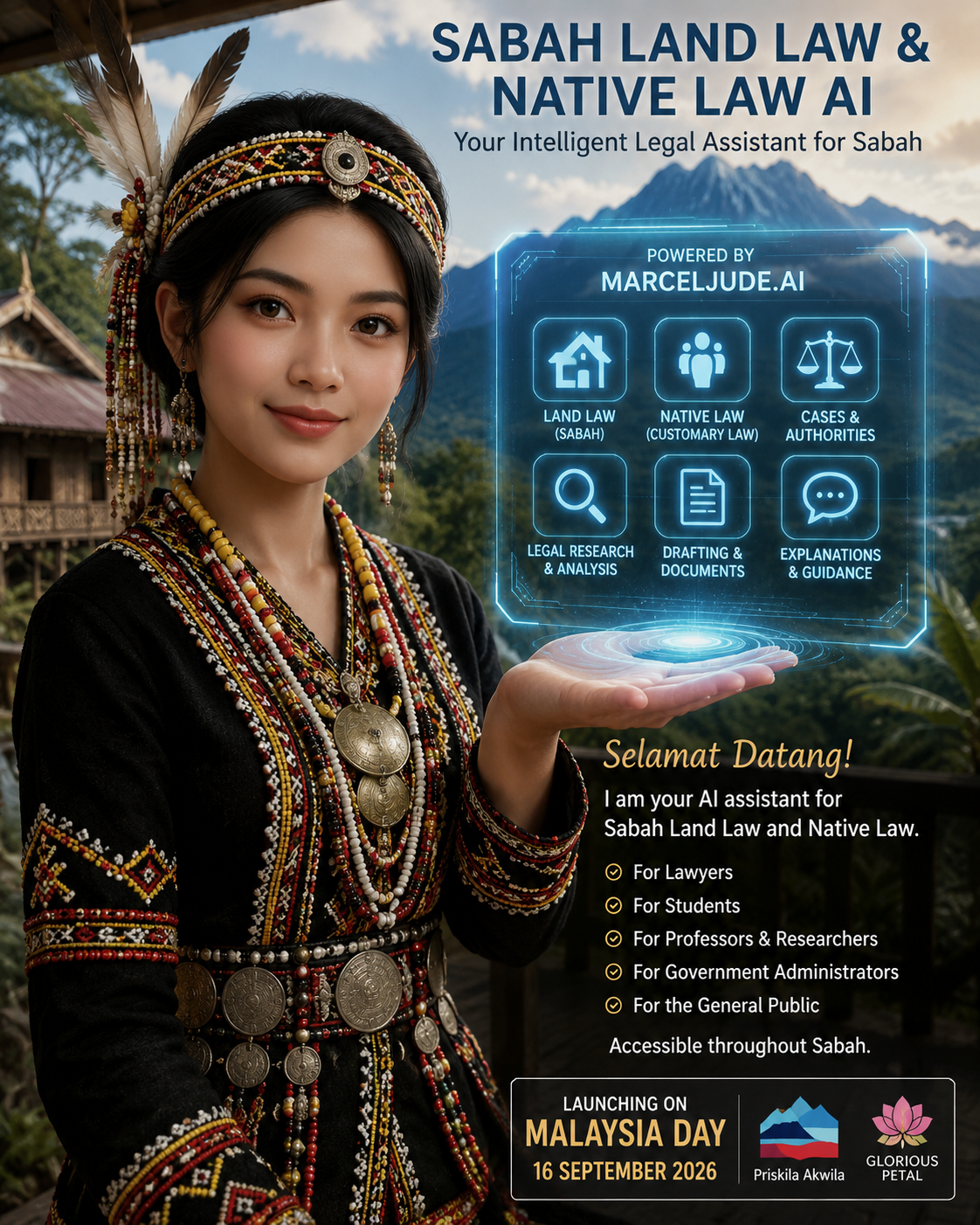


Description
Sabah Land Law & Native Law AI: A Malaysia Day Launch for a Legal Field Long Underserved
On 16 September 2026, in conjunction with Malaysia Day, Priskila Akwila together with Glorious Petal will launch a new legal artificial intelligence platform dedicated to one of Malaysia’s most specialised and under-resourced areas of law: Sabah Land Law and Native Law.
The platform, to be known as Sabah Land Law & Native Law AI, will be powered by marceljude.ai and is intended to serve lawyers, law students, academics, government administrators, native leaders, researchers, and members of the public throughout Sabah.
Its launch date is deeply symbolic. Malaysia Day is observed every year on 16 September to commemorate the formation of Malaysia in 1963, involving Malaya, North Borneo — now Sabah — Sarawak and Singapore, before Singapore’s later separation. Launching a Sabah-focused legal AI on Malaysia Day therefore carries more than technological significance. It is a statement that Sabah’s legal identity, legal history and legal needs deserve tools built specifically for Sabah.
Why Sabah Needs Its Own Legal AI
For decades, Malaysian legal research has been heavily centred on federal legislation, Peninsular Malaysian law, reported superior court cases, and the National Land Code. But Sabah’s land law does not simply follow the National Land Code. The National Land Code is the law governing land administration in Peninsular Malaysia and does not apply in Sabah and Sarawak, which use their own land laws. Sabah’s land system is principally governed by the Sabah Land Ordinance, Cap. 68, an ordinance recognised by Sabah’s own State Attorney-General’s Chambers.
This makes Sabah land law a distinct field. It cannot be fully understood by relying on West Malaysian textbooks or general National Land Code commentaries. Issues involving native titles, native customary rights, land applications, state land, communal title, occupation, alienation, surveys, registration and dealings all require close attention to Sabah’s own statutory framework, administrative practice, native institutions and historical realities.
The need is even more acute in Native Law. Sabah’s native law is administered through a separate native court structure established under the Native Courts Enactment 1992, which provides for the constitution, organisation, procedure, jurisdiction and powers of native courts. The Native Courts and the Native Courts Rules also sit alongside living customary practices, local adat, oral traditions and community-based knowledge. A 2024 study notes that Sabah Native Courts administer native customary law and may deal with matters including breaches of custom, land disputes, inheritance, marital matters and adoption.
Yet the available written materials remain scattered. There are important statutes, rules, cases and some published references, including collections on native court and customary law, but compared with mainstream Malaysian legal subjects, Sabah Native Law remains difficult to research systematically. Much of its working knowledge is held by practitioners, native chiefs, community elders, court officers and experienced administrators rather than being easily accessible in a single, modern legal research system.
What the AI Will Do
The Sabah Land Law & Native Law AI is being developed to do what general legal AI systems can do — legal research, legal explanation, drafting assistance, document review, issue-spotting, case and statute analysis, and legal education support — but with a deliberate focus on Sabah-specific law.
According to the launch concept, it will perform the functions associated with platforms such as ai.lawyer of LEA and marceljude.ai, but will be trained and organised for Sabah’s land and native law environment. Its purpose is not merely to answer general legal questions. Its purpose is to help users navigate the particular legal landscape of Sabah.
For lawyers, it can assist in locating relevant provisions, preparing first drafts, identifying legal issues, structuring arguments and comparing authorities. For students, it can explain difficult legal concepts in plain language. For professors and researchers, it can assist with topic mapping, literature gaps and doctrinal analysis. For government administrators, it can support clearer understanding of land and native law procedures. For the general public, it can make basic legal information more accessible, especially in areas where many people do not know where to begin.
A Tool for Access, Not a Replacement for Judgment
The importance of this project lies not only in speed or automation. It lies in access.
Sabah land disputes and native law questions are often complex because they involve overlapping layers of statute, custom, history, administrative practice, family rights, communal rights and local identity. A general AI trained mainly on broad legal materials may miss the specific legal and cultural context. A Sabah-focused AI can be designed to recognise that Sabah is not Sarawak, and Sabah is not Peninsular Malaysia.
However, the platform should be understood as an assistive tool rather than a substitute for lawyers, judges, native court officers, land administrators or community leaders. In sensitive matters involving native custom, land ownership, inheritance, family disputes, customary fines, native title or state land, human judgment remains essential. The value of the AI is that it can organise information, improve research, reduce confusion and help users ask better questions.
Why Malaysia Day Matters
The decision to launch on Malaysia Day 2026 is powerful. Sabah’s participation in the formation of Malaysia is central to the meaning of 16 September. A legal AI focused on Sabah’s own land law and native law therefore aligns with a broader idea: that Sabah’s laws should be studied, preserved, modernised and made accessible on their own terms.
The project also reflects a wider legal challenge. If legal knowledge remains locked in scattered legislation, rare books, old cases, administrative files and oral expertise, then many people are excluded from understanding the rules that affect their land, family, inheritance and community life. By building a dedicated AI platform, Priskila Akwila and Glorious Petal are attempting to bridge that gap.
A New Chapter for Sabah Legal Knowledge
The launch of Sabah Land Law & Native Law AI could become an important moment in Sabah’s legal development. It recognises that technology should not only serve commercial law, corporate law or heavily reported areas of litigation. It should also serve legal systems that are local, specialised, historically layered and culturally significant.
Sabah Land Law and Native Law have long needed more serious writing, more systematic research, better public access and stronger digital tools. A dedicated AI platform will not solve every problem, but it can begin to change how these areas are learned, researched and understood.
On 16 September 2026, the launch of Sabah Land Law & Native Law AI will therefore be more than the introduction of a new technology product. It will be an effort to place Sabah’s own law where it belongs: at the centre of legal innovation, legal education and public access to justice in Sabah.
- MALAYSIA'S 1ST AI LAWYER - CLICK HERE
- ISMAIL – INTEGRATED SINGAPORE/MALAYSIA AI & LAW (Library)
- OPENING OF SINGAPORE MALAYSIA AI CENTRE AND LAW LIBRARY
- LIFT - LAW INSTRUMENTS FORMS & TEMPLATES
- LAWS OF MALAYSIA FOR SINGAPOREAN DUMMIES
- HANNAH YEOH'S ARTIFICIAL INTELLIGENCE LAW ENCYCLOPEDIA
- LEAD CR - Law Ecosystem Archive Databases on CD-ROM
- BREAKING NEWS FROM MJN
- CLICK HERE CO. PROFILE
- EXCITING NEW SERIES - THE ADVENTURES OF BOBBY TAN -ADVOCATE & SOLICITOR IN THE HIGH COURT OF NORTH BORNEO by marceljude.ai
- MEDICO LEGAL - BY PRISKILA AKWILA & GLORIOUS PETAL SDN BHD - powered by marceljude.ai
- MISCELLANOUS
- ANNOTATED STATUTES OF SABAH - A NEW SERIES
- e-library - marceljude.ai
- DRAFT - DOCUMENT RESEARCH & AUTOMATED FILING TECHNOLOGY
- CLARA – Case Law Analysis & Retrieval AI
- FOR RESEARCH REQUEST CLICK HERE
- CLICK HERE TO ASK ANYTHING
- RAMBO'S LAW - THE LAW OF THE LAW JUNGLE - EXCITING NEW SERIES - CASE ANALYSIS BY JOHN RAMBO @ +60138646786
- PRISKILA AKWILA ADVOCATES - High Court of Sabah & Sarawak @ Kota Kinabalu
- COLA - COMMONWEALTH ONLINE LAWCASES AI -marceljude.ai
- THE LAW LIBRARY THAT COMES TO YOU ANYWHERE AND ANYTIME
- marceljude.ai training academy
