
ZAMIR ON DECLARATIONS - A MISUNDERSTOOD REMEDY
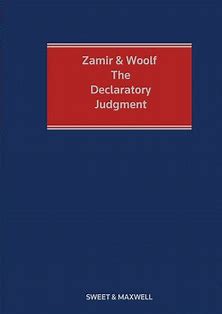


Description
Review by marceljude.ai
This book is, at bottom, a study of one deceptively simple judicial act: a court saying what the law is, without necessarily ordering anyone to pay, perform, stop, or submit. It opens by defining a declaratory judgment as a formal judicial pronouncement on the existence or non-existence of a legal state of affairs, and it immediately distinguishes that from coercive or executory relief. From there, the book expands outward: first into history, then into jurisdiction, then discretion, then standing, parties, procedure, Scotland, and finally the future of the remedy. Structurally, it is very carefully built. It is not a loose handbook. It is an argument about why declarations matter, where they may be granted, when they should be granted, and why they have become one of the most refined tools of modern adjudication.
What makes the book intellectually strong is that it treats declaratory relief not as a minor technical remedy but as a form of preventive justice. The authors insist that legal harm does not begin only when a right is physically invaded or money is lost; uncertainty itself can distort conduct, inhibit lawful action, and destabilise public and private relations. That is why the declaration matters. It removes doubt before the damage matures. The book also shows how the declaration has grown far beyond old disputes about wills and trusts into public law, governmental guidance, human rights, European law, medical ethics, and interim relief. In other words, the book’s real subject is not merely declarations. Its real subject is how courts can govern legal uncertainty with intelligence and restraint.
Chapter 1 — Introduction
Chapter 1 performs the foundational task, and it performs it very well. It answers the naïve but important question: what is a declaration, and why should anyone care about a remedy that does not, on its face, compel obedience? The chapter’s opening definition is doctrinally clean: a declaration states the law; it does not itself execute the law in the way damages, injunctions, or specific performance do. That distinction is crucial, because the whole book depends on the reader understanding that judicial power is not exhausted by coercion. The court’s authority can also lie in clarification.
The chapter then turns to effectiveness and advantage. Its answer is that declaratory relief is often effective precisely because it is non-coercive. It can settle a dispute without escalating it. It can guide conduct before conflict hardens. It can permit a public body, a private citizen, or a commercial actor to know where they stand without first inviting liability or sanction. The chapter’s language of “preventive justice” is the right way to understand this. The declaration is not a weak substitute for “real” relief; it is a different judicial technique, designed for circumstances where clarification may be more useful than compulsion.
The final movement of Chapter 1 is historical and forward-looking at once. It shows the expansion of the remedy from a narrow nineteenth-century setting into modern public law and hard constitutional questions. The chapter highlights the declaration’s use against public authorities, in judicial review, in relation to human-rights incompatibility, and even in ethically difficult medical cases where the court’s function is not to punish or coerce but to authorise or clarify. This is where the book first reveals its deeper thesis: the declaration is the remedy of a mature legal system, because it allows courts to intervene without always overbearing.
As a lecturer’s judgment, I would say Chapter 1 is not merely introductory. It is strategic. It trains the reader to stop measuring remedies only by enforceability. That is a highly sophisticated starting point.
Chapter 2 — The History and the Development
Chapter 2 gives the historical backbone of the whole work. It begins with the old reluctance of the courts, especially Chancery, to grant “naked” declarations, that is, bare statements of right unaccompanied by consequential relief. The classical judicial attitude was suspicious: a court, it was said, was there to do something, not merely to pronounce. The chapter then tracks the erosion of that attitude through statutes, procedural reform, and judicial innovation. This is not antiquarian detail. The point is to show that the modern breadth of declaratory relief was won against a deeply rooted instinct of judicial restraint.
One of the great contributions of this chapter is its explanation of how the declaration became a general remedy. The crucial step is the rejection of the idea that a claimant must wait for a completed cause of action. The book treats this as transformative. A person confronted by legal uncertainty no longer always has to choose between paralysis and illegality. He need not wait to be prosecuted, sued, penalised, or directly invaded before going to court. That move, associated in the book with the development reflected in the Dyson line of reasoning, is what makes declaratory relief modern. It allows the law to act before damage, not merely after it.
The chapter is also important for another reason: it shows how declaratory relief became a remedy against the Crown and then a major instrument of administrative law. The sections on petition of right, bill procedure, and ordinary proceedings against the Crown are not just procedural archaeology. They explain why declarations became particularly significant in litigation involving the state: where coercive relief against the Crown was historically constrained, declaratory relief could still articulate right and wrong. The irony, which the chapter captures well, is that one of the earliest strong appearances of pure declaratory relief was in proceedings against the Crown itself.
The last part of the chapter, on declarations and judicial review, is where history turns into constitutional practice. Here the book explains the procedural reforms of the late twentieth century, the rise of judicial review as the specialised vehicle for controlling public power, and the question when claims must proceed by that route rather than by ordinary action. The discussion around O’Reilly v Mackman is especially important. The book’s approach is subtle: it accepts the need for procedural discipline in public-law claims, but it resists turning procedure into a cage. That theme will return later in the book.
My view is that Chapter 2 is one of the book’s strongest chapters because it does not tell history for ornament. It tells history to explain doctrine. It shows that today’s wide declaratory jurisdiction is the outcome of a constitutional shift: from reactive justice toward anticipatory justice.
Chapter 3 — Jurisdiction
Chapter 3 is the map of the terrain. If Chapter 2 asks how the remedy grew, Chapter 3 asks where it can operate. The chapter opens by reminding the reader that declaratory jurisdiction is not confined to the High Court and county court. Tribunals, arbitrators, ministers in certain statutory settings, the European courts, and even magistrates in limited contexts may all possess declaratory powers. That opening move is significant. It tells the reader that the declaration is not the monopoly of one court structure; it is a legal technique that appears wherever the law needs authoritative clarification.
The treatment of the High Court is especially good because it avoids false simplicity. The book explains that the general jurisdiction is now so wide that it is often best defined negatively, by identifying the cases in which the court lacks power: defects in conditions precedent, problems in the parties’ status, the subject-matter of the dispute, or the nature of the relief sought. That is a very mature way of presenting jurisdiction. It does not exaggerate certainty where the doctrine is broad and fact-sensitive. It also anchors the modern source of the general power in CPR Part 40.20.
The chapter’s reach is impressive. It covers original and supervisory jurisdiction, the county court, European jurisdiction, statutory exclusion, contractual exclusion, settlements and testators, interim and interlocutory declarations, status questions, human rights, parliamentary proceedings, prerogative powers, foreign elements, and extra-legal issues. This breadth is not accidental. The authors are making a point: declarations are the widest of remedies, but they are not limitless. Every boundary matters because declarations sit close to the border between law and governance.
Two parts of Chapter 3 stand out. The first is the discussion of governmental powers and the prerogative. The book accepts the great expansion of reviewability, but it also preserves islands of non-justiciability: national security, treaty-making, mercy, honours, dissolution of Parliament, appointment of ministers. This is a serious reminder that not every legal question is a justiciable question. The declaration is broad, but it is still a judicial remedy, and judges are not licensed to pronounce on everything merely because it has legal language around it.
The second standout section is on extra-legal issues and governmental guidance. The book recognises that courts may sometimes declare the lawfulness of official guidance even when it lacks direct legal force, but it simultaneously warns against courts speaking as moral or political oracles on broad social controversy. That balance is one of the book’s recurring virtues. It is never triumphalist about judicial power. It is ambitious for the declaration, but disciplined about the judicial role.
As a chapter, this is dense and case-heavy, but it is indispensable. It tells you not merely that the declaration is broad, but exactly what kind of breadth it has.
Chapter 4 — Discretion
This is the intellectual heart of the book. If I were teaching the work, I would say to students: do not read Chapter 4 as a side issue. Read it as the chapter that explains the soul of declaratory relief. The book repeatedly insists that the declaration is a discretionary remedy. That point is not procedural decoration. It is the principle that reconciles the enormous breadth of declaratory jurisdiction with the need for judicial restraint. A claimant may prove a legal proposition and still have to persuade the court that a declaration should, in the circumstances, be granted.
The chapter develops this patiently. It stresses that discretion belongs primarily to the trial judge, that it must be exercised judicially rather than arbitrarily, and that reasons matter. This is a powerful theme. Because declaratory relief can reach so far, the discipline on its use must come not from mechanical limitation but from principled reasoning. The book therefore tries to identify the principles of that reasoning. In one of the strongest lines in the work, the court’s power is described as almost unlimited, but limited by its own discretion. That is exactly the paradox the chapter seeks to civilise.
The chapter’s treatment of theoretical issues and advisory opinions is exceptionally valuable. Here the book confronts the oldest anxiety about declarations: that they tempt courts into abstraction. The authors do not deny the danger. Instead, they refine the inquiry. The real question is not whether the claim is abstract in some verbal sense, but whether the declaration would serve a practical purpose. This is why the chapter’s sections on utility are so important. A declaration must do work. It must clarify, terminate, stabilise, guide, or prevent. If it does none of those things, it may properly be refused. But where it does, the mere fact that it looks “advisory” should not end the analysis.
The sections on future rights and negative declarations are among the most conceptually rich in the whole book. The authors show that a declaration is often at its most useful when directed to future relations or non-liability. A person may need to know not only that he has a right, but that he is not liable, not bound, not obliged, or not exposed to sanction if he acts in a certain way. The chapter also treats the special caution required where criminal or quasi-criminal proceedings are in the background, especially where Parliament has created a special tribunal or summary process. Again, the book’s instinct is neither timidity nor activism. It is calibration.
The final parts on alternative remedies and alternative forms of relief are deeply practical. The book rejects the crude notion that a declaration should be refused merely because damages, injunctions, or judicial-review orders are available. The real question is whether the declaration serves a useful purpose and whether it is the most satisfactory form of relief in the circumstances. That pragmatic approach is one of the book’s finest achievements. It treats remedies as instruments of dispute resolution, not as tribal categories.
My verdict is simple: Chapter 4 is the chapter that turns the book from a catalogue into a jurisprudence. It explains why declaratory relief can be broad without becoming lawless.
Chapter 5 — The Claimant and Standing to Bring Proceedings
Chapter 5 asks who may ask the court for a declaration. That question is harder here than elsewhere because, as the book repeatedly stresses, a declaration does not always require an accrued cause of action. If that is so, some limiting principle is necessary; otherwise the courts would be open to spectators, speculators, and busybodies. The chapter opens from exactly that concern. It is an inquiry into locus standi in a setting where traditional private-law assumptions do not always fit.
The book’s first important move is analytical: it tries to separate standing from jurisdiction and from discretion. That separation matters, because courts often blur them. Sometimes they say a claimant lacks standing when the real problem is that the case is unmeritorious or that relief would be useless. Chapter 5, read together with Chapter 9, is quietly critical of that confusion. It wants conceptual honesty. If a court refuses relief because it is not useful, it should say so; it should not camouflage that decision as an absence of standing.
In the private-law setting, the chapter surveys a spectrum of tests: actual infringement of rights, possible effect on rights, special relationships, and the orthodox approach. The book’s tendency is toward flexibility. It recognises that the claimant should have a real stake, but it does not insist on completed harm in every case. That is consistent with the preventive function of the declaration. The chapter is also careful to explain that more than one person may have standing; declaratory litigation is not built on an assumption that only one ideal claimant exists.
In public law, the discussion becomes even more significant. The chapter tracks the “sufficient interest” test in judicial review, the threshold inquiry at permission stage, and the broadening role of legitimate expectation. What emerges is a highly pragmatic doctrine. A deserving applicant in public law should rarely fail merely because of an over-rigid view of standing. The book plainly favours that direction. It treats standing not as an exclusionary fetish, but as a filtering device to keep out the truly unconnected while allowing real public-law grievances to be heard.
From a teaching standpoint, Chapter 5 is one of the book’s most useful chapters because it shows students that procedural concepts are never just procedural. Standing expresses a theory of who may invoke the judicial power. In declaratory law, that question is especially sensitive because the remedy is available before coercive wrong has crystallised.
Chapter 6 — The Defendant
Chapter 6 is shorter, but do not underestimate it. It addresses an issue that often decides the fate of declaratory litigation: who must be before the court? The general rule stated by the chapter is that all persons with a real interest in objecting to the declaration should ordinarily be joined. That is not simply a pleading rule. It is a rule of fairness and legitimacy. A declaration may not formally bind absentees, but it can prejudice them indirectly. The chapter is therefore concerned with proper contradiction: the right people must be present so that the court’s statement of law is responsibly made.
The chapter is also careful not to let joinder become overinclusive. Not everyone with a theoretical, remote, or indirect concern must be made defendant. The interest must be a legal one recognised by law. That is an important corrective. Declaratory litigation should be fully contested, but it should not be paralysed by multiplying parties who are only peripherally touched. The chapter’s method is practical: if there is doubt, seek directions. That is very characteristic of the book as a whole. It prefers managed precision to conceptual panic.
The second half, on the Crown and its servants, is particularly valuable. The book explains when the Crown should be made defendant, when the Attorney-General may intervene, how status proceedings may require official involvement, and when proceedings should be brought against an authorised department. It also considers the personal liability of Crown servants and the possibility of declaratory relief against them, while suggesting that, ordinarily, suing the Crown is preferable to targeting individuals unless there is a real reason to do otherwise. This is sensible and institutionally mature.
As an evaluative point, Chapter 6 shows the book at its most professionally responsible. It reminds the reader that the declaratory judgment is not just about legal theory; it is about ensuring that the court’s pronouncement is procedurally fair and institutionally sound.
Chapter 7 — Procedure
Chapter 7 turns doctrine into litigation practice. Most declaratory proceedings, the book says, are brought in the High Court, and the chapter therefore concentrates there, while noting that the county court may also grant declarations within its more limited jurisdiction. It explains that all three divisions of the High Court can grant declarations, that the wrong division is not fatal, and that proceedings will usually begin by Part 7 or Part 8 claim form unless a statute or judicial-review procedure says otherwise. The point is to demystify the remedy. There is no single mystical “action for declaration”; rather, the declaration can be pursued through different procedural channels.
The judicial-review sections are particularly important. They cover permission, evidence, parties, the grant of declaratory relief on review, and the consequences of having chosen the wrong procedural route. This connects back to Chapter 2’s discussion of O’Reilly v Mackman. The book accepts the need for procedural discipline in public-law claims, but it also recognises that later case law softened rigid exclusivity. The result is a chapter that teaches caution without formalism. Procedure matters, but it is there to organise the litigation, not to defeat substance for sport.
Another useful feature of the chapter is its treatment of final declarations on interlocutory applications, judgments in default, preliminary issues, and counterclaims. This reminds the reader that declaratory relief is highly adaptable. A declaration can appear at different stages of litigation and in different procedural postures. It is not confined to the end of a fully contested trial. That flexibility is one reason the remedy has grown in importance.
If Chapter 4 is the philosophical centre of the book, Chapter 7 is the practitioner’s doorway into that philosophy. It shows how the ideas are made operational in real proceedings.
Chapter 8 — The Action of Declarator in Scotland
Chapter 8 is one of the most rewarding chapters in the book because it gives comparative depth. It explains that in Scotland the remedy is called “declarator,” and it presents the Scottish law in a way that broadly tracks the earlier English chapters. But the chapter is not decorative comparison. It shows that Scotland has a longer and, in some respects, more confident declaratory tradition. The remedy is deeply rooted in Scottish legal thought, going back through Stair and Erskine, and it has long been regarded as a major instrument of justice rather than an exceptional procedural curiosity.
The chapter moves through history, property, contract, trusts and succession, popular actions, the Crown, and judicial review. It then mirrors the English treatment of jurisdiction, utility, future rights, negative declarators, standing, defenders, and procedure. The comparative payoff is large: the reader sees which parts of English law are contingent products of English procedural history and which belong to a wider legal logic of declaratory adjudication. That is a major strength.
The most interesting contrast is about discretion. In England, the declaration is insistently presented as discretionary. In Scotland, according to this chapter, ordinary declarator is not strictly discretionary in the same way; once competency is established and the case is made out, the court will ordinarily grant the remedy. Yet even there, the law still filters out remote, speculative, premature, or improperly contradicted claims. So the systems are different, but not alien to one another. Scotland shows what declaratory justice looks like when the remedy is treated less as indulgence and more as a normal judicial answer.
The sections on future and contingent rights are especially instructive. Scottish law is willing to grant declarator ab ante, but only where the right is practical, disputed, urgent enough, and all proper contradictors are before the court. That is an elegant standard. It captures the same underlying concern found in the English chapters: the court is there to resolve real legal uncertainty, not to speculate across “a long vista of future possibilities.”
The procedural discussion of Scottish judicial review after 1985 is also excellent. It emphasises speed, flexibility, the First Order, and the court’s broad remedial competence. In that respect, Scotland is presented as both comparable to and procedurally distinct from England.
I would describe Chapter 8 as a corrective chapter. It saves the book from becoming too England-centred in its imagination, and it proves that declaratory relief can be a foundational remedy in more than one legal culture.
Chapter 9 — The Future
Chapter 9 is not a loose epilogue. It is a reform chapter. After eight chapters of doctrine and practice, the book asks where the law should go next. It begins from a bold premise: the declaration already has the widest scope of the remedies, but its development is not complete. The chapter points to sensitive areas where declarations have already shown their superiority, especially where courts need to intervene without wrecking ongoing systems or implemented decisions. The examples drawn include financial regulation, delicate medical authorisations, and interim declarations capable of reconciling competing institutional interests.
The first major proposal is conceptual clarity. The authors argue that courts do not always identify the true reason for refusing declaratory relief. Sometimes the language of jurisdiction is used where the real issue is discretion. Sometimes standing does work better described as a merits or utility judgment. This is a very important criticism, and a correct one. The chapter wants the law to become more transparent about refusal. That would improve both reasoning and doctrine.
The second proposal concerns advisory and interim declarations. The book is plainly sympathetic to further development here. It suggests that courts should not be frightened by the word “advisory” when the declaration would resolve real uncertainty in a legally disciplined context. It also welcomes interim declarations as a logical extension of the modern procedural framework. This is entirely consistent with the book’s central vision: declarations are most useful where the law needs to guide complex conduct before irreversible damage occurs.
The chapter also gestures toward a more rational approach to standing and jurisdiction, one less trapped by old categories and more attentive to the actual function of the declaration. In that sense, Chapter 9 is both modest and ambitious. It does not call for judicial omnipotence. It calls for doctrinal honesty and remedial imagination.
As a closing chapter, it works because it draws reform out of the book’s own internal logic. It does not bolt novelty onto tradition; it shows that the future is already latent in the structure of the remedy.
Overall judgment on the book
This is a serious and impressive work. Its greatest strength is that it refuses to treat declaratory relief as a technical afterthought. Instead, it presents the declaration as one of the central ways in which courts preserve legality without always resorting to compulsion. That is a deeply important idea. It explains why the remedy has proved so useful in public law, constitutional tension, status cases, professional and commercial disputes, and ethically difficult medical litigation.
Its second great strength is architecture. The chapters are arranged with real intelligence. Chapter 1 tells you what a declaration is. Chapter 2 tells you how it escaped its narrow historical prison. Chapter 3 tells you where it may operate. Chapter 4 tells you when it ought to operate. Chapter 5 tells you who may invoke it. Chapter 6 tells you who must answer it. Chapter 7 tells you how to pursue it. Chapter 8 shows that another system has long taken the remedy seriously. Chapter 9 tells you why the law should continue to develop it. That is excellent legal writing because each chapter answers the next question generated by the previous one.
Its third strength is tone. The book is neither timid nor reckless. It believes in judicial responsibility, not judicial passivity. But it also insists on limits: utility, justiciability, proper parties, structured discretion, and procedural fairness. In other words, it is a book about judicial power written by people who understand why power must be disciplined. That gives it authority.
If I were to identify a limitation, it is not a failure of thought but a consequence of seriousness. The book is dense, heavily case-led, and at times conceptually repetitive because the same fault lines—jurisdiction, standing, discretion, utility—recur in different settings. But even that repetition has value. It teaches the reader that declaratory law is not a collection of isolated rules. It is a network of recurring judicial judgments about when legal uncertainty deserves authoritative clarification.
My final verdict is this: this is not merely a book about a remedy. It is a book about the civilised use of judicial authority. It shows that sometimes the most powerful thing a court can do is not to command, but to declare.
- MALAYSIA'S 1ST AI LAWYER - CLICK HERE
- ISMAIL – INTEGRATED SINGAPORE/MALAYSIA AI & LAW (Library)
- OPENING OF SINGAPORE MALAYSIA AI CENTRE AND LAW LIBRARY
- LIFT - LAW INSTRUMENTS FORMS & TEMPLATES
- LAWS OF MALAYSIA FOR SINGAPOREAN DUMMIES
- HANNAH YEOH'S ARTIFICIAL INTELLIGENCE LAW ENCYCLOPEDIA
- LEAD CR - Law Ecosystem Archive Databases on CD-ROM
- BREAKING NEWS FROM MJN
- CLICK HERE CO. PROFILE
- EXCITING NEW SERIES - THE ADVENTURES OF BOBBY TAN -ADVOCATE & SOLICITOR IN THE HIGH COURT OF NORTH BORNEO by marceljude.ai
- MEDICO LEGAL - BY PRISKILA AKWILA & GLORIOUS PETAL SDN BHD - powered by marceljude.ai
- MISCELLANOUS
- ANNOTATED STATUTES OF SABAH - A NEW SERIES
- e-library - marceljude.ai
- DRAFT - DOCUMENT RESEARCH & AUTOMATED FILING TECHNOLOGY
- CLARA – Case Law Analysis & Retrieval AI
- FOR RESEARCH REQUEST CLICK HERE
- CLICK HERE TO ASK ANYTHING
- RAMBO'S LAW - THE LAW OF THE LAW JUNGLE - EXCITING NEW SERIES - CASE ANALYSIS BY JOHN RAMBO @ +60138646786
- PRISKILA AKWILA ADVOCATES - High Court of Sabah & Sarawak @ Kota Kinabalu
- COLA - COMMONWEALTH ONLINE LAWCASES AI -marceljude.ai
- THE LAW LIBRARY THAT COMES TO YOU ANYWHERE AND ANYTIME
- marceljude.ai training academy
