
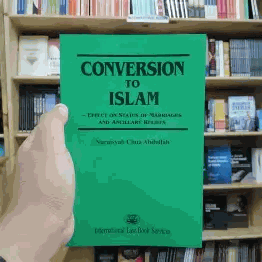
Conversion to Islam: Effect on Status of Marriages and Ancillary Reliefs Nuraisyah Chua Abdullah - marceljude.ai


Description
Book Review by marceljude.ai
Conversion to Islam: Effect on Status of Marriages and Ancillary Reliefs
Nuraisyah Chua Abdullah
Lecturer Faculty of Law Universiti Teknologi Mara
List of Contents with Printed Page Numbers
Preface — front matter
Acknowledgement — front matter
Dedication — front matter
List of Statutes — front matter
List of Abbreviations — front matter
Introduction — front matter
Chapter 1: Islamic Law on Conversion of One Spouse to Islam — p. 1
1.0 Introduction — p. 1
1.1 Islamic prohibition of marriage between parties of different faith — p. 2
1.2 Effect of conversion on marriage — p. 4
1.2.1 Juristic opinions on the effect of conversion — p. 7
1.3 Types of divorce due to rejection of faith — p. 9\
1.4 Conclusion — p. 10
Chapter 2: Effect of Conversion on Marital Status — p. 13
2.0 Introduction — p. 13
2.1 Historical background on freedom of religion — p. 13
2.2 Effect of conversion on marital status by the Islamic laws in Malaysia — p. 15
2.3 Effect of conversion on marital status under the LRA — p. 17
2.3.1 Application of the LRA — p. 18
2.3.2 Present approach to the LRA — p. 22
2.4 Position in India prior to the Hindu Marriage Act 1955 — p. 24
2.5 Present application of the law on conversion in India — p. 25
2.6 Conclusion — p. 29
Chapter 3: Legal Disputes on Ancillary Claims Due to Conversion — p. 31
3.0 Introduction — p. 31 3.1 Right to maintenance — p. 31
3.1.1 Maintenance of spouse — p. 31
3.1.2 Maintenance of children — p. 35
3.1.3 Maintenance of adopted children — p. 37
3.1.4 Maintenance of illegitimate children — p. 39
3.2 Division of property — p. 40
3.3 Right to custody of children — p. 41
3.4 Position in India — p. 45
3.4.1 Right to maintenance — p. 45
3.4.1.1 Maintenance of spouse — p. 45
3.4.1.2 Maintenance of children — p. 46
3.4.1.3 Right to custody of children — p. 46
3.5 Conclusion — p. 47
Chapter 4: Conclusion and Recommendations — p. 49
4.0 Conclusion — p. 49
4.2 Recommendations — p. 50
Selected Judgments — p. 53
Eeswari Visuvalingam v Government of Malaysia — p. 55
In re Maria Huberdina Hertogh; Inche Mansor Adabi v Adrianus Petrus Hertogh & Anor — p. 59
Letchumy v Ramadason — p. 79
Mrs. Marina Jatoi v Nuruddin K. Jatoi & Anor — p. 83
Pedley v Majlis Ugama Islam Pulau Pinang & Anor — p. 109
Tan Sung Mooi v Too Miew Kim — p. 113
Tey Siew Choo @ Nur Aishah Tey Binti Abdullah v Teo Eng Hua — p. 121
Vilayat Raj v Smt. Sunila — p. 129
U. Viswalingam v S. Viswalingam — p. 139
Nur Aisyah Suk bt Abdullah @ Sukwinder Kaur a/p Sajhan Singh v Harjeet Singh — p. 165
Rokiah lwn Mohamed Idris — p. 179
Yip Fook Tai v Manjit Singh s/o Mehar Singh @ Mohd Iskandar Manjit bin Abdullah — p. 183
Glossary — p. 189
Bibliography — p. 191
Overall Thesis of the Book
The book’s central argument is that Malaysian law inadequately handles the legal consequences of one spouse converting to Islam during a subsisting non-Muslim marriage. Its governing concern is the clash between Islamic family law and civil family law, especially under the Law Reform (Marriage and Divorce) Act 1976, commonly referred to in the book as the LRA. The author’s key claim is that the law creates serious hardship because the non-converting spouse is given a statutory route to petition for divorce under section 51 of the LRA, while the converting spouse may be left without an equally clear civil remedy because section 3(3) appears to exclude Muslims from the Act. The book treats this as a legal vacuum that then produces further disputes over maintenance, custody, property, and the legal status of children.
As a law-professor review, I would describe the book as a doctrinal and comparative family-law monograph. It is not merely about religious conversion as a private act of faith. It is about conversion as a jurisdictional event: conversion moves one party into the Islamic legal sphere while the other party remains in the civil-law sphere. That split produces the book’s central conflict: one marriage, two legal systems, two courts, and sometimes no clean procedural pathway.
The book’s strongest contribution is that it refuses to treat conversion as an isolated religious act. It frames conversion as a legal event with consequences for marital status, divorce jurisdiction, maintenance, custody, legitimacy, adoption, property division, and court competence. Its weakness is that the argument sometimes gives more doctrinal attention to the convert spouse’s hardship than to a fully balanced theory of rights for the non-convert spouse and the children. Still, the author repeatedly recognizes that women and children can suffer serious legal uncertainty if the legislature fails to act.
Review of the Introduction
The Introduction frames conversion as both personal transformation and legal disruption. The author begins by explaining conversion in sociological and religious terms: it is a shift of identity, belief, value, and legal personality. This opening is important because it prevents the discussion from becoming purely technical. The book is concerned with law, but the law is triggered by a profound change in a person’s religious identity.
The Introduction then narrows the legal problem. If a person is single, conversion does not create a marital-status dispute. If both spouses convert together, the problem is also relatively straightforward. The hard case is where only one spouse converts. In that situation, the convert spouse becomes subject to Islamic personal law, while the other spouse remains governed by civil family law. The author’s thesis is that Malaysian law does not adequately coordinate these two systems.
A key strength of the Introduction is that it identifies the legal bottleneck early: marital status must be clarified first, because maintenance, custody, and other ancillary reliefs depend on whether the marriage remains legally subsisting. This is doctrinally sound. In family law, ancillary relief normally follows the main matrimonial status question. If the law cannot say clearly whether the marriage exists, has dissolved, or is capable of dissolution by which court, every downstream issue becomes unstable.
The Introduction also explains the method of the book. The author uses statutes, cases, parliamentary debates, textbooks, and comparison with Indian law. That comparative choice is sensible because India also contains plural personal-law systems and therefore faces comparable problems when conversion alters a person’s legal identity. The book does not attempt to compare every personal law in India; it focuses mainly on Hindu marriage, guardianship, adoption, and maintenance legislation. That limitation is methodologically practical.
As a law professor, I would say the Introduction succeeds because it presents a precise research question: what happens to marriage and ancillary claims when one spouse converts to Islam and the other does not? It also gives the reader a roadmap: Islamic law first, then Malaysian civil and Islamic law, then ancillary relief, then recommendations.
Chapter 1 Review: Islamic Law on Conversion of One Spouse to Islam Printed pages: 1–10
Chapter 1 lays the religious and juristic foundation for the entire book. It explains why conversion by one spouse creates a marital-status problem under Islamic law. The chapter’s structure is effective because it begins with general principles, then moves to the specific consequence of conversion, then explains juristic disagreement on the form of dissolution.
1.0 Introduction — p. 1
The opening subsection repeats and deepens the basic meaning of conversion. The author emphasizes that Islam is not treated merely as a cultural identity but as a complete change in belief and faith. The legal point is that Muslim status carries consequences. A person may be Muslim by birth or conversion; once conversion occurs, the person is brought within the obligations and restrictions of Islamic law.
The chapter also discusses the requirements for conversion, including affirmation of faith and legal capacity. This matters because the rest of the book assumes that conversion is legally valid. If conversion itself were disputed, the entire legal analysis would shift. By establishing the threshold requirements at the start, the author keeps the focus on the effects of conversion rather than the validity of conversion.
The subsection’s main legal contribution is that it frames conversion as a change in personal law. In plural legal systems, personal law determines which body of rules applies to marriage, divorce, inheritance, custody, and maintenance. Thus, conversion does not merely alter religious identity; it alters the legal system that claims authority over the person.
1.1 Islamic prohibition of marriage between parties of different faith — p. 2
This subsection explains the general Islamic prohibition against marriage between Muslims and non-Muslims, subject to the recognized issue of kitabiyyah. The author discusses Qur’anic authority and classical interpretation. The doctrinal premise is that marriage is not only a private contract but also a religiously regulated institution. Therefore, difference of faith can become an impediment to the formation or continuation of marriage.
The author’s discussion of kitabiyyah is significant because it introduces nuance. Islamic law does not treat all non-Muslim spouses in exactly the same way. The book explains that a Muslim man may marry a kitabiyyah woman in certain doctrinal understandings, while the position of a Muslim woman marrying a non-Muslim man is treated differently. This distinction becomes important later when Malaysian enactments adopt a strict definition of kitabiyyah.
From a legal-review standpoint, the subsection is useful but also reveals one of the book’s broader tensions. The author is working with religious doctrine as a source of legal analysis, but the practical problem in Malaysia is not only doctrine; it is enforceability across courts. Islamic doctrine may say one thing about marital status, while civil law may require formal dissolution by a civil court before the marriage is treated as ended for civil purposes. The subsection sets up that later conflict.
1.2 Effect of conversion on marriage — p. 4
This is one of the most important parts of Chapter 1. The author examines what happens when conversion occurs after a marriage has already been formed. The central rule discussed is that if both spouses convert, the marriage may continue. If only one spouse converts and the other refuses, the marriage is vulnerable to dissolution.
The subsection relies on Qur’anic material and hadith reports to explain why continuation of marriage between a Muslim and a non-Muslim spouse may be prohibited. The author’s doctrinal logic is that marriage has spiritual, social, and familial consequences. A mixed-faith marriage after conversion may be viewed as threatening the religious identity of the convert and the religious upbringing of children.
This subsection is also important because it distinguishes between conversion before and after consummation and between immediate dissolution and dissolution after a waiting period. That distinction is essential to later statutory discussion, especially because the book repeatedly refers to a three-month period or the idea of waiting through the period of iddah.
A professor’s critique would be that the subsection is doctrinally rich but could have more sharply separated Islamic legal consequence from civil legal consequence. Islamic law may treat the marriage as dissolved after a certain period, but civil law may still treat it as subsisting until a civil decree is granted. The author later addresses this, but Chapter 1 itself is primarily internal to Islamic jurisprudence.
1.2.1 Juristic opinions on the effect of conversion — p. 7
This subsection explains differences among the schools of Islamic law. It discusses the Shafi‘i, Hanbali, Hanafi, and Maliki approaches. The author notes that if both spouses convert, the marriage remains valid. The more difficult situation is unilateral conversion.
The author explains that the Shafi‘i and Hanbali approaches may treat pre-consummation conversion by one spouse as causing immediate separation, while the Hanafi approach is more cautious and may allow time for the other spouse to convert. For post-consummation conversion, the author explains that jurists generally give significance to the iddah period: if the other spouse converts within that period, the marriage may continue; if not, dissolution occurs.
This is one of the best doctrinal sections in the book. It shows that Islamic law is not monolithic. There are internal juristic debates about timing, effect, and classification. This matters because Malaysian law tends to adopt particular doctrinal positions, especially the Shafi‘i position, but legal policy could still learn from other schools where appropriate.
The author’s preference for a non-automatic approach before final dissolution is legally important. It shows a concern for preserving marriage and giving the non-converting spouse time to decide. This also helps the author later argue that Malaysian civil legislation should be clearer and more humane in dealing with both spouses.
1.3 Types of divorce due to rejection of faith — p. 9
This subsection examines whether the separation caused by rejection of faith should be classified as fasakh or talaq. That classification is not merely technical. If dissolution is talaq, it may reduce the number of pronouncements available to the husband in future. If it is fasakh, it operates more like annulment or judicial dissolution by operation of law and does not consume talaq counts.
The author notes that Malik’i, Shafi‘i, Hanbali, and Abu Yusuf positions tend to classify separation due to rejection of faith as fasakh because there is no pronouncement of talaq. Hanafi-related distinctions are also discussed, including whether the converting party is the husband or wife.
As a legal analysis, this subsection shows how classification affects legal consequences. A family-law scholar would appreciate that the author does not simply say “the marriage ends.” She asks: by what legal mechanism does it end? That question matters for remarriage, future reconciliation, and legal record-keeping.
1.4 Conclusion — p. 10
The chapter concludes that Islamic law prohibits marriage between Muslims and non-Muslims except in the kitabiyyah situation; that if both spouses convert, the marriage continues; and that if one spouse converts and the other does not, dissolution may occur after the relevant period. The author prefers fasakh as the better classification because the separation occurs without pronouncement of talaq and because fasakh avoids reducing future talaq counts if the parties later remarry after conversion.
Chapter 1 is therefore the doctrinal foundation of the book. It explains the Islamic-law reason why unilateral conversion destabilizes marriage. Its main strength is clarity of religious-law structure. Its limitation is that it postpones the hardest question: what happens when Islamic-law dissolution is not recognized as binding by civil courts?
Chapter 2 Review: Effect of Conversion on Marital Status
Printed pages: 13–29
Chapter 2 is the legal heart of the book. It moves from Islamic doctrine to Malaysian constitutional and statutory law, then compares India. The chapter asks: when one spouse converts, does the civil marriage end, continue, or become dissolvable only by the non-convert spouse?
2.0 Introduction — p. 13
The chapter begins by identifying the matters to be discussed: freedom of religion, Islamic enactments, civil law before and after the LRA, and the treatment of conversion in Malaysia. The introduction is short but effective. It signals that the chapter will move from constitutional background to statutory interpretation.
The chapter’s importance lies in its shift from religious rule to legal enforceability. In Chapter 1, the question was what Islamic law says. In Chapter 2, the question is what Malaysian law does when one spouse’s personal law changes but the marriage was originally non-Muslim and civil in character.
2.1 Historical background on freedom of religion — p. 13
This subsection discusses the position of Islam in the Federal Constitution and the guarantee of freedom of religion. The author uses this to explain that Malaysia protects Islam while also permitting other religions to be practiced. The constitutional discussion matters because conversion is protected as an exercise of religious freedom, but its consequences affect other people who may not have converted.
The subsection uses cases such as PP v White and Re Estate of Timah binti Abdullah to show different judicial attitudes toward conversion. One key point is that civil courts were more willing to recognize the effect of conversion in inheritance than in marital status. That distinction is important. Inheritance may be treated as a consequence of the deceased’s religious status, while marriage involves vested rights of another living spouse.
This subsection is especially strong in showing that conversion cannot be examined only from the convert’s perspective. A convert’s religious freedom is real, but the non-convert spouse may have civil rights that existed before conversion. The law must therefore balance religious autonomy with vested family-law rights.
2.2 Effect of conversion on marital status by the Islamic laws in Malaysia — p. 15
This subsection explains how Malaysian Islamic family law treats interfaith marriage and conversion. The book notes the strict Malaysian definition of kitabiyyah, especially under the Shafi‘i approach. The author discusses cases such as Maria Menado and U. Viswalingam to show how the concept of kitabiyyah affects marital validity.
The author then identifies a crucial legal distinction: under Islamic enactments, if one spouse converts and the other does not follow within the relevant period, the marriage may be treated as dissolved; however, the conversion does not automatically dissolve the non-Muslim marriage for all civil-law purposes unless confirmed by the relevant court. The Syariah court may declare dissolution from an Islamic-law standpoint, but that declaration may not bind the civil court where the non-convert spouse remains outside Syariah jurisdiction.
This subsection is one of the most significant parts of the book because it explains the dual-system problem. A marriage may be religiously dissolved in one legal forum but still civilly alive in another. That split produces uncertainty over pensions, remarriage, maintenance, custody, and property.
From a law-professor perspective, this is where the book becomes most compelling. It reveals a jurisdictional asymmetry: the Syariah court cannot bind the non-Muslim spouse, while the civil court may still treat the marriage as subsisting. The resulting conflict is not merely theological; it is procedural and constitutional.
2.3 Effect of conversion on marital status under the LRA — p. 17
This subsection discusses the LRA’s grounds for divorce, including conversion to Islam, mutual consent, and irretrievable breakdown. The author focuses on section 51, which allows the non-converting spouse to petition for divorce when the other spouse converts. The author stresses that the wording gives the right to the non-convert spouse, not expressly to the convert spouse.
The problem is severe. If the non-convert spouse chooses not to petition, the civil marriage may remain technically alive. Meanwhile, the convert spouse may be unable to petition under the LRA because section 3(3) says the Act does not apply to Muslims. The author argues that this leaves the convert spouse without adequate relief.
This is the central statutory criticism of the book. The LRA is designed to regulate non-Muslim marriages, but conversion changes one spouse’s religious status after the marriage was formed. The Act deals with the non-convert spouse’s remedy but does not clearly deal with the convert spouse’s remedy. That omission creates the book’s main claim of legislative inadequacy.
2.3.1 Application of the LRA — p. 18
This subsection examines the reach of section 3(3) and section 51 of the LRA. The key issue is whether a convert spouse remains subject to the LRA because the marriage was originally a non-Muslim marriage, or whether conversion removes the convert spouse from the Act.
The author treats section 3(3) as problematic because, read literally, it excludes Muslims. Yet section 51 necessarily contemplates that a Muslim convert can still be affected by a civil divorce petition brought by the non-convert spouse. Thus the LRA both excludes and includes the convert spouse depending on the procedural posture.
This is a classic statutory interpretation problem. A literal reading creates hardship and inconsistency. A purposive reading may allow courts to preserve jurisdiction over matters arising from a non-Muslim marriage. The author favors amendment because judicial interpretation alone is unstable.
2.3.2 Present approach to the LRA — p. 22
This subsection discusses judicial attempts to solve the statutory gap. The book focuses on Tan Sung Mooi v Too Miew Kim and Nur Aishah Tey binti Abdullah v Teo Eng Hua. These cases are important because courts attempted to interpret the LRA in a way that preserves civil-court jurisdiction over marriages originally contracted as non-Muslim marriages.
In Tan Sung Mooi, the court held that the High Court could continue to hear ancillary relief claims even though one party converted after the divorce. The author explains that the court treated the relevant marriage as a non-Muslim marriage and treated the parties’ legal obligations as arising from that marriage.
In Nur Aishah Tey, the convert spouse was allowed to petition for divorce on the ground of irretrievable breakdown, even though she had converted to Islam. The author acknowledges the practical value of this approach but criticizes its reasoning. The concern is that courts may be stretching statutory language rather than applying a clear legislative solution.
As a law professor, I would say this subsection is doctrinally sophisticated because it distinguishes good outcomes from good reasoning. A case may reach a humane result but still rest on fragile statutory interpretation. The author’s deeper point is that rights should not depend on judicial creativity when Parliament can amend the statute directly.
2.4 Position in India prior to the Hindu Marriage Act 1955 — p. 24
The author turns to India as a comparative jurisdiction. Before codification, Hindu and Muslim personal laws operated differently, and conversion could create conflict. The author explains that under older approaches, a convert to Islam might still be affected by prior personal law, but the Shariat Act altered the position by emphasizing Muslim personal law for converts.
This subsection is brief but useful because it shows that Malaysia’s problem is not unique. Legal pluralism often struggles when one person crosses from one personal-law system into another while still bound by a family relationship created under the first system.
2.5 Present application of the law on conversion in India — p. 25
This subsection compares the Indian position under the Hindu Marriage Act. The author explains that conversion by one spouse gives the other spouse a ground for divorce, but the convert spouse may have difficulty petitioning. The book discusses Vilayat Raj v Sunila, where the court allowed a convert to petition under the Hindu Marriage Act because the marriage had been solemnized as a Hindu marriage.
The author then evaluates criticism of that approach, especially the argument that courts should not add grounds or extend legislation beyond its wording. The author also discusses proposed Law Commission reforms that would give converts a clearer statutory route to dissolve pre-conversion marriages, though the author criticizes some proposed safeguards as too strict, especially the long waiting period.
This comparative section is valuable because it shows two possible approaches. One approach is formal: once the spouse converts, the old personal-law statute no longer applies. Another approach is relational: because the marriage was created under that statute, dissolution should also occur under that statute. The author appears to favor the second approach as more practical, but she wants it expressed clearly through legislation.
2.6 Conclusion — p. 29
The chapter concludes that both Malaysia and India experience interpersonal conflict of laws due to religious conversion. The author argues that both systems can leave the convert spouse in a difficult position because the non-convert spouse is treated as the innocent party and the convert spouse as the party at fault.
Chapter 2 is the strongest chapter of the book. It identifies the statutory gap, examines case law, compares India, and shows why legislative amendment is necessary. Its greatest strength is the way it combines doctrinal detail with institutional analysis. Its main weakness is that the comparative Indian discussion could be expanded further, especially on policy arguments for protecting the non-convert spouse.
Chapter 3 Review: Legal Disputes on Ancillary Claims Due to Conversion Printed pages: 31–47
Chapter 3 examines what happens after the marital-status uncertainty spreads into financial and child-related claims. This chapter is practically important because real families are affected less by abstract marital status than by maintenance, custody, property, and child support.
3.0 Introduction — p. 31
The chapter begins from the premise that conversion creates ancillary disputes because the spouses often separate after conversion. Once separation occurs, the legal system must determine who supports whom, who supports the children, who has custody, and how property is divided.
The introduction’s underlying insight is that ancillary relief cannot be treated as secondary in a casual sense. Although ancillary claims follow marital status, they are often the most urgent matters in real life. A spouse may need maintenance immediately; children need care immediately; property may need protection immediately.
3.1 Right to maintenance — p. 31
The chapter’s first major topic is maintenance. The author treats maintenance as a point where Islamic law and civil law may diverge sharply. This is a good organizational choice because maintenance disputes reveal the practical conflict between legal systems: Islamic law may limit or terminate certain obligations after conversion and iddah, while civil law may continue to impose obligations after divorce.
The author’s broader concern is whether the convert spouse remains bound by pre-conversion civil obligations. The answer, in the book’s analysis, is often yes, because civil courts continue to apply the LRA or other civil maintenance statutes where the non-convert spouse cannot go to the Syariah court.
3.1.1 Maintenance of spouse — p. 31
This subsection deals with spousal maintenance. The author explains the Islamic-law views on whether a non-convert wife is entitled to maintenance after the husband converts. The book distinguishes situations where the wife is pregnant, where she refuses conversion, and where the conversion is by the wife rather than the husband.
The author notes that some juristic views discontinue maintenance after the non-convert wife refuses Islam, while other views, including an older Shafi‘i view, allow maintenance during the iddah period because the wife is not at fault for the husband’s change of religion. The author appears to prefer a more balanced view that allows maintenance during the waiting period, emphasizing that a divorced wife is generally entitled to maintenance during iddah unless disqualified.
The subsection then contrasts Islamic law with civil law. Under the LRA, maintenance can continue after divorce. Cases such as Letchumy v Ramadason and Tan Sung Mooi show different judicial approaches to whether maintenance can be ordered against a convert spouse. The book treats Tan Sung Mooi as more protective of non-convert spouses because it preserves civil jurisdiction for ancillary relief.
The subsection is strong because it shows that maintenance is both a doctrinal and a policy issue. The doctrinal issue is which legal system applies. The policy issue is whether a spouse should lose support because the other spouse converted.
3.1.2 Maintenance of children — p. 35
This subsection examines the duty of a convert parent to maintain children. The author distinguishes between maintenance of a spouse and maintenance of children. The obligation to support children is treated as more durable and less controversial, especially regarding the father’s duty.
The author’s analysis suggests that a convert father remains obliged to maintain his children, including non-convert children, because they remain his legitimate children. The book also notes that Islamic family law can extend maintenance beyond the age of majority in certain circumstances, such as education, disability, or unmarried daughters depending on the applicable rule.
This subsection is valuable because it resists the idea that conversion severs parental responsibility. The author’s approach is child-protective: whatever happens to the marital bond, children should not be financially abandoned.
A weakness is that the book gives less sustained theoretical attention to the child’s own rights as independent from both parents’ religious status. A modern family-law lens would emphasize the child’s welfare and best interests as a primary legal principle, not merely as a consequence of parental duty.
3.1.3 Maintenance of adopted children — p. 37
This subsection discusses adopted children, a difficult topic because Islamic law does not treat adoption in the same way as civil law. The author explains that Islamic law does not create artificial blood ties through adoption, whereas civil adoption can give the adopted child a legal status similar to a child born in lawful wedlock.
The book then discusses maintenance of children accepted into the family. The author suggests that even if Islamic law does not create full legal filiation through adoption, it may still support maintenance obligations for a child accepted as a family member. This is a careful and humane distinction. It separates lineage from support.
This is one of the most thoughtful parts of Chapter 3. The author avoids a crude conclusion that adopted children are outside protection. Instead, she recognizes that Islamic principles of care, kinship assistance, and responsibility can justify support even where adoption does not create full biological-style status.
3.1.4 Maintenance of illegitimate children — p. 39
This subsection examines children born outside lawful wedlock. The author explains that Islamic law generally places maintenance responsibility for an illegitimate child on the mother rather than the putative father, while civil law may impose obligations on the father.
The author then analyzes what happens where a child was legitimated by subsequent marriage before conversion. Under civil law, the child may be treated as legitimate, but Islamic law may not recognize legitimacy in the same way if the child was conceived outside lawful wedlock. This creates another conflict between religious and civil classifications.
This subsection is legally important because it shows that conversion affects not only marriage but also the legal identity of children. Legitimacy, maintenance, and parental responsibility may be classified differently depending on which legal system applies.
A professor’s critique is that this subsection could have engaged more deeply with the child’s vulnerability. The law should avoid punishing children for the circumstances of birth or for a parent’s later conversion. The author recognizes the issue, but the normative child-rights analysis could be stronger.
3.2 Division of property — p. 40
This subsection discusses division of matrimonial property. The author argues that property division is less conflict-heavy than maintenance or custody because both Islamic law and civil law recognize some form of division of assets acquired during marriage.
The book discusses harta sepencarian under Islamic family law and compares it with the LRA’s power to divide matrimonial assets acquired by joint efforts. The author’s conclusion is that property division does not involve the same element of faith as marital status or custody, because it concerns contributions to property during marriage.
This is a sound point. Property division is usually more secular in operation even when administered by a religious court. It asks who contributed, directly or indirectly, and what is fair. The convert/non-convert divide is less legally explosive here than in custody or marriage validity.
3.3 Right to custody of children — p. 41
This is the most sensitive and important part of Chapter 3. The author examines Islamic law on hadanah and then compares it with civil custody principles. Islamic law traditionally gives priority to the mother and female relatives for custody of young children, but religious qualification may affect entitlement. In some schools, a non-Muslim custodian may be disqualified because the child’s religious upbringing is considered central.
The author contrasts the Shafi‘i view, which tends to deny custody to a non-Muslim custodian, with the Hanafi view, which may allow a non-Muslim mother to retain custody of young children because custody is associated with care and nurture. This comparison is valuable because it again shows internal diversity within Islamic jurisprudence.
The book then examines Malaysian civil law, where the welfare of the child is the primary consideration. The difficulty is that welfare may include religion, especially where the child is treated as Muslim after one parent’s conversion. Cases such as Yip Fook Tai and Nur Aisyah Suk illustrate different outcomes. In Yip Fook Tai, religion played a strong role in awarding custody to the convert father. In Nur Aisyah Suk, the convert mother obtained custody because the court focused on the child’s welfare and the father’s unsuitable conduct. The author’s final position is that religion should be considered together with other welfare factors, not as the sole factor.
This subsection is doctrinally and morally significant. The author avoids both extremes: she does not say religion is irrelevant, but she also does not say religion alone should decide custody. That is the most defensible family-law position because custody must be child-centered.
3.4 Position in India — p. 45
The Indian comparison returns in the context of ancillary claims. The author discusses maintenance and custody after conversion under Indian law. The book explains that conversion can affect spousal maintenance, child maintenance, and natural guardianship.
This section is useful because it shows that India’s approach may be even harsher in some respects, especially where conversion deprives the convert spouse of natural guardianship rights. Malaysia, in the author’s view, does not impose such an absolute rule against the convert spouse in custody matters.
3.4.1 Right to maintenance — p. 45
This subsection introduces maintenance in India. The author explains that the relevant legal framework shifted with criminal procedure provisions allowing maintenance for wives who cannot maintain themselves. The focus becomes financial need rather than only personal-law status.
The author’s key point is that conversion does not necessarily relieve the convert spouse of maintenance obligations. That parallels the Malaysian problem: conversion changes religious status but does not necessarily erase civil or statutory duties.
3.4.1.1 Maintenance of spouse — p. 45
The author discusses the position of a spouse claiming maintenance after the other spouse converts. The book notes that a converted husband may remain liable to maintain the wife if the marriage is not treated as dissolved or if statutory maintenance rules continue to apply.
This subsection reinforces the book’s general thesis: conversion does not provide a clean escape from pre-existing marital obligations. However, the author also views some of these obligations as inconsistent with Islamic principles where they continue beyond what Islamic law would require.
3.4.1.2 Maintenance of children — p. 46
The author explains that Indian law treats child maintenance as arising from the parent-child relationship. This is a more universal basis than spousal personal law. It means that children remain protected even when parents’ religious identities change.
The subsection’s value is that it supports a broader policy principle: child maintenance should not depend too heavily on the parents’ religious conflict. Children need support regardless of conversion.
3.4.1.3 Right to custody of children — p. 46
The author explains that under Indian Hindu guardianship law, renunciation of Hinduism can deprive a parent of natural guardianship. This is contrasted with Malaysia, where the author believes the convert spouse is not automatically barred from custody.
This is one of the comparative points where Malaysia appears more flexible than India. The author praises the absence of a hard-and-fast rule in Malaysia, at least from the convert spouse’s perspective.
3.5 Conclusion — p. 47
The chapter concludes that conversion affects spouses and children in both Malaysia and India. The author argues that converts are often deprived of the ability to apply their new personal law and remain bound by pre-conversion legal obligations. In maintenance, this can be contrary to Islamic principles; in child maintenance, the author is more accepting because parental support remains justified. In custody, the author concludes that child welfare should dominate and that religion should be considered together with other factors, while visitation rights should not be denied to either parent.
Chapter 3 is highly practical. Its strength is breadth: spouse maintenance, child maintenance, adopted children, illegitimate children, property, custody, and India are all covered. Its limitation is compression. Each issue could support an entire article. Still, as part of a short monograph, the chapter successfully shows how the marital-status problem spreads into every corner of family law.
Chapter 4 Review: Conclusion and Recommendations Printed pages: 49–50
Chapter 4 is concise but important. It distills the book’s normative position: the conflict exists because Malaysian law separates Muslims and non-Muslims into different family-law regimes, but does not adequately handle a marriage that crosses from one regime into another after conversion.
4.0 Conclusion — p. 49
The author concludes that sections 3(3) and 51 of the LRA are the source of continuing difficulty. Section 3(3) excludes Muslims, while section 51 allows the non-convert spouse to petition after the other spouse converts. The convert spouse is therefore treated as the party at fault and may be unable to petition clearly under the LRA.
The author acknowledges that cases such as Tan Sung Mooi and Nur Aishah Tey offer some relief by allowing civil jurisdiction or allowing the convert spouse to rely on breakdown of marriage. But the author criticizes the lack of deeper judicial explanation and insists that case law alone cannot solve the structural problem.
This is a persuasive conclusion. Courts can interpret statutes, but where the statutory architecture is confused, judicial solutions may vary from case to case. Family law needs predictability. Parties should not have to gamble on whether a judge adopts a literal, purposive, or remedial interpretation.
4.2 Recommendations — p. 50
The book recommends amendment of the LRA, especially sections 3(3) and 51. The author supports a solution associated with Ahmad Ibrahim: amend the law so that both the convert spouse and the non-convert spouse can petition for divorce, and so that ancillary relief can be dealt with clearly.
This recommendation is the logical endpoint of the book. If the marriage was contracted under civil law, the civil court should have a clear statutory power to dissolve it and settle ancillary claims even after one spouse converts. That would not deny the convert’s religious status; it would simply resolve the civil consequences of a civil marriage.
The author’s final policy message is that sensitivity around religion must not be used as an excuse for legislative inaction. The law must protect all parties, especially women and children, by providing a clear mechanism for dissolution, maintenance, custody, and property division.
Review of the Selected Judgments Section Printed pages: 53–188
The selected judgments are not decorative appendices. They are part of the book’s legal method. By reproducing major judgments, the author allows readers to see how courts actually reasoned through conversion, jurisdiction, marital status, custody, and maintenance.
The most important cases for the book’s thesis are:
Eeswari Visuvalingam v Government of Malaysia — p. 55. This case supports the idea that a civil marriage may continue to be recognized for civil purposes unless dissolved by a competent court.
Pedley v Majlis Ugama Islam Pulau Pinang & Anor — p. 109. This case is important because it shows the civil-law position that conversion by one spouse does not automatically dissolve the non-Muslim marriage for civil purposes.
Tan Sung Mooi v Too Miew Kim — p. 113. This is one of the key cases preserving High Court jurisdiction over ancillary relief despite conversion, especially where the marriage was originally non-Muslim.
Tey Siew Choo @ Nur Aishah Tey Binti Abdullah v Teo Eng Hua — p. 121. This case is important because it allowed a convert spouse to petition under the LRA on the basis that the marriage had irretrievably broken down.
Vilayat Raj v Smt. Sunila — p. 129. This Indian case is central to the comparative discussion because it allowed a convert from Hinduism to petition under the Hindu Marriage Act for dissolution of a Hindu marriage.
U. Viswalingam v S. Viswalingam — p. 139. This case is crucial because it examines conversion, Muslim personal law, foreign recognition, and whether the marriage had ceased to subsist.
Yip Fook Tai v Manjit Singh — p. 183. This case is important for custody because it treats the child’s religion as relevant to welfare and custody.
The judgments section makes the book unusually useful for law students and researchers. Instead of requiring readers to locate every case separately, the author brings the core materials together. From a teaching perspective, this is valuable because students can compare the author’s interpretation with the judicial text.
The Book’s Major Legal Themes
1. Conversion as a conflict-of-laws event
The book’s most important insight is that conversion changes personal law. In a unitary legal system, religious conversion might not affect divorce jurisdiction. In Malaysia’s plural system, it can shift one spouse into a different legal framework. That creates interpersonal conflict of laws: the legal identity of one spouse changes, but the marriage relationship still includes another spouse whose legal identity has not changed.
2. The civil marriage problem
A central problem is whether a non-Muslim marriage remains civilly alive after one spouse converts. The book’s answer is that, for civil purposes, the marriage generally remains until dissolved by a court with civil jurisdiction. Islamic law may treat the marriage as dissolved, but civil law may not automatically do so. That split is the source of legal uncertainty.
3. Section 51 of the LRA as partial remedy
Section 51 gives a remedy to the non-convert spouse. That is important and protective. But the author argues that it is incomplete because it does not expressly give the convert spouse an equivalent right to petition. This creates unfairness if the non-convert spouse refuses to petition and the convert spouse cannot clearly proceed.
4. Section 3(3) of the LRA as exclusionary obstacle
Section 3(3) says the LRA does not apply to Muslims. The problem is that a convert spouse is now Muslim but remains party to a marriage formed under civil law. The author’s critique is that the law does not clearly say whether the convert remains bound by the LRA for purposes of dissolving the pre-conversion marriage.
5. Ancillary relief as the real-life consequence
The book shows that the marital-status issue is not abstract. It determines maintenance, custody, legitimacy, adoption, property rights, and remarriage. Without clear dissolution rules, spouses and children may be trapped in uncertainty.
6. Child welfare as a balancing principle
In custody disputes, the author recognizes the importance of religion but ultimately argues that religion should not be the sole factor. The welfare of the child should be assessed holistically. This is one of the book’s most balanced positions.
Strengths of the Book
The book’s first strength is doctrinal clarity. It identifies the precise statutory provisions causing difficulty: sections 3(3) and 51 of the LRA.
Its second strength is its layered structure. It begins with Islamic law, moves to Malaysian civil law, then compares India, then studies ancillary relief. This order helps the reader understand the issue progressively.
Its third strength is the use of cases. The book does not argue in abstraction. It grounds its claims in actual litigation, especially Eeswari, Pedley, Tan Sung Mooi, Nur Aishah Tey, U. Viswalingam, and Yip Fook Tai.
Its fourth strength is comparative analysis. The India comparison shows that plural personal-law systems face similar problems, and that statutory drafting must anticipate conversion.
Its fifth strength is practical reform. The book does not merely criticize; it recommends amendment so that both spouses can petition and ancillary relief can be resolved.
Weaknesses and Critical Observations
The book’s main weakness is that its sympathy is often strongest toward the convert spouse’s procedural hardship. That hardship is real, but a fully balanced family-law theory would also give more equal space to the non-convert spouse’s reliance interests. The non-convert spouse entered a civil marriage and may not wish to have marital obligations altered by the unilateral religious decision of the other party.
Second, the book could develop a richer child-rights framework. It discusses custody and welfare, but the child sometimes appears as an object of parental religious and legal claims rather than as a rights-bearing person.
Third, the constitutional discussion is useful but could be deeper. Article 121(1A), civil court jurisdiction, Syariah court jurisdiction, and the rights of non-Muslims raise major constitutional questions. The book addresses these issues, but a more extended constitutional theory would strengthen the analysis.
Fourth, the comparative Indian discussion is helpful but somewhat compressed. India is used mainly to illustrate similar problems, but the deeper constitutional and policy differences between India and Malaysia could be explored further.
Fifth, the recommendation chapter is short. The author’s call for amendment is persuasive, but a model statutory provision would have made the reform proposal stronger.
Professor’s Evaluation of Each Chapter
Chapter 1 is doctrinal and theological. It is strongest when explaining juristic differences and the classification of dissolution as fasakh or talaq. It provides the necessary Islamic-law foundation.
Chapter 2 is the best chapter. It contains the book’s core legal contribution: the analysis of the LRA, section 51, section 3(3), and the civil/Syariah jurisdictional divide.
Chapter 3 is the most practical chapter. It shows how legal uncertainty affects maintenance, children, adopted children, illegitimate children, property, and custody. It is broad and useful, though necessarily compressed.
Chapter 4 is normatively clear but brief. It gives the right recommendation: legislative amendment. Its weakness is that it could have drafted the proposed amendment in fuller detail.
The judgments section is extremely useful for readers who want to understand how the author’s arguments arise from real disputes.
Overall Assessment of the Book
As a legal monograph, the book is a valuable study of conversion, marriage, and ancillary relief in Malaysian family law. Its core contribution is the identification of a structural defect in the LRA: the Act recognizes conversion as a ground for divorce, but it does not clearly and equally empower both spouses to resolve the civil marriage after conversion. This is not a minor technicality. It affects remarriage, maintenance, custody, property, and the legal security of children.
The book is most persuasive when it argues that the law must not leave families in limbo. A spouse’s conversion must be respected as a matter of religious freedom, but the civil consequences of a pre-conversion marriage must be resolved by a court with jurisdiction over both the marriage and the non-convert spouse. The law should neither trap the convert spouse in an undissolved civil marriage nor deprive the non-convert spouse and children of remedies.
The book’s strongest legal policy is this: clarity of marital status is the foundation for justice in ancillary relief. Once the law clearly determines whether and how the marriage is dissolved, maintenance, custody, and property can be addressed more fairly.
Final Verdict
This is a serious and useful family-law text. It is especially valuable for students, lawyers, judges, and scholars interested in Malaysian family law, Islamic family law, conflict of laws, and the civil-Syariah jurisdictional divide. Its analysis is doctrinally grounded, case-driven, and reform-oriented. The book’s most important recommendation — amendment of sections 3(3) and 51 of the LRA — is persuasive because judicial interpretation alone cannot reliably solve the hardship created by unilateral conversion within a civil marriage.
Final evaluation: a strong, focused, legally significant book with a clear reform agenda, strongest in statutory critique and case analysis, and somewhat less developed in constitutional theory and child-rights analysis.
 marceljude.ai @ +60128285778 |  Book Review of Halsbury’s Laws of Singapore, Volume 18: Tort Review author: MarcelJude.ai I read the book and reviewed it as a legal treatise rather than as a narrative textbook. The work identifies itself as Halsbury’s Laws of Singapore, Volume 18, Tort, a 2012 reissue, with the law generally stated as in force on 1 April 2012, subject to later changes included where possible. List of contents, with printed book pages The front matter contains References and Abbreviations at page xi, Table of Cases at page xv, Table of Statutes at page cxxv, Table of Subsidiary Legislation at page cxxxiii, Table of Foreign Legislation at page cxxxv, the main title Tort beginning at page 7, and the Index at page 465. The main title, Tort, is organised into seven main doctrinal chapters: 1. The Law of Tort, printed pages 7–52. This chapter covers the nature and definition of tort, causation, parties liable in tort, joint and several tortfeasors, and remedies and defences. 2. Libel and Slander, printed pages 53–145. This chapter covers defamation, publication, defences, pleadings, damages, injunctions, and malicious falsehood. 3. General Principles of the Law of Negligence, printed pages about 146–240. This chapter covers the nature of negligence, duty of care, standard of care, causation, occupiers’ duties, dangerous operations, defective goods, highways, negligent statements, statutory authorities, proof, defences, contributory negligence, apportionment, and damages. 4. Misrepresentation and Negligent Statements, printed pages 241–318. This chapter covers actionable representation, falsity, fraud, innocent misrepresentation, inducement, materiality, remedies, deceit, negligent words, defences, and measure of damages. 5. Breach of Statutory Duty, printed pages 319–331. This chapter covers the nature of the cause of action, statutory construction, absolute and qualified duties, delegation, vicarious liability, damages, and defences. 6. Nature of Nuisance, printed pages 332–340. This chapter covers nuisance and dangerous user of property, including the rule associated with Rylands v Fletcher. 7. Trespass and Associated Torts, printed pages 341–464. This chapter covers wrongs to the person, assault and battery, false imprisonment, harassment, malicious prosecution, malicious civil proceedings, abuse of process, trespass to land, wrongful interference with goods, conversion, trespass to goods, interference with contractual relations, unlawful means, conspiracy, malicious falsehood, passing off, intellectual property-related unfair practices, and breach of confidence. Overall review of the entire book This book is a dense practitioner’s and scholar’s digest of Singapore tort law. It is not written like a student textbook with hypotheticals, policy debates, or long explanatory essays. Instead, it is closer to an authoritative legal map: each proposition is compressed, heavily footnoted, and arranged so that a lawyer can move quickly from a legal issue to relevant doctrine, statutes, and cases. From a law professor’s perspective, its greatest strength is systematisation. It organises the whole field of tort into doctrinal categories: general tort theory, defamation, negligence, misrepresentation, statutory duty, nuisance, trespass, economic torts, and confidence. The structure shows tort law as a set of overlapping civil wrongs rather than one single theory of liability. The opening definition explains tort as a cause of action arising where a legally recognised duty is breached and injury or loss results, with ordinary redress by damages and, where appropriate, injunctions, declarations, or recovery of possession. Its second strength is Singaporean legal localisation. The book does not merely repeat English common law. It constantly situates common-law principles inside Singapore statutes, Singapore Court of Appeal authority, Singapore High Court authority, and local procedural rules. For a professor, that matters because Singapore tort law is not simply “English tort law in Singapore”; it is common law developed through Singapore’s own courts, institutions, statutes, and policy choices. Its third strength is litigation usefulness. The book repeatedly connects substantive tort doctrine with pleading, proof, remedies, limitation, contribution, defences, and damages. That makes it valuable not only for understanding what a tort is, but also for understanding how a tort claim is actually framed and fought. Its main limitation is that it is not a reflective theoretical book. It rarely pauses to ask broad jurisprudential questions such as whether tort law is best explained by corrective justice, deterrence, loss distribution, rights protection, or economic efficiency. Its method is black-letter and case-driven. That is not a defect for practitioners, but students may need a textbook or lecture notes beside it to understand the deeper policy logic. My overall assessment: highly authoritative, highly compressed, extremely useful for legal research, but demanding for beginners. It is best read with a casebook or lecture framework, because the book tells you what the law is and where to find it, but it does not always slow down to teach why the law evolved as it did. Chapter 1 Review: The Law of Tort Printed pages: 7–52 Chapter 1 is the conceptual foundation of the entire book. It introduces tort as a civil wrong arising from a legally imposed duty, then moves quickly into the core architecture of tort liability: causation, persons who may be liable, joint and several liability, remedies, defences, and extinction of liability. Its function is to give the reader a vocabulary for every later chapter. 1. Nature and Definition of Tort Printed page: 7; paragraphs [240.001]–[240.007] This section defines tort in functional terms: a cause of action accrues where a person suffers injury or loss because another breaches a duty imposed by law. The book rightly emphasises that damages are the ordinary remedy, but not the only remedy; injunctions, declarations, and recovery of possession may also be available. That is a strong opening because it prevents students from thinking tort is only about money compensation. The distinction between tort and crime is important. A single act may be both criminal and tortious, but criminal law vindicates public wrongs while tort law vindicates private civil interests. This matters in Singapore because criminal compensation orders may overlap with civil damages, but they do not necessarily exhaust all civil remedies. The distinction between tort and contract is also central. Contract is based on duties voluntarily undertaken between parties. Tort is based on duties imposed by law. The book’s approach is careful because many modern cases blur the boundary: negligent misstatement, professional negligence, occupiers’ liability, product liability, and pre-contractual misrepresentation may all sit near contract. The subsections on rights of action, lawful competition, use of name or likeness, and damage prepare the reader for later economic and reputational torts. The book is especially useful in distinguishing true legal injury from mere loss caused by lawful competition. That is important in commercial law because not every business loss is legally actionable. 2. Causation in Tort Printed pages: about 11–13; paragraphs [240.008]–[240.009] The causation section introduces the general principles of factual and legal causation. The “but for” test appears as a basic tool: would the damage have occurred but for the defendant’s conduct? The book then signals that causation is not purely mechanical; foreseeability, remoteness, material contribution, and the precise nature of the defendant’s duty all matter. As a professor, I would describe this as one of the book’s most important foundation sections. Causation is the bridge between wrongdoing and liability. Without it, negligence, nuisance, statutory duty, and misrepresentation claims fail even if breach is proven. 3. Parties Liable in Tort Printed pages: about 13–29; paragraphs [240.010]–[240.030] This section explains who may be liable in tort. It covers the Government of Singapore, limits to government liability, the armed forces, statutory bodies, foreign states, corporations, management corporations, trade unions, unincorporated associations, employers, independent contractors, principals and agents, partners, spouses, persons with mental disorders, minors, personal representatives, bankrupts, assignees, visiting forces, and foreigners. The most practically significant subsections are employer liability, independent contractor liability, and principal-agent liability. The book explains that an employer can be liable where it authorises, ratifies, or is vicariously liable for an employee’s torts committed in the course of employment. That is one of the central risk-allocation doctrines in tort law. The section is valuable because it makes tort law institutional. Torts are not committed only by individuals. They are committed through companies, agencies, public authorities, associations, employees, and contractors. For litigation, identifying the correct defendant is often as important as proving the wrong. 4. Joint and Several Tortfeasors Printed pages: about 29–37; paragraphs [240.031]–[240.041] This section deals with multiple wrongdoers. It distinguishes joint tortfeasors, several tortfeasors causing the same damage, and several tortfeasors causing distinct damage. The book explains that where multiple defendants cause the same damage, one may be sued for the whole loss, subject to contribution from others. The subsections cover joint tortfeasors, several tortfeasors, distinct damage, the effect of judgment or release, recovery of contribution, entitlement to contribution, liability to contribute, assessment, apportionment, costs, and contractual indemnity. This section is doctrinally technical but essential. It matters in construction defects, workplace accidents, chain collisions, professional negligence, and commercial conspiracies. The book’s strength is that it links liability with contribution and apportionment, so the reader sees not only who may sue but also how responsibility is redistributed among defendants. 5. Remedies and Defences Printed pages: about 38–52; paragraphs [240.042]–[240.068] This section covers four main subsections: action for damages or injunction, self-redress, defences, and extinction of liability. The remedies discussion explains damages, interest, injunctions, and statutory or equitable remedies. The self-redress section covers situations where the law permits a person to act without first going to court, such as abatement or recaption, though such remedies are generally risky and narrow. The defences section introduces core tort defences such as inevitable accident, act of God, consent, illegality, mistake, and statutory authority. The extinction section addresses how liability may end through limitation, death, release, judgment, satisfaction, or contractual exclusion. As a law professor, I would praise the chapter for ending with remedies and defences. This reinforces the reality that tort law is not just about classifying wrongs. It is about whether a court will grant a remedy, whether a defendant can resist liability, and whether the claim survives procedural and substantive bars. Chapter 2 Review: Libel and Slander Printed pages: about 53–145 This is the longest and most detailed early chapter. It treats defamation as a fully developed litigation system: cause of action, meaning, publication, privilege, fair comment, malice, innocent dissemination, offers of amends, pleadings, damages, injunctions, and malicious falsehood. 1. Causes of Action Printed pages: about 53–76; paragraphs [240.069]–[240.112] The chapter begins with introduction and definitions. It distinguishes libel from slander. Libel concerns defamatory matter in permanent form and is generally actionable without proof of special damage. Slander concerns transient publication, often oral, and usually requires special damage unless it falls into recognised categories actionable per se. Under Elements of the Tort, the book breaks the inquiry into four subparts. Reference to the plaintiff, beginning around page 58, asks whether the words identify the claimant. The legal test is not merely whether the claimant is named, but whether reasonable readers or hearers would understand the words to refer to that person. Determining the meaning of the words, beginning around page 60, is crucial because defamation litigation often turns on meaning. Courts must decide the natural and ordinary meaning, possible innuendo, and whether the alleged defamatory meaning can reasonably be borne. What is defamatory, beginning around page 64, asks whether the statement tends to lower the claimant in the estimation of right-thinking members of society, exposes the claimant to hatred, contempt, or ridicule, or harms reputation in a legally recognised way. Slander actionable per se, beginning around page 69, covers categories where proof of special damage is unnecessary, such as imputations involving crime, office or profession, certain misconduct, and illness. The Publication subsection then distinguishes publication of libel and publication of slander. Publication is not limited to mass media. It means communication to at least one person other than the plaintiff. This is the doctrinal gatekeeper: private insult without publication is not defamation. 2. Defences Printed pages: about 77–112; paragraphs [240.113]–[240.176] The defences section is one of the chapter’s richest parts. Justification, beginning around page 80, is the truth defence. If the defamatory sting is substantially true, the defendant may avoid liability. Absolute privilege protects certain occasions completely, even if the statement is false or malicious. Its subsections cover introduction, administration of justice and reports, parliamentary proceedings and reports, and affairs of state. The policy is institutional: some settings require complete freedom of speech to function. Qualified privilege protects communications made on occasions of duty, interest, or public concern, unless defeated by malice. Its common-law subsections cover communications between persons with a common duty or interest, communications to the public generally, and fair and accurate reports of parliamentary and judicial proceedings. Its statutory subsections include extracts from parliamentary reports and fair and accurate reports in newspapers or broadcasts on specified matters. Fair comment, beginning around page 99, protects opinion on matters of public interest. The book explains the distinction between fact and comment, the need for factual basis, and the difference between fair comment and justification. Defences defeated by malice shows that qualified privilege and fair comment may fail if the claimant proves improper motive. This is doctrinally important because malice is often the hinge between protected speech and actionable defamation. Innocent dissemination, offer of amends, leave and licence, and limitation complete the defensive architecture. These sections are useful for media defendants, distributors, online intermediaries, and litigants considering settlement. 3. Pleadings, Practice and Relief Printed pages: about 113–136; paragraphs [240.177]–[240.209] This section is especially practical. It covers commencement of action, pleadings, statement of claim, defence, reply, costs, damages, and final injunctions. The statement of claim must identify the words complained of, publication, reference, defamatory meaning, and any special damage where required. The defence may plead justification, privilege, fair comment, consent, limitation, or other bars. The reply becomes necessary where the plaintiff must answer a pleaded defence, especially malice in response to privilege. The damages section is important because defamation damages are not merely compensatory in the ordinary economic sense. They may vindicate reputation, compensate hurt feelings, and respond to aggravating conduct. The final injunction section is also crucial: courts are cautious about prior restraint but may restrain repetition after liability is established. 4. Malicious Falsehood Printed pages: about 137–145; paragraphs [240.210]–[240.220] Malicious falsehood is treated separately from defamation. It protects economic interests against false statements made maliciously that cause pecuniary loss. The subsections cover cause of action, malice, and special damage. The distinction is subtle but important. Defamation protects reputation. Malicious falsehood protects against falsehoods that damage business, property, or economic interests. This section prepares the reader for later economic torts in Chapter 7. Chapter 3 Review: General Principles of the Law of Negligence Printed pages: about 146–240 This chapter is the heart of modern tort law. Negligence is the most flexible tort and the main vehicle for personal injury, professional liability, defective premises, defective goods, negligent public authority conduct, negligent misstatement, and economic loss. The book describes negligence as failure to exercise the care required in particular circumstances, but it does not treat careless conduct alone as enough. The claimant must prove duty, breach, causation, remoteness, and damage. 1. Nature of Negligence Printed pages: about 146–170; paragraphs [240.221]–[240.231] The chapter begins with general principles, explaining negligence as conduct falling below the required standard of care. It then moves to the requirements of negligence: duty, breach, causation, remoteness, and proof of loss. The duty to take care subsection is doctrinally central. It explains the relationship between foreseeability, proximity, and policy. In Singapore, this necessarily brings in the two-stage duty framework associated with modern Singapore authority. The section’s value is that it prevents a simplistic view that foreseeable harm automatically creates liability. The standard of care subsection explains reasonable care. It covers ordinary persons, skilled professionals, and context-sensitive risk assessment. A law professor would emphasise that negligence is not judged by hindsight; it asks what reasonable care required at the time. The causation subsection then ties breach to damage. Negligence liability requires proof that breach caused the claimant’s loss and that the loss is not too remote. 2. Situations in Which a Duty of Care Arises Printed pages: about 170–206; paragraphs [240.232]–[240.264] This section is organised by recurring factual contexts. Duty of occupier covers duties to visitors, neighbours, and trespassers. This is important because premises liability depends heavily on status, control, foreseeability, and the nature of the danger. Duty of those who are not occupiers to those on the premises covers builders, contractors, landlords, maintenance providers, and others whose conduct affects premises safety even though they are not occupiers. Dangerous operations and dangerous articles deals with heightened risk. The more dangerous the activity or object, the more careful the defendant must be. Goods supplied covers duties owed by manufacturers, suppliers, repairers, and others whose goods may injure users or property. Highways and public places concerns obstructions, dangers, road use, public access, and the responsibilities of those who create or control hazards in public spaces. Negligent statements is a major doctrinal bridge to Chapter 4. The book recognises that careless words may cause economic loss where a duty of care exists. That area depends heavily on assumption of responsibility, reliance, proximity, and policy. Statutory authorities deals with public bodies. This is difficult because courts must balance compensation for harm against public functions, discretion, resource allocation, and separation of powers. 3. Civil Proceedings and Remedies Printed pages: about 206–240; paragraphs [240.265]–[240.302] The proof section explains the burden of proof and res ipsa loquitur. Res ipsa loquitur is important where the accident itself suggests negligence, especially where the defendant controlled the relevant thing or situation. The defences section covers volenti non fit injuria, limitation, illegality, inevitable accident, and other matters. Consent is not simply awareness of danger; it requires voluntary acceptance of the legal risk. The apportionment section covers contributory negligence and joint tortfeasors. This is practically central because many negligence cases involve shared fault. The damages section covers inter vivos claims and claims where death results. The book’s treatment is useful because negligence litigation often turns less on abstract duty and more on how damages are quantified. As a chapter, this is the book’s strongest teaching chapter. It links doctrine, contexts, proof, defences, and remedies in a way that mirrors litigation. Chapter 4 Review: Misrepresentation and Negligent Statements Printed pages: 241–318 This chapter sits between contract, tort, equity, and statute. It explains when a false statement becomes legally actionable, when fraud is present, when negligence is enough, and how damages are assessed. The book states that a tort action may lie where a representor fraudulently or negligently makes a false representation to a representee who alters position and suffers loss by relying on it. 1. Introduction Printed page: 241; paragraphs [240.303]–[240.304] The introduction frames misrepresentation as a basis for damages. It also addresses postponement of limitation where fraud or concealment is involved. This is a practical opening because misrepresentation claims often arise years after a transaction. 2. Representation Printed pages: about 242–251; paragraphs [240.305]–[240.317] This section asks what counts as a representation. What constitutes a representation explains the basic elements of a factual assertion capable of inducing action. Statements of intention may be actionable where they imply a present state of mind and that state is false. Promises and forecasts are not automatically representations, but they may become actionable where they imply present facts, expertise, or genuine belief. Statements of opinion, belief, or information can be representations where the speaker implies that they honestly hold the opinion or have a reasonable basis. Statements of law may be treated as representations in appropriate circumstances. Statements as to documents cover representations about the existence, authenticity, or contents of documents. Exaggeration and puff recognises that some promotional language is too vague or hyperbolic to be legally actionable. This section is pedagogically strong because it teaches students that the law does not treat all words alike. A representation is not merely something said; it is a legally significant statement in context. 3. How Representations May Be Made Printed pages: about 252–255; paragraphs [240.318]–[240.322] Representations may be express, such as written or oral statements, or implied from conduct. This is important in commercial transactions where silence, half-truths, conduct, documents, or performance may communicate meaning. 4. Parties to a Representation Printed pages: about 256–265; paragraphs [240.323]–[240.337] The book distinguishes the representor from the representee. The representor is the person legally responsible for the statement. The representee is the person to whom the representation is made or whom it is intended to influence. This matters because misrepresentation liability depends on relational structure. Not every person who hears a statement can sue. The claimant must show that the representation was made to them or to a class including them, and that reliance was legally relevant. 5. Misrepresentation Printed pages: about 266–275; paragraphs [240.338]–[240.350] This section explains falsity. Falsity asks whether the representation was untrue. Construction of representation determines what the representation actually meant. Falsity by omission, silence, or inaction recognises that silence can mislead where there is a duty to speak, a half-truth, or a change in circumstances. Representation composed of several statements requires the court to assess the representation as a whole. Relevant date of falsity asks when the statement must be false for liability to arise. This is one of the most analytically refined sections because it shows that falsity is not always obvious. It depends on meaning, context, timing, and omission. 6. Fraud Printed pages: about 276–282; paragraphs [240.351]–[240.357] Fraud is the most serious form of misrepresentation. It requires dishonesty: knowledge of falsity, absence of belief in truth, or recklessness. The book’s treatment is doctrinally orthodox and litigation-focused. The key teaching point is that fraud is not merely inaccuracy. Fraud concerns the defendant’s state of mind. 7. Innocent Misrepresentation Printed pages: about 283–285; paragraphs [240.358]–[240.360] This section addresses misrepresentation without fraud. It is especially important because modern statutory and common-law developments may impose liability or remedies even where deceit is not proven. 8. Inducement and Materiality Printed pages: about 286–297; paragraphs [240.361]–[240.375] This section covers inducement, materiality, and alteration of position. Inducement asks whether the claimant actually relied on the representation. Materiality asks whether the representation was of a kind likely to influence a reasonable person or relevant to the decision. Alteration of position asks whether the claimant changed position because of the representation. This section is crucial because falsehood alone is not enough. Tort law requires a causal link between representation and loss. 9. Effect of Misrepresentation Printed pages: about 298–301; paragraphs [240.376]–[240.377] This section covers remedies and legal consequences. Misrepresentation may justify damages, rescission, or other relief depending on whether the claim is fraudulent, negligent, innocent, contractual, statutory, or equitable. 10. Action for Damages Printed pages: about 302–318; paragraphs [240.378]–[240.398] This section covers the cause of action of deceit, damage, parties, negligent words, defences, and measure of damages. The deceit subsection explains that fraudulent misrepresentation is a tort. The damage subsection identifies recoverable damage and the causal connection between misrepresentation and loss. The parties subsection asks who may sue and be sued. The damages for negligent words subsection is particularly important. It explains that a tortious claim may arise for careless statements where a duty to take care exists, independent of contract or fiduciary duty. The defence and measure of damages subsections complete the litigation framework. As a chapter, Chapter 4 is excellent for advanced students because it shows the overlap between tort, contract, equity, and statute. Its limitation is that beginners may find the categories difficult without a transactional example. Chapter 5 Review: Breach of Statutory Duty Printed pages: 319–331 This chapter is short but conceptually important. It explains when breach of a statute gives rise to a private tort action. The key point is that breach of a statute does not automatically create a damages claim. The court must construe the statute to decide whether Parliament intended a private right of action. 1. Nature of the Cause of Action Printed page: 319; paragraphs [240.399]–[240.401] The book treats breach of statutory duty as a common-law tort action arising from violation of a statutory obligation. It distinguishes this tort from negligence. The same facts may support both claims, but they are analytically different. 2. Construction of Statute to Ascertain Whether Action Lies Printed pages: about 322–324; paragraphs [240.402]–[240.405] This is the doctrinal core. The court considers whether the statute protects a limited class, whether the damage is the kind the statute was intended to prevent, whether the statute provides its own remedies or penalties, the nature of the obligation, and the general statutory purpose. This section is excellent because it teaches statutory interpretation through tort. A statute may impose a public duty, a regulatory duty, or a private-law duty. Only the last will support damages. 3. Absolute and Qualified Duties; Delegation; Vicarious Liability Printed pages: about 325–327; paragraphs [240.406]–[240.409] This section distinguishes absolute statutory duties from duties qualified by reasonable care. It also addresses whether performance may be delegated and whether vicarious liability applies. That distinction matters greatly. If the duty is absolute, the claimant may not need to prove negligence. If the duty is qualified, breach may depend on fault or reasonable precautions. 4. Damages Printed page: about 328; paragraphs [240.410]–[240.412] The damages section connects statutory breach to ordinary tort compensation. The claimant must still show relevant loss and causation. 5. Defences Printed pages: about 329–331; paragraphs [240.413]–[240.418] The defences section covers statutory defences, contributory negligence, consent, common employment, and other possible bars. This chapter is one of the most efficient in the book. It is brief, but it gives a complete litigation path: duty, construction, breach, causation, damages, and defences. Chapter 6 Review: Nature of Nuisance Printed pages: 332–340 Chapter 6 deals with land-based and community-based interference. Nuisance is not simply “annoyance.” In law, it concerns unreasonable interference with public rights or private use and enjoyment of land. 1. Nuisance Printed pages: about 332–335; paragraphs [240.419]–[240.426] This section explains the meaning of nuisance, the distinction between nuisance and other claims, statutory nuisance, public nuisance, private nuisance, forms of interference, who may sue, and related remedies. The book is strong in connecting nuisance with property interests. Private nuisance usually requires a proprietary interest in land, not merely personal discomfort. The text explains that generally only a person with a proprietary interest, such as a freehold or leasehold interest, may sue in private nuisance, though exclusive de facto possession may sometimes matter. 2. Dangerous User of Property Printed pages: about 336–340; paragraphs [240.427]–[240.432] This section covers the rule in Rylands v Fletcher, non-natural use, dangerous things, escape, acts of God or strangers, plaintiff default, consent, and common benefit. The book explains that the Rylands v Fletcher rule is closely related to nuisance but conceptually distinct. It imposes strict liability where a person brings onto land something likely to cause mischief if it escapes and damage results from escape. As a professor, I would call Chapter 6 concise but doctrinally dense. It is especially useful for environmental harm, construction disputes, water escape, industrial operations, and neighbour disputes. Chapter 7 Review: Trespass and Associated Torts Printed pages: 341–464 This is the broadest chapter. It covers intentional torts to the person, property torts, process torts, economic torts, unfair practices, and breach of confidence. It is effectively a collection of discrete torts connected by intentional interference, possession, legal process, business interests, or confidential information. 1. Wrongs to the Person Printed pages: about 341–380; paragraphs [240.433]–[240.503] The chapter begins with classification and limitation. Assault and battery, beginning around page 344, covers intentional interference with bodily security. Assault concerns apprehension of imminent unlawful contact; battery concerns unlawful contact itself. The subsections explain general principles, remedies, and defences such as self-defence, defence of others, lawful authority, and consent. False imprisonment, beginning around page 349, covers total restraint of liberty without lawful justification. Its remedies and defences include release, damages, justification, lawful arrest, and other lawful authority. Intentional physical harm other than trespass to the person and harassment, beginning around page 355, address intentional harm outside classic trespass categories. Malicious prosecution, beginning around page 356, protects persons from being subjected to criminal process maliciously and without reasonable and probable cause. The subsections deal with what counts as prosecution, termination in the plaintiff’s favour, malice, absence of reasonable cause, damage, and remedies. Malicious procurement of issue of search warrant, malicious civil proceedings, registration of judgments, and abuse of process extend the chapter into misuse of legal machinery. These are important because the legal system itself can become an instrument of harm if invoked improperly. 2. Wrongs to Property Printed pages: about 381–451; paragraphs [240.504]–[240.602] This section is divided into trespass to land, wrongful interference with goods, and trespass to goods. Trespass to land, beginning around page 384, covers unlawful entry, continuing trespass, trespass and nuisance distinctions, distress, execution, tenants, abuse of authority, aerial intrusion, and remedies. It also covers who may sue, especially the importance of possession, and defences such as licence, necessity, legal authority, and claim of right. Wrongful interference with goods, beginning around page 399, is one of the most technical parts of the book. It covers detinue, trover, conversion, who may sue, who may be sued, remedies, damages, waiver, defences, and judgment. Conversion is especially important: it protects possessory and proprietary interests in goods against acts inconsistent with the owner’s rights. Trespass to goods, beginning around page 444, covers direct interference with goods, possession or right to possession, remedies, self-help, claim of right, recaption, authority of law, and related defences. This property section is valuable because it teaches an older but still important part of tort law: the law protects possession as well as ownership. That principle explains why finders, bailees, possessors, and owners may have different but overlapping claims. 3. Unfair Practices Printed pages: about 452–464; paragraphs [240.603]–[240.623] This final section brings the book into economic torts and commercial wrongs. Interference with contractual relationships, beginning around page 452, concerns inducing breach or interference with performance of contracts. It requires careful attention to knowledge, intention, justification, validity of contract, and proof of inducement. Intentional damage to business by unlawful means, beginning around page 455, covers harm to business caused through unlawful acts. The book treats this separately from mere competition. Conspiracy, beginning around page 456, covers combinations of two or more persons, intention to injure, unlawful means, predominant purpose, company-director issues, proof, and remedies. Malicious falsehood, around page 461, cross-links back to Chapter 2 but is placed here because of its economic and commercial function. Unfair practices relating to industrial property, around page 461, includes passing off, copyright infringement, patent infringement, and trade mark infringement. Breach of confidence, around page 463, concludes the chapter. It is a significant ending because confidence sits at the border of tort, equity, privacy, commercial secrecy, and intellectual property. Chapter 7 is the most sprawling chapter, but that breadth is justified. It shows that tort law protects the body, liberty, land, goods, legal process, business relationships, commercial reputation, and confidential information. Law-professor critique of the book’s method The book’s method is black-letter, categorical, and authority-led. It does not begin with theory and derive rules. It begins with legal categories and states the operative rules, exceptions, statutory modifications, and leading authorities. That makes it excellent for litigation and research. Its treatment of negligence is especially valuable because it shows that modern tort law is not merely about moral blame. It is about duty boundaries, institutional competence, foreseeability, proximity, causation, remoteness, defences, and damages. Its treatment of defamation is also strong because it gives an integrated view of cause of action, meaning, defences, malice, procedure, damages, and injunctions. That integration is crucial in defamation practice. The misrepresentation chapter is sophisticated because it recognises overlap between tort and contract. The book does not artificially isolate the doctrines. It lets the reader see how deceit, negligent misstatement, statutory misrepresentation, inducement, rescission, and damages interact. The shorter chapters on statutory duty and nuisance are efficient and useful, though they are less reflective. A professor might wish for more policy discussion: why courts hesitate to infer private rights of action from statutes; why nuisance protects land-based interests more than personal discomfort; why strict liability remains limited. The final chapter on trespass and associated torts is doctrinally rich but less unified. That is not really the book’s fault. These torts are historically diverse. Still, the chapter would be easier for students if it began with a conceptual map distinguishing personal security, liberty, possession, property, legal process, economic relations, and confidential information. Whole-book judgment As a whole, Halsbury’s Laws of Singapore, Volume 18: Tort is a research work of high practical authority. It is best used by lawyers, judges, academics, and advanced students who already understand basic legal method. It is less suitable as a first introduction for a beginner because it assumes comfort with cases, statutes, procedural language, and cross-references. The book’s central achievement is that it shows Singapore tort law as a structured field: not a random collection of wrongs, but an ordered system built around duty, injury, causation, protected interests, remedies, defences, and institutional limits. Final evaluation by MarcelJude.ai: This is a strong, authoritative, practitioner-grade treatment of Singapore tort law. Its greatest virtues are precision, organisation, and case density. Its main weakness is limited theoretical exposition. For legal research, it is excellent. For teaching, it is best paired with cases and explanatory lectures. |
- MALAYSIA'S 1ST AI LAWYER - CLICK HERE
- ISMAIL – INTEGRATED SINGAPORE/MALAYSIA AI & LAW (Library)
- OPENING OF SINGAPORE MALAYSIA AI CENTRE AND LAW LIBRARY
- LIFT - LAW INSTRUMENTS FORMS & TEMPLATES
- LAWS OF MALAYSIA FOR SINGAPOREAN DUMMIES
- HANNAH YEOH'S ARTIFICIAL INTELLIGENCE LAW ENCYCLOPEDIA
- LEAD CR - Law Ecosystem Archive Databases on CD-ROM
- BREAKING NEWS FROM MJN
- CLICK HERE CO. PROFILE
- EXCITING NEW SERIES - THE ADVENTURES OF BOBBY TAN -ADVOCATE & SOLICITOR IN THE HIGH COURT OF NORTH BORNEO by marceljude.ai
- MEDICO LEGAL - BY PRISKILA AKWILA & GLORIOUS PETAL SDN BHD - powered by marceljude.ai
- MISCELLANOUS
- ANNOTATED STATUTES OF SABAH - A NEW SERIES
- e-library - marceljude.ai
- DRAFT - DOCUMENT RESEARCH & AUTOMATED FILING TECHNOLOGY
- CLARA – Case Law Analysis & Retrieval AI
- FOR RESEARCH REQUEST CLICK HERE
- CLICK HERE TO ASK ANYTHING
- RAMBO'S LAW - THE LAW OF THE LAW JUNGLE - EXCITING NEW SERIES - CASE ANALYSIS BY JOHN RAMBO @ +60138646786
- PRISKILA AKWILA ADVOCATES - High Court of Sabah & Sarawak @ Kota Kinabalu
- COLA - COMMONWEALTH ONLINE LAWCASES AI -marceljude.ai
- THE LAW LIBRARY THAT COMES TO YOU ANYWHERE AND ANYTIME
- marceljude.ai training academy
